
#FactCheck- Old Ladakh Protest Video Falsely Shared as Violence Following Sonam Wangchuk’s Arrest
Executive Summary
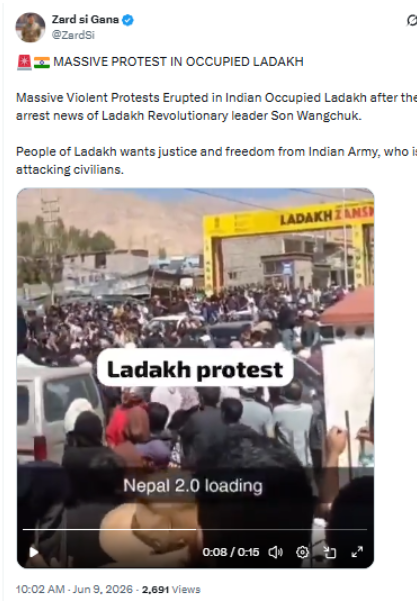
Last September, protests were held in Ladakh over several demands, including full statehood, extension of Sixth Schedule protections, separate Lok Sabha seats for Leh and Kargil, and reservation in jobs. During that period, some demonstrations turned violent. Since then, talks between stakeholders and the government have continued regarding these demands. Amid this backdrop, Pakistani propaganda handles on social media are sharing a video of a protest and claiming that violent demonstrations have erupted in Ladakh following the arrest of education reformer Sonam Wangchuk. CyberPeace Research Wing research found the claim to be misleading. The claim regarding Sonam Wangchuk’s arrest is false, while the viral video is actually from protests that took place in September last year.
Claim:
Sharing the video, a user wrote: “Massive protests in Ladakh. Violent demonstrations have erupted after reports of the arrest of Ladakh’s revolutionary leader Sonam Wangchuk. The people of Ladakh seek justice and freedom from the Indian Army, which is attacking civilians.”
https://x.com/ZardSi/status/2064204063248695393?s=20
Fact Check:
Our research found the claim to be misleading. The viral video is from protests held in September last year, and the claim that Sonam Wangchuk has been arrested is also false. We first converted the video into keyframes and conducted a reverse image search using Google Lens. This led us to several videos and news reports covering the same incident. The viral footage was found in a news report uploaded on September 24, 2025, by Asianet News English on YouTube.
https://www.youtube.com/@asianetnewsenglish
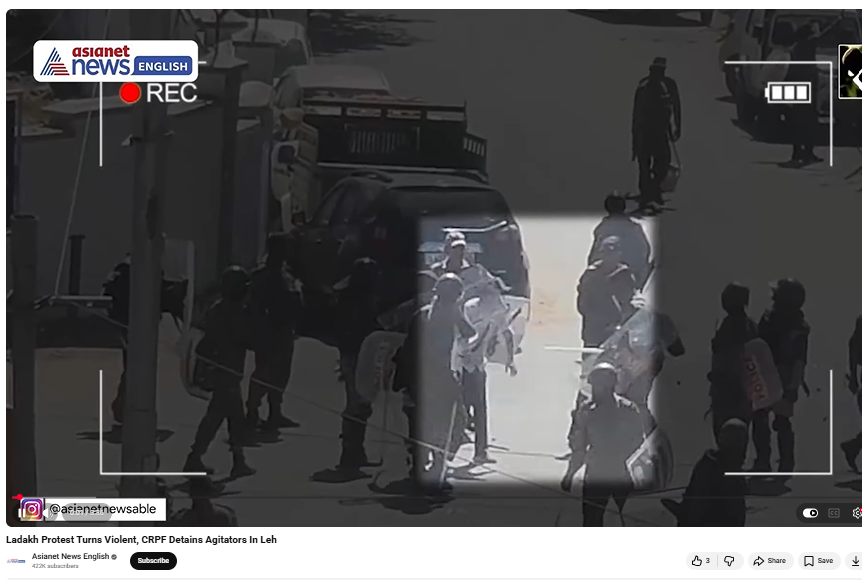
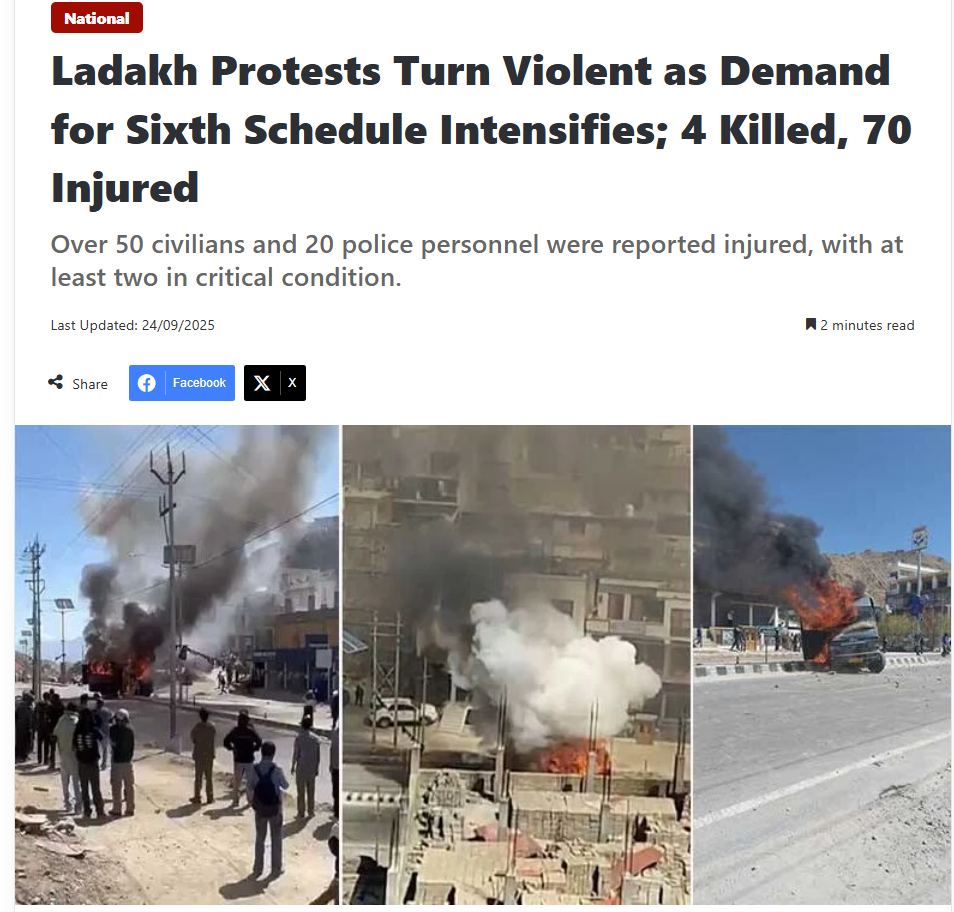
According to the information provided with the video, large-scale protests took place in Leh in support of demands for Sixth Schedule status and full statehood for Ladakh. The movement turned violent following clashes with police, and protesters allegedly set fire to a BJP office in Leh. CRPF personnel and local police later detained several protesters, bringing the situation under control. We also found a report published by Arunachal24, which stated that at least four people were killed and more than 70 injured in violent clashes between protesters demanding statehood and constitutional safeguards for Ladakh and security forces. The report further mentioned that protesters set fire to a local BJP office and a CRPF vehicle, following which authorities imposed a strict curfew across Leh.
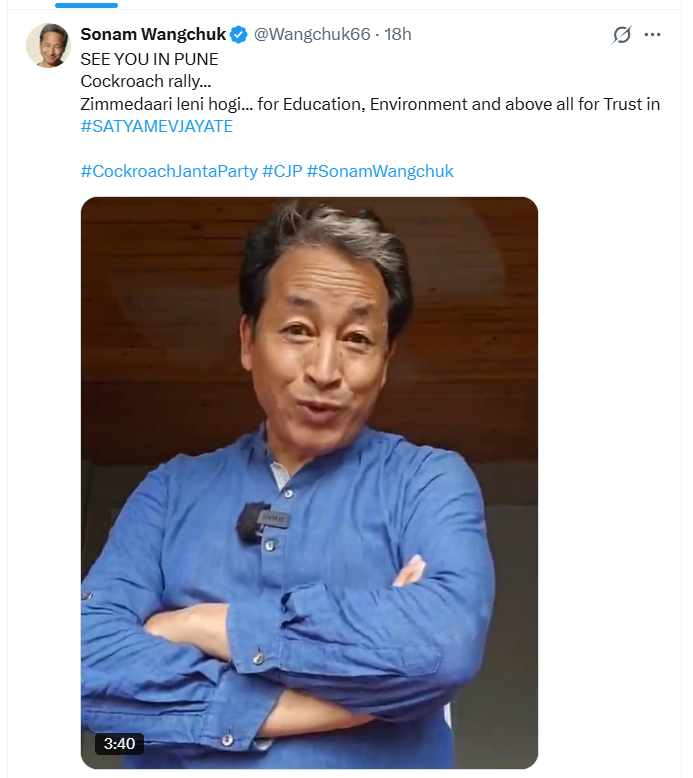
Our team also found that the claim about Sonam Wangchuk’s arrest is entirely false. Wangchuk remains active on social media and had posted an update on June 10, indicating that he had not been detained.
Conclusion:
The fact-check clearly shows that the viral claim is misleading. There is no evidence that Sonam Wangchuk has been arrested. The viral video is not recent and actually shows protests that took place in Ladakh in September 2025.

Related Blogs
Executive Summary
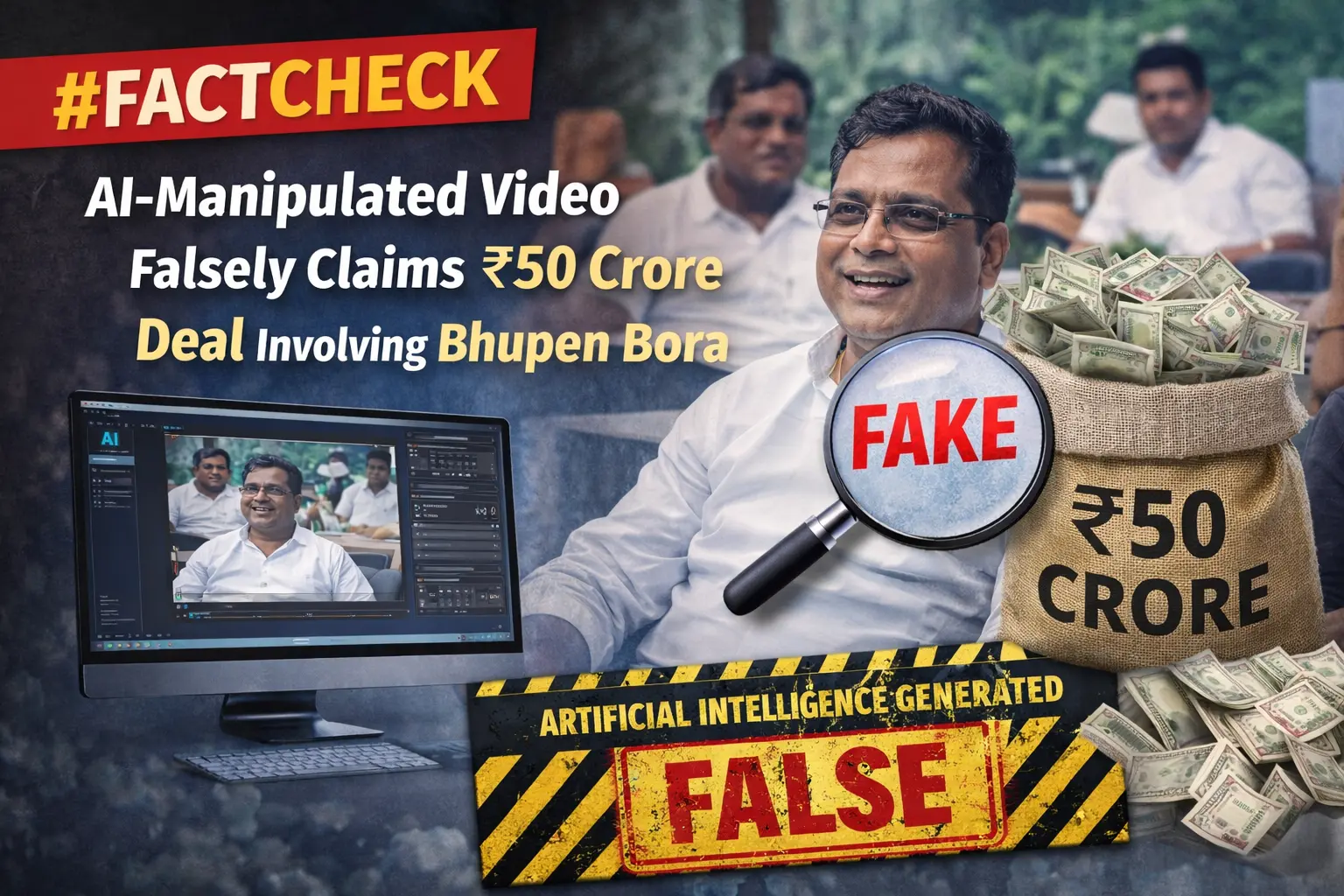
A purported news clip circulating on social media claims that the Bharatiya Janata Party (BJP) purchased Bhupen Bora, a leader of the Indian National Congress, for ₹50 crore as part of a political deal in Assam. The viral clip further alleges that the transaction took place under the leadership of Assam Chief Minister Himanta Biswa Sarma and included an agreement to induct several Congress leaders into the BJP.
However, research by CyberPeace found the viral claim to be false and revealed that the original news video had been manipulated using AI and shared with misleading claims.
Claim
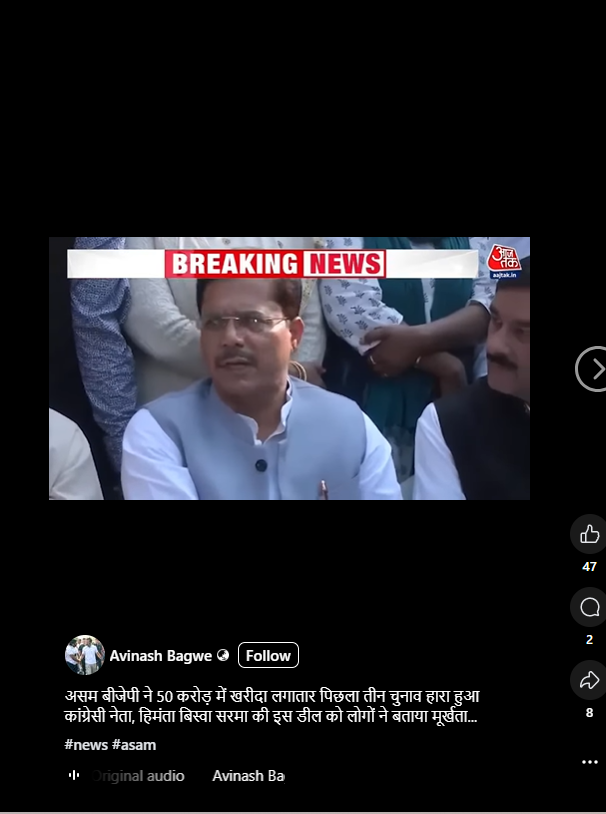
On February 18, 2026, a user shared the viral video on Facebook, claiming that the Assam BJP had bought a Congress leader who had lost the last three elections for ₹50 crore, and that the alleged deal led by Himanta Biswa Sarma had drawn public criticism.
Fact Check:
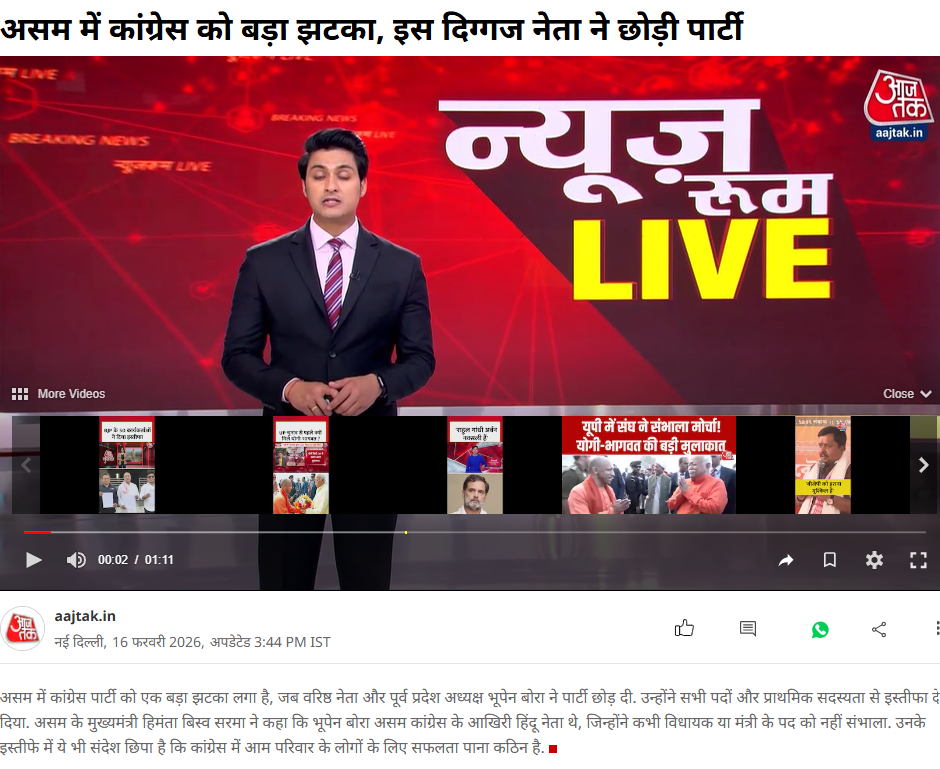
To verify the authenticity of the claim, we extracted key frames from the viral video and conducted a reverse image search using Google Lens. During the research, we found the original version of the video published on the website of Aaj Tak on February 16, 2026. In the original report, the anchor is only seen reporting on Bhupen Bora’s resignation from the party. The report does not mention any alleged financial transaction or political deal, contrary to the claims made in the viral clip.
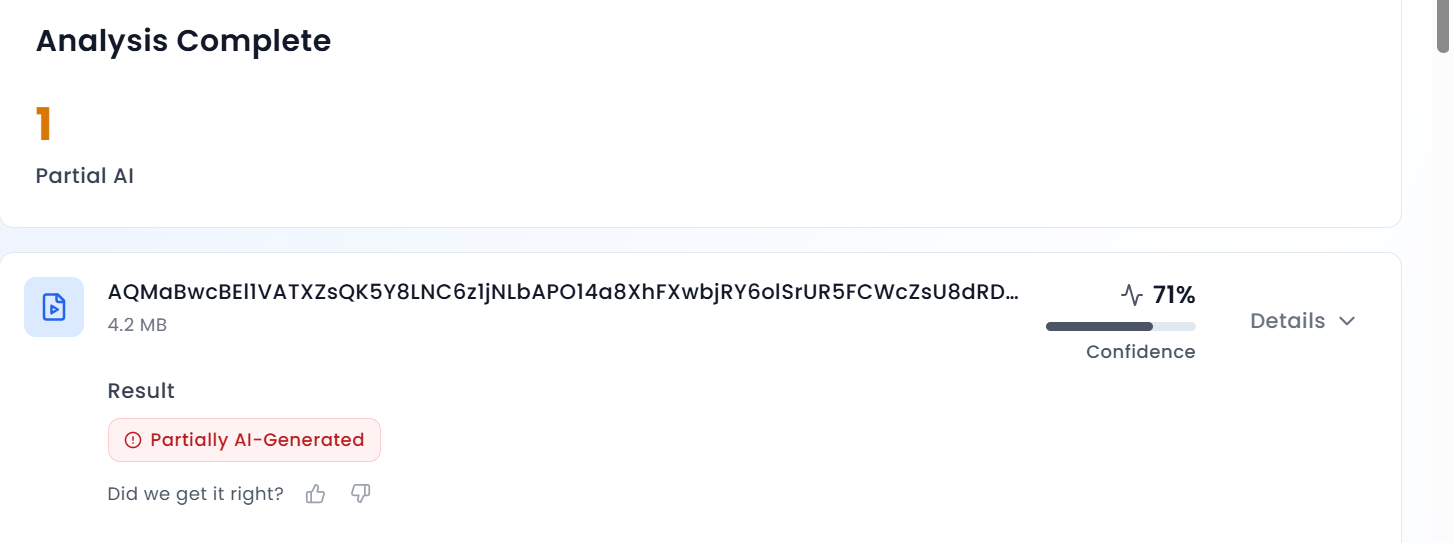
In the next stage of the research, the viral video was analysed using the AI detection tool AURGIN AI, which identified the video as AI-generated.
Conclusion
Our research found that users had manipulated the original news broadcast using AI and shared it with misleading claims. The viral clip does not show any real financial deal between Bhupen Bora and the Assam Chief Minister.
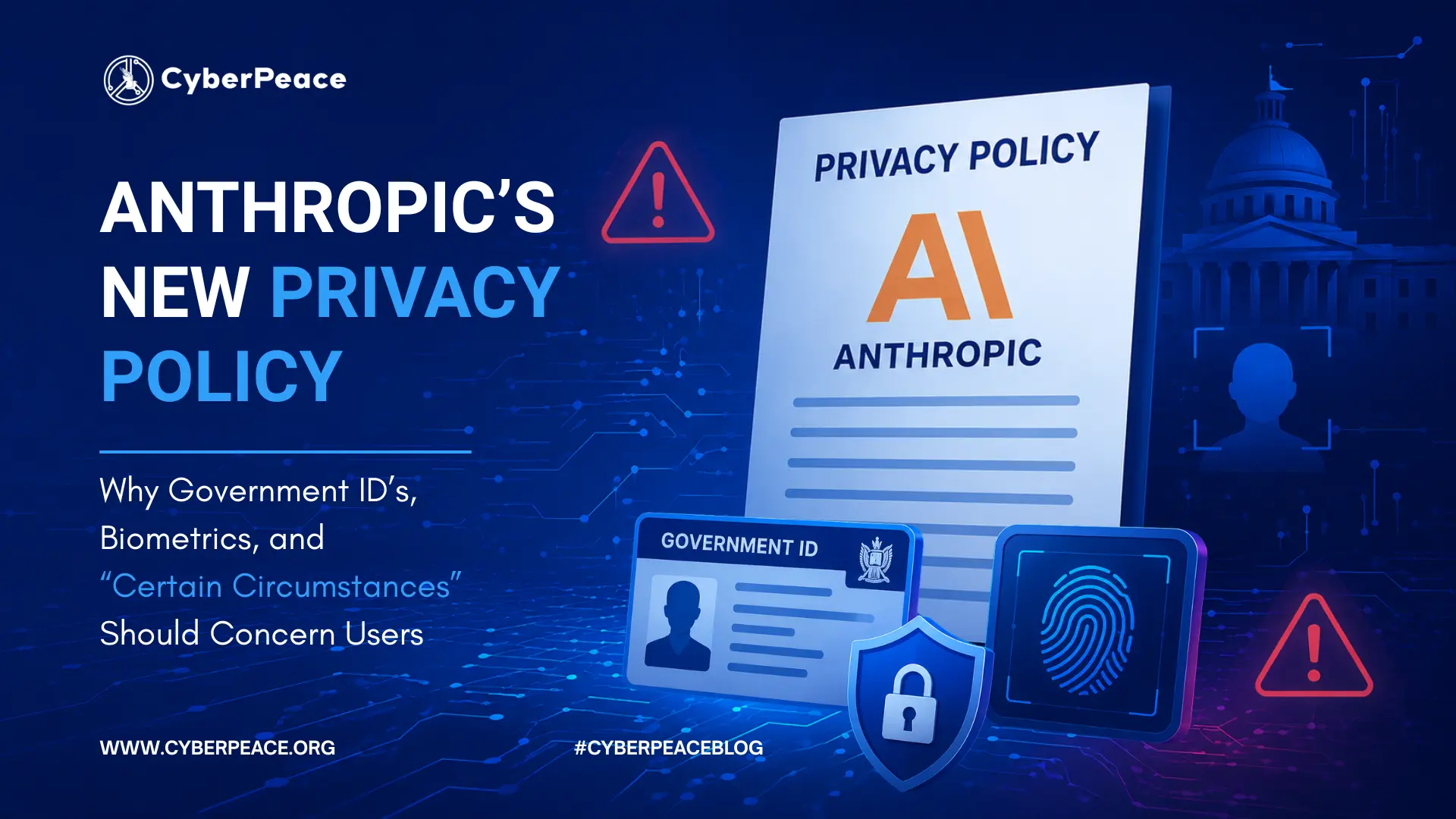
With AI touching new milestones everyday an increasing need for making it secure is also arising. As these AI companies increase their operations and position in the market as providers of powerful tools in the market. A recent concern due to Anthropic's recent privacy policy update which will be effective from July 8, 2026 shows how companies have begun expanding the amount of personal information they collect in the name of safety, compliance, and trust. While they are being demonstrated as measures to improve safety of users and prevent abuse, it raises important questions about privacy, biometric data, surveillance, data retention, and user autonomy, some of which we will be addressing in this article.
Identity Verification of consumers
One of the most notable update to Anthropic's privacy policy is the category of "Verification Data." According to the policy, users may be asked to verify their age or identity in certain circumstances. Depending on the verification method, Anthropic may collect:
- Images of government-issued identity documents;
- Information appearing on those documents, including identification numbers and date of birth for age verification;
- Photographs or videos of the user;
- Facial geometry templates, which may constitute biometric data under certain legal frameworks; and
- The outcome of the verification process.
At first, this may appear similar to the Know Your Customer (KYC) procedures employed by banks or financial institutions but Claude is not a banking service. It is a consumer AI platform. The issue is not that verification exists, but that the circumstances under which it may be required remain undefined.
THE PROBLEM WITH “CERTAIN CIRCUMSTANCES”
The policy refers to verification being required in "certain circumstances." The public notification from Anthropic mentions that these circumstances may include access to particular features, routine platform integrity checks, abuse prevention mechanisms, policy enforcement activities, or legal compliance obligations. The ambiguity of this phrase raises important concerns. From a user perspective, it is difficult to determine, When verification may be triggered ? Whether verification applies only to suspicious accounts ? Whether access to future features may depend upon verification ? Whether users in particular regions will face more frequent verification requirements ? Whether verification requests may increase as AI regulation expands ? This broad language and discretionary power that the company has along with flexibility in the hands of the company creates uncertainty for users who may have initially joined a platform expecting only an email address and payment information to be required.
Government IDs collection: A new risk category
Almost all AI services have operated without collecting government-issued identity documents. Once a company begins processing such information, the privacy implications change dramatically. Because government issued IDs contain: Full legal names, Dates of birth, Identification numbers, Addresses, Photographs and information regarding nationality. When companies collect these documents, they will have an important database of highly sensitive personal information. Even if the company itself does not retain the documents indefinitely, the existence of a verification process introduces additional privacy and security risks. As per Anthropic has stated that identity verification is conducted through third-party providers such as Persona. According to article on the official site titled ‘Identity verification on Claude’, Persona stores the identity documents and selfie data, while Anthropic retains access to verification records when necessary. From the user's perspective, several important realities remain: First, the data still exists somewhere. Second, another third party organization is now involved in processing highly sensitive personal information. Third, Anthropic retains the ability to access verification records under certain circumstances. Therefore, although Anthropic may not directly maintain copies of every uploaded identity document, the practical result remains that sensitive information enters a broader ecosystem of entities and systems. Identity documents today are among the most valuable forms of personal information from the perspective of fraudsters, cybercriminals, and malicious actors. Therefore, any system that handles such documents becomes an attractive target for attack.
More information on persona’s government ID verification- https://withpersona.com/blog/what-is-government-id-verification
The Biometric Dimension
Another significant aspect of the update is the reference to facial geometry templates. Unlike passwords, biometric identifiers cannot easily be changed if compromised. A person can replace a password or even obtain a new identification card, but they cannot simply obtain a new face. Facial geometry templates are sensitive because they enable automated identity matching. Although these templates, as claimed, are not equivalent to photographs, they are nevertheless derived from unique physical characteristics of a person. In many jurisdictions, including parts of the European Union and several U.S. states, biometric data receives enhanced legal protection because of its permanence and sensitivity, let us see how it unfolds in these jurisdictions.
The Unanswered Retention Question
It is unclear in the policy as to how long the data will be retained because retention limits serve as one of the most important safeguards in modern privacy law, they have given another vague answer that “They're bound to protect it with industry-standard security controls and delete it in line with the retention limits we've set and applicable law.” The longer sensitive information remains stored, the greater the likelihood of unauthorized access, misuse, accidental disclosure, or legal compulsion.
Court Orders and Government Access
Anthropic may be required to disclose information pursuant to valid legal processes such as subpoenas, court orders, warrants, or regulatory directives. The existence of identity verification records means that future requests could potentially be linked to verified identities rather than pseudonymous accounts. This does not mean governments receive unrestricted access to user data. However, it does mean that once identity verification information exists within a company's ecosystem, it may become subject to lawful disclosure requirements. The privacy implications are therefore materially different from those associated with anonymous or pseudonymous AI usage.
Shifting Responsibility onto Users
Another concern is that the privacy policy states that users are responsible for ensuring they possess the necessary rights, permissions, or authority when uploading files, connecting third-party services, or instructing Claude to retrieve information. Anthropic is effectively informing users that they bear responsibility for ensuring that uploaded or connected data is lawfully accessible. As AI assistants gain greater capabilities, this transfer of responsibility from platform to user is likely to become increasingly common. Beyond individual privacy, Anthropic's verification policy also raises larger questions about data sovereignty and the cross-border movement of sensitive personal information. In India, the Justice K.S. Puttaswamy (Retd.) v. Union of India judgment recognized privacy as a fundamental right under Article 21 of the Constitution, affirming that individuals have the right to informational self-determination and control over their personal data. Yet, under Anthropic's verification framework, an Indian user may be required to upload a government-issued identity document and biometric information, which are processed by Persona, a U.S.-based identity verification company acting on behalf of Anthropic. Although users voluntarily consent to this process, it nevertheless results in highly sensitive identity information crossing national borders and entering the control of foreign private entities governed primarily by foreign contractual arrangements and multiple legal regimes. While governments issue identity documents as sovereign instruments of citizenship, their verification and processing are increasingly outsourced to multinational technology companies. Questions arise not only about how securely such information is handled, but also about which country's laws ultimately govern access, retention, disclosure, and accountability when personal data leaves the jurisdiction in which it originated. Under the Digital Personal Data Protection Act, 2023, cross-border transfer of personal data is generally permitted unless the Central Government specifically restricts transfers to certain jurisdictions. Therefore, a foreign company processing identity documents is not, by itself, unlawful but this legality does not eliminate legitimate concerns. Users realistically have limited bargaining power and little practical understanding of how long their identity documents, biometric templates, or verification records will be retained, who within the corporate ecosystem may access them, or how they may be disclosed pursuant to foreign legal processes.
Conclusion
The policy is commendable in some respects because it openly identifies the categories of information that may be collected rather than obscuring them behind vague terminology. However, important concerns remain regarding the extent of verification triggers, the handling of biometric information, the absence of clearly disclosed retention periods, and the long-term implications of linking AI accounts to government-issued identities. As AI systems become more integrated into daily life, these questions will likely become central issues in debates about digital privacy, surveillance, autonomy, and the future governance of artificial intelligence.
Executive Summary
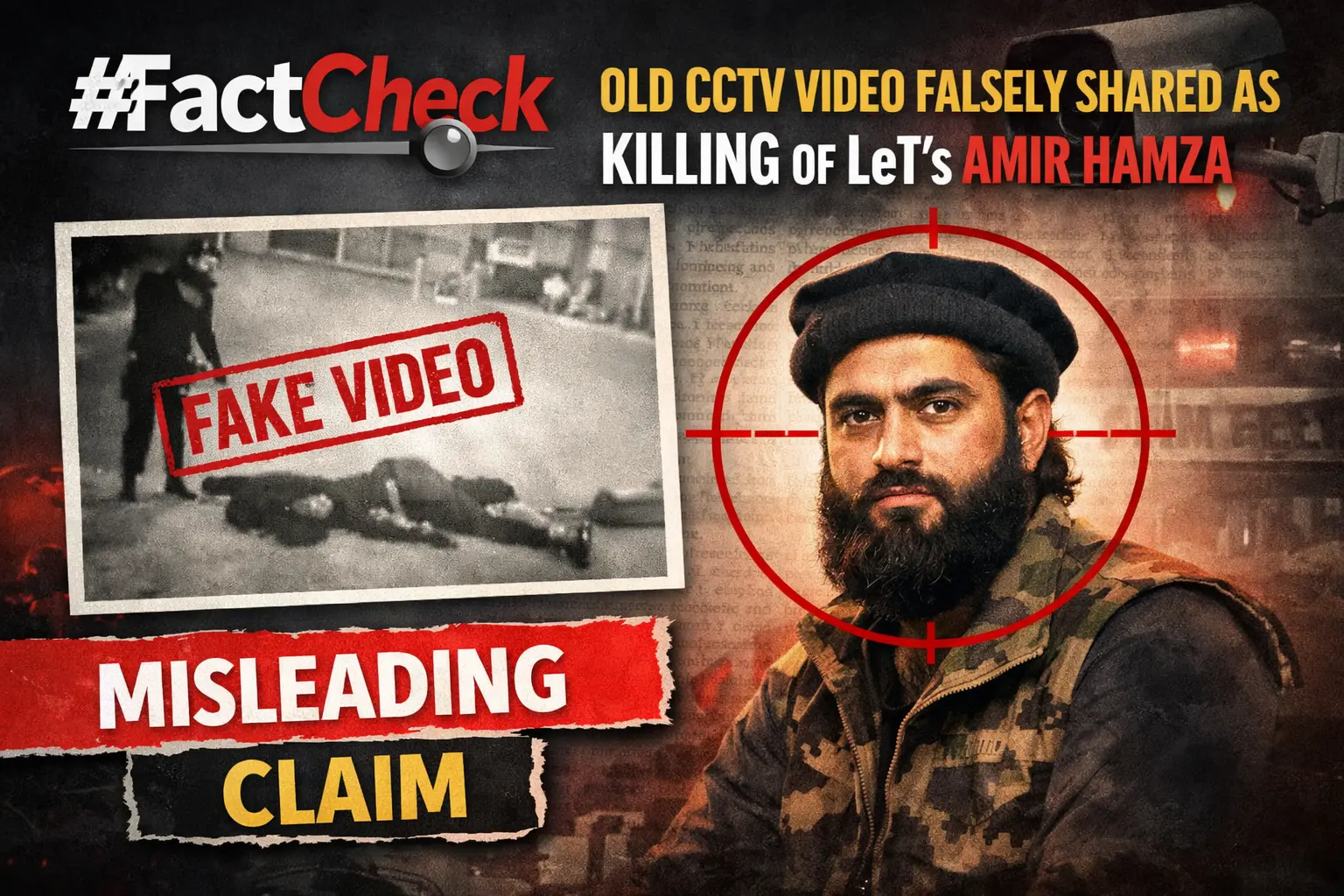
A CCTV video showing a man being shot is being widely circulated on social media with the claim that it depicts the killing of Lashkar-e-Taiba terrorist Amir Hamza in Pakistan. However, research by the CyberPeace Research Wing found that the claim is misleading. The viral video existed online even before the reported attack on Amir Hamza.
Claim
Social media users are sharing a CCTV clip claiming that Lashkar-e-Taiba terrorist Amir Hamza was shot dead in Pakistan.
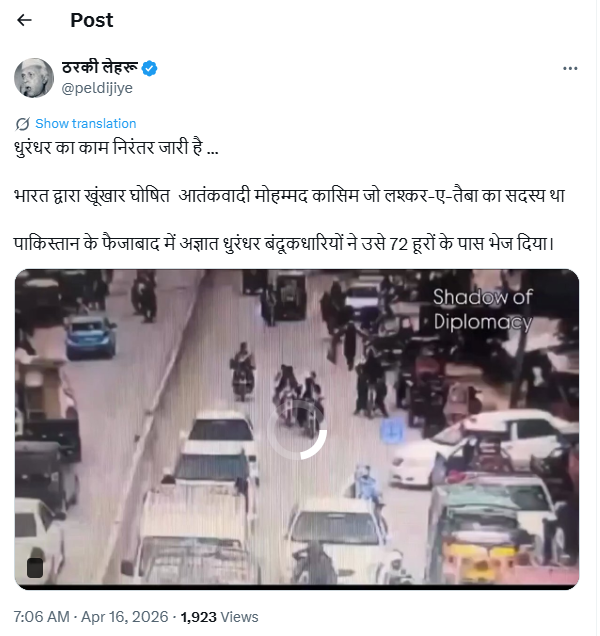
Fact Check
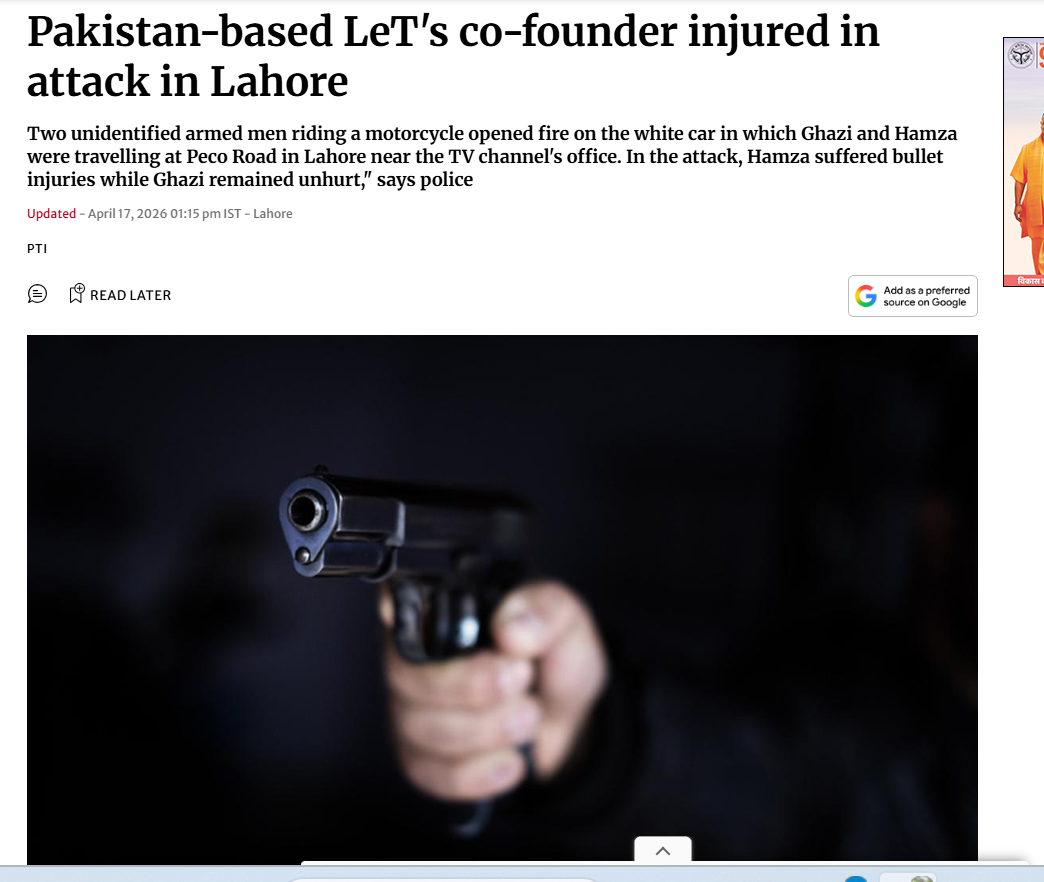
To verify the claim, we first searched relevant keywords such as “Maulana Amir Hamza firing Lahore.” This led us to a report published on April 17, 2026, by The Hindu. Citing Pakistani channel 24 News HD TV, the report stated that unidentified attackers opened fire on the car of TV host Justice Nazir Ahmed Ghazi. Amir Hamza was injured in the incident, not killed.
We also reviewed the official social media accounts of 24 News HD TV. A post on its X handle (@24NewsHD) confirmed that Justice Ghazi was safe, while Amir Hamza sustained injuries in the firing incident in Lahore.
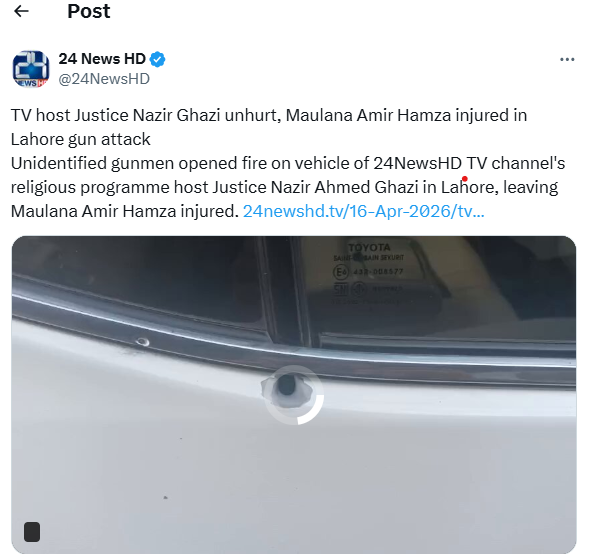
For further verification, we extracted keyframes from the viral video and performed a reverse image search. The same clip was found uploaded on March 28, 2026, on a Pakistani Facebook page. According to the post, the CCTV footage was linked to the killing of an individual named Saifullah Malakhel.
Although we could not independently verify the exact origin of the video, our findings clearly indicate that the footage predates the recent attack on Amir Hamza and is unrelated to the incident.
Conclusion
The viral claim is false. Amir Hamza was not killed but reportedly injured in the firing incident, as per credible media reports. The CCTV video being shared in this context is old and unrelated, and has been circulated with a misleading narrative.
