
#FactCheck- Old Bangladesh Clip Misused as West Bengal Election Incident
Executive Summary
A video showing two men attempting to break into a house, only to be confronted by armed personnel who force them to kneel, is being widely shared on social media in the context of the upcoming West Bengal Assembly elections. The clip is being circulated with claims that it shows Central Reserve Police Force personnel intervening after workers of the Trinamool Congress allegedly tried to intimidate locals. However, an research by the CyberPeace Research Wing found that the claim is false. The viral video has no connection to India or the West Bengal elections and is being shared with a misleading narrative.
Claim
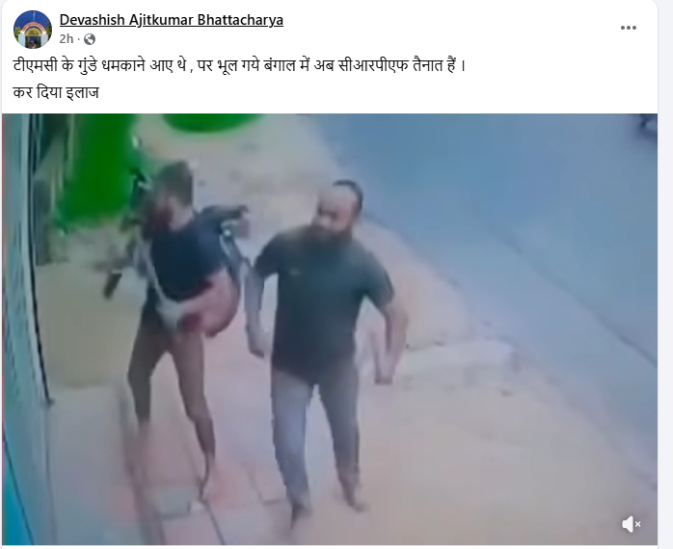
A Facebook user named Devashish Ajitkumar Bhattacharya shared the video on April 20, 2026, with the caption suggesting that TMC workers attempted to threaten people but were stopped by CRPF personnel deployed in West Bengal.
- Archive link: https://perma.cc/R42V-49FV
Fact Check
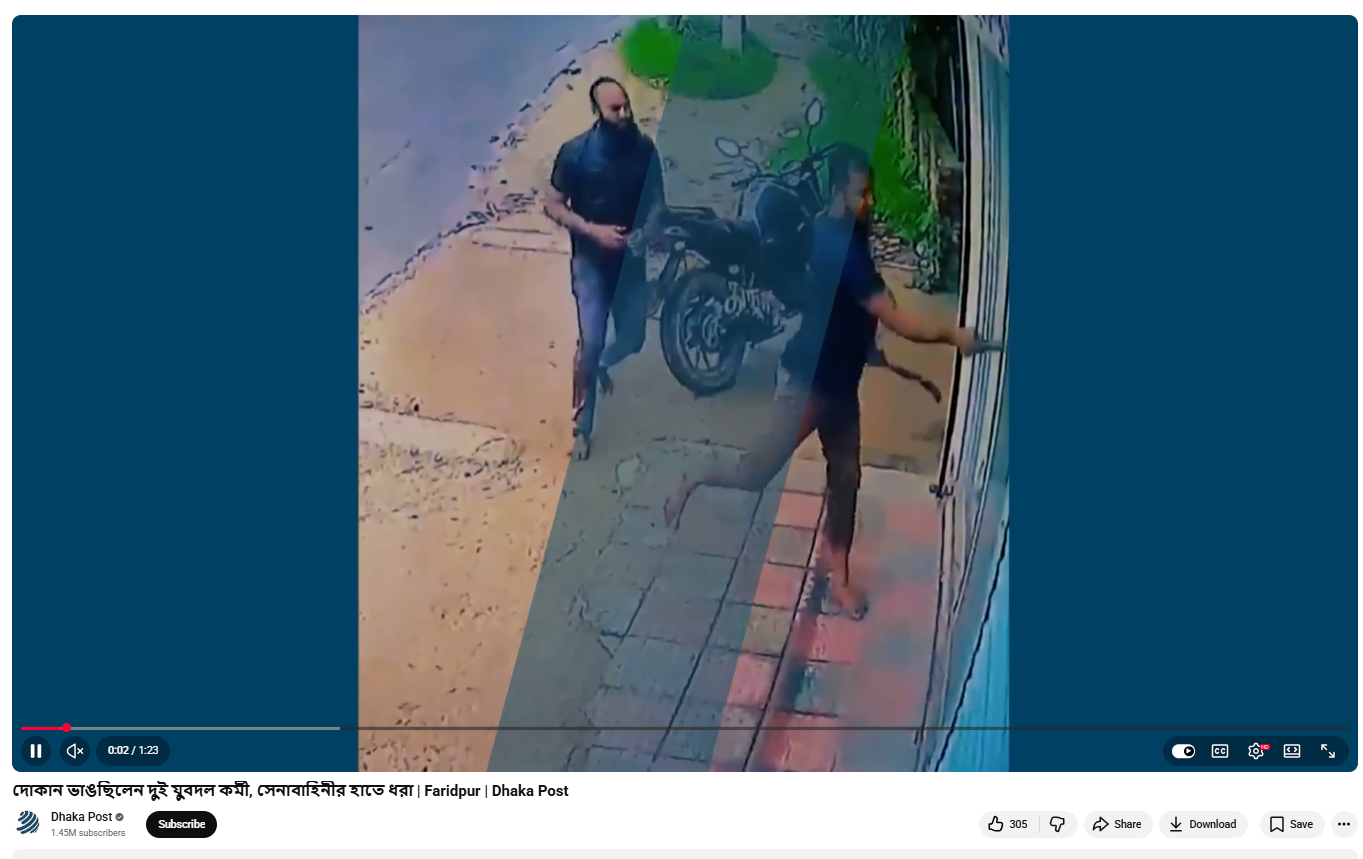
To verify the claim, we extracted keyframes from the viral video and conducted a reverse image search. This led us to the same video uploaded on August 17, 2024, on the official YouTube channel of Bangladeshi news outlet Dhaka Post. The details accompanying the video confirmed that the incident took place in Bangladesh.
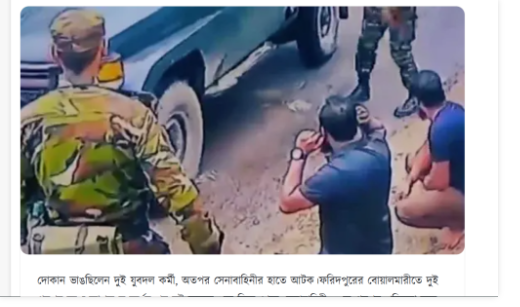
Further research led us to a report published on August 17, 2024, by 24 Hours Khobor, which stated that the incident occurred in Faridpur, Bangladesh. According to the report, a clash broke out between two groups, following which the army intervened and arrested two individuals identified as Tutul Hossain and Dukhu Mia. Both were later sent to jail by a court.
Conclusion
The viral claim linking the video to the West Bengal Assembly elections is false. The footage does not show any incident involving CRPF personnel or political workers in India. Instead, it is from an unrelated घटना in Bangladesh that took place in 2024. The video has been taken out of context and is being circulated with a misleading narrative to create confusion around the ongoing election environment.

Related Blogs
Executive Summary
A picture is rapidly going viral on social media, showing Indian cricketer Virat Kohli and actor Anushka Sharma having breakfast together. Users are sharing this photo, presenting it as a "candid" (real) moment.
Research by the CyberPeace Research Wing revealed that the photo of Virat Kohli and Anushka Sharma having breakfast is completely fake. This image does not depict a real moment, but has been created using Artificial Intelligence (AI).
Claim
A picture is rapidly going viral on social media, showing Indian cricketer Virat Kohli and actor Anushka Sharma having breakfast together. Users are sharing this photo, presenting it as a "candid" (real) moment.
https://www.facebook.com/reel/951138134598230
Fact Check
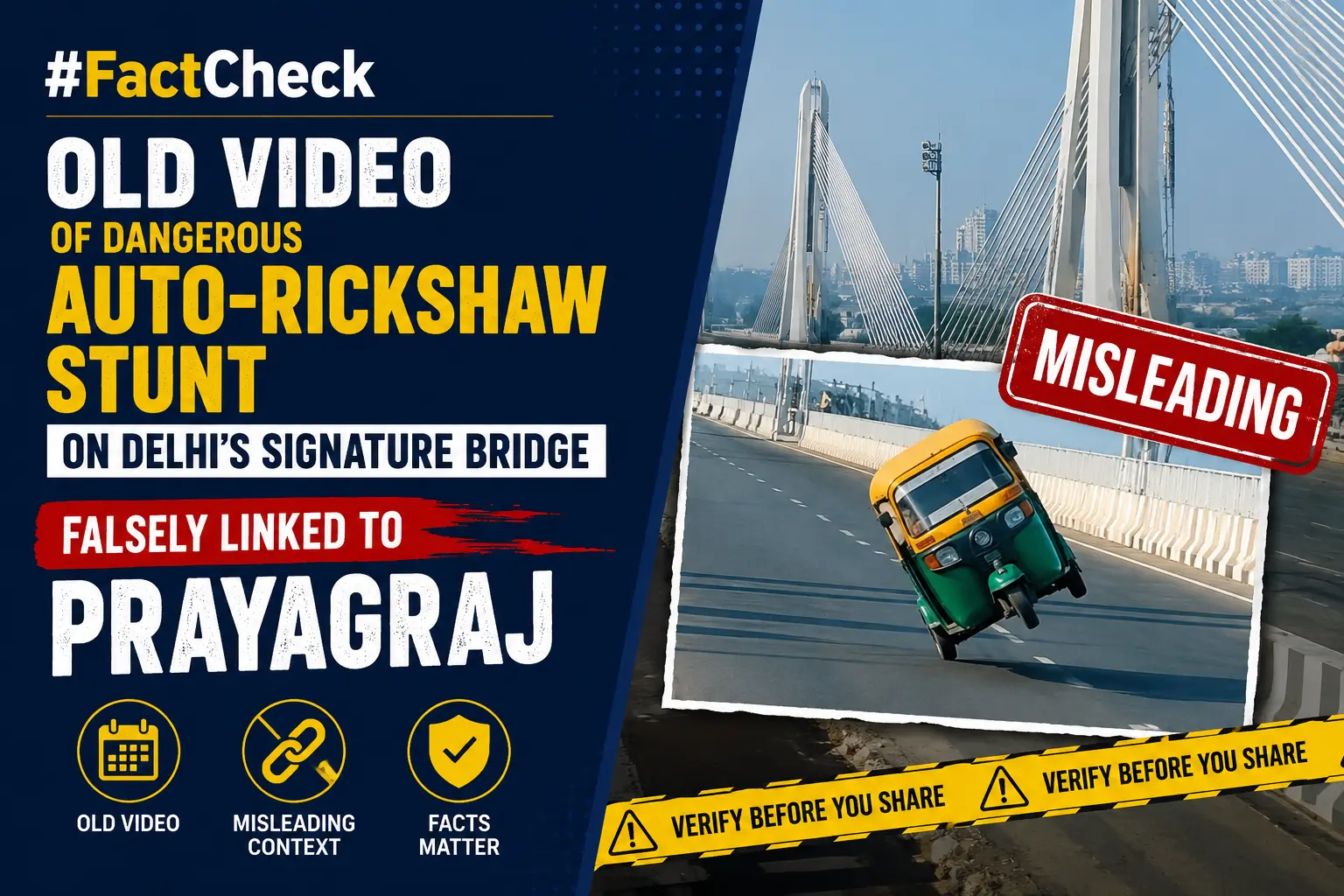
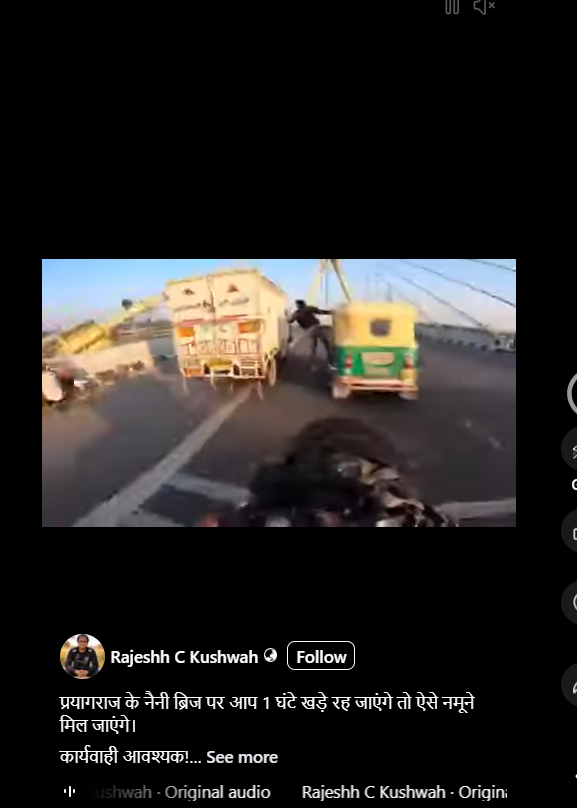
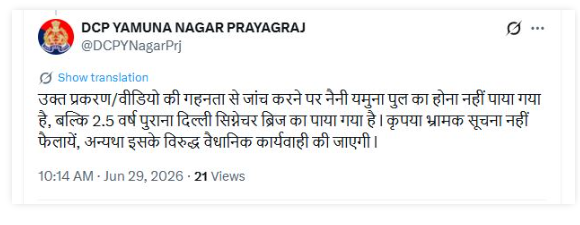
We extracted several keyframes from the viral video and searched them using the Google Lens tool. We found that this video was also quite viral on X (formerly Twitter). Responding to users, the official X handle of DCP Yamuna Nagar, Prayagraj, stated, “Upon a detailed research of the said matter/video, it has been found that it is not from the Naini Yamuna Bridge, but is a 2.5-year-old video from Delhi’s Signature Bridge. Please do not spread misleading information, otherwise legal action will be initiated against it.”
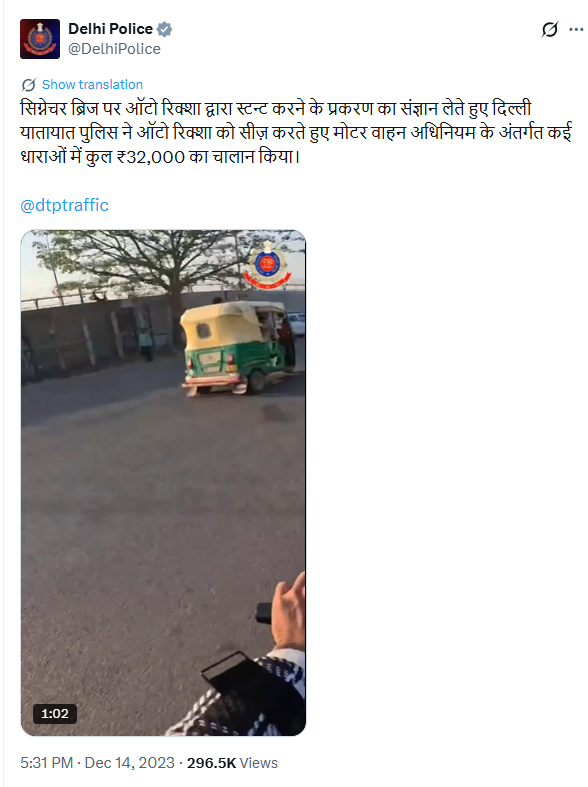
During our search, we found a post on the official X handle of the Delhi Police. Sharing the viral video, they wrote that taking cognizance of the auto-rickshaw stunt incident on the Signature Bridge, the Delhi Traffic Police seized the auto-rickshaw and issued a challan totaling ₹32,000 under various sections of the Motor Vehicles Act.
https://x.com/DelhiPolice/status/1735268792434057352?s=20
Conclusion
In our research, the viral post turned out to be fake. A video of an incident that took place on Delhi's Signature Bridge in 2023 is now being falsely circulated to spread misinformation as an incident from a bridge in Prayagraj. No such incident has taken place on the Naini Bridge in Prayagraj.

Introduction
The Central Board of Secondary Education (CBSE) has issued a warning to students about fake social media accounts that spread false information about the CBSE. The board has warned students not to trust the information coming from these accounts and has released a list of 30 fake accounts. The board has expressed concern that these handles are misleading students and parents by spreading fake information with the name and logo of the CBSE. The board has has also clarified that it is not responsible for the information being spread from these fake accounts.
The Central Board of Secondary Education (CBSE), a venerable institution in the realm of Indian education, has found itself ensnared in the web of cyber duplicity. Impersonation attacks, a sinister facet of cybercrime, have burgeoned, prompting the Board to adopt a vigilant stance against the proliferation of counterfeit social media handles that masquerade under its esteemed name and emblem.
The CBSE, has revealed a list of approximately 30 spurious handles that have been sowing seeds of disinformation across the social media landscape. These digital doppelgängers, cloaked in the Board's identity, have been identified and exposed. The Board's official beacon in this murky sea of falsehoods is the verified handle '@cbseindia29', a lighthouse guiding the public to the shores of authentic information.
This unfolding narrative signifies the Board's unwavering commitment to tackle the scourge of misinformation and to fortify the bulwarks safeguarding the sanctity of its official communications. By spotlighting the rampant growth of fake social media personas, the CBSE endeavors to shield the public from the detrimental effects of misleading information and to preserve the trust vested in its official channels.
CBSE Impersonator Accounts
The list of identified malefactors, parading under the CBSE banner, serves as a stark admonition to the public to exercise discernment while navigating the treacherous waters of social media platforms. The CBSE has initiated appropriate legal manoeuvres against these unauthorised entities to stymie their dissemination of fallacious narratives.
The Board has previously unfurled comprehensive details concerning the impending board examinations for both Class 10 and Class 12 in the year 2024. These academic assessments are slated to commence from February 15 to April 2, 2024, with a uniform start time of 10:30 AM (IST) across all designated dates.
The CBSE has made it unequivocally clear that there are nefarious entities lurking in the shadows of social media, masquerading in the guise of the CBSE. It has implored students and the general public not to be ensnared by the siren songs emanating from these fraudulent accounts and has also unfurled a list of these imposters. The Board's warning is a beacon of caution, illuminating the path for students as they navigate the digital expanse with the impending commencement of the CBSE Class X and XII exams.
Sounding The Alarm
The Central Board of Secondary Education (CBSE) has sounded the alarm, issuing an advisory to schools, students, and their guardians about the existence of fake social media platform handles that brandish the board’s logo and mislead the academic community. The board has identified about 30 such accounts on the microblogging site 'X' (formerly known as Twitter) that misuse the CBSE logo and acronym, sowing confusion and disarray.
The board is in the process of taking appropriate action against these deceptive entities. CBSE has also stated that it bears no responsibility for any information disseminated by any other source that unlawfully appropriates its name and logo on social media platforms.
Sources reveal that these impostors post false information on various updates, including admissions and exam schedules. After receiving complaints about such accounts on 'X', the CBSE issued the advisory and has initiated action against those operating these accounts, sources said.
The Brute Nature of Impersonation
In the contemporary digital epoch, cybersecurity has ascended to a position of critical importance. It is the bulwark that ensures the sanctity of computer networks is maintained and that computer systems are not marked as prey by cyber predators. Cyberattacks are insidious stratagems executed with the intent of expropriating, manipulating, or annihilating authenticated user or organizational data. It is imperative that cyberattacks be mitigated at their roots so that users and organizations utilizing internet services can navigate the digital domain with a sense of safety and security. Knowledge about cyberattacks thus plays a pivotal role in educating cyber users about the diverse types of cyber threats and the preventive measures to counteract them.
Impersonation Attacks are a vicious form of cyberattack, characterised by the malicious intent to extract confidential information. These attacks revolve around a process where cyber attackers eschew the use of malware or bots to perpetrate their crimes, instead wielding the potent tactic of social engineering. The attacker meticulously researches and harvests information about the legitimate user through platforms such as social media and then exploits this information to impersonate or masquerade as the original, legitimate user.
The threats posed by Impersonation Attacks are particularly insidious because they demand immediate action, pressuring the victim to act without discerning between the authenticated user and the impersonated one. The very nature of an Impersonation Attack is a perilous form of cyber assault, as the original user who is impersonated holds rights to private information. These attacks can be executed by exploiting a resemblance to the original user's identity, such as email IDs. Email IDs with minute differences from the legitimate user are employed in this form of attack, setting it apart from the phishing cyber mechanism. The email addresses are so similar and close to each other that, without paying heed or attention to them, the differences can be easily overlooked. Moreover, the email addresses appear to be correct, as they generally do not contain spelling errors.
Strategies to Prevent
To prevent Impersonation Attacks, the following strategies can be employed:
- Proper security mechanisms help identify malicious emails and thereby filter spamming email addresses on a regular basis.
- Double-checking sensitive information is crucial, especially when important data or funds need to be transferred. It is vital to ensure that the data is transferred to a legitimate user by cross-verifying the email address.
- Ensuring organizational-level security is paramount. Organizations should have specific domain names assigned to them, which can help employees and users distinguish their identity from that of cyber attackers.
- Protection of User Identity is essential. Employees must not publicly share their private identities, which can be exploited by attackers to impersonate their presence within the organization.
Conclusion
The CBSE's struggle against the masquerade of misinformation is a reminder of the vigilance required to safeguard the legitimacy of our digital interactions. As we navigate the complex and uncharted terrain of the internet, let us arm ourselves with the knowledge and discernment necessary to unmask these digital charlatans and uphold the sanctity of truth.
References
- https://timesofindia.indiatimes.com/city/ahmedabad/cbse-warns-against-misuse-of-its-name-by-fake-social-media-handles/articleshow/107644422.cms
- https://www.timesnownews.com/education/cbse-releases-list-of-fake-social-media-handles-asks-not-to-follow-article-107632266
- https://www.etvbharat.com/en/!bharat/cbse-public-advisory-enn24021205856
Executive Summary
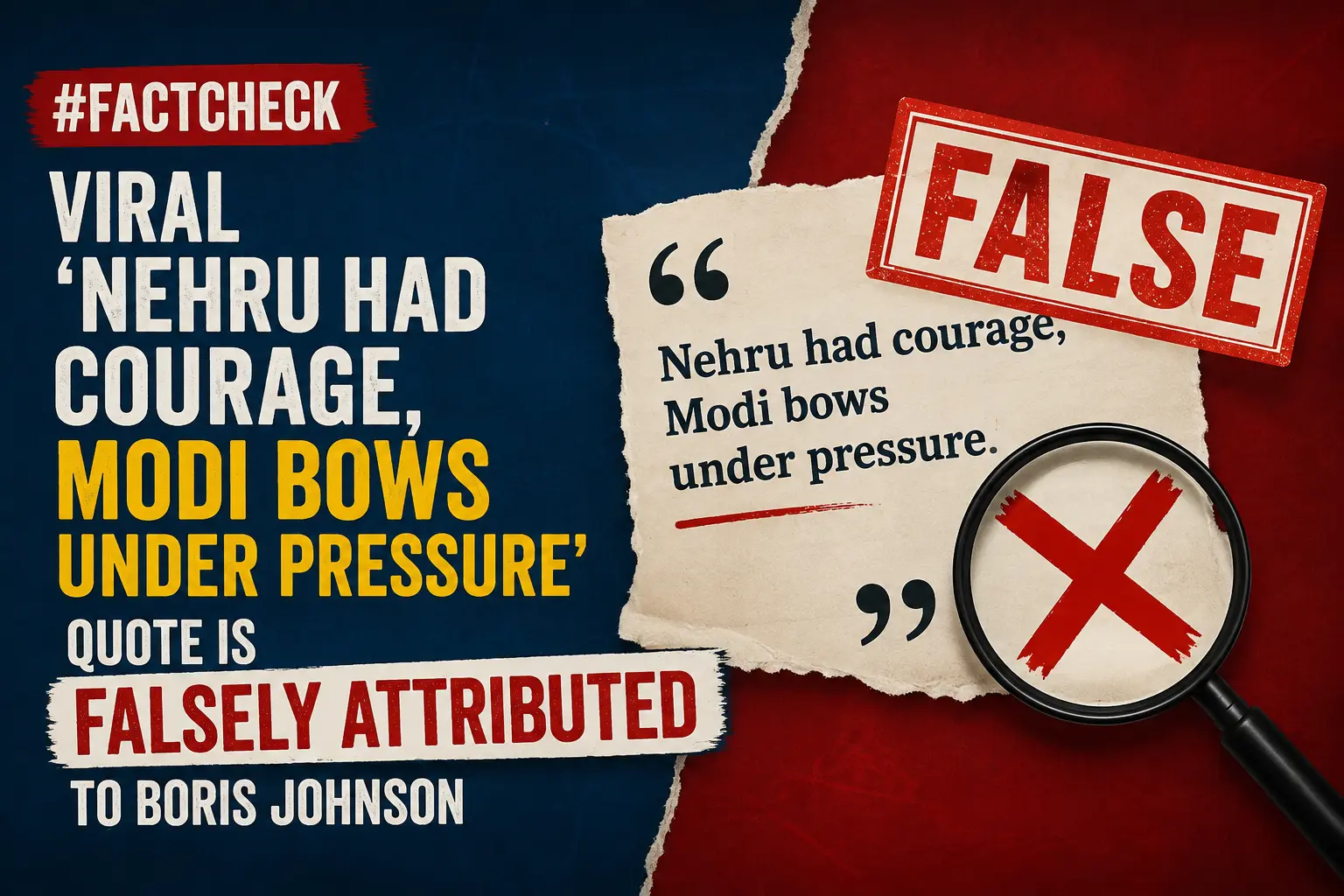
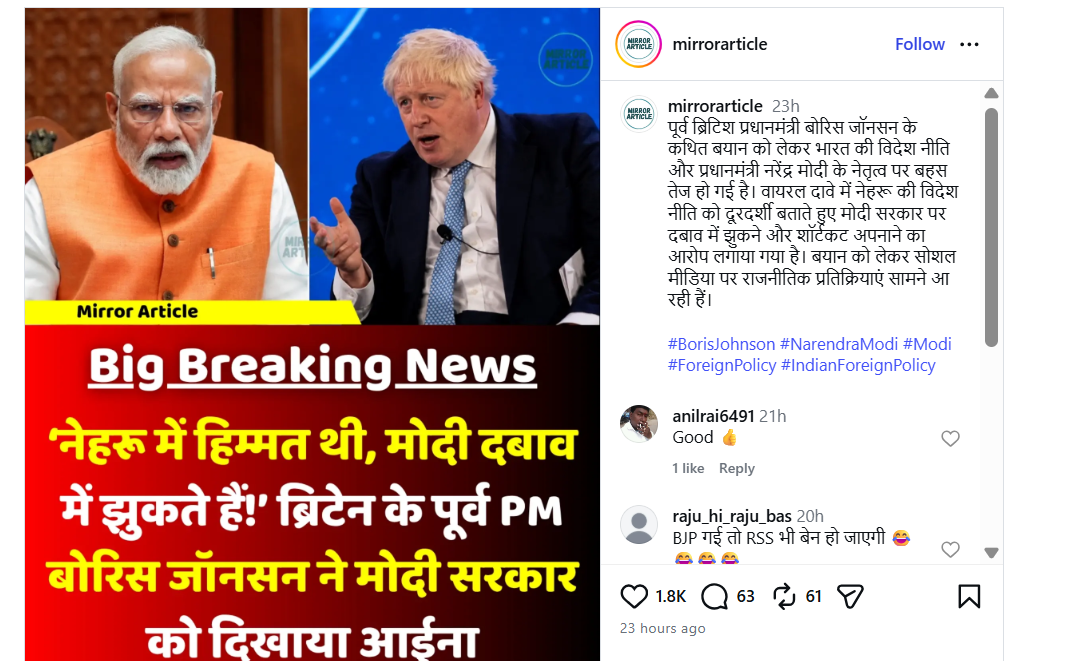
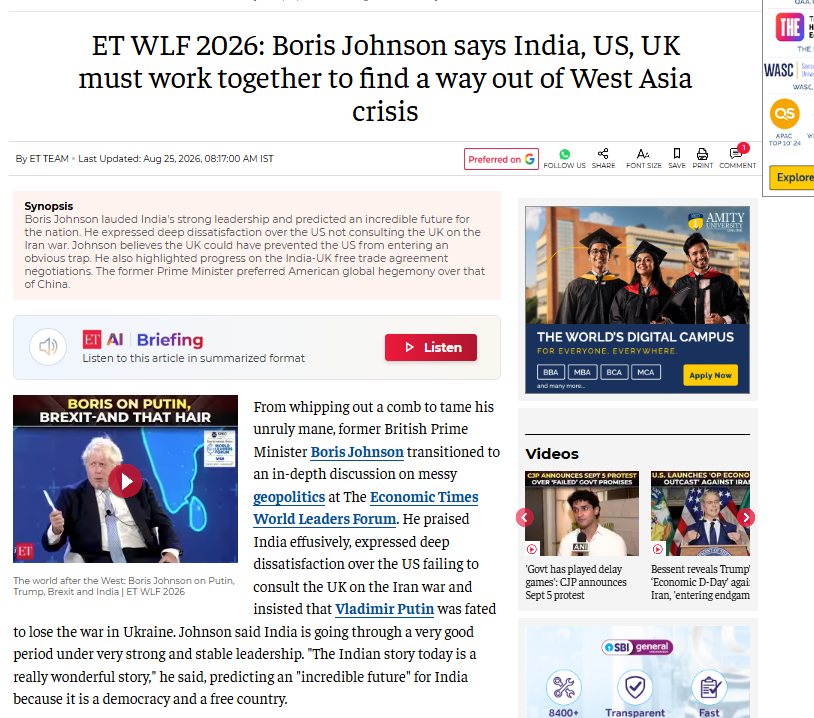
A purported statement attributed to former British Prime Minister Boris Johnson is going viral on social media. The post claims that Johnson said about Prime Minister Narendra Modi, “Modi bows under pressure.” It also attributes a comparison between Jawaharlal Nehru and Modi to Johnson, portraying Nehru as more courageous. A research done by the Research Wing of the CyberPeace found the viral claim to be false. During the research, the team examined Boris Johnson’s interview at the ET World Leaders Forum 2026, along with media reports related to the interview. The available transcript contains no remark by Johnson saying “Modi bows under pressure” or anything similar. On the contrary, he praised the changes and development taking place in India.
Claim:
A user on Instagram shared the viral claim, writing: “The purported statement by former British Prime Minister Boris Johnson has intensified the debate over India’s foreign policy and Prime Minister Narendra Modi’s leadership. The viral claim describes Nehru’s foreign policy as visionary while accusing the Modi government of bowing under pressure and taking shortcuts. The statement has triggered political reactions on social media.” The link to the post, its archive link, and a screenshot are provided below.
https://www.instagram.com/p/Dcdo_TGy-W0/
Fact Check
To verify the authenticity of the viral claim, the Desk examined the available transcript and reports of Boris Johnson’s interview at the ET World Leaders Forum 2026. The Desk found that Johnson also praised India’s current situation. He said that India is going through a “very good period under very strong and stable leadership.” He described India’s progress as “a really wonderful story” and expressed optimism about the country’s future.
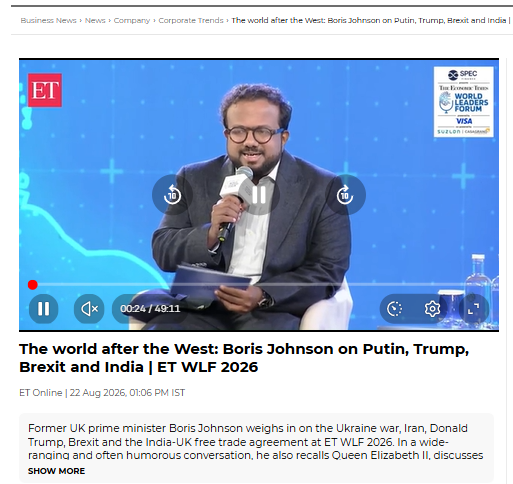
During the interview, Johnson discussed several international issues, including India-UK relations, US-UK ties, NATO defence spending, the Iran war and the Ukraine war. The available interview transcript contains no statement from him saying that “Modi bows under pressure” or that Nehru was more courageous than Modi. Johnson also referred to Jawaharlal Nehru in the context of India-Russia relations. He recalled that the late Queen Elizabeth II had once shared an anecdote about a conversation she had with Nehru in the 1950s, during which Nehru reportedly told her that India would always stand by Russia and that some things never change.
Conclusion
Boris Johnson did not make any statement at the ET World Leaders Forum 2026 suggesting that “Modi bows under pressure” or that “Nehru had courage.” On the contrary, he praised India’s progress and spoke positively about Prime Minister Narendra Modi’s leadership. Johnson did mention Nehru during the conversation, but his reference was in the context of India-Russia relations and an old conversation between Nehru and the late Queen Elizabeth II. He did not compare Nehru with Modi, nor did he criticise Modi. Therefore, the claim circulating on social media attributing the statement “Nehru had courage, Modi bows under pressure” to Boris Johnson is false.
