
#FactCheck- AI-Generated Video Falsely Linked to Iranian Attack on Amazon Data Center in Bahrain
Executive Summary
A video showing a damaged building allegedly belonging to Amazon is going viral on social media. The clip is being shared with the claim that it depicts the aftermath of an Iranian missile strike on an Amazon data center in Bahrain on April 1, 2026. However, research by CyberPeace has found the claim to be misleading. While reports confirm that Iran targeted a U.S.-linked cloud infrastructure in Bahrain, the viral video itself is not real footage and has been created using artificial intelligence.
Claim
A Facebook user, “Tripti Speaks,” shared the viral video on April 2, 2026, with the caption:“Iranian attack on Amazon’s cloud computing data center in Bahrain. IRGC fired missiles at Batelco in Bahrain where AWS infrastructure is located, damaging servers and disrupting services.”
- Archived link::https://perma.cc/XH7S-QTX6

Fact Check
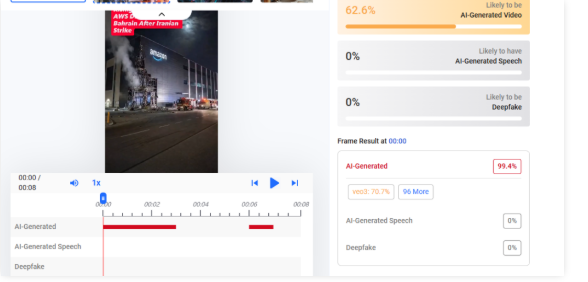
To verify the claim, we extracted multiple keyframes from the viral video and conducted a reverse image search using Google. However, we did not find any credible sources or reports featuring this specific footage. This raised suspicion about the authenticity of the video. We then analyzed it using the AI detection tool Hive Moderation, which indicated a 63% probability that the video is AI-generated.
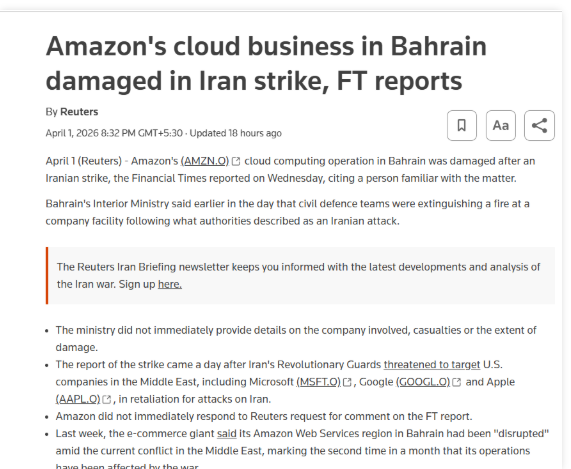
According to a report published by Reuters on April 1, 2026, Iran launched a missile attack targeting Amazon’s cloud computing operations in Bahrain. The Islamic Revolutionary Guard Corps (IRGC) had earlier warned that U.S.-linked companies in the Middle East—including Microsoft, Google, and Apple—could be targeted.
Conclusion
Our research found that while there are credible reports confirming an Iranian attack on cloud infrastructure linked to Amazon in Bahrain, the viral video circulating on social media does not depict the real incident. The footage shows no presence in verified news coverage and has been flagged by AI detection tools as likely artificial. Therefore, the video is AI-generated and misleadingly linked to the incident.

Related Blogs

Introduction
The use of digital information and communication technologies for healthcare access has been on the rise in recent times. Mental health care is increasingly being provided through online platforms by remote practitioners, and even by AI-powered chatbots, which use natural language processing (NLP) and machine learning (ML) processes to simulate conversations between the platform and a user. Thus, AI chatbots can provide mental health support from the comfort of the home, at any time of the day, via a mobile phone. While this has great potential to enhance the mental health care ecosystem, such chatbots can present technical and ethical challenges as well.
Background
According to the WHO’s World Mental Health Report of 2022, every 1 in 8 people globally is estimated to be suffering from some form of mental health disorder. The need for mental health services worldwide is high but the supply of a care ecosystem is inadequate both in terms of availability and quality. In India, it is estimated that there are only 0.75 psychiatrists per 100,000 patients and only 30% of the mental health patients get help. Considering the slow thawing of social stigma regarding mental health, especially among younger demographics and support services being confined to urban Indian centres, the demand for a telehealth market is only projected to grow. This paves the way for, among other tools, AI-powered chatbots to fill the gap in providing quick, relatively inexpensive, and easy access to mental health counseling services.
Challenges
Users who seek mental health support are already vulnerable, and AI-induced oversight can exacerbate distress due to some of the following reasons:
- Inaccuracy: Apart from AI’s tendency to hallucinate data, chatbots may simply provide incorrect or harmful advice since they may be trained on data that is not representative of the specific physiological and psychological propensities of various demographics.
- Non-Contextual Learning: The efficacy of mental health counseling often relies on rapport-building between the service provider and client, relying on circumstantial and contextual factors. Machine learning models may struggle with understanding interpersonal or social cues, making their responses over-generalised.
- Reinforcement of Unhelpful Behaviors: In some cases, AI chatbots, if poorly designed, have the potential to reinforce unhealthy thought patterns. This is especially true for complex conditions such as OCD, treatment for which requires highly specific therapeutic interventions.
- False Reassurance: Relying solely on chatbots for counseling may create a partial sense of safety, thereby discouraging users from approaching professional mental health support services. This could reinforce unhelpful behaviours and exacerbate the condition.
- Sensitive Data Vulnerabilities: Health data is sensitive personal information. Chatbot service providers will need to clarify how health data is stored, processed, shared, and used. Without strong data protection and transparency standards, users are exposed to further risks to their well-being.
Way Forward
- Addressing Therapeutic Misconception: A lack of understanding of the purpose and capabilities of such chatbots, in terms of care expectations and treatments they can offer, can jeopardize user health. Platforms providing such services should be mandated to lay disclaimers about the limitations of the therapeutic relationship between the platform and its users in a manner that is easy to understand.
- Improved Algorithm Design: Training data for these models must undertake regular updates and audits to enhance their accuracy, incorporate contextual socio-cultural factors for profile analysis, and use feedback loops from customers and mental health professionals.
- Human Oversight: Models of therapy where AI chatbots are used to supplement treatment instead of replacing human intervention can be explored. Such platforms must also provide escalation mechanisms in cases where human-intervention is sought or required.
Conclusion
It is important to recognize that so far, there is no substitute for professional mental health services. Chatbots can help users gain awareness of their mental health condition and play an educational role in this regard, nudging them in the right direction, and provide assistance to both the practitioner and the client/patient. However, relying on this option to fill gaps in mental health services is not enough. Addressing this growing —and arguably already critical— global health crisis requires dedicated public funding to ensure comprehensive mental health support for all.
Sources
- https://www.who.int/news/item/17-06-2022-who-highlights-urgent-need-to-transform-mental-health-and-mental-health-care
- https://health.economictimes.indiatimes.com/news/industry/mental-healthcare-in-india-building-a-strong-ecosystem-for-a-sound-mind/105395767#:~:text=Indian%20mental%20health%20market%20is,access%20to%20better%20quality%20services.
- https://www.frontiersin.org/journals/digital-health/articles/10.3389/fdgth.2023.1278186/full

THREE CENTRES OF EXCELLENCE IN ARTIFICIAL INTELLIGENCE:
India’s Finance Minister, Mrs. Nirmala Sitharaman, with a vision of ‘Make AI for India’ and ‘Make AI work for India, ’ announced during the presentation of Union Budget 2023 that the Indian Government is planning to set up three ‘Centre of Excellence’ for Artificial Intelligence in top Educational Institutions to revolutionise fields such as health, agriculture, etc.
Under the ‘Amirt Kaal,’ i.e., the budget of 2023 is a stepping stone by the government to have a technology-driven knowledge-based economy and the seven priorities that have been set up by the government called ‘Saptarishi’ such as inclusive development, reaching the last mile, infrastructure investment, unleashing potential, green growth, youth power, and financial sector will guide the nation in this endeavor along with leading industry players that will partner in conducting interdisciplinary research, developing cutting edge applications and scalable problem solutions in such areas.
The government has already formed the roadmap for AI in the nation through MeitY, NASSCOM, and DRDO, indicating that the government has already started this AI revolution. For AI-related research and development, the Centre for Artificial Intelligence and Robotics (CAIR) has already been formed, and biometric identification, facial recognition, criminal investigation, crowd and traffic management, agriculture, healthcare, education, and other applications of AI are currently being used.
Even a task force on artificial intelligence (AI) was established on August 24, 2017. The government had promised to set up Centers of Excellence (CoEs) for research, education, and skill development in robotics, artificial intelligence (AI), digital manufacturing, big data analytics, quantum communication, and the Internet of Things (IoT) and by announcing the same in the current Union budget has planned to fulfill the same.
The government has also announced the development of 100 labs in engineering institutions for developing applications using 5G services that will collaborate with various authorities, regulators, banks, and other businesses.
Developing such labs aims to create new business models and employment opportunities. Among others, it will also create smart classrooms, precision farming, intelligent transport systems, and healthcare applications, as well as new pedagogy, curriculum, continual professional development dipstick survey, and ICT implementation will be introduced for training the teachers.
POSSIBLE ROLES OF AI:
The use of AI in top educational institutions will help students to learn at their own pace, using AI algorithms providing customised feedback and recommendations based on their performance, as it can also help students identify their strengths and weaknesses, allowing them to focus their study efforts more effectively and efficiently and will help train students in AI and make the country future-ready.
The main area of AI in healthcare, agriculture, and sustainable cities would be researching and developing practical AI applications in these sectors. In healthcare, AI can be effective by helping medical professionals diagnose diseases faster and more accurately by analysing medical images and patient data. It can also be used to identify the most effective treatments for specific patients based on their genetic and medical history.
Artificial Intelligence (AI) has the potential to revolutionise the agriculture industry by improving yields, reducing costs, and increasing efficiency. AI algorithms can collect and analyse data on soil moisture, crop health, and weather patterns to optimise crop management practices, improve yields and the health and well-being of livestock, predict potential health issues, and increase productivity. These algorithms can identify and target weeds and pests, reducing the need for harmful chemicals and increasing sustainability.
ROLE OF AI IN CYBERSPACE:
Artificial Intelligence (AI) plays a crucial role in cyberspace. AI technology can enhance security in cyberspace, prevent cyber-attacks, detect and respond to security threats, and improve overall cybersecurity. Some of the specific applications of AI in cyberspace include:
- Intrusion Detection: AI-powered systems can analyse large amounts of data and detect signs of potential cyber-attacks.
- Threat Analysis: AI algorithms can help identify patterns of behaviour that may indicate a potential threat and then take appropriate action.
- Fraud Detection: AI can identify and prevent fraudulent activities, such as identity theft and phishing, by analysing large amounts of data and detecting unusual behaviour patterns.
- Network Security: AI can monitor and secure networks against potential cyber-attacks by detecting and blocking malicious traffic.
- Data Security: AI can be used to protect sensitive data and ensure that it is only accessible to authorised personnel.
CONCLUSION:
Introducing AI in top educational institutions and partnering it with leading industries will prove to be a stepping stone to revolutionise the development of the country, as Artificial Intelligence (AI) has the potential to play a significant role in the development of a country by improving various sectors and addressing societal challenges. Overall, we hope to see an increase in efficiency and productivity across various industries, leading to increased economic growth and job creation, improved delivery of healthcare services by increasing access to care and, improving patient outcomes, making education more accessible and effective as AI has the potential to improve various sectors of a country and contribute to its overall development and progress. However, it’s important to ensure that AI is developed and used ethically, considering its potential consequences and impact on society.
References:

Introduction
The mysteries of the universe have been a subject of curiosity for humans over thousands of years. To solve these unfolding mysteries of the universe, astrophysicists are always busy, and with the growing technology this seems to be achievable. Recently, with the help of Artificial Intelligence (AI), scientists have discovered the depths of the cosmos. AI has revealed the secret equation that properly “weighs” galaxy clusters. This groundbreaking discovery not only sheds light on the formation and behavior of these clusters but also marks a turning point in the investigation and discoveries of new cosmos. Scientists and AI have collaborated to uncover an astounding 430,000 galaxies strewn throughout the cosmos. The large haul includes 30,000 ring galaxies, which are considered the most unusual of all galaxy forms. The discoveries are the first outcomes of the "GALAXY CRUISE" citizen science initiative. They were given by 10,000 volunteers who sifted through data from the Subaru Telescope. After training the AI on 20,000 human-classified galaxies, scientists released it loose on 700,000 galaxies from the Subaru data.
Brief Analysis
A group of astronomers from the National Astronomical Observatory of Japan (NAOJ) have successfully applied AI to ultra-wide field-of-view images captured by the Subaru Telescope. The researchers achieved a high accuracy rate in finding and classifying spiral galaxies, with the technique being used alongside citizen science for future discoveries.
Astronomers are increasingly using AI to analyse and clean raw astronomical images for scientific research. This involves feeding photos of galaxies into neural network algorithms, which can identify patterns in real data more quickly and less prone to error than manual classification. These networks have numerous interconnected nodes and can recognise patterns, with algorithms now 98% accurate in categorising galaxies.
Another application of AI is to explore the nature of the universe, particularly dark matter and dark energy, which make up over 95% energy of the universe. The quantity and changes in these elements have significant implications for everything from galaxy arrangement.
AI is capable of analysing massive amounts of data, as training data for dark matter and energy comes from complex computer simulations. The neural network is fed these findings to learn about the changing parameters of the universe, allowing cosmologists to target the network towards actual data.
These methods are becoming increasingly important as astronomical observatories generate enormous amounts of data. High-resolution photographs of the sky will be produced from over 60 petabytes of raw data by the Vera C. AI-assisted computers are being utilized for this.
Data annotation techniques for training neural networks include simple tagging and more advanced types like image classification, which classify an image to understand it as a whole. More advanced data annotation methods, such as semantic segmentation, involve grouping an image into clusters and giving each cluster a label.
This way, AI is being used for space exploration and is becoming a crucial tool. It also enables the processing and analysis of vast amounts of data. This advanced technology is fostering the understanding of the universe. However, clear policy guidelines and ethical use of technology should be prioritized while harnessing the true potential of contemporary technology.
Policy Recommendation
- Real-Time Data Sharing and Collaboration - Effective policies and frameworks should be established to promote real-time data sharing among astronomers, AI developers and research institutes. Open access to astronomical data should be encouraged to facilitate better innovation and bolster the application of AI in space exploration.
- Ethical AI Use - Proper guidelines and a well-structured ethical framework can facilitate judicious AI use in space exploration. The framework can play a critical role in addressing AI issues pertaining to data privacy, AI Algorithm bias and transparent decision-making processes involving AI-based tech.
- Investing in Research and Development (R&D) in the AI sector - Government and corporate giants should prioritise this opportunity to capitalise on the avenue of AI R&D in the field of space tech and exploration. Such as funding initiatives focusing on developing AI algorithms coded for processing astronomical data, optimising telescope operations and detecting celestial bodies.
- Citizen Science and Public Engagement - Promotion of citizen science initiatives can allow better leverage of AI tools to involve the public in astronomical research. Prominent examples include the SETI @ Home program (Search for Extraterrestrial Intelligence), encouraging better outreach to educate and engage citizens in AI-enabled discovery programs such as the identification of exoplanets, classification of galaxies and discovery of life beyond earth through detecting anomalies in radio waves.
- Education and Training - Training programs should be implemented to educate astronomers in AI techniques and the intricacies of data science. There is a need to foster collaboration between AI experts, data scientists and astronomers to harness the full potential of AI in space exploration.
- Bolster Computing Infrastructure - Authorities should ensure proper computing infrastructure should be implemented to facilitate better application of AI in astronomy. This further calls for greater investment in high-performance computing devices and structures to process large amounts of data and AI modelling to analyze astronomical data.
Conclusion
AI has seen an expansive growth in the field of space exploration. As seen, its multifaceted use cases include discovering new galaxies and classifying celestial objects by analyzing the changing parameters of outer space. Nevertheless, to fully harness its potential, robust policy and regulatory initiatives are required to bolster real-time data sharing not just within the scientific community but also between nations. Policy considerations such as investment in research, promoting citizen scientific initiatives and ensuring education and funding for astronomers. A critical aspect is improving key computing infrastructure, which is crucial for processing the vast amount of data generated by astronomical observatories.
References
- https://mindy-support.com/news-post/astronomers-are-using-ai-to-make-discoveries/
- https://www.space.com/citizen-scientists-artificial-intelligence-galaxy-discovery
- https://www.sciencedaily.com/releases/2024/03/240325114118.htm
- https://phys.org/news/2023-03-artificial-intelligence-secret-equation-galaxy.html
- https://www.space.com/astronomy-research-ai-future
