
#FactCheck- Marco Rubio Video Digitally Manipulated to Falsely Claim India First Sought Ceasefire from Pakistan
Executive Summary
A video of US Secretary of State Marco Rubio is rapidly going viral on social media, in which he can allegedly be heard making a statement regarding the 2025 India-Pakistan conflict. Along with the video, it is being claimed that the US played a crucial role in ending the conflict between the two countries, but India was the first to initiate a ceasefire with Pakistan. Users are sharing this video believing it to be true.
Research by the CyberPeace Research Wing revealed that the video has been digitally manipulated. Rubio did state that the United States played a role in ending the conflict, but he never said that India was the first to request a ceasefire from Pakistan. This alleged statement was not part of the original video and was added later to alter the clip.
Claim
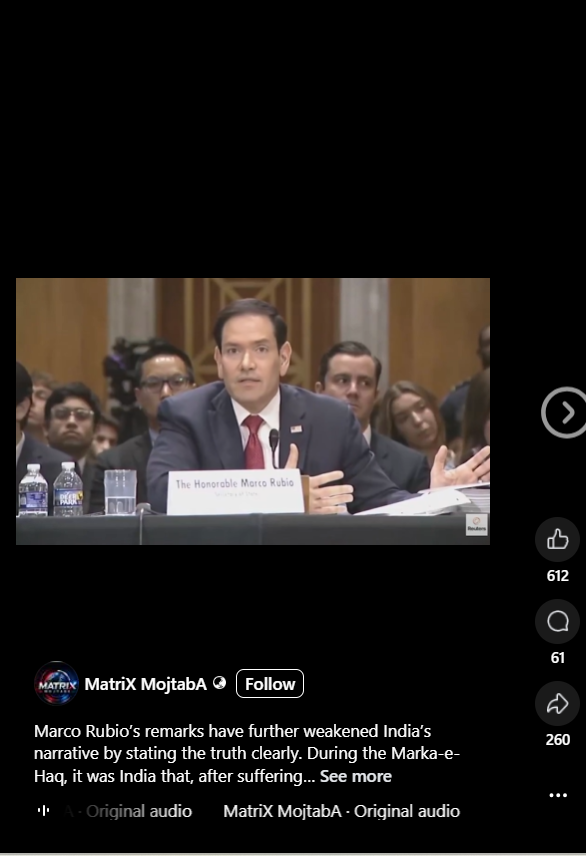
A user on a Facebook page shared the viral video and wrote, "Marco Rubio's statement has clearly brought out the truth, weakening India's claim. During 'Maarka-e-Haq', after suffering heavy losses, India was the first party to request a ceasefire from Pakistan. This highlights the gap between India's public claims and the ground reality, where the military..." The post link, archive link, and screenshot can be seen below. https://www.facebook.com/reel/1015648544746728
https://www.facebook.com/reel/1015648544746728
Fact Check
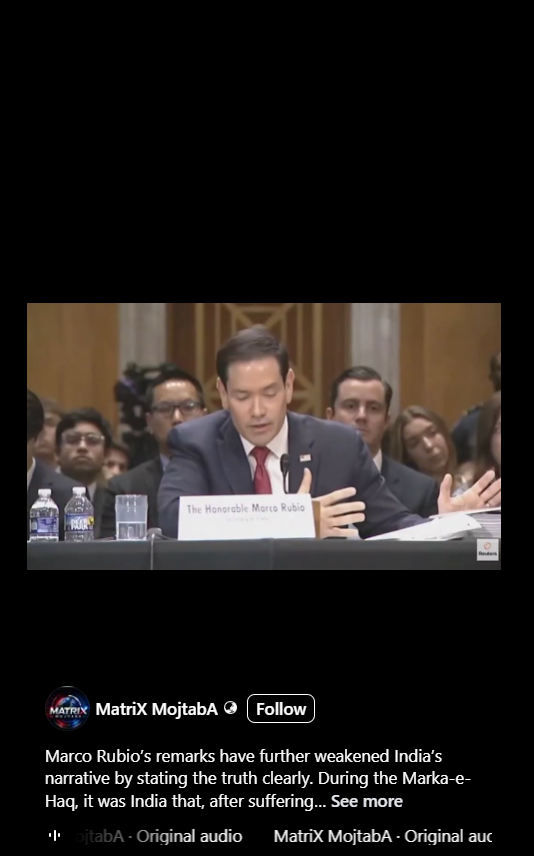
We investigated the viral video using the InVid tool and extracted several of its keyframes. These keyframes were then subjected to a reverse image search via Google Lens. The investigation revealed that the exact same video had been shared on social media previously, showing the same background and setting. The post link and screenshot can be seen below.
https://www.facebook.com/reel/1015648544746728
In the next step of our investigation, we found a video published on Reuters' official YouTube channel on June 2, 2026, whose background matches the viral video. However, nowhere in this original video is Marco Rubio heard saying that India was the first to request a ceasefire from Pakistan. The post link and screenshot can be seen below.
https://www.youtube.com/watch?v=qSpp5IYO6Cs
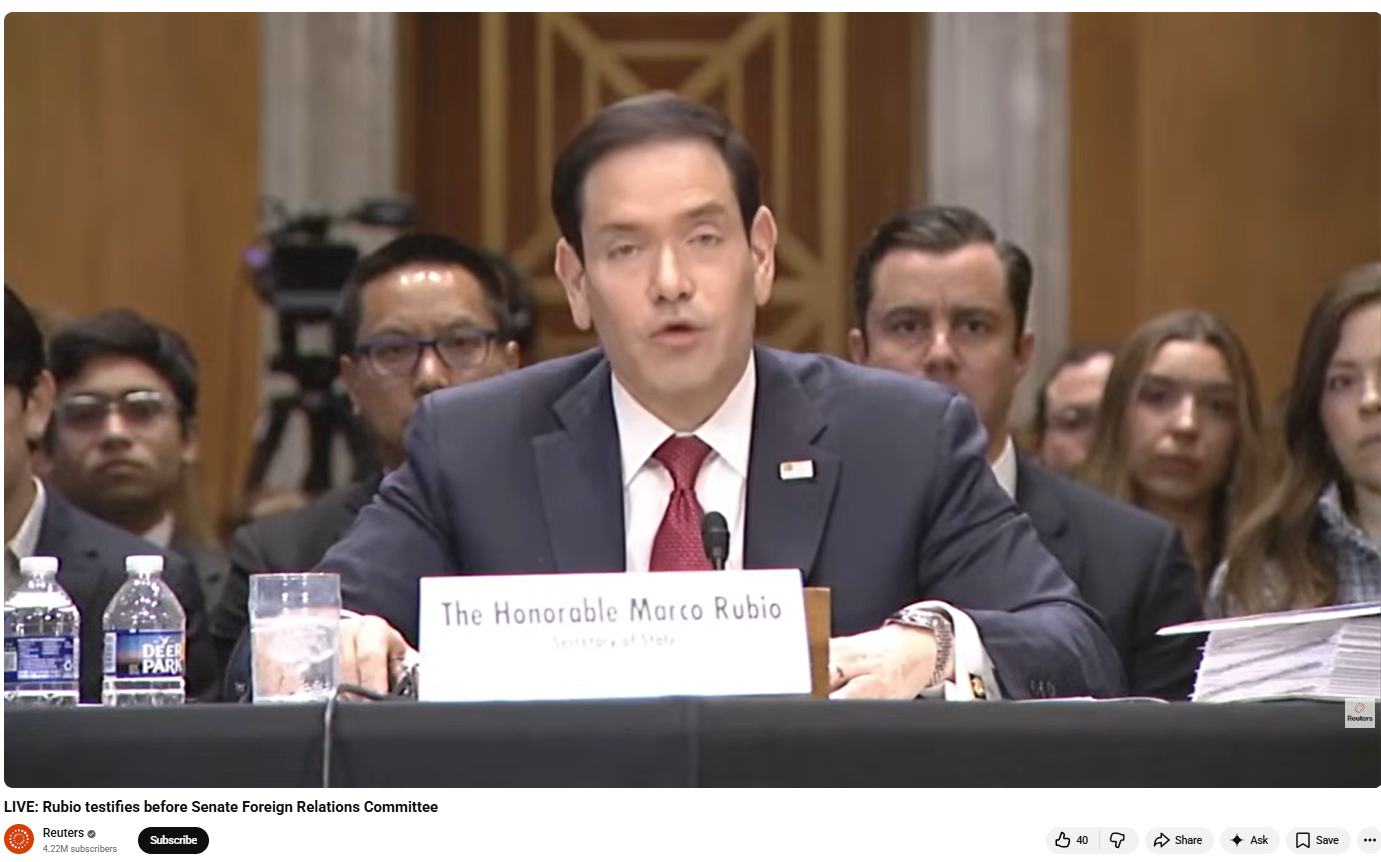
At the 2-hour 8-minute 55-second mark of the Reuters video, Rubio only states that the US played a role in ending the India-Pakistan conflict. Following this, he discusses the Thailand-Cambodia conflict. This makes it clear that the alleged statement in the viral video was digitally added or edited in, and is not part of the original footage.
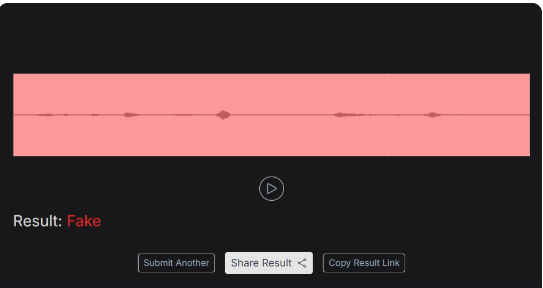
Taking the investigation further, we scanned the suspicious audio portion of the viral video using the AI detection tool 'Resemble AI'. According to the analysis results, clear signs of audio manipulation were detected.
Conclusion:
Our investigation revealed that the video has been digitally manipulated. Rubio did state that the United States played a role in ending the conflict, but he never said that India was the first to request a ceasefire from Pakistan. This alleged statement was not part of the original video and was altered by adding it later.

Related Blogs

Executive Summary
A video is being shared on social media showing a little girl crying while holding onto a pole amid muddy water covering a road. The video is being shared with the claim that it shows the situation during the recent floods in Nepal. A research by CyberPeace’s Research Wing found the viral claim to be false. Our research revealed that the viral video is AI-generated and is being shared with a misleading claim.
Claim:
A user on the social media platform Instagram shared the viral video with the caption: “The situation in Nepal looks extremely frightening after the floods. Floodwater has covered the area, and the frightened face of a little girl amid the water is moving everyone emotionally. Seeing the innocent girl’s condition in this difficult situation has raised concerns among people.”
https://www.instagram.com/reels/DctRY9OF0Th/

Fact Check
A reverse image search of keyframes from the viral video on Google did not yield any credible media reports related to the video. Upon closely examining the viral video, we suspected that it might be AI-generated. We subsequently scanned the video using the AI detection tool Hive Moderation. According to the results, the video has a 99 percent probability of being AI-generated.
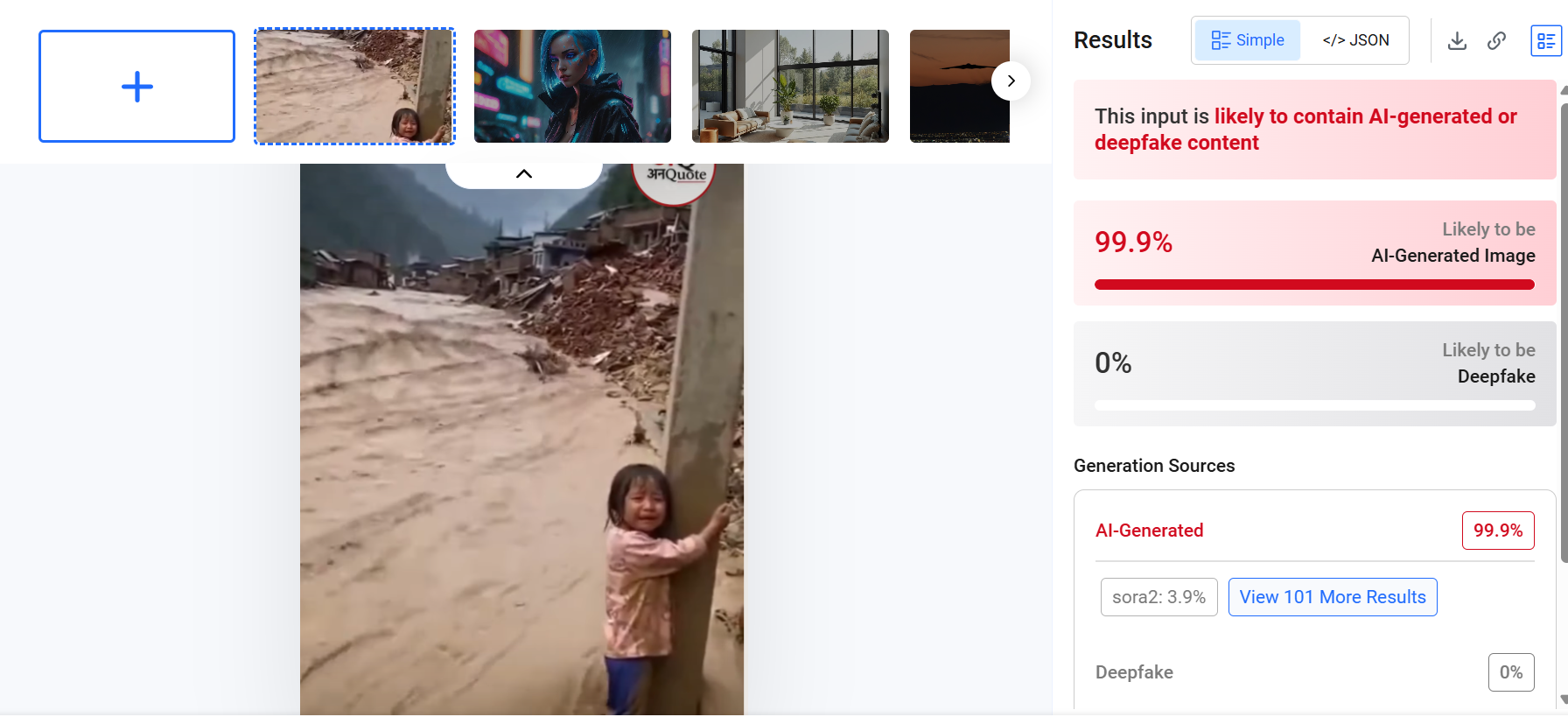
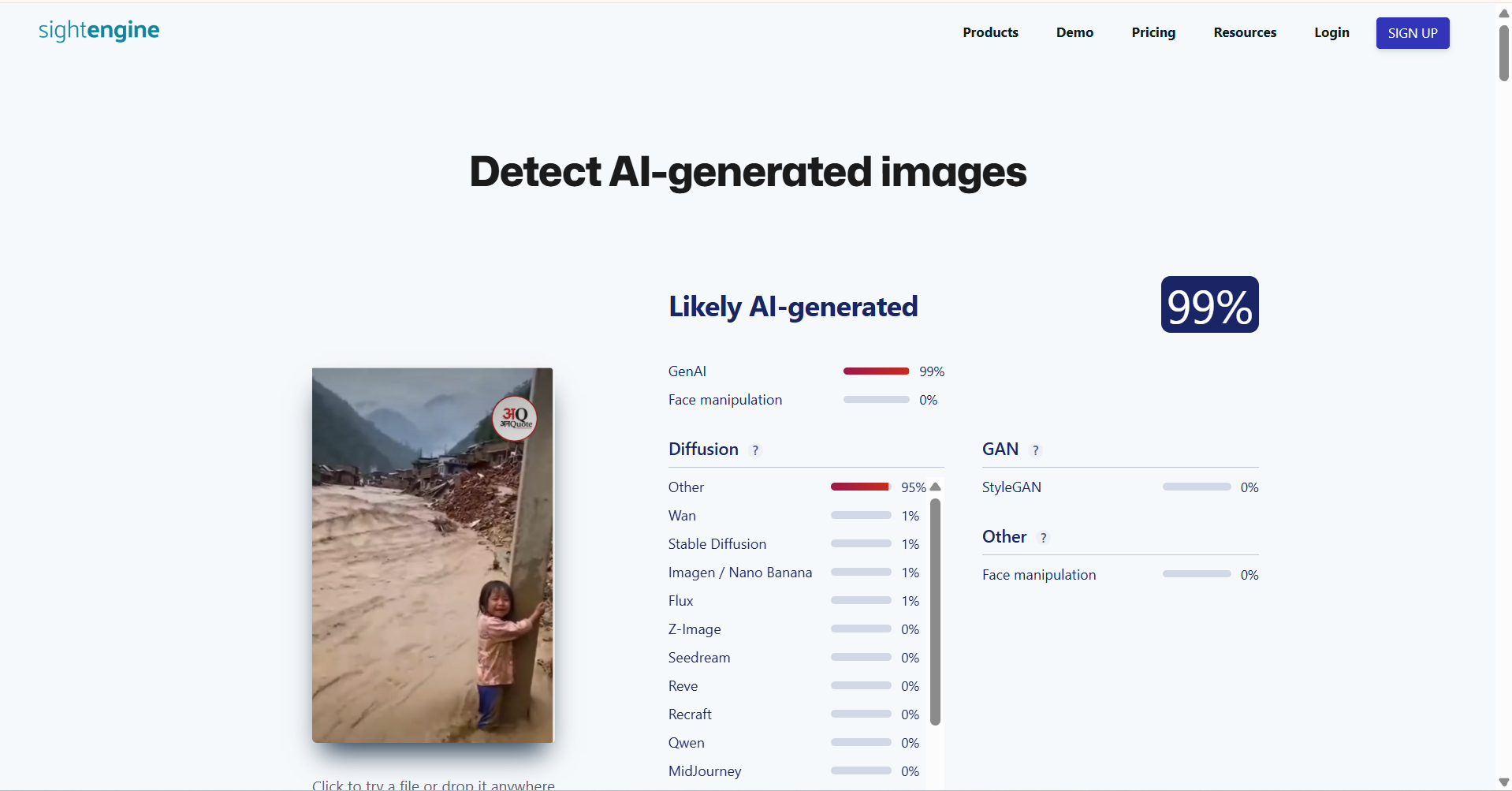
As part of the next step of ourresearch, we scanned the viral video using another AI detection tool, Sightengine. According to the results, the video has a 99 percent probability of being AI-generated.
Conclusion
Our research found that the viral video is AI-generated and is being shared with a misleading claim.
Introduction
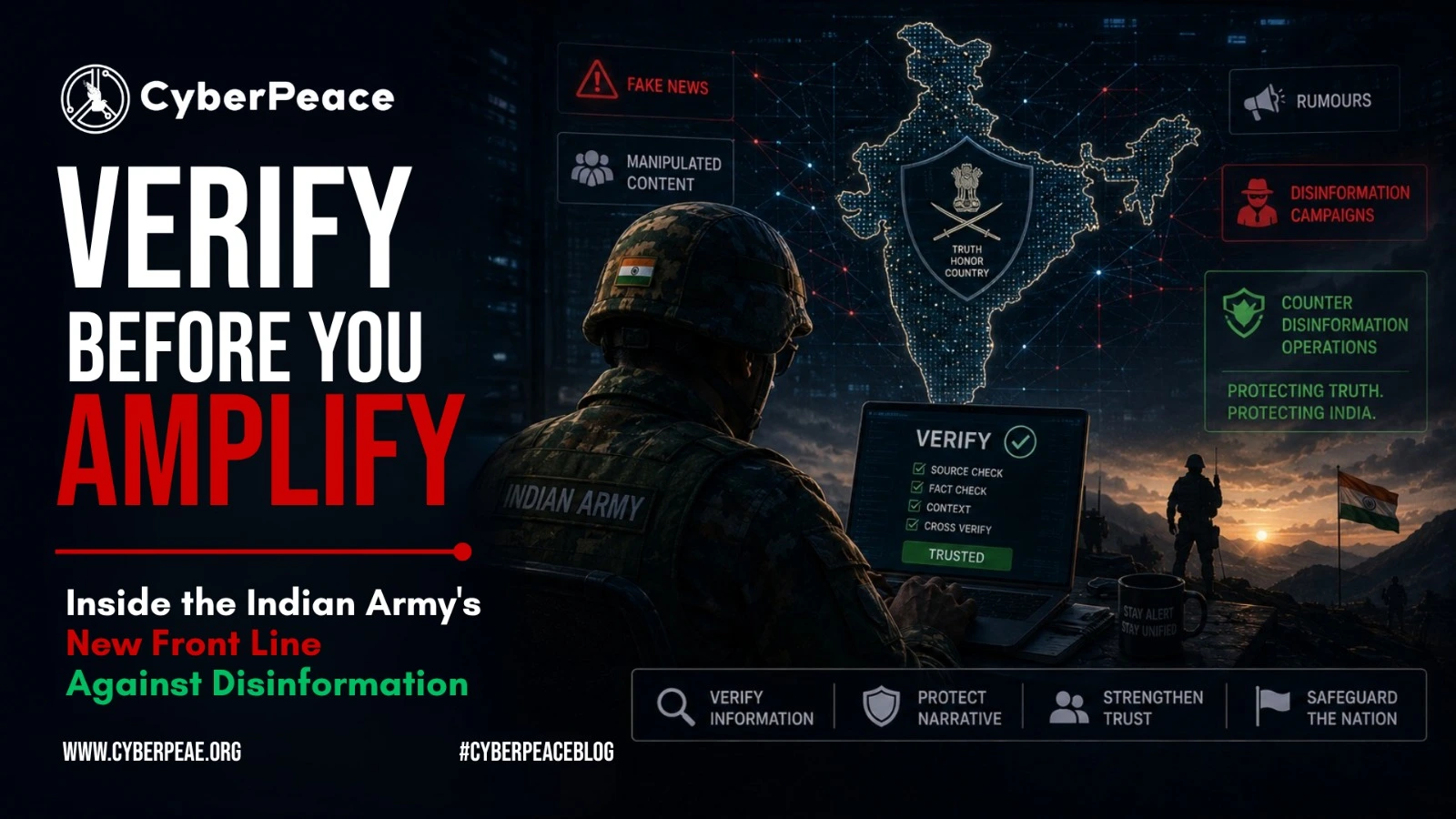
In a significant step, the Indian Army beefed up its information warfare capacity on June 25, 2026, with the operationalisation of @MythbusterXX, its dedicated fact-checking handle designed to counter any form of misinformation, disinformation, malinformation, and deepfakes on the army swiftly. Adopting the motto 'Verify Before You Amplify,' the service seeks to pivot from reactive statements to active cognitive warfare. In a milieu where manipulated narratives can be as decisive in shaping public perception as kinetic force is on the battlefield, truth itself has transformed into a critical national security objective.
This is clear proof that protecting India’s digital battleground will from now on be defined not just by troop deployments but also by its institutional verification capacities, swift attribution mechanisms, and public awareness.
When the Battlefield Went Digital
Today warfare extends to timelines, group chats, and prime-time graphics packages. The distinction between misinformation , disinformation , and malinformation is crucial to operations. After all, they necessitate different types of counters. Generative AI just exponentially increased their velocity, cost, and the creepy believability of synthesized audio, video, and images. Operation Sindoor, India's May 2025 military response to a Pahalgam terror attack, provides a blueprint for just how large it can get.
According to the fact-checking site BOOM, 68% of fact checks in May related to Operation Sindoor, describing the campaign as a misinformation superspreader, and, more directly, India's Chief of Defence Staff General Anil Chauhan lamented at last year’s Shangri-La Dialogue that roughly 15% of his military’s operational time was spent on countering false news. New Delhi matched this response level; the Ministry of Information and Broadcasting had blocked over 1,400 URLs, many bearing false information or communally inciteful narratives from accounts in Pakistan. These challenges won't be vanishing any time soon. Microsoft's July 2025 Digital Defence Report lists India among the top countries targeted for AI-powered state-backed hacking, noting the automation of attacks and generation of fake content used to influence opinion.
CyberPeace's regulatory tracking also indicates steps toward building infrastructure to mitigate this, a Rule 7 complaint system for deepfakes, and efforts to foster local detection capabilities under the IndiaAI mission signal it's now an infrastructural threat.
Why the Army Chose to Speak First
On 1 June 2026, the Indian government’s official fact-checking unit debunked a deepfake of former Army Chief General Dhiraj Seth talking about India’s engagement with the Taliban that emanated from Pakistan-affiliated propaganda sources, appearing within days of a change of military command. Barely days after General Dhiraj Seth was elevated to Chief of Army Staff, the 31st person to hold the post, another fabricated deepfake used spliced authentic footage with AI-cloned audio to falsely allege he had blamed the past army leadership for hiding the bodies of soldiers to protect their image.
Such a dual targeting of India’s army chiefs with deepfakes in such close succession is a testament as to why an authoritative, constantly running fact-check machine isn’t an optional extra but a strategic must-have.
Architecture is as important as architecture itself. India tried a statutory fact-checking model with a government-owned Fact Check Unit under the Information Technology (IT) Rules of 2023 through the Press Information Bureau (PIB). It had to retreat from the edge of the constitutional cliff. In September 2024, when the Bombay High Court struck down key provisions of these rules. It ruled it unconstitutional to empower the state to declare digital content relating to the state itself as fake, false, or misleading. A similar reading of the analysis by CyberPeace found that digital speech should be given the same protections as offline speech, and this should be the benchmark for any counter-misinformation policy.
MythbusterXX carefully avoids the constitutional controversy by acting as an institutional avenue that produces verified information and rebuttals in response to disinformation. There is a profound distinction between answering falsehoods with factual, credible speech versus shutting them down with state power, the very proportionality that civil libertarians have said must govern a democracy's approach to online misinformation.
Platforms as Accelerants, Not Just Conduits
Part of the issue lies upstream, with the algorithms and broadcasters that favor speedy falsehood over careful confirmation. A month’s supply of “false and misleading stories,” the Reuters Institute for the Study of Journalism observed, streamed online within hours of Operation Sindoor's onset: one fact-checker identified approximately seventy false claims by the close of day one. Meanwhile, on the small screen, graphics depicting escalating conflicts were being televised, with broadcasters forced to scramble under 24/7 competition.
Amplified manipulation of the crisis narrative is also a factor; studies show that thousands of accounts have been reposting exactly the same party content for three years, making crisis-induced viral narratives predictable rather than organic phenomena. For the most part, the platforms that manage these narratives and the algorithms that direct content on both sides of the divide are not just innocent delivery systems.
Digital Literacy as the First Line of Defence
Institutional rebuttals only go so far if citizens lack the reflex to pause before sharing, which is where CyberPeace's own work becomes directly relevant. Through a multi-year, Google.org-backed initiative, CyberPeace Foundation aims to reach over 40 million Indian internet users, including 9 million underserved beneficiaries, through a multilingual resource centre offering 650 hours of content, state-level helplines, and quick-response teams staffed by digital forensics and fact-checking experts. Longer-running efforts such as the Digital Shakti campaign and the annual eRaksha competition, run with NCERT, have built a culture of responsible digital citizenship among young and first-time internet users since 2019, while CyberPeace Corps, the foundation's volunteer arm, carries the same message into classrooms and campuses through cyber-awareness sessions run with universities and school networks nationwide. Notably, CyberPeace's own research on children's online safety had already flagged manipulated Army-related videos as a category of digital manipulation designed to cast doubt on official military positions, well before @MythbusterXX existed. The Army's tagline and CyberPeace's mission converge on the same insight: verification is a civic skill, not merely an institutional service.
A Season of Deepfakes
The history book of compromised defence material in the past year alone would be edifying. The International Federation of Journalists recorded one such deepfake widely circulated that relied on AI voice cloning and lip-sync tools to present the Pakistani PM conceding defeat, though the video actually contained his praise for the Pakistani air force’s performance following Operation Sindoor.
Other similar videos featured the Indian Prime Minister, External Affairs Minister, and Home Minister allegedly apologising to Pakistan and a deepfake with a foreign head of state in voice-cloned style applauding India’s armed forces. None needed a state’s resources, but just a laptop, voice cloning available readily, and a citizenry ready to spread rather than confirm the authenticity of any such sensational information before spreading it on to the masses.
Building the Verification Reflex
A resilient information ecosystem needs different actors playing complementary roles:
- Citizens: Do not equate virality with credibility. Verify all national security-related information through official sources, such as @MythbusterXX, before reposting or forwarding it.
- Journalists: Apply rigorous verification standards to live broadcasts, war-room graphics, and breaking reports, just as you would to print journalism, and avoid speculation during fast-moving military operations.
- Researchers and fact-checkers: Use open-source forensic and AI-detection technologies to authenticate questionable material. BOOM researchers, for instance, used Deepfake-o-meter to scrutinize misleading videos of political leaders before fact-checking and publishing them.
- Policymakers: Favored constitutionally proportional and carefully tailored regulations over broad-based takedown mandates. While the 2026 IT Amendment Rules require platforms to shift their obligations from compliance with takedowns towards preventive diligence on synthetic media, implementation should continue to be informed by judicial protections afforded to freedom of speech and due process.
Cyber Resilience Is National Security Now
Legal scholars examining Operation Sindoor have drawn a useful distinction between coordinated information warfare, which is strategic and intentional, and the diffuse, uncoordinated mis/disinformation that dominated timelines during the conflict, cautioning that disproportionate state responses to the latter can compromise citizens' right to know just as much as the falsehoods themselves. Getting that balance right, between speed and due process, between institutional voice and censorship, is the real test facing India's information ecosystem, in defence and far beyond it. CyberPeace has made a related argument in its own work on AI-enabled espionage: institutions such as the National Critical Information Infrastructure Protection Centre and the Defence Cyber Agency are already folding AI-based monitoring into their processes, yet no amount of institutional surveillance substitutes for a citizenry trained to spot manipulation on sight.
@MythbusterXX will not end deepfakes, and no single handle can. But it signals something CyberPeace has argued for years: resilience against synthetic and manipulated media requires authoritative institutional voices, digitally literate citizens, forensically equipped researchers, and proportionate policy, all pulling in the same direction. "Verify before you amplify" is not just an Army campaign. It is the operating discipline a democracy needs to protect its own information age.
Conclusion
@MythbusterXX can't possibly kill deepfakes and disinformation, but this marks a milestone shift towards developing an institutional resilience for India's info battlefield. For, after all, national security in the age of info warfare depends less on tech and more on robust institutions, constitutional balance in policymaking, responsible social platforms, and a citizenry that clicks "forward" only after clicking "verify."
* * * * *
This piece is part of CyberPeace's ongoing work on misinformation, disinformation, and digital citizenship in India. For more on CyberPeace's initiatives in digital literacy and cyber resilience, visit cyberpeace.org.
Key Sources
- Dynamite News, "Indian Army launches fact-check push against deepfake videos and fake military claims" (June 2026)
- ADG PI – Indian Army, official announcement on X (@adgpi)
- Press Information Bureau, Government of India, press release on countering misinformation during Operation Sindoor
- Reuters Institute for the Study of Journalism, "Truth is the casualty: How Indian fact-checkers debunked false claims during the India-Pakistan crisis"
- International Federation of Journalists, "AI, Deepfakes, and the Fog of War" and "Operation Sindoor and the Two Wars" (June 2025)
- Republic World, "Operation Sindoor Haunts Pakistan: Islamabad's Latest AI Deepfake Bid Against Indian Army Chief General Dhiraj Seth Exposed" (July 2026)
- TechPolicy Press, "Sanity Prevails as Bombay High Court Strikes Down India Government's Fact Check Unit", and LiveLaw, coverage of the tie-breaker verdict, on the IT Amendment Rules, 2023 (Fact-Check Unit)
- Dark Reading, "Indian Army Propaganda Spread by 1.4K AI-Powered Social Media Accounts"
- Inforrm, "(Dis)information warfare and the right to know: lessons from Operation Sindoor"
- CyberPeace Foundation, initiatives page and The CyberPeace Initiative (Google.org-backed digital literacy programme)
- CyberPeace Foundation, "AI-Powered Espionage: How India's Cybersecurity Strategy Must Evolve"
- CyberPeace Foundation, "From Deepfakes to Due Diligence – Decoding India's IT Amendment Rules"
- Wikipedia, CyberPeace Foundation (background on Digital Shakti and eRaksha)
Introduction
In April 2026, Anthropic revealed Claude Mythos, an artificial intelligence application capable of finding security flaws in computer networks more effectively than human beings. The corporation claimed to have found hundreds of thousands of substantially serious vulnerabilities in established desktop operating systems and web-based browsers that have not been used for at least 20 years. This news has greatly alarmed those responsible for leading financial organisations, banks, and governments throughout the world. Nevertheless, this news demonstrates a much larger problem: we do not have enough cybersecurity professionals trained to do this kind of work. At the current estimate, there are 4.8 million cyber security professionals short of what is needed globally. There is a need to develop different kinds of workforce training programs to help prepare these professionals as we continue to see the emergence of new AI technologies.
What Is Claude Mythos ?
Anthropic created Claude Mythos as part of its Claude AI system, competing against ChatGPT and Google Gemini. In April 2026, expert testing revealed Mythos excelled at identifying problems in legacy code and suggested exploitation methods. It found a vulnerability that had existed for 27 years. Because of these advanced capabilities, Anthropic restricted access through “Project Glasswing,” giving it only to 12 major tech companies and 40 organizations managing critical software. Canadian Finance Minister François-Philippe Champagne called it an “unknown unknown.” Andrew Bailey of the Bank of England said regulators needed to examine what Mythos could mean for financial attacks. The European Union raised concerns. India’s Finance Minister Nirmala Sitharaman warned at SEBI’s Foundation Day on April 25, 2026, that cybersecurity is the single most pressing challenge facing markets today. She stated a single successful cyberattack on a major exchange or large broker could disrupt markets nationally and shake public confidence for years. Sitharaman emphasized that AI tools make attacks faster, more adaptive, and autonomous, capable of discovering system vulnerabilities and manipulating code.
The Real Problem: Discovery Versus Fixing
Mythos highlights a fundamental mismatch in cybersecurity. Finding a vulnerability does not guarantee it will be fixed. Organizations face challenges patching systems. Many use obsolete technology, and updates can break dependent components. Organizations in developing nations often lack financial resources for repairs or downtime. Critical systems like hospitals, banks, and power grids cannot go offline. Before Mythos, human hackers found vulnerabilities slowly. Now AI tools find weaknesses faster than they can be fixed, creating a dangerous gap. Ciaran Martin, former head of the UK’s National Cyber Security Centre, explained that Mythos is “a really good hacker” against unprotected systems. Organizations following basic security practices—regular updates, strong passwords, network protection, trained staff can likely defend against it. The UK AI Safety Institute concluded Mythos poses the biggest threat to poorly defended systems, noting: “We cannot say for sure whether Mythos Preview would be able to attack well-defended systems.”
The Workforce Challenge
The Mythos announcement exposes the real problem: we lack enough trained cybersecurity workers. There is a global shortage of 4.8 million workers against a current workforce of 5.5 million. In AI security specifically, 34 percent of needed skills are missing. But the harder problem is that AI is changing needed skills. Entry-level jobs monitoring security alerts are being automated. These were traditional career starting points. Young people learned basic skills and moved to advanced roles. Now these positions disappear while new AI security jobs emerge for which nobody has training. Organizations cannot hire fast enough for new AI roles because few people have these skills. This leads to a vicious cycle. With fewer entry-level positions available, there will be fewer young adults entering the job market which results in even fewer workers with this skill set; thus, the shortage of qualified applicants increases; this thereby increases organizations’ vulnerability. Without action taken immediately, this issue will continue to worsen
Way Forward
- Clarify What Skills We Need
Governments and industry must work together to define what cybersecurity workers need in an AI world. Currently, aspiring professionals study networking, software, and vulnerability finding, but AI security training barely exists. Governments should work with universities and companies to clarify needed skills: understanding what AI tools can and cannot do in security, finding and fixing AI system problems.
- Support Workers Who Lose Jobs To Automation
Workers who find themselves losing their jobs due to automation will require government support. All too often without an alternative, these skilled and trained workers will leave their profession forever. The government will need to provide funding for training of displaced employees, support for those changing careers to become cyber security professionals.
- Create Clear Rules For AI Security Tools
When companies create powerful security tools, governments must understand their capabilities and risks. Companies should be required to thoroughly test tools before release, clearly explain what tools can do and their limitations, and explain safety and misuse prevention plans. Governments should monitor actual tool usage, not simply trust voluntary compliance.
- Focus On Basic Security First
Most attacks do not need advanced AI tools. They succeed because organizations have not implemented basic security. Some never update software, train employees, use strong passwords, protect data properly, or test defenses. Governments should require organizations, especially those managing critical systems, to implement these basics.
Conclusion
Claude Mythos matters not because it is a weapon of destruction, but because it forces hard questions: Do we have enough skilled workers? Are our systems well-protected? The answer is no. We face a shortage of 4.8 million cybersecurity workers and lack AI security training. Yet this is also an opportunity. Governments can invest in training, strengthen defenses, and create clear rules for AI security tools. Governments, organizations and educational institutions must collaborate to create viable Cybersecurity career pathways. We can act through either creating panic or creating a trained and prepared workforce to meet today’s challenges. The time is now.
References
- https://www.bbc.com/news/articles/crk1py1jgzko
- https://red.anthropic.com/2026/mythos-preview/
- https://www.anthropic.com/project/glasswing
- https://www.aisi.gov.uk/blog/our-evaluation-of-claude-mythos-previews-cyber-capabilities
- https://www.bsg.ox.ac.uk/people/ciaran-martin
- https://www.isc2.org/Insights/2024/10/Cybersecurity-Workforce-INSIGHTS-October-2024
- https://decrypt.co/364141/anthropic-claude-mythos-serious-threat-overhyped-ai-security-institute
- https://www.businesstoday.in/latest/economy/story/fm-nirmala-sitharaman-wants-sebi-regulated-entities-to-remain-exceptionally-vigilant-heres-why-527437-2026-04-25
- https://www.theweek.in/news/biz-tech/2026/04/25/sebi-38th-anniversary-cybersecurity-concerns.html
