
#FactCheck- Hong Kong Fire Video Falsely Shared as Footage of Recent Israeli Attack on Iran
Executive Summary
A video is being widely shared on social media with the claim that it shows the aftermath of a recent Israeli attack on Iran. The footage shows multiple residential high-rise buildings engulfed in flames, with thick plumes of smoke rising into the sky. Users sharing the video claim that Israel carried out more than 500 airstrikes on Iran. CyberPeace Research Wingresearch found the claim to be misleading. The viral video is not related to any Israeli attack on Iran. It actually shows a massive fire that broke out in a residential complex in Hong Kong in November 2025.
Claim:
An X user shared the viral video and wrote, “Israel has carried out more than 500 surgical strikes on Iran in the last 24 hours. Enjoying it thoroughly. Keep it up.”
Post link, archive link and screenshot can be seen below:
https://x.com/ocjain4/status/2064715707997413618?s=20

Fact Check:
To verify the authenticity of the viral video, we extracted keyframes and conducted a Google Lens search. During the research, we found the same footage on Reuters’ website, where it had been published on November 26, 2025.
Report link and screenshot can be seen below:
https://www.reuters.com/video/watch/idRW511126112025RP1/

According to Reuters, the video shows a massive fire that engulfed multiple high-rise residential buildings in Hong Kong’s northern Tai Po district. The blaze claimed the lives of at least four people. Thick smoke could be seen billowing from the buildings as firefighters and emergency response teams worked to bring the fire under control.
After establishing the source of the video, we conducted a keyword search on Google and found a report published by NDTV on November 27, 2025, which also covered the incident.
Report link and screenshot can be seen below:

Conclusion:
Our research found that the viral video is not related to any Israeli attack on Iran. The footage actually shows a massive fire that broke out in residential buildings in Hong Kong in November 2025. Chinese President Xi Jinping had expressed condolences to the victims, including a firefighter who lost his life while on duty.

Related Blogs

Introduction
A new dawn in the realm of cyber security and criminal justice is on the horizon. Maharashtra's Deputy Chief Minister, Devendra Fadnavis, has recently announced the advent of the country's most sophisticated cyber lab—a bastion against the dark arts of cybercrime. This announcement, made with the gravitas befitting a statesman, was not merely a bureaucratic note; it was a clarion call to a future where technology and law converge to create a safer society.
The cyber lab, poised to be the largest and most modern of its kind, is not just a facility—it is a symbol of the state's commitment to harnessing the power of technology in the ceaseless battle against crime. Fadnavis, who also holds the state's home portfolio, underscored the significance of this initiative during a function where he also emphasised the need for the Maharashtra police to brace themselves for the enforcement of three transformative criminal laws set to take effect from the first of July 2024.
In compliance with the New Laws
These laws—the Bharatiya Nyaya Sanhita, the Bharatiya Nagarik Suraksha Sanhita, and the Bharat Sakshya Act—They are not mere statutory texts; they are the architects of a new edifice of criminal justice, designed with the mortar of modern electronic and technical evidence to buttress the conviction rates and fortify the legal system.
At the inauguration of the Evidence Management Centre (EMC) and the Evidence Dispatch Van (EDV) in Navi Mumbai, Fadnavis spoke with an air of prescience about the radical shifts these new acts will engender. The EMC, a paragon of innovation with its no-human-intervention ethos, is set to revolutionise the procedure of handling evidence, thereby amplifying the likelihood of securing convictions in an era increasingly marred by cyber frauds and hacking escapades.
Recent Trend
The Deputy Chief Minister's vision extends beyond the present, into a realm where blockchain technology becomes an ally of law enforcement, rendering evidence tampering an obsolete concern. Under the new legislative framework, expert collection of evidence is mandated for crimes with sentences exceeding seven years, a move that underscores the gravity with which digital and electronic evidence is now regarded.
The Cyber Lab
The Navi Mumbai police Commissionerate stands as the vanguard of this new legal era, being the first in the country to align with the upcoming laws. As digital transactions burgeon, so too does the evil of cybercrime. Fadnavis assures us that the cyberlaw, a veritable nexus of modernity, will bring together banks, non-banking financial companies (NBFCs), and social media platforms on a unified platform to detect and thwart crimes with alacrity.
This announcement was made in the presence of Maharashtra's Director General of Police, Rashmi Shukla, and Navi Mumbai's police commissioner, Milind Bharambe, both of whom are key figures in the conception of this project. Their attendance shows the collective resolve of Maharashtra's law enforcement to elevate its capabilities in cybercrime prevention.
Conclusion
The establishment of this cyber lab is a vivid thread woven with the intent to protect the digital integrity of its citizens. It is a testament to the state's foresight and its unwavering commitment to staying abreast of the evolving landscape of crime and technology. As we stand on the cusp of this new era, we are reminded that the fight against crime is perennial, but with such pioneering initiatives, victory is not just a possibility—it is an inevitability.
References
- https://indianexpress.com/article/cities/mumbai/navi-mumbai-cyber-lab-criminal-laws-fadnavis-9206801/
- https://www.the420.in/why-maharashtras-new-cyber-lab-could-be-a-game-changer-for-national-security/
- https://apacnewsnetwork.com/2024/03/navi-mumbai-to-host-indias-most-advanced-crime-busting-lab-boosting-conviction-rates-maharashtra-deputy-cm-fadnavis-announces/

Introduction
AI has transformed the way we look at advanced technologies. As the use of AI is evolving, it also raises a concern about AI-based deepfake scams. Where scammers use AI technologies to create deep fake videos, images and audio to deceive people and commit AI-based crimes. Recently a Kerala man fall victim to such a scam. He received a WhatsApp video call, the scammer impersonated the face of the victim’s known friend using AI-based deep fake technology. There is a need for awareness and vigilance to safeguard ourselves from such incidents.
Unveiling the Kerala deep fake video call Scam
The man in Kerala received a WhatsApp video call from a person claiming to be his former colleague in Andhra Pradesh. In actuality, he was the scammer. He asked for help of 40,000 rupees from the Kerala man via google pay. Scammer to gain the trust even mentioned some common friends with the victim. The scammer said that he is at the Dubai airport and urgently need the money for the medical emergency of his sister.
As AI is capable of analysing and processing data such as facial images, videos, and audio creating a realistic deep fake of the same which closely resembles as real one. In the Kerala Deepfake video call scam the scammer made a video call that featured a convincingly similar facial appearance and voice as same to the victim’s colleague which the scammer was impersonating. The Kerala man believing that he was genuinely communicating with his colleague, transferred the money without hesitation. The Kerala man then called his former colleague on the number he had saved earlier in his contact list, and his former colleague said that he has not called him. Kerala man realised that he had been cheated by a scammer, who has used AI-based deep-fake technology to impersonate his former colleague.
Recognising Deepfake Red Flags
Deepfake-based scams are on the rise, as they pose challenges that really make it difficult to distinguish between genuine and fabricated audio, videos and images. Deepfake technology is capable of creating entirely fictional photos and videos from scratch. In fact, audio can be deepfaked too, to create “voice clones” of anyone.
However, there are some red flags which can indicate the authenticity of the content:
- Video quality- Deepfake videos often have compromised or poor video quality, and unusual blur resolution, which might pose a question to its genuineness.
- Looping videos: Deepfake videos often loop or unusually freeze or where the footage repeats itself, indicating that the video content might be fabricated.
- Verify Separately: Whenever you receive requests for such as financial help, verify the situation by directly contacting the person through a separate channel such as a phone call on his primary contact number.
- Be vigilant: Scammers often possess a sense of urgency leading to giving no time to the victim to think upon it and deceiving them by making a quick decision. So be vigilant and cautious when receiving and entertaining such a sudden emergency which demands financial support from you on an urgent basis.
- Report suspicious activity: If you encounter such activities on your social media accounts or through such calls report it to the platform or to the relevant authority.
Conclusion
The advanced nature of AI deepfake technology has introduced challenges in combatting such AI-based cyber crimes. The Kerala man’s case of falling victim to an AI-based deepfake video call and losing Rs 40,000 serves as an alarming need to remain extra vigilant and cautious in the digital age. So in the reported incident where Kerala man received a call from a person appearing as his former colleague but in actuality, he was a scammer and tricking the victim by using AI-based deepfake technology. By being aware of such types of rising scams and following precautionary measures we can protect ourselves from falling victim to such AI-based cyber crimes. And stay protected from such malicious scammers who exploit these technologies for their financial gain. Stay cautious and safe in the ever-evolving digital landscape.

Executive Summary
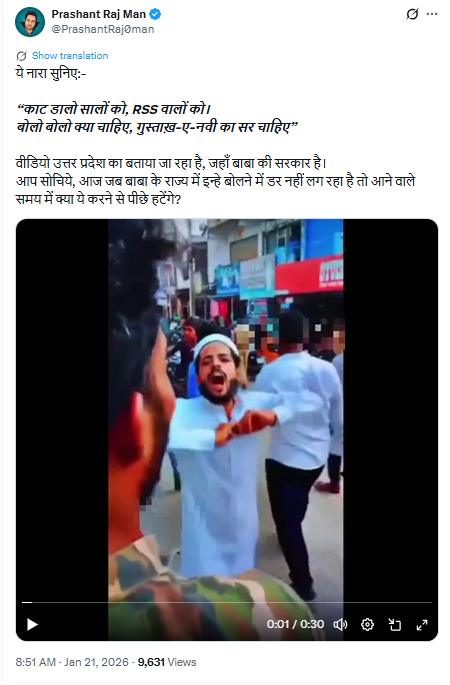
A video showing a group of people wearing Muslim caps raising provocative slogans against the Rashtriya Swayamsevak Sangh (RSS) is being widely shared on social media. Users sharing the clip claim that the incident took place recently in Uttar Pradesh. However, CyberPeace research found the claim to be false. The probe established that the video is neither recent nor related to Uttar Pradesh. In fact, the footage dates back to 2022 and is from Telangana. The slogans heard in the video were raised during a protest against Goshamahal MLA T. Raja Singh, and the clip is now being circulated with a misleading claim.
Claim
On January 21, 2026, a user on social media platform X (formerly Twitter) shared the video claiming it showed people in Uttar Pradesh chanting slogans such as, “Kaat daalo saalon ko, RSS walon ko” and “Gustakh-e-Nabi ka sar chahiye.” The post suggested that such slogans were being raised openly in Uttar Pradesh despite strict law enforcement. Links to the post and its archive are provided below.
Fact Check:
To verify the claim, CyberPeace research conducted a reverse image search using keyframes from the viral video. The same footage was found on a Facebook account where it had been uploaded on August 26, 2022, indicating that the video is not recent.

Further verification led the team to a report published by news portal OpIndia on August 25, 2022, which featured identical visuals from the viral clip. According to the report, the video showed a protest march organised against BJP MLA T. Raja Singh following his alleged controversial remarks about Prophet Muhammad. The report identified one of the individuals in the video as Kaleem Uddin, who was allegedly heard raising the slogan “Kaat daalo saalon ko,” to which the crowd responded “RSS walon ko.” The slogan was linked to incitement against RSS members.

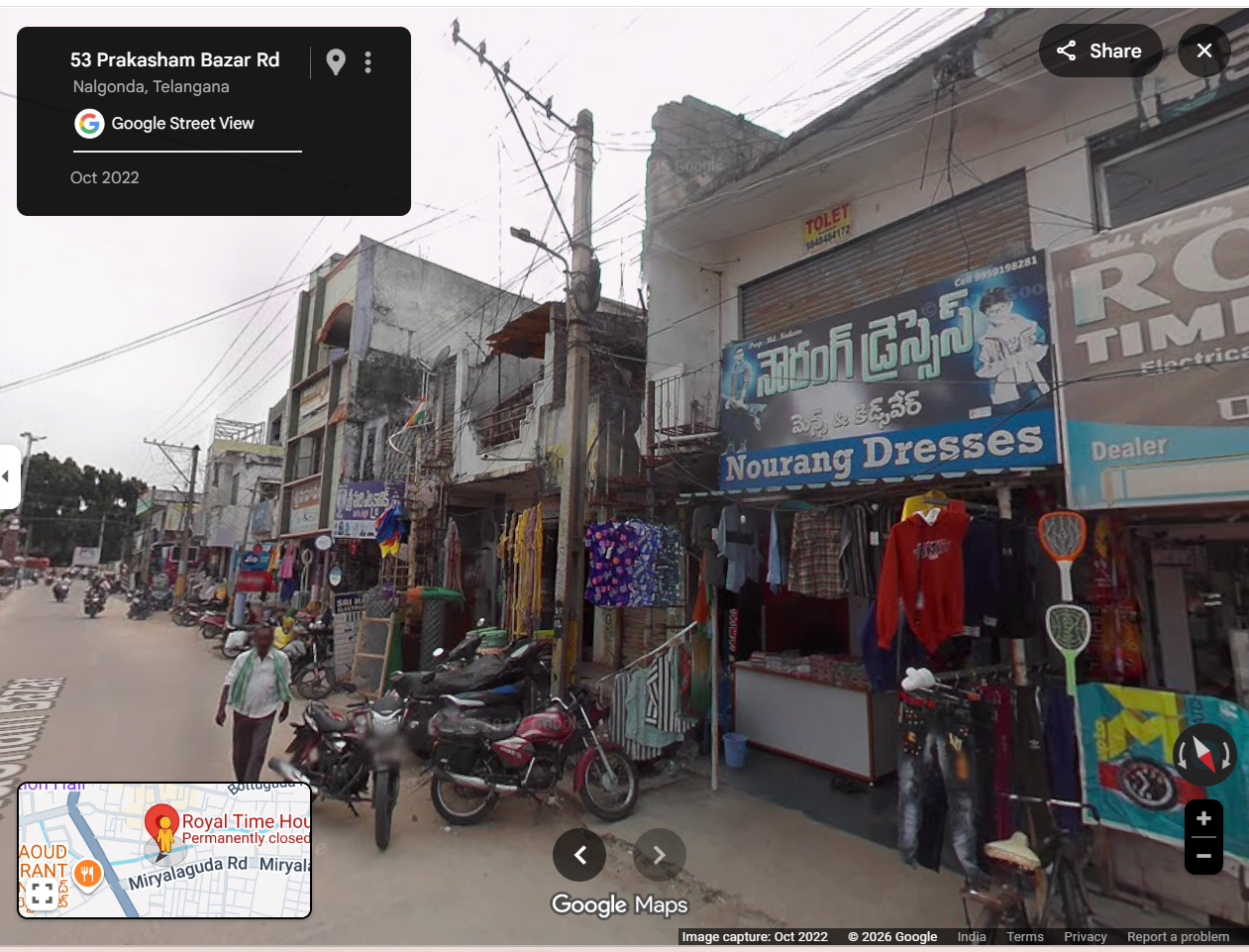
To confirm the location, the video was examined closely. A shop sign reading “Royal Time House” was visible in the footage. Using Google Street View, the same shop was located in Nalgonda, Telangana, conclusively establishing that the video was filmed there and not in Uttar Pradesh.
Conclusion
CyberPeace research confirmed that the viral video is from 2022 and was recorded in Telangana, not Uttar Pradesh. The clip is being falsely circulated with a misleading claim to give it a communal and political angle.
