
Cyber Operations and Critical Infrastructure Resilience
Introduction
Cyberwarfare has evolved into one of the most decisive instruments of statecraft and conflict. The increasing digitisation of critical infrastructure like power grids, water systems, transportation systems, healthcare networks, and energy sources has made these systems new targets in the war of algorithms. Military logic is evolving to paralyse the nation’s critical infrastructure to keep its resources engaged in repairing them and thereby break the nation’s ability to deter and counter attacks, all without firing a single bullet.
From Ransomware to an Invisible Sabotage: The changing nature of warfare
The operational technology (OT) landscape has become the epicentre of cyber operations, all around the world. Once, which was insulated, related to industrial systems that controlled turbines, pipelines, or dams, they now stand connected to the Internet through supervisory control and data acquisition (SCADA) and the Internet of Things. These connections have also become gateways for attackers, besides enhancing the efficiency of the infrastructural lifelines of the nation.
Groups like Volt Typhoon, Sandworm, Laurionite, and Cyberavengers have transformed the art of digital infiltration into a strategic shift. Volt Typhoon, which is linked to China, has used “living-off-the-land” techniques to exploit the legitimate administrative tools to remain invisible while scanning the critical infrastructures in the US. Sandworm, which is aligned with Russia’s GRU (Glavnoye Razvedyvatelnoye Upravlenie) or Main Intelligence Directorate (in English), has demonstrated the power of cyber sabotage in real time, as its attacks on Ukraine’s power grids in 2015 and 2021 had left millions in darkness, coinciding with kinetic missile strikes. Meanwhile, the Iranian-affiliated Cyberavengers group, which has weaponised the AI-assisted malware, such as IOCONTROL, that are capable of hijacking water and energy control systems. Each of these systems used in these operations reflects a shift from direct espionage activities to a state of strategic paralysis.
In comparison to the traditional cybercrime activities that are aimed at stealing data and extortion of money, these campaigns repeatedly target the physical systems, which consist of the machinery that sustains civilian life and military preparedness.
The Military Logic behind Cyber Targeting: A Web of Vulnerabilities
A critical infrastructure is a complex ecosystem that covers power generation, transportation, communication, and manufacturing are all interconnected, which means a single compromised node can cascade into a national paralysis. For instance, a breach in the systems of the dam can flood an entire city, a grid shutdown can halt water supply to hospitals, and even affect air traffic. The 2015 Black Energy Malware attack in Ukraine has proved this possibility when three utilities were hacked, plunging thousands of homes into darkness. The Iranian hackers once again gained access to the Bowman Avenue Dam of New York and controlled its floodgates, which gave a chilling demonstration of the destructive reality of digital manipulation.
The systems remain vulnerable mainly for 3 reasons such as-
- Legacy Architectures: Many of these industrial systems were designed decades ago with no built-in cybersecurity mechanisms.
- Slow Patching and Segmentation Gaps: All updates and segmentation between IT and TO networks often lag, providing open entry points for attackers.
- Converging with IoT: The integration of smart sensors and cloud-based management tools has expanded the attack surface exponentially.
This interconnected fragility has turned our critical infrastructures into both a weapon and a target or a tool for coercion in modern hybrid warfare. Between 2023 and 2024, over 420 cyberattacks were witnessed in several critical global infrastructures, which averaged to 13 attacks per second, according to a news report. These were not just random acts of digital vandalism; they were deliberate and coordinated operational attempts by state-led actors from China, Russia, and Iran.
Developing a new Resilience as the new tool of Deterrence
Cyber deterrence no longer rests on the fear of retaliation, it relies on the need for resilience. Nations that can absorb attacks, maintain continuity, and recover rapidly would be the true superpowers of this digital age. Segmentation, real-time threat detection, and AI-assisted recovery models are vital pillars of this model of resilience. The logic of modern cyberwarfare is clear, which means that the more a nation digitizes, the more it will need to defend itself.
However, as the line between war and peace blurs, safeguarding critical infrastructure is no longer just an IT priority; rather, it is a national security doctrine. In this silent theatre of cyberwarfare, survival will depend not only on firepower, but on firewalls.
References
- https://rmcglobal.com/critical-infrastructure-under-siege-the-top-ot-threats-of-2025/
- https://ccdcoe.org/uploads/2018/10/Geers2009_The-Cyber-Threat-to-National-Critical-Infrastructures.pdf
- https://www.researchgate.net/publication/335752979_Cybersecurity_of_Critical_Infrastructure
- https://arxiv.org/html/2510.04118v1
- https://www.anapaya.net/blog/top-5-critical-infrastructure-cyberattacks

Related Blogs
.webp)
Introduction
The digital ecosystem has undergone a profound transformation due to the rapid growth of artificial intelligence, especially through its generative applications. While this progress has introduced innovative technologies, it has also intensified the risks of deepfakes, misinformation, and identity theft. The Information Technology (Intermediary Guidelines and Digital Media Ethics Code) Amendment Rules, 2026, introduced by the Government of India, mark an important step toward stronger digital governance and greater oversight of online activities. These latest amendments establish new regulatory standards and represent India’s most comprehensive effort so far to address synthetically generated information, including AI created audio, video, and images that closely imitate reality.
Understanding the Core Shift: From Reactive to Proactive Regulation
The 2026 amendment establishes its main characteristic through its shift from a reactive compliance system to a proactive due diligence system. Intermediaries must now operate as active participants who take responsibility for detecting, marking and controlling dangerous material instead of functioning as neutral channels. The rules establish an official definition for stands for Synthetically Generated Information(SGI), which they protect through legal regulations, while they address issues such as impersonation scams, election manipulation and non-consensual deepfake content. The current transition represents a worldwide pattern that shows that governments are starting to make online platforms responsible for the material they display.
Key Provisions of the IT Amendment Rules, 2026
1. Mandatory Labelling of AI-Generated Content
Platforms must ensure that all AI-generated content is clearly labelled or watermarked to distinguish it from authentic media. Users must reveal their uploaded content's synthetic origin while platforms must confirm the information.
2. The 3-Hour Takedown Rule
The most contentious aspect of this regulation establishes new rules that require content removal to be processed within much shorter timeframes.:
- The government and courts grant three-hour time limits for removing unlawful content.
- The two-hour deadline applies to media that includes non-consensual intimate imagery.
The current time frame allows content removal within three hours, which represents a major decrease from the previous content removal time, which lasted between 24 and 36 hours, because online misinformation needs urgent attention.
3. Traceability and Metadata Requirements
The rules require AI-generated content to include both digital fingerprints and metadata, which enables traceability and accountability through their embedded digital fingerprints. The provision serves as an essential tool for law enforcement to investigate cases while it helps identify which parties generated harmful content.
4. Safe Harbour Conditionality
Intermediaries who do not meet the following three conditions risk losing their safe harbour protection through Section 79 of the IT Act:
- The first requirement demands that intermediaries must implement proper labelling.
- The second requirement demands that intermediaries must complete their takedown responsibilities within specific timeframes
- The third requirement demands that intermediaries must complete their due diligence tasks.
This development represents a major transition for digital platforms, which will face increased responsibility for their actions.
5. Strengthened Grievance Redressal
The amendment establishes two new requirements for platforms. The amendment requires platforms to create systems that operate at all times to monitor their compliance with regulations.
Significance: Why These Rules Matter
The 2026 amendments are significant for multiple reasons:
- The rules require labelling and rapid content removal, which helps to stop the viral dissemination of misleading information.
- The framework provides better identity protection, defamation defence and protection against non-consensual imagery.
- The new rules make intermediaries responsible for their own compliance failures.
- The regulation of AI-generated misinformation protects democratic processes during electoral periods and public discussions.
The rules demonstrate India's goal to establish international standards for AI governance and digital responsibility.
Challenges and Concerns
The amendments present key issues that exist despite their positive aspects:
- The process of removing content at high speed creates risks for legitimate expression because safeguards need to be established through careful planning.
- The technical and infrastructural requirements governing compliance create financial burdens for smaller platforms that operate as intermediaries.
The existing challenges demonstrate the necessity for a solution that protects both human rights and security needs.
Conclusion
The IT Amendment Rules, 2026, establish a critical turning point for India's progress toward digital governance. The framework aims to establish a more secure digital environment through its solution of AI-generated content and deepfake detection problems, which create transparency and accountability issues. The rules will achieve their goals through proper implementation, which requires creating quick enforcement methods that protect both legal processes and free speech rights. The ongoing development of AI technology requires regulatory systems to keep changing while including all citizens and upholding democratic principles.
References
- https://vajiramandravi.com/current-affairs/it-rules-amendment-2026
- https://indianexpress.com/article/legal-news/indias-new-3-hour-deepfake-removal-rule-experts-urge-strict-compliance-10528122
- https://timesofindia.indiatimes.com/technology/tech-news/governments-new-it-rules-make-ai-content-labelling-mandatory-give-google-youtube-instagram-and-other-platforms-3-hours-for-takedowns/articleshow/128157496.cms
- https://www.drishtiias.com/daily-updates/daily-news-analysis/information-technology-amendment-rules-2026
- https://visionias.in/current-affairs/news-today/2026-02-11/science-and-technology/government-notified-the-information-technology-intermediary-guidelines-and-digital-media-ethics-code-amendment-rules-2026
.webp)
Executive Summary
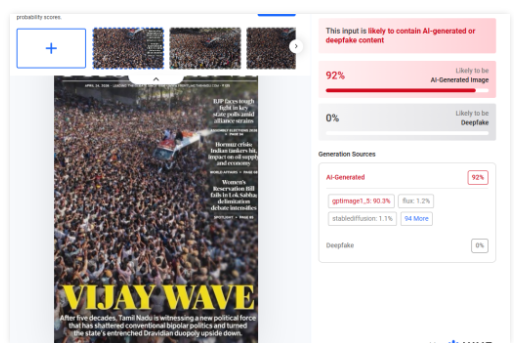
As Tamil Nadu voted in the 2026 Assembly elections, with 84.69 percent polling recorded on April 23, a purported cover page of Frontline magazine began circulating on social media. The viral image featured a massive rally crowd of South Indian actor and Tamilaga Vetri Kazhagam (TVK) chief Joseph Vijay, claiming that a “Vijay Wave” had emerged in the state. The alleged cover also stated that Tamil Nadu was witnessing a new political force after five decades, one that had challenged the dominance of Dravida Munnetra Kazhagam (DMK) and All India Anna Dravida Munnetra Kazhagam (AIADMK).
However, research by the CyberPeace Research Wing found that the viral cover page is fake. Frontline magazine has not published any such edition, and its latest issue is related to health.
Claim:
X user “Dr. Ravishankar Sadasivam” shared the viral image on April 22, 2026, claiming the “wave is real” and suggesting that Vijay could emerge as a top contender in a three-cornered contest. The post further claimed that after MGR, Vijay was drawing the largest spontaneous crowds in Tamil Nadu politics.

Fact Check:
To verify the claim, relevant keyword searches were conducted online. During the research, a clarification post from Frontline magazine’s official X account, shared on April 22, 2026, was found. In the post, the publication clearly stated that the viral cover page was fake and had not been published by the magazine. It further said that the fabricated cover was being circulated online by supporters of TVK.

A review of the official Frontline website also found no edition carrying such a cover page.

Additionally, the viral image was analyzed using the AI detection tool Hive Moderation, which rated it as 92 percent likely to be AI-generated.
Conclusion:
The claim that Frontline magazine published a cover story on a “Vijay Wave” during the Tamil Nadu Assembly elections is false. The viral cover page is fake and is being circulated online to mislead people.

Executive Summary:
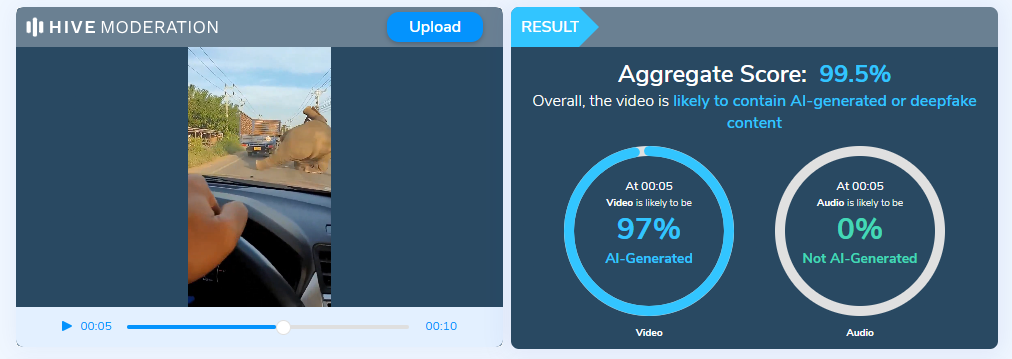
A video circulating on social media claims to show a live elephant falling from a moving truck due to improper transportation, followed by the animal quickly standing up and reacting on a public road. The content may raise concerns related to animal cruelty, public safety, and improper transport practices. A detailed examination using AI content detection tools, visual anomaly analysis indicates that the video is not authentic and is likely AI generated or digitally manipulated.
Claim:
The viral video (archive link) shows a disturbing scene where a large elephant is allegedly being transported in an open blue truck with barriers for support. As the truck moves along the road, the elephant shifts its weight and the weak side barrier breaks. This causes the elephant to fall onto the road, where it lands heavily on its side. Shortly after, the animal is seen getting back on its feet and reacting in distress, facing the vehicle that is recording the incident. The footage may raise serious concerns about safety, as elephants are normally transported in reinforced containers, and such an incident on a public road could endanger both the animal and people nearby.

Fact Check:
After receiving the video, we closely examined the visuals and noticed some inconsistencies that raised doubts about its authenticity. In particular, the elephant is seen recovering and standing up unnaturally quickly after a severe fall, which does not align with realistic animal behavior or physical response to such impact.
To further verify our observations, the video was analyzed using the Hive Moderation AI Detection tool, which indicated that the content is likely AI generated or digitally manipulated.
Additionally, no credible news reports or official sources were found to corroborate the incident, reinforcing the conclusion that the video is misleading.
Conclusion:
The claim that the video shows a real elephant transport accident is false and misleading. Based on AI detection results, observable visual anomalies, and the absence of credible reporting, the video is highly likely to be AI generated or digitally manipulated. Viewers are advised to exercise caution and verify such sensational content through trusted and authoritative sources before sharing.
- Claim: The viral video shows an elephant allegedly being transported, where a barrier breaks as it moves, causing the animal to fall onto the road before quickly getting back on its feet.
- Claimed On: X (Formally Twitter)
- Fact Check: False and Misleading
