
#FactCheck- AI-Generated Video of Alleged Iranian Attack on US Helicopter Goes Viral with False Claims
Executive Summary
A video is being widely shared on social media showing armed personnel attacking a helicopter. The video is being circulated with the claim that Iranian soldiers shot down a US military helicopter near the Strait of Hormuz amid rising tensions between the United States and Iran. CyberPeace Research Wing research found the claim to be false. The viral video is AI-generated and is being shared with misleading context.
Claim:
An X (formerly Twitter) user shared the video on June 10, 2026, with the caption: “This is great cinema. Breaking News: Iran used a $150 weapon to bring down a $1 billion US military aircraft. For the first time, America has met its real enemy.”
Post link and archive link can be seen below:
https://x.com/TheIncNews/status/2064758088012607544?s=20
https://archive.ph/LUDUz

Fact-Check
To verify the claim, we conducted a keyword search on Google. However, no credible media reports were found supporting this claim.

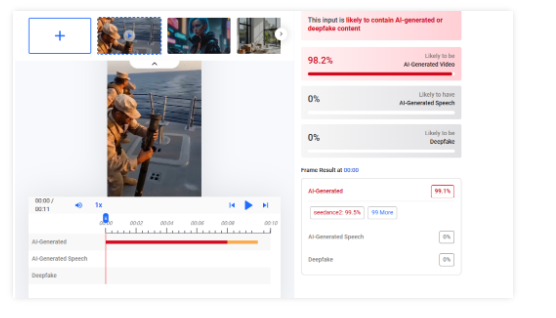
On closely examining the video, we suspected it to be AI-generated. We then analyzed it using the AI detection tool HIVE MODERATION. The results indicated that the video is 98% likely to be AI-generated.
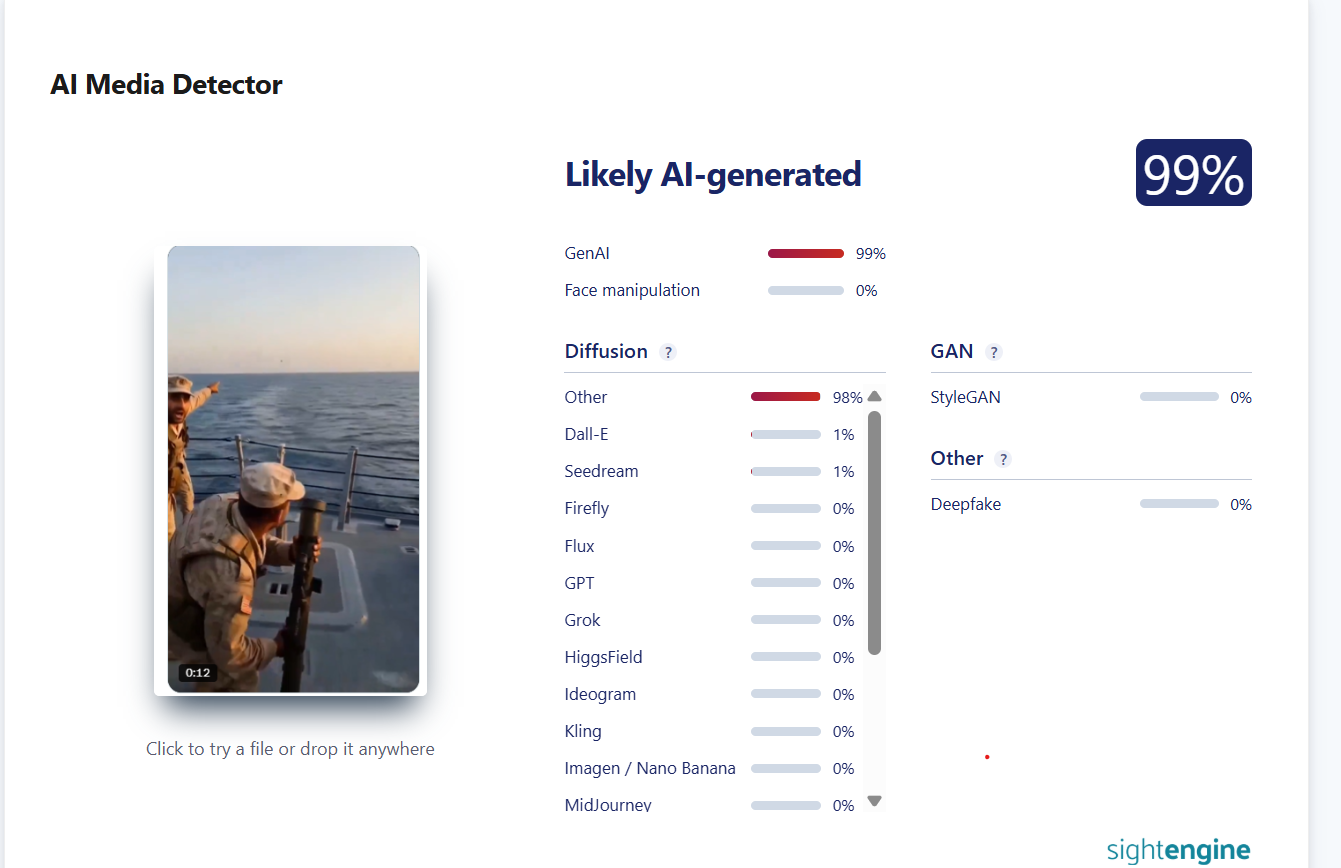
In the next step, we further analyzed the video using another AI detection tool, SIGHTENGINE. The results showed a 99% probability of the video being AI-generated.
Conclusion:
Our research confirms that the viral video is AI-generated and does not depict any real-world incident. The content is being circulated with a misleading and false narrative, falsely linking it to ongoing geopolitical tensions, despite there being no credible evidence or verified reports supporting such a claim.

Related Blogs

Introduction
In India, the population of girls and adolescents is 253 million, as per the UNICEF report, and the sex ratio at birth is 929 per 1000 male children as of 2023. Cyberspace has massively influenced the daily aspects of our lives, and hence the safety aspect of cyberspace cannot be ignored any more. The social media platforms play a massive role in information dissemination and sharing. The data trail created by the use of such platforms is often used by cyber criminals to target innocent girls and children.
On Ground Stats
Of the six million crimes police in India recorded between 1 January and 31 December last year, 428,278 cases involved crimes against women. It’s a rise of 26.35% over six years – from 338,954 cases in 2016. A majority of the cases in 2021, the report said, were of kidnappings and abduction, rapes, domestic violence, dowry deaths and assaults. Also, 107 women were attacked with acid, 1,580 women were trafficked, 15 girls were sold, and 2,668 were victims of cybercrimes. With more than 56,000 cases, the northern state of Uttar Pradesh, which is India’s most populous with 240 million people, once again topped the list. Rajasthan followed it with 40,738 cases and Maharashtra with 39,526 cases. This shows the root of the problem and how deep this menace goes in our society. With various campaigns and initiatives by Government and the CSO, awareness is on the rise, but still, we need a robust prevention mechanism to address this issue critically.
Influence of Social Media Platforms
Social media platforms such as Facebook, Instagram and Twitter were created to bring people closer by eliminating geographical boundaries, which is strengthened by the massive internet connectivity network across the globe. Throughout 2022, on average, there are about 470.1 million active social media users in India on a monthly basis, with an annual growth rate of 4.2 % in 2021-22. This represents about 33.4 % of the total population. These social media users, on average, spend about 2.6 hours on social media, and each, on average, has accounts on 8.6 platforms.
The bad actors have also upskilled themselves and are now using these social platforms to commit cybercrimes. Some of these crimes against girls and women include – Impersonation, Identity theft, Cyberstalking, Cyber-Enabled human trafficking and many more. These crimes are on the rise post-pandemic, and instances of people using fake IDs to lure young girls into their traps are being reported daily. One such instance is when Imran Mansoori created an Instagram account in the name of Rahul Gujjar, username: rahul_gujjar_9010. Using social engineering and scoping out the vulnerabilities, he trapped a minor girl in a relationship & took her to a hotel in Moradabad. The hotel manager raised the suspicion of seeing a different ID & called the Police, Imran was then arrested. But many such crimes go unreported, and it is essential for all stakeholders to create a safeguard regarding girls’ and women’s safety.
Legal Remedies at our disposal
The Indian Legal system has been evolving with time towards the online safety of girls and women. The National Commission for Protection of Child Rights (NCPCR) and the National Commission for Women (NCW) have worked tirelessly to safeguard girls and women to create a wholesome, safe, secure environment. The Information Technology Act governs cyberspace and its associated rights and duties. The following provisions of the IT Act are focused towards safeguarding the rights –
- Violation of privacy – Section 66E
- Obscene material – Section 67
- Pornography & sexually explicit act – Section 67A
- Child pornography – Section 67B
- Intermediaries due diligence rules – Section 79
Apart from these provisions, acts like POCSO, IPC, and CrPC, draft the Digital Personal Data Protection Bill, Intermediary Guidelines on Social Media and Online Gaming and telecommunications bill.
Conclusion
The likelihood of becoming a victim of cybercrime is always growing due to increased traffic in the virtual world, which is especially true for women who are frequently viewed as easy targets. The types of cyber crimes that target women have grown, and the trend has not stopped in India. Cyber flaming, cyber eve-teasing, cyber flirting, and internet cheating are some new-generation crimes that are worth mentioning here. In India, women tend to be reluctant to speak up about issues out of concern that doing so might damage their reputations permanently. Without being fully aware of the dangers of the internet, women grow more susceptible the more time they spend online. Women should be more alert to protect themselves from targeted online attacks.
.webp)
Introduction
The digital ecosystem has undergone a profound transformation due to the rapid growth of artificial intelligence, especially through its generative applications. While this progress has introduced innovative technologies, it has also intensified the risks of deepfakes, misinformation, and identity theft. The Information Technology (Intermediary Guidelines and Digital Media Ethics Code) Amendment Rules, 2026, introduced by the Government of India, mark an important step toward stronger digital governance and greater oversight of online activities. These latest amendments establish new regulatory standards and represent India’s most comprehensive effort so far to address synthetically generated information, including AI created audio, video, and images that closely imitate reality.
Understanding the Core Shift: From Reactive to Proactive Regulation
The 2026 amendment establishes its main characteristic through its shift from a reactive compliance system to a proactive due diligence system. Intermediaries must now operate as active participants who take responsibility for detecting, marking and controlling dangerous material instead of functioning as neutral channels. The rules establish an official definition for stands for Synthetically Generated Information(SGI), which they protect through legal regulations, while they address issues such as impersonation scams, election manipulation and non-consensual deepfake content. The current transition represents a worldwide pattern that shows that governments are starting to make online platforms responsible for the material they display.
Key Provisions of the IT Amendment Rules, 2026
1. Mandatory Labelling of AI-Generated Content
Platforms must ensure that all AI-generated content is clearly labelled or watermarked to distinguish it from authentic media. Users must reveal their uploaded content's synthetic origin while platforms must confirm the information.
2. The 3-Hour Takedown Rule
The most contentious aspect of this regulation establishes new rules that require content removal to be processed within much shorter timeframes.:
- The government and courts grant three-hour time limits for removing unlawful content.
- The two-hour deadline applies to media that includes non-consensual intimate imagery.
The current time frame allows content removal within three hours, which represents a major decrease from the previous content removal time, which lasted between 24 and 36 hours, because online misinformation needs urgent attention.
3. Traceability and Metadata Requirements
The rules require AI-generated content to include both digital fingerprints and metadata, which enables traceability and accountability through their embedded digital fingerprints. The provision serves as an essential tool for law enforcement to investigate cases while it helps identify which parties generated harmful content.
4. Safe Harbour Conditionality
Intermediaries who do not meet the following three conditions risk losing their safe harbour protection through Section 79 of the IT Act:
- The first requirement demands that intermediaries must implement proper labelling.
- The second requirement demands that intermediaries must complete their takedown responsibilities within specific timeframes
- The third requirement demands that intermediaries must complete their due diligence tasks.
This development represents a major transition for digital platforms, which will face increased responsibility for their actions.
5. Strengthened Grievance Redressal
The amendment establishes two new requirements for platforms. The amendment requires platforms to create systems that operate at all times to monitor their compliance with regulations.
Significance: Why These Rules Matter
The 2026 amendments are significant for multiple reasons:
- The rules require labelling and rapid content removal, which helps to stop the viral dissemination of misleading information.
- The framework provides better identity protection, defamation defence and protection against non-consensual imagery.
- The new rules make intermediaries responsible for their own compliance failures.
- The regulation of AI-generated misinformation protects democratic processes during electoral periods and public discussions.
The rules demonstrate India's goal to establish international standards for AI governance and digital responsibility.
Challenges and Concerns
The amendments present key issues that exist despite their positive aspects:
- The process of removing content at high speed creates risks for legitimate expression because safeguards need to be established through careful planning.
- The technical and infrastructural requirements governing compliance create financial burdens for smaller platforms that operate as intermediaries.
The existing challenges demonstrate the necessity for a solution that protects both human rights and security needs.
Conclusion
The IT Amendment Rules, 2026, establish a critical turning point for India's progress toward digital governance. The framework aims to establish a more secure digital environment through its solution of AI-generated content and deepfake detection problems, which create transparency and accountability issues. The rules will achieve their goals through proper implementation, which requires creating quick enforcement methods that protect both legal processes and free speech rights. The ongoing development of AI technology requires regulatory systems to keep changing while including all citizens and upholding democratic principles.
References
- https://vajiramandravi.com/current-affairs/it-rules-amendment-2026
- https://indianexpress.com/article/legal-news/indias-new-3-hour-deepfake-removal-rule-experts-urge-strict-compliance-10528122
- https://timesofindia.indiatimes.com/technology/tech-news/governments-new-it-rules-make-ai-content-labelling-mandatory-give-google-youtube-instagram-and-other-platforms-3-hours-for-takedowns/articleshow/128157496.cms
- https://www.drishtiias.com/daily-updates/daily-news-analysis/information-technology-amendment-rules-2026
- https://visionias.in/current-affairs/news-today/2026-02-11/science-and-technology/government-notified-the-information-technology-intermediary-guidelines-and-digital-media-ethics-code-amendment-rules-2026
.webp)
Introduction
Against the dynamic backdrop of Mumbai, where the intersection of age-old markets and cutting-edge innovation is a daily reality, an initiative of paramount importance has begun to take shape within the hallowed walls of the Reserve Bank of India (RBI). This is not just a tweak, a nudge in policy, or a subtle refinement of protocols. What we're observing is nothing short of a paradigmatic shift, a recalibration of systemic magnitude, that aims to recalibrate the way India's financial monoliths oversee, manage, and secure their informational bedrock – their treasured IT systems.
On the 7th of November, 2023, the Reserve Bank of India, that bastion of monetary oversight and national fiscal stability, unfurled a new doctrine – the 'Master Direction on Information Technology Governance, Risk, Controls, and Assurance Practices.' A document comprehensive in its reach, it presents not merely an update but a consolidation of all previously issued guidelines, instructions, and circulars relevant to IT governance, plaited into a seamless narrative that extols virtues of structured control and unimpeachable assurance practices. Moreover, it grasps the future potential of Business Continuity and Disaster Recovery Management, testaments to RBI's forward-thinking vision.
This novel edict has been crafted with a target audience that spans the varied gamut of financial entities – from Scheduled Commercial Banks to Non-Banking Financial Companies, from Credit Information Companies to All India Financial Institutions. These are the juggernauts that keep the economic wheels of the nation churning, and RBI's precision-guided document is an unambiguous acknowledgment of the vital role IT holds in maintaining the heartbeat of these financial bodies. Here lies a riveting declaration that robust governance structures aren't merely preferred but essential to manage the landscape of IT-related risks that balloon in an era of ever-proliferating digital complexity.
Directive Structure
The directive's structure is a combination of informed precision and intuitive foresight. Its seven chapters are not simply a grouping of topics; they are the seven pillars upon which the temple of IT governance is to be erected. The introductory chapter does more than set the stage – it defines the very reality, the scope, and the applicability of the directive, binding the reader in an inextricable covenant of engagement and anticipation. It's followed by a deep dive into the cradle of IT governance in the second chapter, drawing back the curtain to reveal the nuanced roles and defiant responsibilities bestowed upon the Board of Directors, the IT Strategy Committee, the clairvoyant Senior Management, the IT Steering Committee, and the pivotal Head of IT Function.
As we move along to the third chapter, we encounter the nuts and bolts of IT Infrastructure & Services Management. This is not just a checklist; it is an orchestration of the management of IT services, third-party liaisons, the calculus of capacity management, and the nuances of project management. Here terms like change and patch management, cryptographic controls, and physical and environmental safeguards leap from the page – alive with earnest practicality, demanding not just attention but action.
Transparency deepens as we glide into the fourth chapter with its robust exploration of IT and Information Security Risk Management. Here, the demand for periodic dissection of IT-related perils is made clear, along with the edifice of an IT and Information Security Risk Management Framework, buttressed by the imperatives of Vulnerability Assessment and Penetration Testing.
The fifth chapter presents a tableau of circumspection and preparedness, as it waxes eloquent on the necessity and architecture of a well-honed Business Continuity Plan and a disaster-ready DR Policy. It is a paean to the anticipatory stance financial institutions must employ in a world fraught with uncertainty.
Continuing the narrative, the sixth chapter places the spotlight on Information Systems Audit, delineating the precise role played by the Audit Committee of the Board in ushering in accountability through an exhaustive IS Audit of the institution's virtual expanse.
And as we perch on the final chapter, we're privy to the 'repeal and other provisions' of the directive, underscoring the interplay of other applicable laws and the interpretation a reader may yield from the directive's breadth.
Conclusion
To proclaim that this directive is a mere step forward in the RBI's exhaustive and assiduous efforts to propel India's financial institutions onto the digital frontier would be a grave understatement. What we are witnessing is the inception of a more adept, more secure, and more resilient financial sector. This directive is nothing less than a beacon, shepherding in an epoch of IT governance marked by impervious governance structures, proactive risk management, and an unyielding commitment to the pursuit of excellence and continuous improvement. This is no ephemeral shift - this is, indisputably, a revolutionary stride into a future where confidence and competence stand as the watchwords in navigating the digital terra incognita.
