
#FactCheck: Old Kolkata Student Protest Video Falsely Linked to CJP Protests in Delhi
Executive Summary
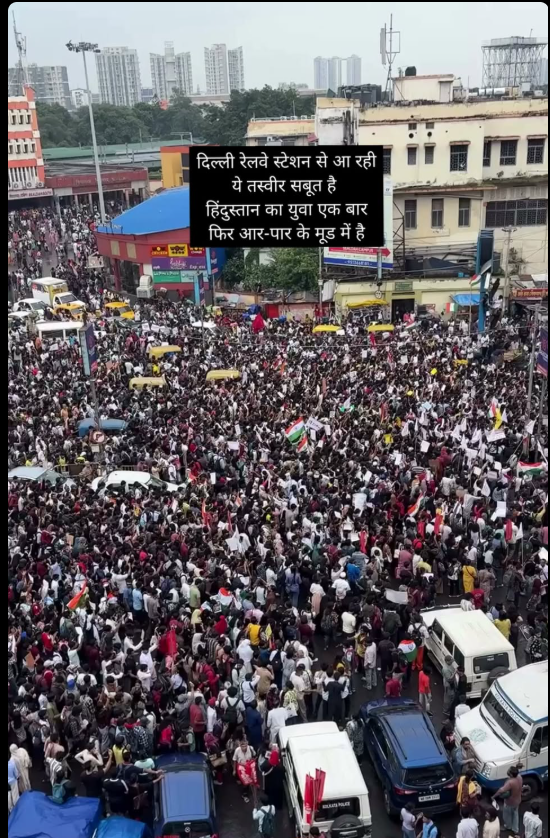
A video is going viral on social media in the name of the protests organised by the ‘Cockroach Janata Party’ (CJP) in Delhi on October 10 and 11. The video is being shared as footage from Delhi Railway Station, with the claim that the protests led to a massive traffic jam outside the station. CyberPeace Research conducted a detailed analysis of the viral video and found the claim to be misleading. The video is not from Delhi but from Sealdah Railway Station in Kolkata, where students held a protest in July 2026. The old video from that time is now being circulated in connection with the protests in Delhi, falsely linking the two events.
Claim
On October 10, 2026, the Facebook page ‘Atrangi Khabar’ shared a video with the following caption:“Massive Protest and Traffic Jam: Huge Crowd Gathers Outside Delhi Railway Station, Several Passengers Miss Their Trains! A massive traffic jam occurred outside Delhi Railway Station on Saturday due to a large-scale protest.
As a result, railway passengers faced severe difficulties reaching the station, and several passengers even missed their trains because of the traffic congestion. The video clearly shows a huge crowd filling the roads and an atmosphere of chaos all around.”
https://www.facebook.com/reel/2176543963241315/?s=single_unit
Fact Check
To verify the authenticity of the viral video, we first extracted several keyframes and searched them using Google Lens. We found that the video had been uploaded on multiple platforms on earlier dates. An Instagram account named ‘Faruk Biswas’ (faruk.biswas.581730) had shared the video on July 24, 2026, identifying it as footage of a student protest in Kolkata.
https://www.instagram.com/reels/DbLd3N3of7a/

During our search, we also found the same video on a Facebook page named ‘KaimurLive’. The caption accompanying the video read, “Student protests continue in Kolkata and several other parts of the country. Today, a massive gathering of students was seen on the streets of Kolkata. #NEETPaperLeak”
http://facebook.com/reel/2024661971511084

Conclusion
Our research found the viral post to be misleading. An old video from Sealdah Railway Station in Kolkata is being falsely shared as footage from Delhi Railway Station. The original video dates back to July 2026 and has no connection to the protests held in Delhi on October 10 and 11, 2026.

Related Blogs

In the vast, interconnected cosmos of the internet, where knowledge and connectivity are celebrated as the twin suns of enlightenment, there lurk shadows of a more sinister nature. Here, in these darker corners, the innocence of childhood is not only exploited but also scarred, indelibly and forever. The production, distribution, and consumption of Child Sexual Abuse Material (CSAM) have surged to alarming levels globally, casting a long, ominous shadow over the digital landscape.
In response to this pressing issue, the National Human Rights Commission (NHRC) has unfurled a comprehensive four-part advisory, a beacon of hope aimed at combating CSAM and safeguarding the rights of children in this digital age. This advisory dated 27/10/23 is not merely a reaction to the rising tide of CSAM, but a testament to the imperative need for constant vigilance in the realm of cyber peace.
The statistics paint a sobering picture. In 2021, more than 1,500 instances of publishing, storing, and transmitting CSAM were reported, shedding a harsh light on the scale of the problem. Even more alarming is the upward trend in cases reported in subsequent years. By 2023, a staggering 450,207 cases of CSAM had already been reported, marking a significant increase from the 204,056 and 163,633 cases reported in 2022 and 2021, respectively.
The Key Aspects of Advisory
The NHRC's advisory commences with a fundamental recommendation - a redefinition of terminology. It suggests replacing the term 'Child Pornography' with 'Child Sexual Abuse Material' (CSAM). This shift in language is not merely semantic; it underscores the gravity of the issue, emphasizing that this is not about pornography but child abuse.
Moreover, the advisory calls for the definition of 'sexually explicit' under Section 67B of the IT Act, 2000. This step is crucial for ensuring the prompt identification and removal of online CSAM. By giving a clear definition, law enforcement can act swiftly in removing such content from the internet.
The digital world knows no borders, and CSAM can easily cross jurisdictional lines. NHRC recognizes this challenge and proposes that laws be harmonized across jurisdictions through bilateral agreements. Moreover, it recommends pushing for the adoption of a UN draft Convention on 'Countering the Use of Information and Communications Technologies for Criminal Purposes' at the General Assembly.
One of the critical aspects of the advisory is the strengthening of law enforcement. NHRC advocates for the creation of Specialized State Police Units in every state and union territory to handle CSAM-related cases. The central government is expected to provide support, including grants, to set up and equip these units.
The NHRC further recommends establishing a Specialized Central Police Unit under the government of India's jurisdiction. This unit will focus on identifying and apprehending CSAM offenders and maintaining a repository of such content. Its role is not limited to law enforcement; it is expected to cooperate with investigative agencies, analyze patterns, and initiate the process for content takedown. This coordinated approach is designed to combat the problem effectively, both on the dark web and open web.
The role of internet intermediaries and social media platforms in controlling CSAM is undeniable. The NHRC advisory emphasizes that intermediaries must deploy technology, such as content moderation algorithms, to proactively detect and remove CSAM from their platforms. This places the onus on the platforms to be proactive in policing their content and ensuring the safety of their users.
New Developments
Platforms using end-to-end encryption services may be required to create additional protocols for monitoring the circulation of CSAM. Failure to do so may invite the withdrawal of the 'safe harbor' clause under Section 79 of the IT Act, 2000. This measure ensures that platforms using encryption technology are not inadvertently providing safe havens for those engaged in illegal activities.
NHRC's advisory extends beyond legal and law enforcement measures; it emphasizes the importance of awareness and sensitization at various levels. Schools, colleges, and institutions are called upon to educate students, parents, and teachers about the modus operandi of online child sexual abusers, the vulnerabilities of children on the internet, and the early signs of online child abuse.
To further enhance awareness, a cyber curriculum is proposed to be integrated into the education system. This curriculum will not only boost digital literacy but also educate students about relevant child care legislation, policies, and the legal consequences of violating them.
NHRC recognizes that survivors of CSAM need more than legal measures and prevention strategies. Survivors are recommended to receive support services and opportunities for rehabilitation through various means. Partnerships with civil society and other stakeholders play a vital role in this aspect. Moreover, psycho-social care centers are proposed to be established in every district to facilitate need-based support services and organization of stigma eradication programs.
NHRC's advisory is a resounding call to action, acknowledging the critical importance of protecting children from the perils of CSAM. By addressing legal gaps, strengthening law enforcement, regulating online platforms, and promoting awareness and support, the NHRC aims to create a safer digital environment for children.
Conclusion
In a world where the internet plays an increasingly central role in our lives, these recommendations are not just proactive but imperative. They underscore the collective responsibility of governments, law enforcement agencies, intermediaries, and society as a whole in safeguarding the rights and well-being of children in the digital age.
NHRC's advisory is a pivotal guide to a more secure and child-friendly digital world. By addressing the rising tide of CSAM and emphasizing the need for constant vigilance, NHRC reaffirms the critical role of organizations, governments, and individuals in ensuring cyber peace and child protection in the digital age. The active contribution from premier cyber resilience firms like Cyber Peace Foundation, amplifies the collective action forging a secure digital space, highlighting the pivotal role played by think tanks in ensuring cyber peace and resilience.
References:
- https://www.hindustantimes.com/india-news/nhrc-issues-advisory-regarding-child-sexual-abuse-material-on-internet-101698473197792.html
- https://ssrana.in/articles/nhrcs-advisory-proliferation-of-child-sexual-abuse-material-csam/
- https://theprint.in/india/specialised-central-police-unit-use-of-technology-to-proactively-detect-csam-nhrc-advisory/1822223/

Executive Summary
Following the reported box office success of ‘Dhurandhar 2: The Revenge’, released on March 19, 2026, a video of Ranveer Singh visiting a temple is being widely shared on social media. Users claim that the actor visited the Kashi Vishwanath Temple to offer prayers after the film’s success. Research by CyberPeace found that the viral claim is misleading. The video of Ranveer Singh visiting the Kashi Vishwanath Temple is not recent. It dates back to 2024, when he visited the temple with Kriti Sanon, and is unrelated to the release or success of ‘Dhurandhar 2: The Revenge’.
Claim
An Instagram user “newsbharatplus” shared the video on March 26, 2026, with a caption stating that after the massive success of Dhurandhar 2, Ranveer Singh visited the temple and performed rituals.

Fact Check
To verify the claim, we extracted keyframes from the viral video and conducted a reverse image search. This led us to a report published by Dainik Jagran on April 14, 2024. According to the report, Ranveer Singh had visited the Kashi Vishwanath Temple along with Kriti Sanon and noted fashion designer Manish Malhotra. During the visit, the trio was seen offering prayers, wearing traditional attire, and applying sandalwood tilak.
https://www.jagran.com/entertainment/bollywood-ranveer-singh-and-kriti-sanon-visits-kashi-vishwanath-temple-with-manish-malhotra-see-photos-here-23696781.html
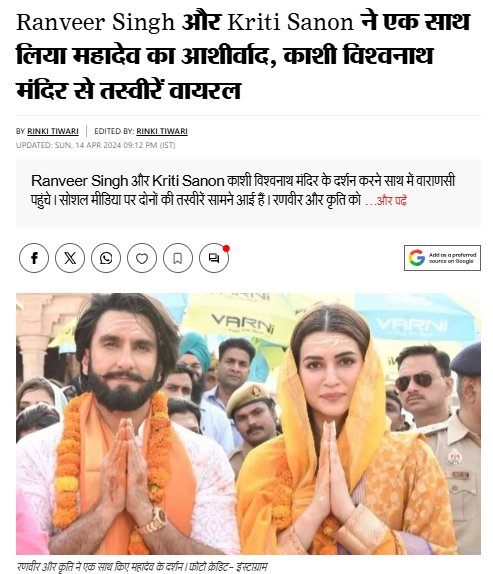
We also found a video report on the official YouTube channel of Times Now Navbharat, uploaded on April 15, 2024, showing Ranveer Singh and Kriti Sanon at the temple. The report also featured visuals from a fashion event held in Varanasi.
- https://www.youtube.com/watch?v=OMuW_SVbfb4

Conclusion
The viral claim is misleading. The video of Ranveer Singh visiting the Kashi Vishwanath Temple is not recent. It dates back to 2024, when he visited the temple with Kriti Sanon, and is unrelated to the release or success of ‘Dhurandhar 2: The Revenge’.
Introduction
Deepfake technology, which combines the words "deep learning" and "fake," uses highly developed artificial intelligence—specifically, generative adversarial networks (GANs)—to produce computer-generated content that is remarkably lifelike, including audio and video recordings. Because it can provide credible false information, there are concerns about its misuse, including identity theft and the transmission of fake information. Cybercriminals leverage AI tools and technologies for malicious activities or for committing various cyber frauds. By such misuse of advanced technologies such as AI, deepfake, and voice clones. Such new cyber threats have emerged.
India Topmost destination for deepfake attacks
According to Sumsub’s identity fraud report 2023, a well-known digital identity verification company with headquarters in the UK. India, Bangladesh, and Pakistan have become an important participants in the Asia-Pacific identity fraud scene with India’s fraud rate growing exponentially by 2.99% from 2022 to 2023. They are among the top ten nations most impacted by the use of deepfake technology. Deepfake technology is being used in a significant number of cybercrimes, according to the newly released Sumsub Identity Fraud Report for 2023, and this trend is expected to continue in the upcoming year. This highlights the need for increased cybersecurity awareness and safeguards as identity fraud poses an increasing concern in the area.
How Deeepfake Works
Deepfakes are a fascinating and worrisome phenomenon that have emerged in the modern digital landscape. These realistic-looking but wholly artificial videos have become quite popular in the last few months. Such realistic-looking, but wholly artificial, movies have been ingrained in the very fabric of our digital civilisation as we navigate its vast landscape. The consequences are enormous and the attraction is irresistible.
Deep Learning Algorithms
Deepfakes examine large datasets, frequently pictures or videos of a target person, using deep learning techniques, especially Generative Adversarial Networks. By mimicking and learning from gestures, speech patterns, and facial expressions, these algorithms can extract valuable information from the data. By using sophisticated approaches, generative models create material that mixes seamlessly with the target context. Misuse of this technology, including the dissemination of false information, is a worry. Sophisticated detection techniques are becoming more and more necessary to separate real content from modified content as deepfake capabilities improve.
Generative Adversarial Networks
Deepfake technology is based on GANs, which use a dual-network design. Made up of a discriminator and a generator, they participate in an ongoing cycle of competition. The discriminator assesses how authentic the generated information is, whereas the generator aims to create fake material, such as realistic voice patterns or facial expressions. The process of creating and evaluating continuously leads to a persistent improvement in Deepfake's effectiveness over time. The whole deepfake production process gets better over time as the discriminator adjusts to become more perceptive and the generator adapts to produce more and more convincing content.
Effect on Community
The extensive use of Deepfake technology has serious ramifications for several industries. As technology develops, immediate action is required to appropriately manage its effects. And promoting ethical use of technologies. This includes strict laws and technological safeguards. Deepfakes are computer trickery that mimics prominent politicians' statements or videos. Thus, it's a serious issue since it has the potential to spread instability and make it difficult for the public to understand the true nature of politics. Deepfake technology has the potential to generate totally new characters or bring stars back to life for posthumous roles in the entertainment industry. It gets harder and harder to tell fake content from authentic content, which makes it simpler for hackers to trick people and businesses.
Ongoing Deepfake Assaults In India
Deepfake videos continue to target popular celebrities, Priyanka Chopra is the most recent victim of this unsettling trend. Priyanka's deepfake adopts a different strategy than other examples including actresses like Rashmika Mandanna, Katrina Kaif, Kajol, and Alia Bhatt. Rather than editing her face in contentious situations, the misleading film keeps her look the same but modifies her voice and replaces real interview quotes with made-up commercial phrases. The deceptive video shows Priyanka promoting a product and talking about her yearly salary, highlighting the worrying development of deepfake technology and its possible effects on prominent personalities.
Actions Considered by Authorities
A PIL was filed requesting the Delhi High Court that access to websites that produce deepfakes be blocked. The petitioner's attorney argued in court that the government should at the very least establish some guidelines to hold individuals accountable for their misuse of deepfake and AI technology. He also proposed that websites should be asked to identify information produced through AI as such and that they should be prevented from producing illegally. A division bench highlighted how complicated the problem is and suggested the government (Centre) to arrive at a balanced solution without infringing the right to freedom of speech and expression (internet).
Information Technology Minister Ashwini Vaishnaw stated that new laws and guidelines would be implemented by the government to curb the dissemination of deepfake content. He presided over a meeting involving social media companies to talk about the problem of deepfakes. "We will begin drafting regulation immediately, and soon, we are going to have a fresh set of regulations for deepfakes. this might come in the way of amending the current framework or ushering in new rules, or a new law," he stated.
Prevention and Detection Techniques
To effectively combat the growing threat posed by the misuse of deepfake technology, people and institutions should place a high priority on developing critical thinking abilities, carefully examining visual and auditory cues for discrepancies, making use of tools like reverse image searches, keeping up with the latest developments in deepfake trends, and rigorously fact-check reputable media sources. Important actions to improve resistance against deepfake threats include putting in place strong security policies, integrating cutting-edge deepfake detection technologies, supporting the development of ethical AI, and encouraging candid communication and cooperation. We can all work together to effectively and mindfully manage the problems presented by deepfake technology by combining these tactics and adjusting the constantly changing terrain.
Conclusion
Advanced artificial intelligence-powered deepfake technology produces extraordinarily lifelike computer-generated information, raising both creative and moral questions. Misuse of tech or deepfake presents major difficulties such as identity theft and the propagation of misleading information, as demonstrated by examples in India, such as the latest deepfake video involving Priyanka Chopra. It is important to develop critical thinking abilities, use detection strategies including analyzing audio quality and facial expressions, and keep up with current trends in order to counter this danger. A thorough strategy that incorporates fact-checking, preventative tactics, and awareness-raising is necessary to protect against the negative effects of deepfake technology. Important actions to improve resistance against deepfake threats include putting in place strong security policies, integrating cutting-edge deepfake detection technologies, supporting the development of ethical AI, and encouraging candid communication and cooperation. We can all work together to effectively and mindfully manage the problems presented by deepfake technology by combining these tactics and making adjustments to the constantly changing terrain. Creating a true cyber-safe environment for netizens.
References:
- https://yourstory.com/2023/11/unveiling-deepfake-technology-impact
- https://www.indiatoday.in/movies/celebrities/story/deepfake-alert-priyanka-chopra-falls-prey-after-rashmika-mandanna-katrina-kaif-and-alia-bhatt-2472293-2023-12-05
- https://www.csoonline.com/article/1251094/deepfakes-emerge-as-a-top-security-threat-ahead-of-the-2024-us-election.html
- https://timesofindia.indiatimes.com/city/delhi/hc-unwilling-to-step-in-to-curb-deepfakes-delhi-high-court/articleshow/105739942.cms
- https://www.indiatoday.in/india/story/india-among-top-targets-of-deepfake-identity-fraud-2472241-2023-12-05
- https://sumsub.com/fraud-report-2023/
