
MoD to Deploy a New OS
Introduction
Cyberspace is the new and the fifth dimension of warfare as recognised by the UN. In recent times we have seen a significant rise in cyber attacks on nations’ strategic interests and critical infrastructure. The scope of cyberwarfare is increasing rapidly in contemporary times. Nations across the globe are struggling with this issue. The Ministry of Defence of the Government of India has been fundamental to take preventive measures towards all attacks on the Republic of India. The ministry is the junction for all three forces: Airforce, Navy and Army and creates coordination between the forces and deploys the force at strategic locations in terms of enemy threats.
The new OS
Governments across the world have developed various cyber security measures and mechanisms to keep data and information safe and secure. Similarly, the Indian Government has been very critical in deploying cybersecurity strategies, policies, measures, and bills to safeguard the Indian cyber-ecosystem. The Ministry of Defence has recently made a transition in terms of the Operating System used in the daily functions of the ministry. Earlier, the ministry was using an OS from Microsoft, which has now been replaced with the indigenous OS named “Maya” based on open-source Ubuntu. This is the first time the ministry will be deploying indigenous operating software. This step comes at a time of global rise in cyber attacks, and the aspect of indigenous OS will prevent malware and spyware attacks.
What is Maya?
Users will not notice many differences while switching to Maya because it has a similar interface and functionality to Windows. The first instruction is to install Maya on all South Block PCs with Internet access before August 15. In these systems, a Chakravyuh “endpoint detection and protection system” is also being installed. Maya isn’t yet installed on any computers connected to the networks of the three Services; instead, it is solely used in Defence Ministry systems. It had also been reviewed by the three Services and would shortly be adopted on service networks. The Army and Air Force were currently reviewing it after the Navy had already given its approval.
OS Maya was created by government development organisations in less than six months. An official from the ministry has informed that Maya would stop malware attacks and other cyberattacks, which have sharply increased. The nation has recently experienced a number of malware and extortion attacks, some of which targeted vital infrastructure. The Defence Ministry has made repeated attempts in the past to switch from Windows to an Indian operating system.
How will the new OS help?
The OS Maya is a critically developed OS and is expected to cater to the needs of all cybersecurity and safety issues of contemporary threats and vulnerabilities.
The following aspects need to be kept in mind in regard to safety and security issues:
- Better and improved security and safety
- Reduced chances of cyberattacks
- Promotion of Inidegenous talent and innovation
- Global standard OS
- Preventing and precautionary measures
- Safety by Design for overall resilience
- Improved Inter forces coordination
- Upskilling and capacity building for Serving personnel
Conclusion
Finally, the emergence of cyberspace as the fifth dimension of warfare has compelled countries all over the world to adopt a proactive stance, and India’s Ministry of Defence has made a significant move in this area. The significance of strengthened cybersecurity measures has been highlighted by the rising frequency and level of complexity of cyberattacks against key assets and vital infrastructure. The Ministry’s choice to use the local Maya operating system is a key step in protecting the country’s cyber-ecosystem. Maya’s debut represents a fundamental shift in the cybersecurity approach as well as a technology transition. This change not only improves the security and protection of confidential data but also demonstrates India’s dedication to supporting innovation and developing homegrown talent. Government development organisations have shown their commitment to solving the changing difficulties of the digital age by producing cutting-edge operating systems like Maya in a relatively short amount of time.

Related Blogs

Executive Summary
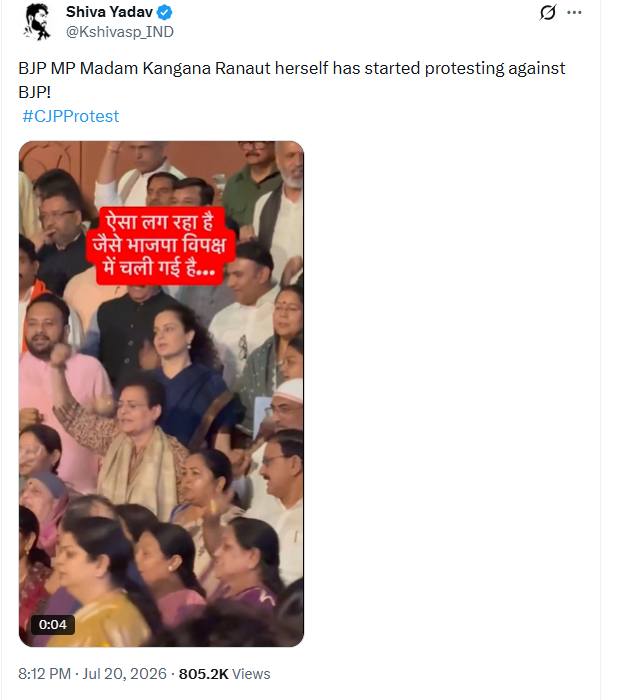
A video from the Parliament complex is being widely shared on social media with the claim that Bharatiya Janata Party (BJP) MP Kangana Ranaut has come out in support of the ongoing Cockroach Janata Party (CJP)-led protest at Delhi’s Jantar Mantar. The viral post claims that Ranaut can be seen raising slogans in support of the protesters. CyberPeace Research Wing’s research found the claim to be misleading. The viral footage is not related to the ongoing CJP protest. It dates back to April 2026, when BJP women MPs staged a demonstration outside Parliament after the 131st Constitutional Amendment Bill failed to pass. The old video is now being falsely linked to the current protest.
Claim:
On July 20, 2026, an X (formerly Twitter) user shared the viral video claiming that “BJP MP Kangana Ranaut has now started protesting against her own party.”
The post link, archive link and screenshot are provided below.
https://x.com/Kshivasp_IND/status/2079215438664233391
Fact Check:
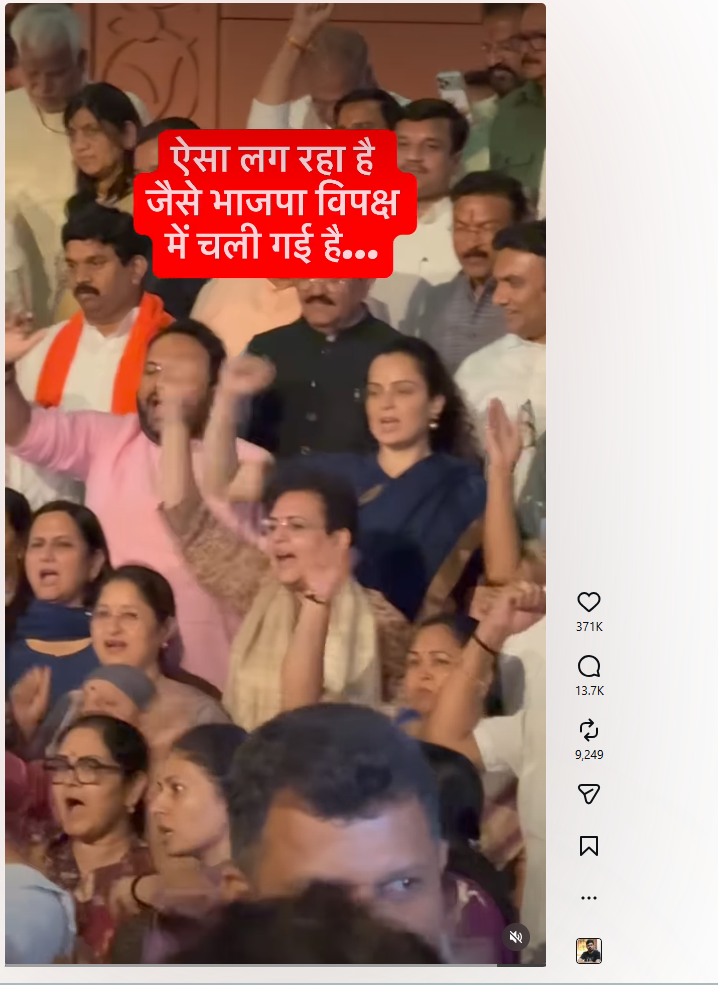
To verify the claim, the Desk extracted keyframes from the viral video and conducted a reverse image search using Google Lens. This led to the same video uploaded on the Instagram account ashutoshjourno on April 17, 2026. The caption accompanying the post read, “Aaj Makar Dwar ka nazara alag tha” (The scene at Makar Dwar was different today).
https://www.instagram.com/reels/DXPQoIAiQ3L/
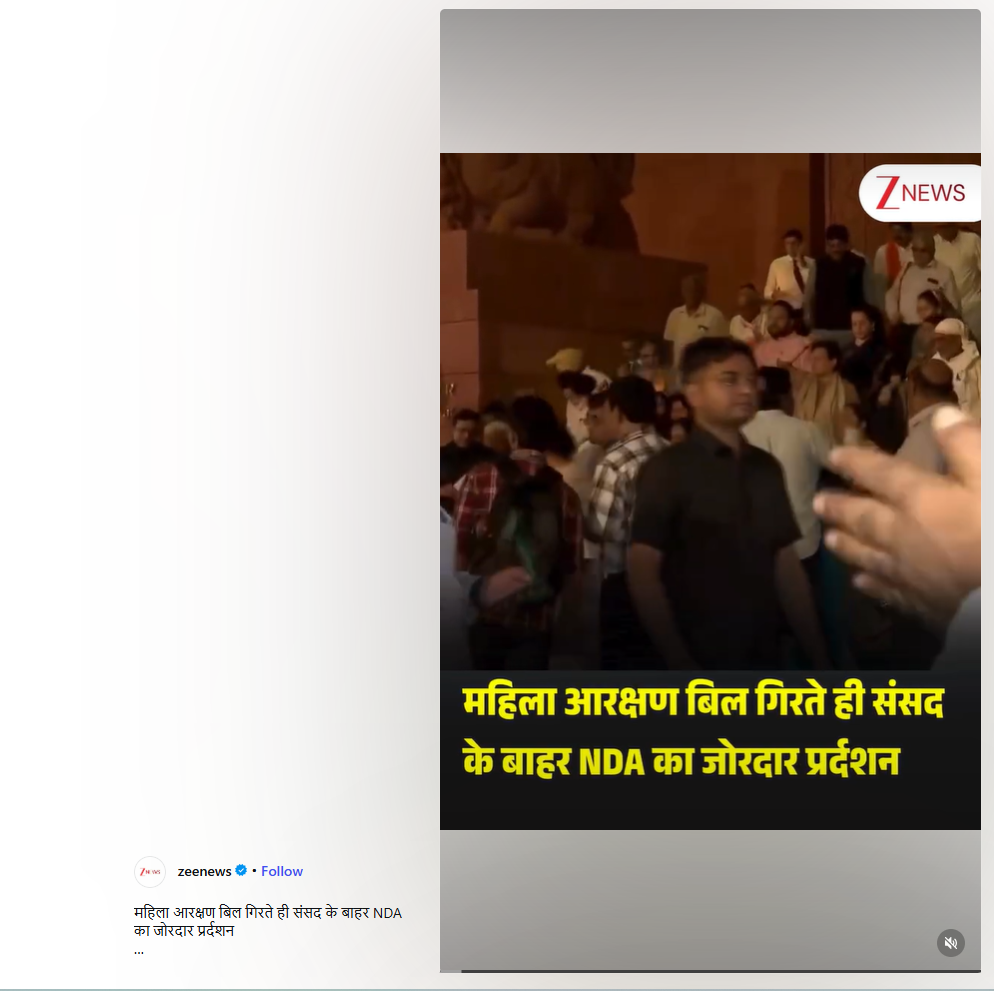
In the next stage of the research, the Desk carried out a keyword search based on the clues obtained from the Instagram post. This led to a Zee News report published on April 17, 2026, which reported that NDA MPs staged a protest outside Parliament after the 131st Constitutional Amendment Bill failed to pass. The visuals in the report matched those seen in the viral video.
https://www.instagram.com/reels/DXPL4tOky5P/
Conclusion:
CyberPeace Research Wing’s research found the viral claim to be misleading. The video is unrelated to the ongoing CJP protest at Jantar Mantar. It was recorded in April 2026, when BJP women MPs protested outside Parliament following the failure of the 131st Constitutional Amendment Bill to pass. The old footage is now being falsely shared as a recent video of Kangana Ranaut supporting the CJP protest.
.webp)
For more than a century, cinema has evolved alongside technology. Sound transformed silent films, colour changed visual storytelling, computer-generated imagery expanded the limits of imagination, and streaming reshaped how audiences experience films. Each transformation brought uncertainty, but Artificial Intelligence represents a different kind of shift. It is not merely changing how films are made; it is beginning to challenge who, or what, gets to create and perform them.
This debate has moved from theory to reality with Tilly Norwood, an AI-generated performer created by Particle 6 through its AI talent division Xicoia. After months of discussion surrounding the role of artificial performers in entertainment, Norwood is now set to headline her own feature film, Misaligned which is a project that places artificial intelligence at the centre of both the production process and the story itself. The film is described as a comedy-drama following an AI character without a tangible existence. The story follows that, guided by another AI character, she begins developing ambitions, emotions, and a desire to understand what it means to become “human” The premise of the movie is intentionally self-reflective. An AI performer, whose very existence has raised questions about authenticity and creativity, will now portray a character experiencing those same conflicts.
AI as storyteller?
Using Artificial Intelligence in filmmaking is not recent, for years production studios have used technology for visual effects, editing assistance, restoration, recommendation systems, and production planning. The emergence of AI-generated performers, however, introduces a far more complex question, can AI replace the actors who are core to storytelling?
When Tilly was first introduced at the Zurich film festival in late 2025 by the Dutch producer Eline Van Der Velden, CEO and Founder of Particle 6, introduced it as a hybrid model of film-making, where there are directors, producers, production team but a "synthetic performer" in the lead role and a comprehensive AI-experts team. Van Der Velden argued that human creativity was not being replaced but supplemented by AI.
This was not well received by the film community. Actors like Emily Blunt and SAG-AFTRA (the Screen Actors Guild- American Federation of Television and Radio Artists) a US labor organization representing roughly 160,000 professionals across the entertainment and media industries, including actors, performers, journalists, musicians, and voice actors, released a statement condemning this project with synthetic performer. They emphasised that ‘creativity is, and should remain, human-centered. The union is opposed to the replacement of human performers by synthetics.’
The Question of Authenticity
Acting has historically been understood as an interpretation of human experience. Performers bring personal histories, emotions, cultural backgrounds, and individual perspectives into their roles. The criticism is that an AI actor does not exist in a tangible form and essentially has no real story or background of any kind. Particle 6 describes Tilly only as a twenty-something who lives in London and loves coffee which is a very shallow context and has no personality at all. The film is also set in the fictional "Tillyverse," not a real place and exists on some cloud system reinforcing the sense that there is no lived reality behind the character.
At their core, AI performers are outputs of generative systems rather than individuals with lived experience or personal artistic interpretation. These systems learn by identifying patterns from vast datasets and generating results based on existing material, which raises questions about whether such performances can be considered original creative expression at all. Tilly Norwood's music video ‘Taking the Lead’ illustrated this gap in practice, drawing attention to inconsistencies in natural emotion, visual continuity, and expression across scenes.
Human actors, by contrast, bring authenticity and emotional depth shaped by real experience and creative interpretation which are qualities that recognition and awards have traditionally been built around. If a performance is produced through algorithms trained on existing creative patterns, a fundamental question follows: what exactly is being celebrated, the technology, the final output, or the humans guiding the system?
Creativity, Consent, and the Legal Grey Areas
AI performers also raise significant questions about intellectual property, personality rights, consent, and compensation. Existing legal and contractual frameworks were primarily designed around human performers who are individuals who negotiate compensation, own aspects of their identity, and participate in the wider cultural ecosystem surrounding cinema. However, an AI actor challenges these traditional assumptions. If a digital performer does not possess legal personhood, creative ownership, or independent rights, questions emerge regarding who should receive recognition and financial benefits: the developers, production studios, directors, or the human creators involved in building the technology?
Also if a digital actor’s expressions, movements, or style are influenced by thousands of existing performers, determining ownership becomes complicated. Who controls an AI-generated performance? Who deserves credit? Should performers have rights over how their likeness, voice, or style influences future AI systems?
Any advantages?
The most significant advantage of AI-assisted filmmaking may lie in what it offers smaller production houses and independent creators. By reducing certain production costs, AI tools could let filmmakers with limited resources attempt ambitious ideas that were previously out of reach. Beyond this production advantage, however, the acceptance of AI performers themselves remains uncertain. Projects like Misaligned are therefore less a proven shift in cinema than an industry experiment testing how far technology can move into a traditionally human creative space.
The Future of Cinema: Replacement or Reinvention?
Every major technological transformation in cinema has created fears about what might be lost, yet cinema has consistently adapted by absorbing new technologies into its storytelling. AI may follow a similar path, but the stakes are different as it does not simply change the tools available to artists, it challenges the definitions of creativity, authorship, and performance itself.
Much of cinema's economic and cultural life is really built on the bond between audiences and actors. It's actors who drive ticket sales, build loyal fan followings, and become cultural figures in their own right, through interviews, public appearances, and the visible journey of training, struggle, and growth that shapes a career. An AI-generated performer can mimic parts of that celebrity image, but it can't actually show up for any of it the way a person can. Handing central creative roles to artificial personalities also raises a fairness question, especially at a time when so many human performers are already struggling to find work.
Whether audiences will really embrace fully synthetic performers as stand-ins for human actors is still an open question. Misaligned may end up being the first real test of that. Early reaction to Tilly Norwood has been largely critical within the industry and among audiences. How viewers respond to Misaligned itself will be an early test of whether that scepticism holds.
Cinema has always found ways to absorb new technology, but AI is testing something deeper than the tools filmmakers use. As machines get better at telling human stories, the real challenge is making sure the human element behind those stories doesn't get lost.
References
- https://theprint.in/feature/tilly-norwood-tillyverse-misaligned-particle6-ai-actor/2980654/
- https://www.cbsnews.com/news/tilly-norwood-ai-generated-actor-feature-film/
- https://www.sagaftra.org/sag-aftra-statement-synthetic-performer
- https://www.hollywoodreporter.com/movies/movie-news/ai-actor-tilly-norwood-movie-debut-misaligned-1236638719/

Introduction
The Government of India has initiated a cybercrime crackdown that has resulted in the blocking of 781,000 SIM cards and 208,469 IMEI (International Mobile Equipment Identity) numbers that are associated with digital fraud as of February 2025. This data was released as a written response by the Union Minister of State for Home Affairs, Bandi Sanjay Kumar, with respect to a query presented in the Lok Sabha. A significant jump from the 669,000 SIM cards blocked in the past year, efforts aimed at combating digital fraud are in full swing, considering the increasing cases. The Indian Cyber Crime Coordination Centre (I4C) is proactively blocking other platform accounts found suspicious, such as WhatsApp Accounts (83,668) and Skype IDs (3,962) on its part, aiding in eliminating identified threat actors.
Increasing Digital Fraud And The Current Combative Measures
According to the data tabled by the Ministry of Finance in the Rajya Sabha, the first 10 months of the Financial year 2024-2025 have recorded around 2.4 million incidents covering an amount of Rs. 4,245 crore involving cases of digital Financial Fraud cases. Apart from the evident financial loss, such incidents also take an emotional toll as people are targeted regardless of their background and age, leaving everyone equally vulnerable. To address this growing problem, various government departments have dedicated measures to combat and reduce such incidents. Some of the notable initiatives/steps are as follows:
- The Citizen Financial Cyber Fraud Reporting and Management System- This includes reporting Cybercrimes through the nationwide toll-free (1930) number and registration on the National Cyber Crime Reporting Portal. On being a victim of digital fraud, one can call the toll-free number, describing details of the incident, which would further help in the investigation. After reporting the incident, the complainant receives a generated login ID/acknowledgement number that they can use for further reference.
- International Incoming Spoofed Calls Prevention System- This is a mechanism developed to counter fraudulent calls that appear to originate from within India but are actually made from international locations. This system prevents the misuse of the Calling Line Identity (CLI), which is manipulated to deceive recipients in order to carry out financial crimes like digital arrests, among other things. Coordinating with the Department of Telecommunication (DoT), private telecommunication service providers (TSPs) are being encouraged to check with their ILD (International Long-Distance) network as a measure. Airtel has recently started categorising such numbers as International numbers on their part.
- Chakshu Facility at Sanchar Saathi platform- A citizen-centric initiative, created by the Department of Telecommunications, to empower mobile subscribers. It focuses on reporting unsolicited commercial communication (spam messages) and reporting suspected fraudulent communication. (https://sancharsaathi.gov.in/).
- Aadhaar-based verification of SIM cards- A directive issued by the Prime Minister's Office to the Department of Telecommunications mandates an Aadhaar-based biometric verification for the issuance of new SIM cards. This has been done so in an effort to prevent fraud and cybercrime through mobile connections obtained using fake documents. Legal action against non-compliant retailers in the form of FIRs is also being taken.
On the part of the public, awareness of the following steps could encourage them on how to deal with such situations:
- Awareness regarding types of crimes and the tell-tale signs of the modus operandi of a criminal: A general awareness and a cautionary approach to how such crimes take place could help better prepare and respond to such malicious scams. Some important signs on the part of the offender include pressuring the victim into immediate action, insistence on video calls, and the threat of arrest in case of non-compliance. It is also important to note that no official authority, in any legal capacity, allows for enabling a digital/online arrest.
- Knowing the support channels: Awareness regarding reporting mechanisms and cyber safety hygiene tips can help in building cyber resilience amongst netizens.
Conclusion
As cybercrooks continue to find new ways of duping people of their hard-earned money, both government and netizens must make efforts to combat such crimes and increase awareness on both ends (systematic and public). Increasing developments in AI, deepfakes, and other technology often render the public inept at assessing the veracity of the source, making them susceptible to such crime. A cautionary yet proactive approach is need of the hour.
References
- https://mobileidworld.com/india-blocks-781000-sim-cards-in-major-cybercrime-crackdown/
- https://www.storyboard18.com/how-it-works/over-83k-whatsapp-accounts-used-for-digital-arrest-blocked-home-ministry-60292.htm
- https://www.business-standard.com/finance/news/digital-financial-frauds-touch-rs-4-245-crore-in-the-apr-jan-period-of-fy25-125032001214_1.html
- https://www.business-standard.com/india-news/govt-blocked-781k-sims-3k-skype-ids-83k-whatsapp-accounts-till-feb-125032500965_1.html
- https://pib.gov.in/PressReleasePage.aspx?PRID=2042130
- https://mobileidworld.com/india-mandates-aadhaar-biometric-verification-for-new-sim-cards-to-combat-fraud/
- https://pib.gov.in/PressReleaseIframePage.aspx?PRID=2067113
