#FactCheck- AI-Generated Image of Narendra Modi Goes Viral Ahead of Kerala Elections
Executive Summary
As Kerala gears up for its upcoming Assembly elections, political activity has intensified across the state. Amid this charged atmosphere, a purported image of Narendra Modi has gone viral on social media. The image shows the Prime Minister holding coconuts, with several photographers around him. It is being claimed that the photo was taken during his recent visit for the 2026 Kerala Assembly election campaign.
However, an research by the CyberPeace has debunked the claim, confirming that the image is fake and generated using artificial intelligence.
Claim
A Facebook user named “Javed Ahmad” shared the viral image on April 6, 2026, with a sarcastic caption suggesting that the Prime Minister was posing for reels during his Kerala visit.
- https://www.facebook.com/Ahmadspeaks4u/posts/pfbid0aRnhwXBjnfSXF9S48vaH1gTQrGQmxnRmhpJCRxMWazqLJhYs6zxM9rot51qtBgRLl
- https://perma.cc/N3AM-Q2YC

Fact Check
To verify the claim, we conducted keyword searches on Google but found no credible news reports supporting it. A reverse image search also did not yield any reliable sources. Additionally, a thorough review of the Prime Minister’s official social media accounts showed no trace of such an image or event. Given these inconsistencies, suspicion arose about the image’s authenticity.
The viral image was then analyzed using AI detection tools. Results from HIVE Moderation indicated a 99% probability that the image is AI-generated.
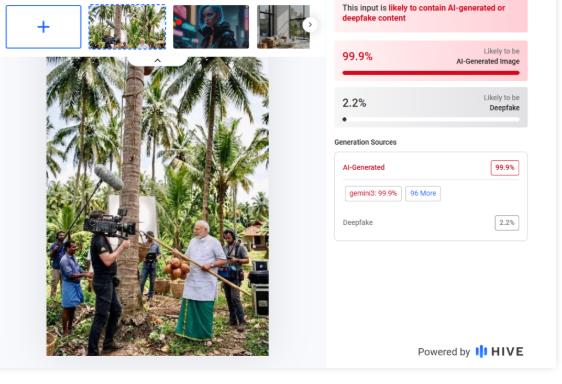
Another tool, Wasit AI, also confirmed that the image is artificially created.

Conclusion
The claim is false. The viral image of Prime Minister Narendra Modi is not real and has been generated using AI tools, likely similar to Google AI.
Related Blogs

.webp)
Introduction
In an era where organisations are increasingly interdependent through global supply chains, outsourcing and digital ecosystems, third-party risk has become one of the most vital aspects of enterprise risk management. The SolarWinds hack, the MOVEit vulnerabilities and recent software vendor attacks all serve as a reminder of the necessity to enhance Third-Party Risk Management (TPRM). As cyber risks evolve and become more sophisticated and as regulatory oversight sharpens globally, 2025 is a transformative year for the development of TPRM practices. This blog explores the top trends redefining TPRM in 2025, encompassing real-time risk scoring, AI-driven due diligence, harmonisation of regulations, integration of ESG, and a shift towards continuous monitoring. All of these trends signal a larger movement towards resilience, openness and anticipatory defence in an increasingly dependent world.
Real-Time and Continuous Monitoring becomes the Norm
The old TPRM methods entailed point-in-time testing, which typically was an annual or onboarding process. By 2025, organisations are shifting towards continuous, real-time monitoring of their third-party ecosystems. Now, authentic advanced tools are making it possible for companies to take a real-time pulse of the security of their vendors by monitoring threat indicators, patching practices and digital footprint variations. This change has been further spurred by the growth in cyber supply chain attacks, where the attackers target vendors to gain access to bigger organisations. Real-time monitoring software enables the timely detection of malicious activity, equipping organisations with a faster defence response. It also guarantees dynamic risk rating instead of relying on outdated questionnaire-based scoring.
AI and Automation in Risk Assessment and Due Diligence
Manual TPRM processes aren't sustainable anymore. In 2025, AI and machine learning are reshaping the TPRM lifecycle from onboarding and risk classification to contract review and incident handling. AI technology can now analyse massive amounts of vendor documentation and automatically raise red flags on potential issues. Natural language processing (NLP) is becoming more common for automated contract intelligence, which assists in the detection of risky clauses or liability gaps or data protection obligations. In addition, automation is increasing scalability for large organisations that have hundreds or thousands of third-party relationships, eliminating human errors and compliance fatigue. However, all of this must be implemented with a strong focus on security, transparency, and ethical AI use to ensure that sensitive vendor and organisational data remains protected throughout the process.
Risk Quantification and Business Impact Mapping
Risk scoring in isolation is no longer adequate. One of the major trends for 2025 is the merging of third-party risk with business impact analysis (BIA). Organisations are using tools that associate vendors to particular business processes and assets, allowing better knowledge of how a compromise of a vendor would impact operations, customer information or financial position. This movement has resulted in increased use of risk quantification models, such as FAIR (Factor Analysis of Information Risk), which puts dollar values on risks associated with vendors. By using the language of business value, CISOs and risk officers are more effective at prioritising risks and making resource allocations.
Environmental, Social, and Governance (ESG) enters into TPRM
As ESG keeps growing on the corporate agenda, organisations are taking TPRM one step further than cybersecurity and legal risks and expanding it to incorporate ESG-related factors. In 2025, organisations evaluate if their suppliers have ethical labour practices, sustainable supply chains, DEI (Diversity, Equity, Inclusion) metrics and climate impact disclosures. This growth is not only a reputational concern, but also a third-party non-compliance with ESG can now invoke regulatory or shareholder action. ESG risk scoring software and vendor ESG audits are becoming components of onboarding and performance evaluations.
Shared Assessments and Third-Party Exchanges
With the duplication of effort by having multiple vendors respond to the same security questionnaires, the trend is moving toward shared assessments. Systems such as the SIG Questionnaire (Standardised Information Gathering) and the Global Vendor Exchange allow vendors to upload once and share with many clients. This change not only simplifies the due diligence process but also enhances data accuracy, standardisation and vendor experience. In 2025, organisations are relying more and more on industry-wide vendor assurance platforms to minimise duplication, decrease costs and maximise trust.
Incident Response and Resilience Partnerships
Another trend on the rise is bringing vendors into incident response planning. In 2025, proactive organisations address major vendors as more than suppliers but as resilience partners. This encompasses shared tabletop exercises, communication procedures and breach notification SLAs. With the increasing ransomware attacks and cloud reliance, organisations are now calling for vendor-side recovery plans, RTO and RPO metrics. TPRM is transforming into a comprehensive resilience management function where readiness and not mere compliance takes centre stage.
Conclusion
Third-Party Risk Management in 2025 is no longer about checklists and compliance audits; it's a dynamic, intelligence-driven and continuous process. With regulatory alignment, AI automation, real-time monitoring, ESG integration and resilience partnerships leading the way, organisations are transforming their TPRM programs to address contemporary threat landscapes. As digital ecosystems grow increasingly complex and interdependent, managing third-party risk is now essential. Early adopters who invest in tools, talent and governance will be more likely to create secure and resilient businesses for the AI era.
References
- https://finance.ec.europa.eu/publications/digital-operational-resilience-act-dora_en
- https://digital-strategy.ec.europa.eu/en/policies/nis2-directive
- https://www.meity.gov.in/data-protection-framework
- https://securityscorecard.com
- https://sharedassessments.org/sig/
- https://www.fairinstitute.org/fair-model
%20(2).webp)
Introduction
Digitalization in India has been a transformative force, India is also marked as the second country in the world in terms of active internet users. With this adoption of digitalization and technology, the country is becoming a digitally empowered society and knowledge-based economy. However, the number of cyber crimes in the country has also seen a massive spike recently with the sophisticated cyber attacks and manipulative techniques being used by cybercriminals to lure innocent individuals and businesses.
As per recent reports, over 740,000 cybercrime cases were reported to the I4C, in the first four months of 2024, which raises serious concern on the growing nature of cyber crimes in the country. Recently Prime Minister Modi in his Mann Ki Baat address, cautioned the public about a particular rising cyber scam known as ‘digital arrest’ and highlighted the seriousness of the issue and urged people to be aware and alert about such scams to counter them. The government has been keen on making efforts to reduce and combat cyber crimes by introducing new measures and strengthening the regulatory landscape governing cyberspace in India.
Indian Cyber Crime Coordination Centre
Indian Cybercrime Coordination Centre (I4C) was established by the Ministry of Home Affairs (MHA) to provide a framework and eco-system for law enforcement agencies (LEAs) to deal with cybercrime in a coordinated and comprehensive manner. I4C handles the ‘National Cyber Crime Reporting Portal’ (https://cybercrime.gov.in) and the 1930 Cyber Crime Helpline. Recently at the Indian Cyber Crime Coordination Centre (I4C) Foundation Day celebration, Union Home Minister Amit Shah launched the Cyber Fraud Mitigation Centre (CFMC), Samanvay platform (Joint Cybercrime Investigation Facilitation System), 'Cyber Commandos' program and Online Suspect Registry as efforts to combat the cyber crimes, establish cyber resilence and awareness and strengthening capabilities of law enforcement agencies.
Regulatory landscape Governing Cyber Crimes
Information Technology Act, 2000 (IT Act) and the rules made therein, the Intermediary Guidelines, Digital Personal Data Protection Act, 2023 and Bhartiya Nyay Sanhita, 2023 are the major legislation in India governing Cyber Laws.
CyberPeace Recommendations
There has been an alarming uptick in cybercrimes in the country highlighting the need for proactive approaches to counter these emerging threats. The government should prioritise its efforts by introducing robust policies and technical measures to reduce cybercrime in the country. The law enforcement agencies' capabilities must be strengthened with advanced technologies to deal with cyber crimes especially considering the growing sophisticated nature of cyber crime tactics used by cyber criminals.
The netizens must be aware of the manipulative tactics used by cyber criminals to target them. Social media companies must also implement robust measures on their respective platforms to counter and prevent cyber crimes. Coordinated approaches by all relevant authorities, including law enforcement, cybersecurity agencies, and regulatory bodies, along with increased awareness and proactive engagement by netizens, can significantly reduce cyber threats and online criminal activities.
References
- https://www.statista.com/statistics/1499739/india-cyber-crime-cases-reported-to-i4c/#:~:text=Cyber%20crime%20cases%20registered%20by%20I4C%20India%202019%2D2024&text=Over%20740%2C000%20cases%20of%20cyber,related%20to%20online%20financial%20fraud
- https://www.deccanherald.com/india/parliament-panel-to-examine-probe-agencies-efforts-to-tackle-cyber-crime-illegal-immigration-3270314
- https://pib.gov.in/PressReleaseIframePage.aspx?PRID=2003158

Overview:
The National Payments Corporation of India (NPCI) officially revealed on the 31st of July 2024 that its client C-Edge Technologies had been subject to a ransomware attack. These circumstances have caused C-Edge to be separated from retail payment systems to eliminate more threats to the national payment systems. More than 200 cooperative and regional rural banks have been affected leading to disruptions in normal services including ATM withdrawals and UPI transactions.
About C-Edge Technologies:
C-Edge Technologies was founded in the year 2010 especially to meet the specific requirements of the Indian banking and other allied sectors accentuating more on the cooperative and the regional rural banks. The company offers a range of services such as Core Banking Solutions by functioning as the center of a bank where customers’ records are managed and accounting of transactions takes place, Payment Solutions through the implementation of payment gateways and mobile banking facilities, cybersecurity through threat detection and incident response to protect banking organizations, data analytics and AI through the analytics of big banking data to reduce risks and detect frauds.
Details of Ransomware attack:
Reports say, this ransomware attack has been attributed by the RansomEXX group which primarily targeted Brontoo Technology Solutions, a key collaborator with C-Edge, through a misconfigured Jenkins server, which allowed unauthorized access to the systems.
The RansomExx group also known as Defray777 or Ransom X utilized a sophisticated variant known as RansomEXX v2.0 to execute the attack. This group often targets large organizations and demands substantial ransoms. RansomEXX uses various malware tools such as IcedID, Vatet Loader, and PyXie RAT. It typically infiltrates systems through phishing emails, exploiting vulnerabilities in applications and services, including Remote Desktop Protocol (RDP). The ransomware encrypts files using the Advanced Encryption Standard (AES), with the encryption key further secured using RSA encryption. This dual-layer encryption complicates recovery efforts for victims. RansomEXX operates on a ransomware-as-a-service model, allowing affiliates to conduct attacks using its infrastructure. Earlier in 2021, it attacked StarHub and Gigabyte’s servers for ransome.
Impact due to the attack:
The immediate consequences of the ransomware attack include:
- Service Disruption: This has negative implications to consumers especially the citizens who use the banks to do their day to day banking activities such as withdrawals and online transactions. Among the complaints some of them relate to cases where the sender’s account has been debited without the corresponding credit to the receiver account.
- Isolation Measures: Likely, NPCI is already following the right measures as it had disconnected C-Edge from its networks to contain the proliferation of the ransomware. This decision was made as a precautionary measure so that all functional aspects in a larger financial system are safeguarded.
Operations resumed:
The National Payments Corporation of India (NPCI) said it has restored connectivity with C-Edge Technologies Ltd after the latter’s network connection was severed by NPCI over security concerns that were evaluated by an external forensic auditing firm. The audit affirmed that all affected systems were contained in order to avoid the occurrence of ransomware attack contagion. All the affected systems were localized in C-Edge’s data center and no repercussion was evidenced regarding the infrastructure of the cooperative banks or the regional rural banks that are involved in the business. Both NPCI and C-Edge Technologies have resumed normalcy so that the banking and financial services being offered by these banks remain safe and secure.
Major Implications for Banking Sector:
The attack on C-Edge Technologies raises several critical concerns for the Indian banking sector:
- Cybersecurity Vulnerabilities: It also shows the weak linkages which are present within the technology system that help smaller sized banks. Nevertheless, the service has been offered by C-Edge regarding their cybersecurity solution, this attack evidence that the securities required should improve in all types of banks and banking applications.
- Financial Inclusion Risks: Co operative and regional rural banks also have its importance in the financial inclusion especially in rural and semi urban areas. Gradually, interruptions to their services pose a risk to signal diminished improvement in financial literacy for the excluded groups contrary to the common year advancement.
- Regulatory Scrutiny: After this event, agencies such as the Reserve Bank of India (RBI) may enhance the examination of the banking sector’s cybersecurity mechanisms. Some of the directives may even require institutions to adhere to higher compliance measures regarding the defense against cyber threats.
Way Forward: Mitigation
- Strengthening Cybersecurity: It is important to enhance the cyber security to eliminate this kind of attacks in the future. This may include using better threat detection systems, penetration testing to find the vulnerabilities, system hardening, and network monitoring from time to time.
- Transition to Cloud-Based Solutions: The application of adaptations in cloud solutions can contribute to the enhancement in operative efficiency as well as optimization in the utilization of resources. The security features of cloud should be implemented for safety and protection against cyber threats for SMEs in the banking sector.
- Leveraging AI and Data Analytics: Development of the AI-based solutions for fraud and risk control means that bank organizations get the chance to address threats and to regain clients’ trust.
Conclusion:
This ransomware attack in C-Edge Technologies in the banking sector provides a warning for all the infrastructures. Initial cleanup methodologies and quarantining are effective. The continuous monitoring of cyber security features in the infrastructure and awareness between employees helps to avoid these kinds of attacks. Building up cyber security areas will also effectively safeguard the institution against other cyber risks in the future and fortify the confidence and reliability of the financial system, especially the regional rural banks.
Reference:
- https://www.businesstoday.in/technology/news/story/c-edge-technologies-a-deep-dive-into-the-indian-fintech-powerhouse-hit-by-major-cyberattack-439657-2024-08-01
- https://www.thehindu.com/sci-tech/technology/customers-at-several-small-sized-banks-affected-as-tech-provider-c-edge-suffers-ransomware-attack/article68470198.ece
- https://www.cnbctv18.com/technology/ransomware-attack-disrupts-over-200-co-operative-banks-regional-rural-banks-19452521.htm
- https://timesofindia.indiatimes.com/city/ahmedabad/ransomware-breach-at-c-edge-impacts-transactions-for-cooperative-banks/articleshow/112180914.cms
- https://www.emsisoft.com/en/blog/41027/ransomware-profile-ransomexx/