
#FactCheck- AI-Generated Deepfake Falsely Attributes Film Remark to Army Chief Upendra Dwivedi
Executive Summary
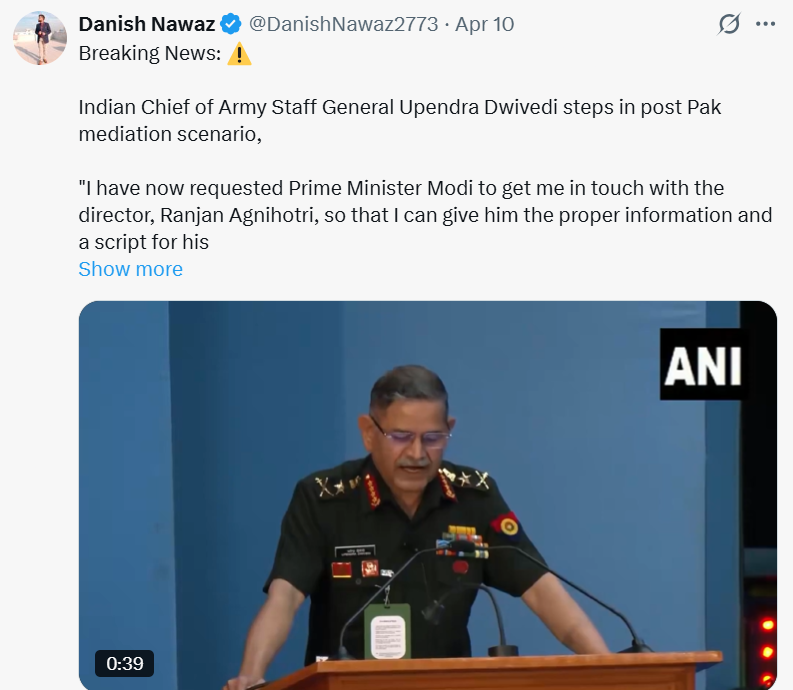
A video circulating on social media, shared by a Pakistani account, claims to show Indian Army Chief General Upendra Dwivedi making a controversial statement. In the clip, he is allegedly heard saying that he requested Prime Minister Narendra Modi to connect him with film director Ranjan Agnihotri so he could provide inputs and a script for a movie on “Operation Sindoor.”
However, research by CyberPeace has found that the viral video is an AI-generated deepfake. General Upendra Dwivedi has made no such statement.
Claim
A Pakistani user shared the viral video on X (formerly Twitter) on April 10, 2026, making the above claim.
Post links:
- https://x.com/DanishNawaz2773/status/2042312967811973225?s=20
- https://archive.ph/kAwoR
Fact Check
To verify the claim, we conducted keyword searches on Google but found no credible media reports supporting it. Further research led us to the original video posted on the X account of ANI. In this authentic clip, General Upendra Dwivedi is seen speaking at the ‘Ran Samwad’ seminar held in Bengaluru.
In the original video, he discusses the operational aspects of “Operation Sindoor,” including ground intelligence, cyber and electronic warfare inputs, Pakistan’s behaviour, and the challenges of a two-front scenario. There is no mention whatsoever of Pakistan mediation, Prime Minister Modi, Ranjan Agnihotri, any movie script, or a film based on Operation Sindoor.
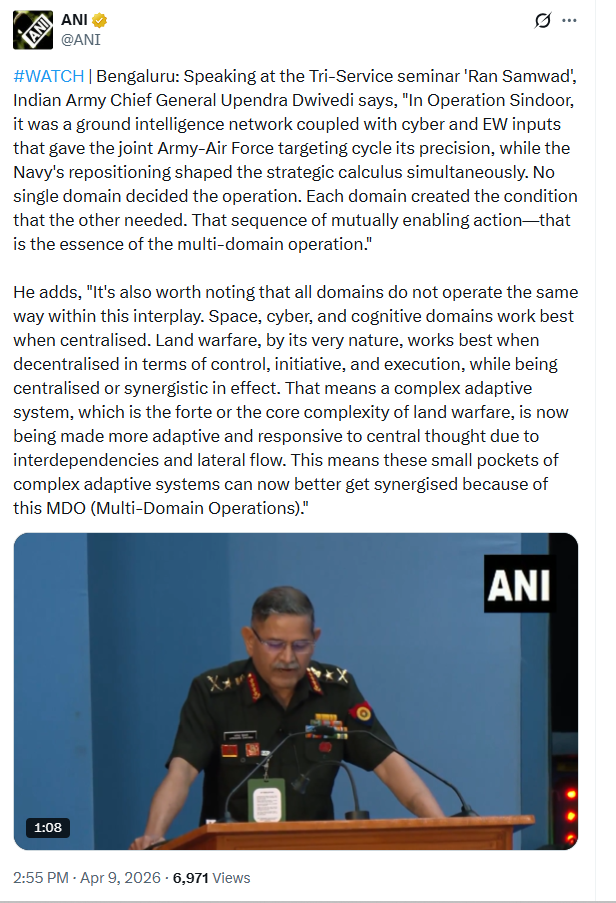
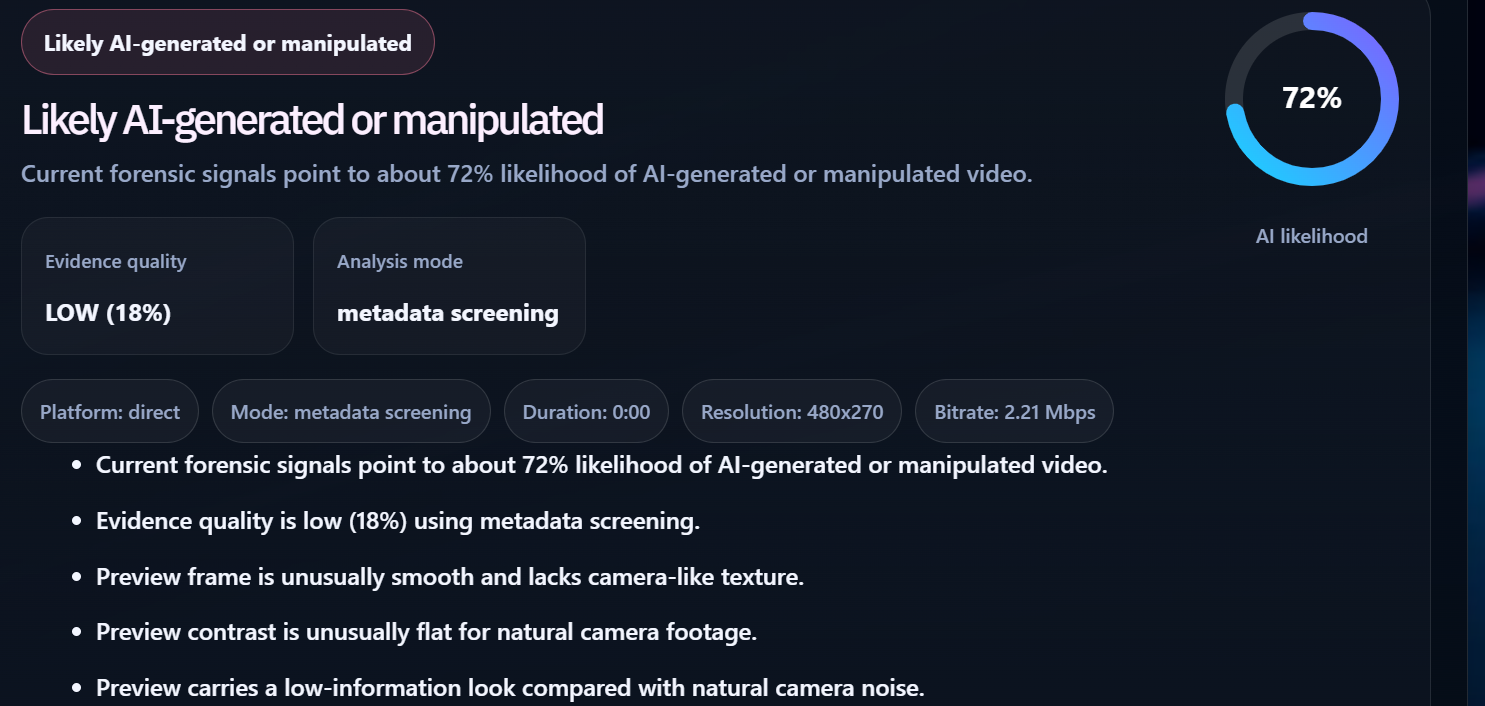
This clearly indicates that the viral clip has been manipulated and taken out of context. The video was further analyzed using the AI detection tool DetectVideo AI, which indicated a 72% probability that the content is AI-generated. This strongly supports the conclusion that the video is a deepfake.
Conclusion
The viral claim is false. The video featuring General Upendra Dwivedi has been digitally altered using AI techniques to insert fabricated statements. The original footage is from the ‘Ran Samwad’ seminar in Bengaluru, where he spoke about military strategy and multi-domain operations, not about any film or director. There is no evidence to suggest that he made any statement regarding contacting a filmmaker or contributing to a movie script. The inclusion of such references in the viral clip is entirely fabricated. This case highlights how AI-generated deepfakes are increasingly being used to spread misinformation, especially in sensitive contexts involving the military and international relations. Viewers are advised to rely on verified sources and exercise caution before sharing such content.

Related Blogs

Introduction
The Kerala High Court banned the use of mobile phones during office hours on the 2nd of December 2024, and issued an Official Memorandum titled, ‘Indulgence In Online Gaming And Watching Social Media Content During Office Hours’. This memorandum, issued by the Registrar General, prohibits mobile phone usage for personal activities such as gaming and social media during working hours. This memorandum aims to curb the productivity woes and reinforce professional discipline and further ensure the smooth functioning of the office operations.
The memorandum reiterated its earlier notices from 2009 and 2013, where the High Court had emphasised that violations would be taken seriously. This reflects the High Court’s commitment to maintaining efficiency and professionalism in the workplace. According to the memorandum, controlling officers will monitor the staff for violations and strict actions will be taken if the rules are flouted.
Background
The circumstances that led to the Kerala HC’s decision are as follows: staff engaged in playing online games, browsing social media, watching videos or movies and even engaging in online shopping or trading during work hours, excluding the allocated lunch recess (as per the memorandum).
As mentioned earlier, this memorandum is not the first of its kind. There were similar directives that were issued in 2009 and 2013 to target the poor productivity standards, rooted in the staff members' behaviours. The present memorandum is unlike the previously mentioned ones as, it specifically addresses the rise in mobile-based distractions, like online gaming and trading. The present directive does not outline any exceptions to senior officials with designated responsibilities, and emphasises universal adherence for all levels of the workforce.
According to Cell Phones at Workplace Statistics, around 97% of workers use their smartphones during work hours, mixing personal and job-related activities. And more than 55% of managers say that cell phones are a major reason for lower productivity among employees.
Therefore, it can be safely concluded that even though smartphones have become indispensable tools for communication, their misuse has wider implications for overall organisational productivity.
CyberPeace Outlook
The Kerala High Court's decision to restrict personal mobile phone usage during work hours underscores the importance of fostering a disciplined and focused workplace environment. While smartphones are vital for communication, their misuse poses significant productivity challenges. Some proactive steps that employers can take are implementing clear policies, conducting regular training sessions and promoting a culture of accountability. Balancing digital freedom and professional responsibility is the key to ensuring that technological tools serve as enablers of efficiency rather than distractions in the workplace.
References
- https://www.thehindu.com/sci-tech/technology/kerala-high-court-issues-memo-banning-staff-from-gaming-and-social-media-during-work-hours/article68963949.ece
- https://timesofindia.indiatimes.com/technology/tech-news/kerala-high-court-bans-mobile-gaming-and-social-media-for-staff-during-work-hours/articleshow/116101149.cms
- https://images.assettype.com/barandbench/2024-12-05/1hiq8ffv/Kerala_High_Court_OM.pdf
- https://www.coolest-gadgets.com/cell-phones-at-workplace-statistics/

Over The Top (OTT)
OTT messaging platforms have taken the world by storm; everyone across the globe is working on OTT platforms, and they have changed the dynamics of accessibility and information speed forever. Whatsapp is one of the leading OTT messaging platforms under the tech giant Meta as of 2013. All tasks, whether personal or professional, can be performed over Whatsapp, and as of today, Whatsapp has 2.44 billion users worldwide, with 487.5 Million users in India alone[1]. With such a vast user base, it is pertinent to have proper safety and security measures and mechanisms on these platforms and active reporting options for the users. The growth of OTT platforms has been exponential in the previous decade. As internet penetration increased during the Covid-19 pandemic, the following factors contributed towards the growth of OTT platforms –
- Urbanisation and Westernisation
- Access to Digital Services
- Media Democratization
- Convenience
- Increased Internet Penetration
These factors have been influential in providing exceptional content and services to the consumers, and extensive internet connectivity has allowed people from the remotest part of the country to use OTT messaging platforms. But it is pertinent to maintain user safety and security by the platforms and abide by the policies and regulations to maintain accountability and transparency.
New Safety Features
Keeping in mind the safety requirements and threats coming with emerging technologies, Whatsapp has been crucial in taking out new technology and policy-based security measures. A number of new security features have been added to WhatsApp to make it more difficult to take control of other people’s accounts. The app’s privacy and security-focused features go beyond its assertion that online chats and discussions should be as private and secure as in-person interactions. Numerous technological advancements pertaining to that goal have focussed on message security, such as adding end-to-end encryption to conversations. The new features allegedly increase user security on the app.
WhatsApp announced that three new security features are now available to all users on Android and iOS devices. The new security features are called Account Protect, Device Verification, and Automatic Security Codes
- For instance, a new programme named “Account Protect” will start when users migrate an account from an old device to a new one. If users receive an unexpected alert, it may be a sign that someone is trying to access their account without their knowledge. Users may see an alert on their previous handset asking them to confirm that they are truly transitioning away from it.
- To make sure that users cannot install malware to access other people’s messages, another function called “Device Verification” operates in the background. Without the user’s knowledge, this feature authenticates devices in the background. In particular, WhatsApp claims it is concerned about unlicensed WhatsApp applications that contain spyware made explicitly for this use. Users do not need to take any action due to the company’s new checks that help authenticate user accounts to prevent this.
- The final feature is dubbed “automatic security codes,” It builds on an already-existing service that lets users verify that they are speaking with the person they believe they are. This is still done manually, but by default, an automated version will be carried out with the addition of a tool to determine whether the connection is secure.
While users can now view the code by visiting a user’s profile, the social media platform will start to develop a concept called “Key Transparency” to make it easier for its users to verify the validity of the code. Update to the most recent build if you use WhatsApp on Android because these features have already been released. If you use iOS, the security features have not yet been released, although an update is anticipated soon.
Conclusion
Digital safety is a crucial matter for netizens across the world; platforms like Whatsapp, which enjoy a massive user base, should lead the way in terms of OTT platforms’ cyber security by inculcating the use of emerging technologies, user reporting, and transparency in the principles and also encourage other platforms to replicate their security mechanisms to keep bad actors at bay. Account Protect, Device Verification, and Automatic Security Codes will go a long way in protecting the user’s interests while simultaneously maintaining convenience, thus showing us that the future with such platforms is bright and secure.
[1] https://verloop.io/blog/whatsapp-statistics-2023/#:~:text=1.,over%202.44%20billion%20users%20worldwide.
.webp)
Introduction
The AI Action Summit is a global forum that brings together world leaders, policymakers, technology experts, and industry representatives to discuss AI governance, ethics, and its role in society. This year, the week-long Paris AI Action Summit officially culminated on the 11th of February, 2025. It brought together experts from the industry, policymakers, and other dignitaries to discuss Artificial Intelligence and its challenges. The event was co-chaired by Indian Prime Minister Narendra Modi and French President Emmanuel Macron. In line with the summit, the Indian delegation actively engaged in the 2nd India-France AI Policy Roundtable, an official side event of the summit, and the 14th India-France CEOs Forum. These discussions were on diverse sectors including defense, aerospace, technology, etc. among other things.
Prime Minister Modi’s Address
During the AI Action Summit in Paris, Prime Minister Narendra Modi drew attention to the revolutionary effect of AI in politics, the economy, security, and society. Stressing the requirement of international cooperation, he promoted strong frameworks of governance to combat AI-based risks and consequently, build public confidence in new technologies. Needed efforts with respect to cybersecurity issues such as deepfakes and disinformation were also acknowledged.
Democratising AI, and sharing its benefits, particularly with the Global South not only aligned with Sustainable Development Goals (SDGs) but also affirmed India’s resolve towards sharing expertise and best practices. India’s remarkable feat of creating a Digital Public Infrastructure, that caters to a population of 1.4 billion through open and accessible technology was highlighted as well.
Among the key announcements, India revealed its plans to create its own Large Language Model (LLM) that reflects the country's linguistic diversity, strengthening its AI aspirations. Further, India will be hosting the next AI Action Summit, reaffirming its position in international AI leadership. The Prime Minister also welcomed France's initiatives, such as the launch of the "AI Foundation" and the "Council for Sustainable AI", initiated by President Emmanuel Macron. He emphasized the necessity to extend the Global Partnership for AI and to get it more representative and inclusive so that Global South voices are actually incorporated into AI innovation and governance.
Other Perspectives
Though there were 58 countries that signed the international agreement on a more open, inclusive, sustainable, and ethical approach to AI development (including India, France, and China), the UK and the US have refused to sign the international agreement at the AI Summit stating their issues with global governance and national security. While the former raised concerns about the lack of sufficient details regarding the establishment of global AI governance and AI’s effect on national security as their reason, the latter showcased its reservations about the overly wide AI regulations which had the potential to hamper a transformative industry. Meanwhile, the US is also looking forward to ‘Stargate’, its $500 billion AI infrastructure project alongside the companies- OpenAI, Softbank, and Oracle.
CyberPeace Insights
The Summit has garnered greater significance with the backdrop of the release of platforms such as DeepSeek R1, China’s AI assistant system similar to that of OpenAI’s ChatGPT. On its release, it was the top-rated free application on Apple’s app store and sent the technology stocks tumbling. Moreover, investors world over appreciated the creation of the model which was made roughly in about $5 million while other AI companies spent more in comparison (keeping in mind the restrictions caused by the chip export controls in China). This breakthrough challenges the conventional notion that massive funding is a prerequisite for innovation, offering hope for India’s burgeoning AI ecosystem. With the IndiaAI mission and fewer geopolitical restrictions, India stands at a pivotal moment to drive responsible AI advancements.
References:
- https://www.mea.gov.in/press-releases.htm?dtl/39023/Prime_Minister_cochairs_AI_Action_Summit_in_Paris_February_11_2025
- https://indianexpress.com/article/explained/explained-sci-tech/what-is-stargate-trumps-500-billion-ai-project-9793165/
- https://pib.gov.in/PressReleasePage.aspx?PRID=2102056
- https://pib.gov.in/PressReleasePage.aspx?PRID=2101947
- https://pib.gov.in/PressReleasePage.aspx?PRID=2101896
- https://www.timesnownews.com/technology-science/uk-and-us-decline-to-sign-global-ai-agreement-at-paris-ai-action-summit-here-is-why-article-118164497
- https://www.thehindu.com/sci-tech/technology/india-57-others-sign-paris-joint-statement-on-inclusive-sustainable-ai/article69207937.ece
