
#FactCheck -2018 Baba Ramdev Video on Cheap Petrol Resurfaces Amid Fuel Price Hike, Shared Out of Context
Executive Summary
Amid rising petrol and diesel prices in India, an old video statement by Baba Ramdev is being widely shared on social media. In the viral clip, Ramdev can be heard saying that if the government permits him to open petrol pumps, he can provide petrol and diesel across the country at Rs 35-40 per litre. He is also heard suggesting that petrol and diesel should be brought under the lowest GST slab. However, CyberPeace Research Wing research found the viral claim to be misleading. The research revealed that Baba Ramdev made the statement during a private news channel event in 2018 and has not made any such recent remark.
Claim
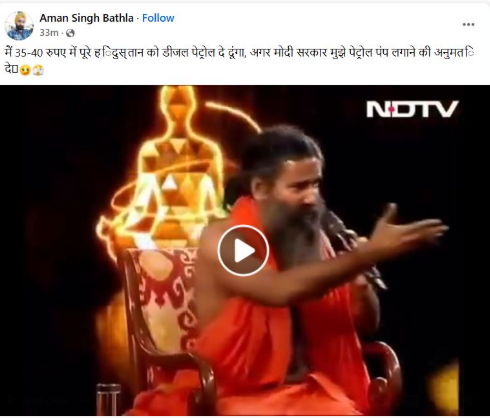
A Facebook user named “Aman Singh Bathla” shared the old video of Baba Ramdev on May 26, 2026, and wrote:
“I can provide petrol and diesel to the entire country at Rs 35-40 if the Modi government allows me to open petrol pumps!”
- https://www.facebook.com/reel/2215528532606679
- https://www.facebook.com/reel/2215528532606679
- https://perma.cc/LA4L-3KCK
Fact Check
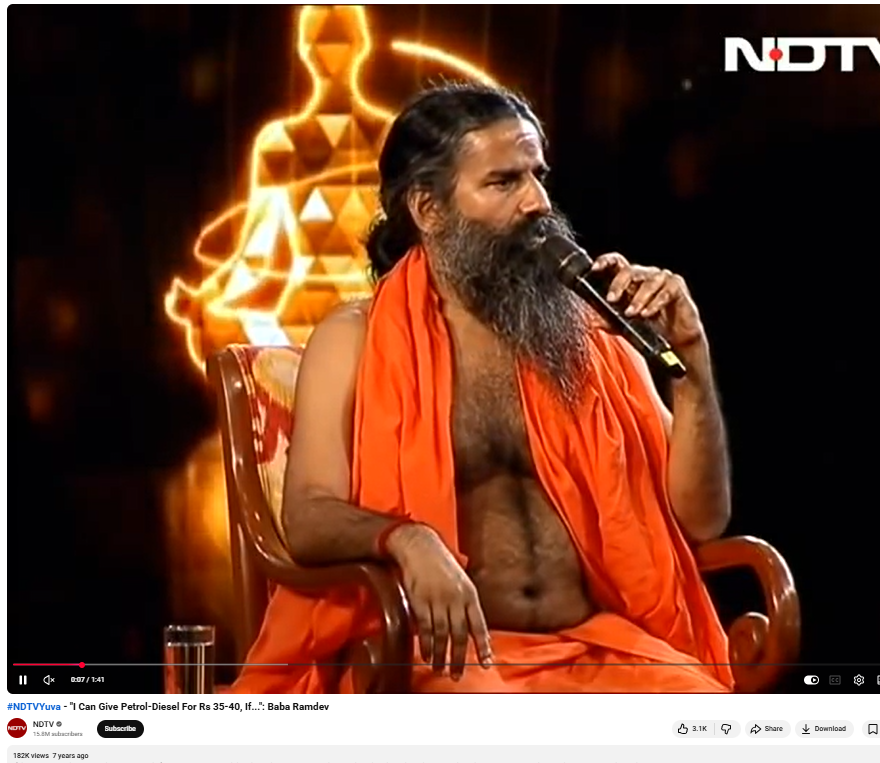
To verify the claim, we closely examined the viral video and noticed the logo of NDTV in the clip. Based on this clue, we searched NDTV’s official YouTube channel using relevant keywords and found the original video uploaded on September 16, 2018. In the full video, Baba Ramdev is seen making the viral statement during the NDTV Youth Conclave. During the discussion, the anchor had asked him a question regarding rising fuel prices, and Ramdev responded with the now-viral remarks in that context.
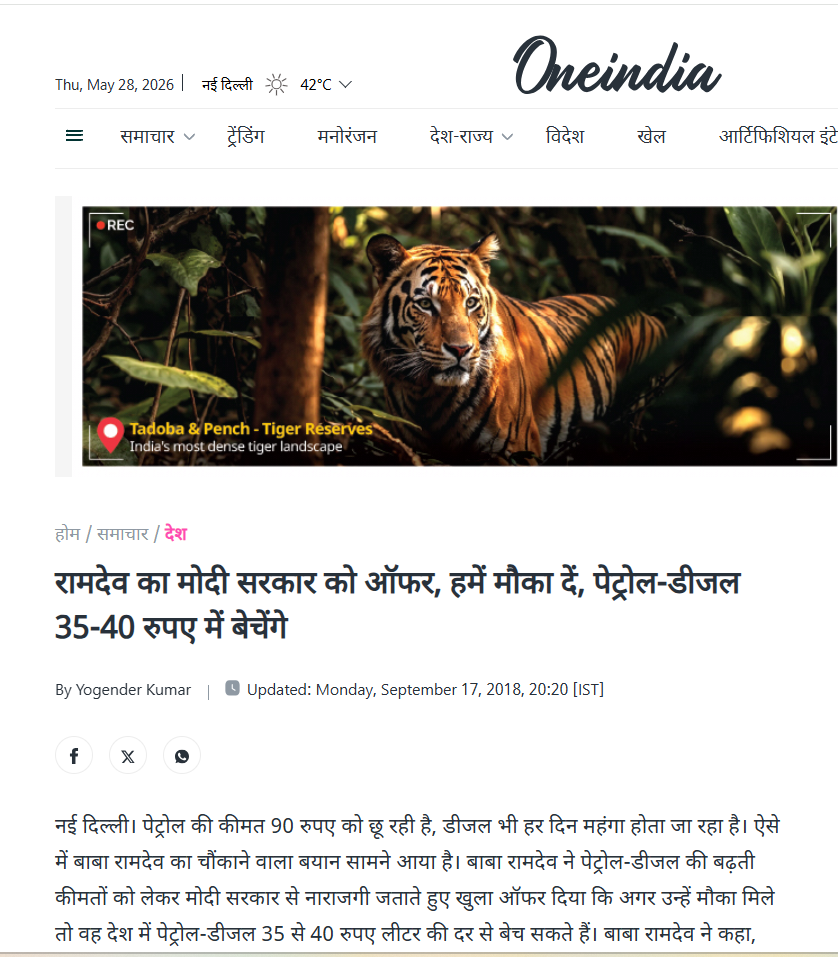
During further searches, we also found reports about the same statement on the website of Oneindia dated September 17, 2018. The report quoted Ramdev as saying that if the government allowed him to set up petrol pumps and offered some tax relief, he could provide fuel at Rs 35-40 per litre. He also suggested bringing petroleum products under GST, preferably in the 5 to 12 percent slab, to provide relief to consumers.
Our research confirmed that Baba Ramdev’s viral statement dates back to 2018 and has no connection with the recent rise in fuel prices.
Conclusion
The viral post was found to be misleading. Baba Ramdev made the statement in September 2018 during a private news channel event. His old remarks are now being circulated out of context to create confusion over the current fuel price situation.

Related Blogs

EXECUTIVE SUMMARY:
A viral video is surfacing claiming to capture an aerial view of Mount Kailash that has breathtaking scenery apparently providing a rare real-life shot of Tibet's sacred mountain. Its authenticity was investigated, and authenticity versus digitally manipulative features were analyzed.
CLAIMS:
The viral video claims to reveal the real aerial shot of Mount Kailash, as if exposing us to the natural beauty of such a hallowed mountain. The video was circulated widely in social media, with users crediting it to be the actual footage of Mount Kailash.


FACTS:
The viral video that was circulated through social media was not real footage of Mount Kailash. The reverse image search revealed that it is an AI-generated video created by Sonam and Namgyal, two Tibet based graphic artists on Midjourney. The advanced digital techniques used helped to provide a realistic lifelike scene in the video.
No media or geographical source has reported or published the video as authentic footage of Mount Kailash. Besides, several visual aspects, including lighting and environmental features, indicate that it is computer-generated.
For further verification, we used Hive Moderation, a deep fake detection tool to conclude whether the video is AI-Generated or Real. It was found to be AI generated.

CONCLUSION:
The viral video claiming to show an aerial view of Mount Kailash is an AI-manipulated creation, not authentic footage of the sacred mountain. This incident highlights the growing influence of AI and CGI in creating realistic but misleading content, emphasizing the need for viewers to verify such visuals through trusted sources before sharing.
- Claim: Digitally Morphed Video of Mt. Kailash, Showcasing Stunning White Clouds
- Claimed On: X (Formerly Known As Twitter), Instagram
- Fact Check: AI-Generated (Checked using Hive Moderation).
%20(1).webp)
Disclaimer:
The information is based on claims made by threat actors and does not imply confirmation of the breach, by CyberPeace. CyberPeace includes this detail solely to provide factual transparency and does not condone any unlawful activities. This information is shared only for research purposes and to spread awareness. CyberPeace encourages individuals and organizations to adopt proactive cybersecurity measures to protect against potential threats.
🚨 Data Breach Alert ⚠️:
Recently The Research Wing of CyberPeace and Autobot Infosec have come across a claim on a threat actor’s dark web website alleging a data breach involving 637k+ records from Federal Bank. According to the threat actor’s claim, the data allegedly includes sensitive details such as-
- 🧑Customer Name
- 🆔Customer ID
- 🏠 Customer Address
- 🎂 Date of Birth
- 🔢 Age
- 🚻 Gender
- 📞Mobile Number
- 🪪 PAN Number
- 🚘 Driving License Number
- 🛂 Passport Number
- 🔑 UID Number
- 🗳️ Voter ID Information
The alleged data was initially discovered on a dark web website, where the threat actors allegedly claimed to be offering the breached information for sale. Following their announcement of the breach, a portion of the data was reportedly published on December 27, 2024. A few days later, the full dataset was allegedly released on the same forum.
About the Threat Actor Group:
Bashe, a ransomware group that emerged in 2024, is claimed to have evolved from the LockBit ransomware group, previously operating under the names APT73 and Eraleig. The group employs data encryption combined with extortion tactics, threatening to release sensitive information if ransom demands are unmet. Their operations primarily target critical industries, including technology, healthcare, and finance, demonstrating a strategic focus on high-value sectors.

Breakdown of the Alleged Post by the Threat Actor:
- Target: Allegedly involves Customer’s Data of Federal Bank.
- Data Volume: Claimed breach includes 637,894 records.
- Data Fields: Threat actor claims the data contains sensitive information, including Customer name, Customer ID, Date of Birth, PAN Number, Age, Gender, Father Name, Spouse Name, Driving Licence, Passport Number, UID Number, Voter ID, District, Zip Code, Home Address, Mailing Address, State etc.
Analysis:
The analysis of the alleged data breach highlights the states purportedly most impacted, along with insights into the affected age groups, gender distribution, and other key insights associated with the compromised data. This evaluation aims to provide a clearer understanding of the claimed breach's scope and its potential demographic and geographic impact.
Top States Impacted:
As per the alleged breached data, Tamil Nadu has the highest number of affected customers, accounting for a significant 34.49% of the total breach. Karnataka follows closely with 26.89%, indicating a substantial number of individuals affected in the state. In contrast states such as Uttar Pradesh, Haryana, Delhi, and Rajasthan report minimal impact, with each state having less than 1% of affected customers. Gujarat records 3.70% of the breach, with a sharp drop in affected numbers from other states, highlighting a significant disparity in the extent of the breach across regions.

Impacted Age Range Statistics:
The alleged data breach has predominantly impacted customers in the 31-40 years age group, which constitutes the largest segment at 35.80% of the affected individuals. Following this, the 21-30 years age group also shows significant impact, comprising 27.72% of those affected. The 41-50 years age group accounts for 20.55% of the impacted population, while individuals aged 50 and above represent 12.68%. In contrast, the 0-20 years age group is the least affected, with only 3.24% of customers falling into this category.

Gender Wise Statistics:
The alleged data breach has predominantly impacted male customers, who constitute the majority at 74.05% of the affected individuals. Female customers account for 23.18%, while a smaller segment, categorized as "Others," constitutes 2.77%.

The alleged dataset from the threat actors indicated that a significant portion of customers' personal identification data was compromised. This includes sensitive information such as driving licenses, passport numbers, UID numbers, voter IDs, and PAN numbers.
Significance of the Allegations:
Though the claims have not been independently verified at our end it underscores the rising risks of cyberattacks and data breaches, especially in the financial and banking sectors. If true, the exposure of such sensitive information could lead to financial fraud, identity theft, and severe reputational damage for individuals and organizations alike.
CyberPeace Advisory:
CyberPeace emphasizes the importance of vigilance and proactive measures to address cybersecurity risks:
- Monitor Your Accounts: Keep a close eye on financial and email accounts for any suspicious activity.
- Update Passwords: Change your passwords immediately and enable Multi Factor Authentication(MFA) wherever possible.
- Beware of Phishing Attacks: Threat actors may exploit the leaked data to craft targeted phishing scams. Do not click on unsolicited links or share sensitive details over email or phone.
- For Organizations: Strengthen data protection mechanisms, regularly audit security infrastructure, and respond swiftly to emerging threats.
- Report: For more assistance or to report cyber incidents, visit https://cybercrime.gov.in or contact our helpline team at helpline@cyberpeace.net.
We advise affected parties and the broader public to stay alert and take necessary precautions. CyberPeace remains committed to raising awareness about cybersecurity threats and advocating for better protection mechanisms. We urge all stakeholders to investigate the claims and ensure appropriate steps are taken to protect the impacted data, if the breach is confirmed. Our Research Wing is actively observing the situation and we aim to collaborate with the stakeholders and relevant agencies to mitigate the impact.
Stay Vigilant! Stay CyberPeaceful.

Executive Summary
A viral image claims that an Israeli helicopter shot down in South Lebanon. This investigation evaluates the possible authenticity of the picture, concluding that it was an old photograph, taken out of context for a more modern setting.

Claims
The viral image circulating online claims to depict an Israeli helicopter recently shot down in South Lebanon during the ongoing conflict between Israel and militant groups in the region.


Factcheck:
Upon Reverse Image Searching, we found a post from 2019 on Arab48.com with the exact viral picture.


Thus, reverse image searches led fact-checkers to the original source of the image, thus putting an end to the false claim.
There are no official reports from the main news agencies and the Israeli Defense Forces that confirm a helicopter shot down in southern Lebanon during the current hostilities.
Conclusion
Cyber Peace Research Team has concluded that the viral image claiming an Israeli helicopter shot down in South Lebanon is misleading and has no relevance to the ongoing news. It is an old photograph which has been widely shared using a different context, fueling the conflict. It is advised to verify claims from credible sources and not spread false narratives.
- Claim: Israeli helicopter recently shot down in South Lebanon
- Claimed On: Facebook
- Fact Check: Misleading, Original Image found by Google Reverse Image Search
