
#FactCheck - Viral Video Distorts Rahul Gandhi’s Speech to Push False Religious Claim
Executive Summary
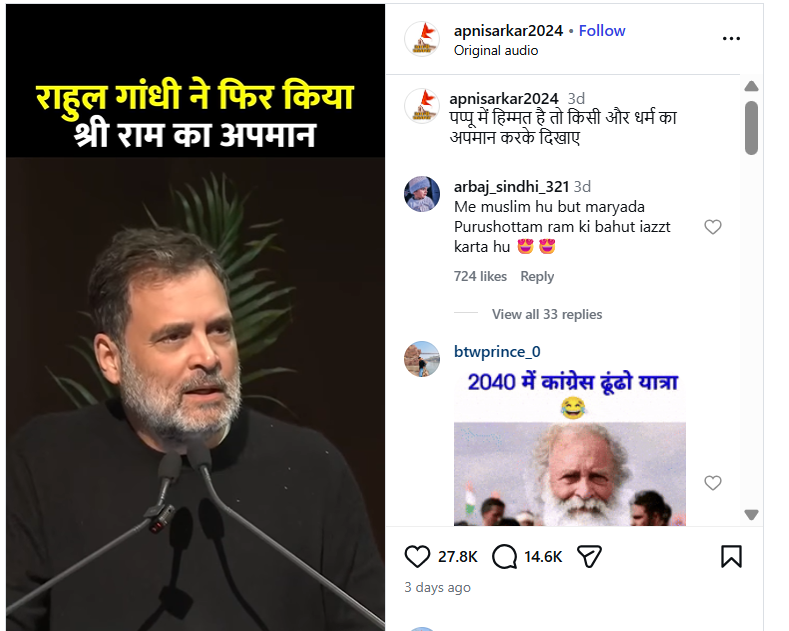
A video of the Leader of the Opposition in the Lok Sabha and Congress MP Rahul Gandhi is being widely shared on social media. In the clip, Gandhi is seen saying that he does not know what “G Gram G” is. Several users are sharing the video with the claim that Rahul Gandhi insulted Lord Ram. However, CyberPeace research found that the claim is misleading. Rahul Gandhi was not referring to Lord Ram in the video. Instead, he was speaking about a newly introduced law titled Viksit Bharat–G RAM G (VB–G RAM G), which has been brought in to replace the Mahatma Gandhi National Rural Employment Guarantee Act (MGNREGA). The viral clip has been shared with a false narrative.
Claim
On January 22, 2026, an Instagram user apnisarkar2024 shared the video claiming, “Rahul Gandhi once again insulted Shri Ram.” (Link, archive link, and screenshot available above)
- https://www.instagram.com/reel/DTzeiy0k3l5
- https://perma.cc/J3A3-NGBM?type=standard
Research
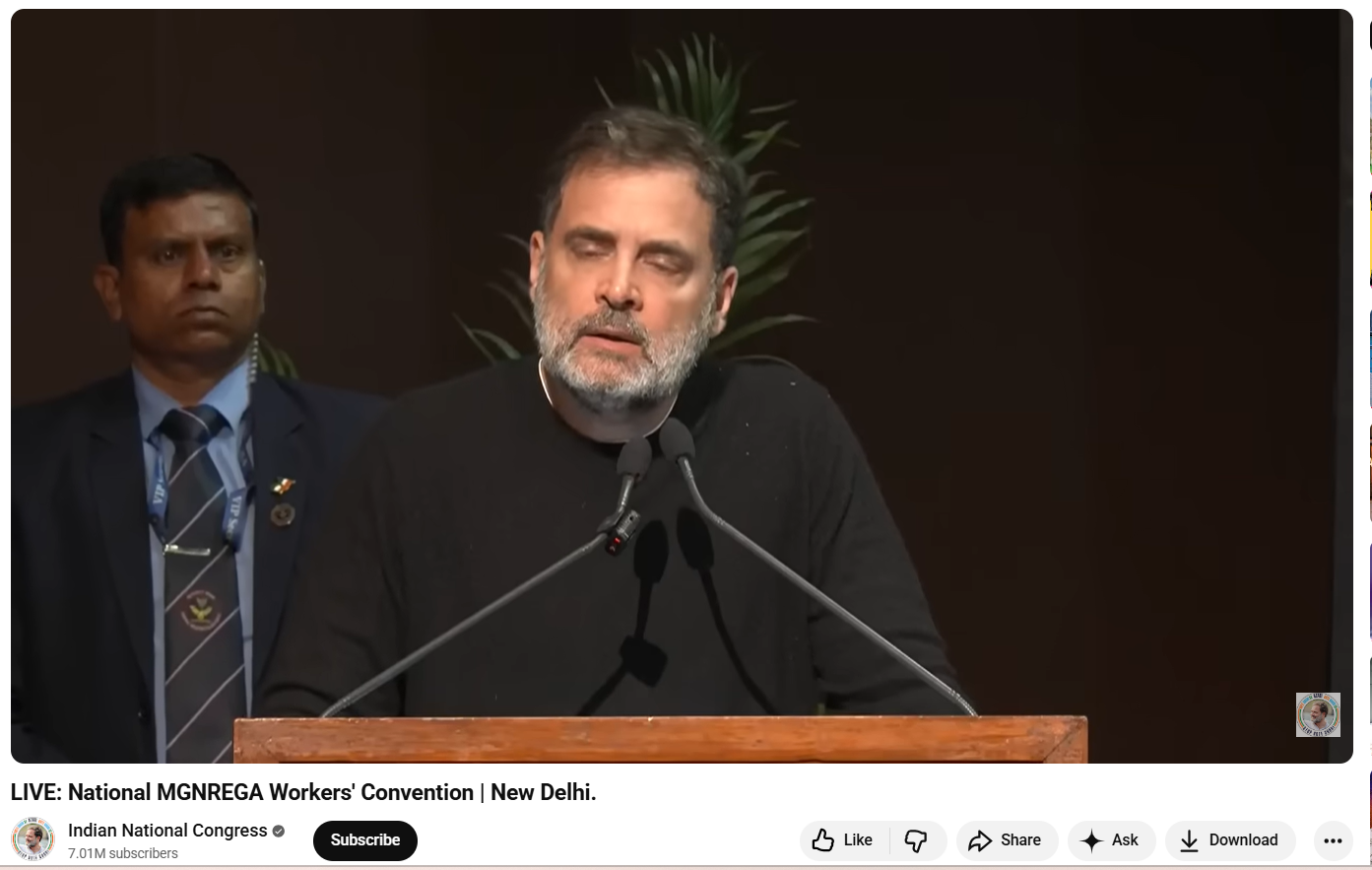
As part of the Research, we first closely examined the viral video. In the clip, Rahul Gandhi is heard saying: “I don’t know what Gram G is. I don’t even know the name of this new law… what is G Gram G…” At no point in the video does Rahul Gandhi mention Lord Ram or make any comment related to religion. To verify the context, we extracted keyframes from the viral clip and conducted a Google Lens search. This led us to a longer version of the same speech uploaded on the official YouTube channel of the Indian National Congress on January 22, 2026. The viral segment appears after the 39:50-minute mark.
The video is from the National MGNREGA Convention held in New Delhi, where Rahul Gandhi criticised the central government over the replacement of MGNREGA with the new VB–G RAM G law. During his speech, he expressed his opposition to the new legislation and stated that he was unfamiliar with its details. Throughout the address, he did not mention or refer to Lord Ram in any manner.
Conclusion
Rahul Gandhi’s remarks in the viral video were related to the newly introduced VB–G RAM G law and were part of his criticism of the central government’s policy decisions. He did not insult Lord Ram. The video is being shared on social media with a misleading and false claim.

Related Blogs

Executive Summary
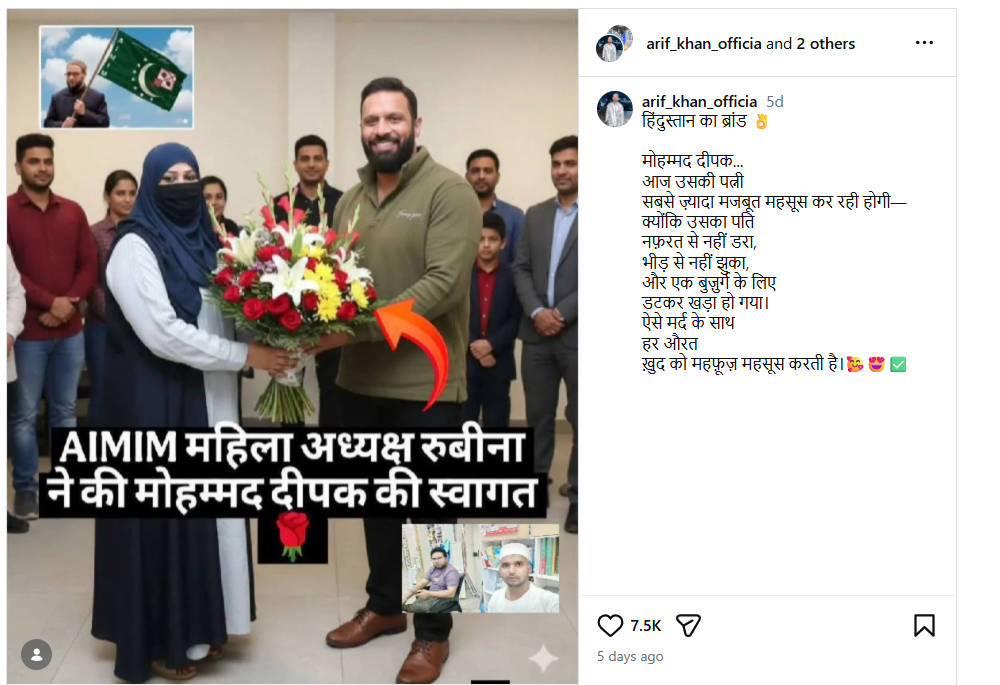
A dispute had recently emerged in Kotdwar, Uttarakhand, over the name of a shop. During the controversy, a local youth, Deepak Kumar, came forward in support of the shopkeeper. The incident subsequently became a subject of discussion on social media, with users expressing varied reactions. Meanwhile, a photo began circulating on social media showing a burqa-clad woman presenting a bouquet to Deepak Kumar. The image is being shared with the claim that All India Majlis-e-Ittehadul Muslimeen (AIMIM)’s women’s president, Rubina, welcomed “Mohammad Deepak Kumar” by presenting him with a bouquet. However, research conducted by the CyberPeace found the viral claim to be false. The research revealed that users are sharing an AI-generated image with a misleading claim.
Claim:
On social media platform Instagram, a user shared the viral image claiming that AIMIM’s women’s president Rubina welcomed “Mohammad Deepak Kumar” by presenting him with a bouquet. The link to the post, its archived version, and a screenshot are provided below.
Fact Check:
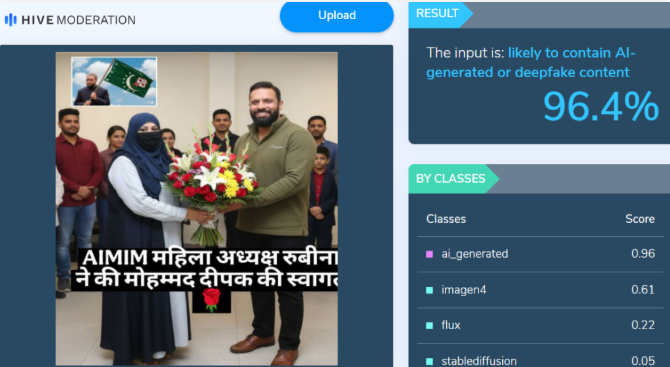
Upon closely examining the viral image, certain inconsistencies raised suspicion that it could be AI-generated. To verify its authenticity, the image was analysed using the AI detection tool Hive Moderation, which indicated a 96 percent probability that the image was AI-generated.
In the next stage of the research , the image was also analysed using another AI detection tool, Wasit AI, which likewise identified the image as AI-generated.

Conclusion
The research establishes that users are circulating an AI-generated image with a misleading claim linking it to the Kotdwar controversy.

Executive Summary
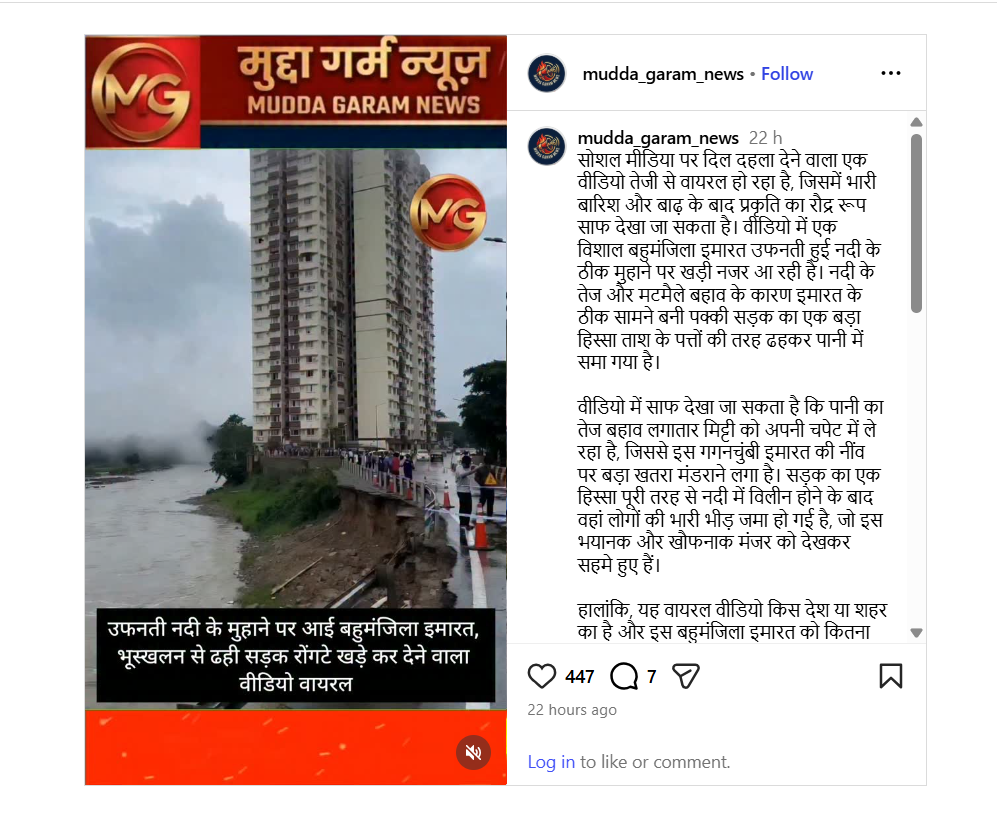
A video is being shared on social media showing a multi-storey building located beside what appears to be a river. A road runs alongside the building, with visible erosion and large cracks. A crowd of people can be seen standing near the edge of the road close to the building. Suddenly, the front portion of the building collapses into the water, followed moments later by the rear section tilting and falling into the river. As the building collapses, people are seen running in panic. The video is being shared with the claim that it shows a real incident in which a multi-storey building collapsed like a house of cards due to heavy rainfall, a swollen river, and severe erosion that also caused part of the road to cave in. CyberPeace Research Wing’s research found the viral claim to be false. Our research revealed that the video is not real. It was generated using Artificial Intelligence (AI) and is being circulated with a false claim.
Claim
An Instagram user shared the viral video on July 15, 2026, claiming that it shows a multi-storey building collapsing into a swollen river due to heavy rainfall and strong water currents, while part of the adjacent road also collapsed because of a landslide.
https://www.instagram.com/reel/DazTcrBCBrI/?utm_source=ig_web_button_share_sheet
Fact Check
To verify the claim, we extracted several keyframes from the viral video and conducted a reverse image search using Google Lens. During the research, we found no credible news reports, authentic videos, or reliable sources related to the incident. However, we found the same video uploaded on a YouTube Shorts channel named @mohammedalmekhlafiht1555. The channel's cover image describes the creator as an "AI & Automation Engineer." In addition, the descriptions of videos uploaded on the channel explicitly mention "Made With AI."
https://youtube.com/shorts/zFotETyAz8E?si=b6wj_eAG-nj7U1HE


We also carried out a detailed visual analysis of the footage. During the collapse, the front portion of the building falls into the water almost as a single block without breaking apart, which is highly unrealistic. After a brief pause, the rear section tilts and also falls almost intact onto the first section, without disintegrating despite the massive impact. The behaviour of people in the video also appears unnatural. Some individuals are seen running with their hands raised, while others inexplicably move toward the collapsing building and even jump into the water. Workers repairing the damaged road appear completely unaffected by the nearby collapse. In a real structural failure of this magnitude, buildings typically break apart into multiple sections, generating debris, dust, and strong shockwaves that would significantly affect nearby people.

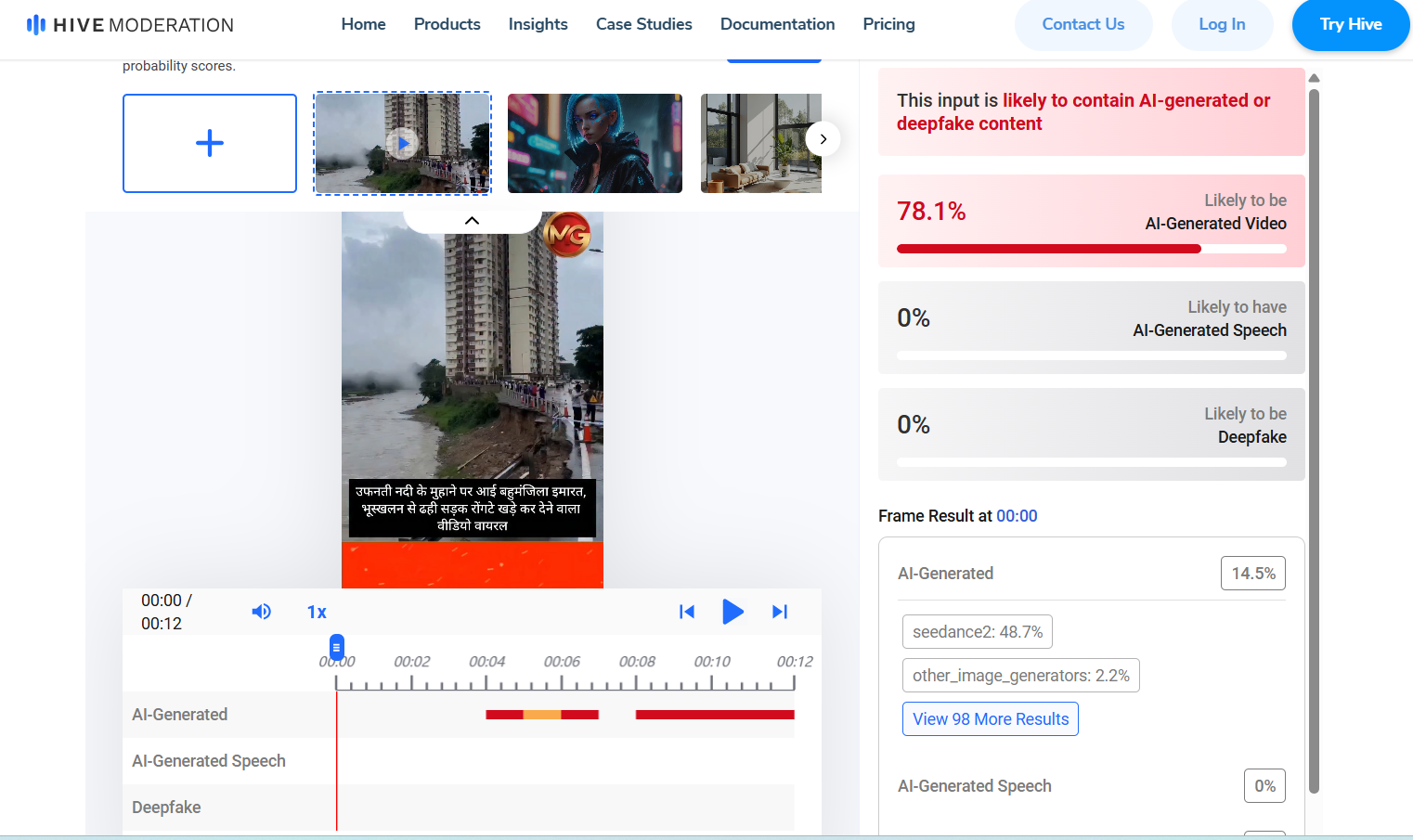
In the next stage of our research, we analysed the video using the AI detection tool Hive Moderation, which indicated a 78.1% probability that the video was AI-generated.
For additional verification, we also examined the video using AI or Not, which concluded that the footage has a 96% probability of being AI-generated.

Finally, we analysed the video using Wasit.AI, which also indicated a 75% probability that the video had been created using Artificial Intelligence.

Conclusion
Our research found that the viral video does not depict a real incident. It was generated using Artificial Intelligence and is being shared on social media with a false and misleading claim that it shows a multi-storey building collapsing into a river due to heavy rainfall and erosion.

Executive Summary
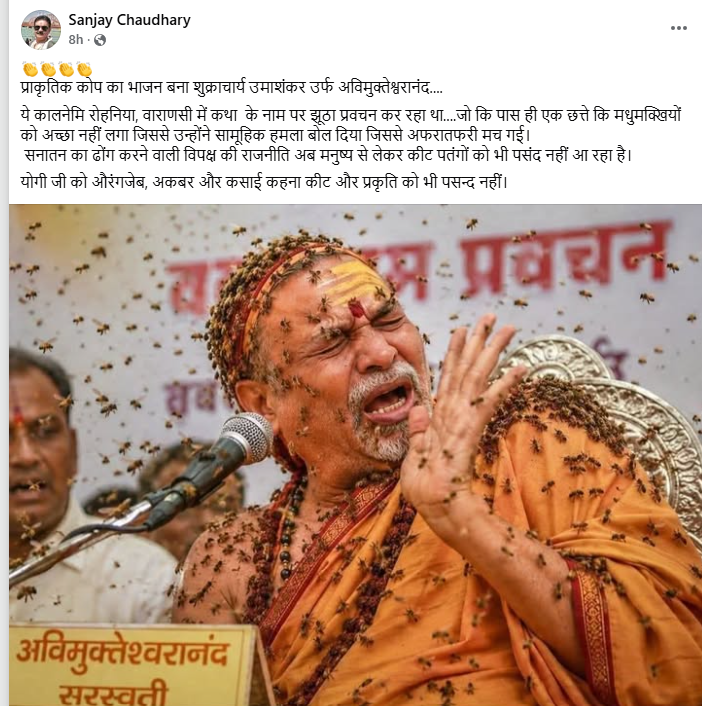
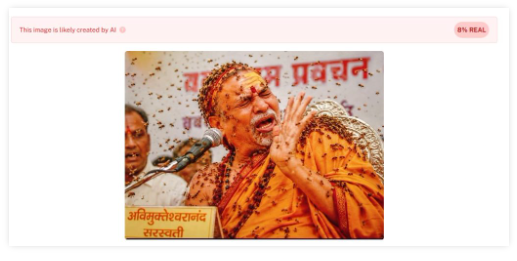
During the Gau Raksha Yatra of Shankaracharya Swami Avimukteshwaranand Saraswati, bees reportedly attacked a discourse event in Rohania area of Varanasi, Uttar Pradesh. Following the incident, a picture has gone viral on social media showing bees attacking Swami Avimukteshwaranand Saraswati. Several users are sharing the image as genuine while targeting the Shankaracharya online. CyberPeace Research Wing investigated the viral image and found it to be fake. Our research revealed that the picture was created using Artificial Intelligence (AI). While it is true that a bee attack occurred during Swami Avimukteshwaranand Saraswati’s discourse program, the viral image itself is fabricated.
Claim
A Facebook user named “Sanjay Chaudhary” shared the viral image on May 15, 2026, with the caption: “Prakritik kop ka bhajan bana Shukracharya Umashankar alias Avimukteshwaranand… This Kaalnemi was delivering false sermons in Rohania, Varanasi in the name of religion… The bees from a nearby hive did not like it and collectively attacked, creating chaos. Even insects and nature no longer like the opposition’s politics disguised as Sanatan Dharma. Calling Yogi Ji Aurangzeb, Akbar and butcher is not acceptable even to nature and insects.”
Post link and archive link are given below:
- https://www.facebook.com/sanjaychaudhary073/posts/pfbid02kgts8igKDwgctz3MamECMGoGfQR5aWPTdsDgLeux3pD9jwP7ADfgNpoPfHvMb9Zul
- https://perma.cc/E6SE-BAXZ
Fact-Check
To verify the viral claim, we used Google Open Search tools and found reports related to the incident on the YouTube channel of News18 UP Uttarakhand. A report published on May 13, 2026 stated that bees attacked the discourse event during Swami Avimukteshwaranand’s Gau Raksha Yatra in Rohania, Varanasi. The incident created panic at the venue, forcing the Swami to end his discourse midway. The channel also uploaded a YouTube Shorts video related to the incident.

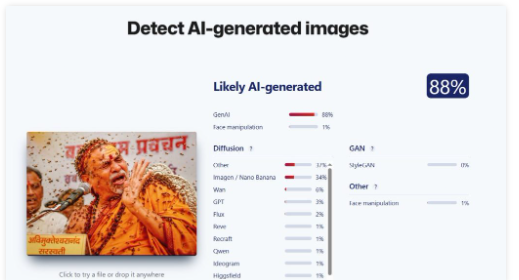
As part of the research, we further analyzed the viral image using AI detection tools. First, we used the tool “Sight Engine,” which indicated an 88 percent probability that the image was AI-generated.
We then examined the image using another AI detection tool called “Undetectable,” which also suggested that the photo was likely created using AI.
Conclusion
Our research found that the viral image is AI-generated. The picture was created using artificial intelligence tools. While bees did attack during Swami Avimukteshwaranand Saraswati’s Gau Raksha Yatra on May 13, 2026, the viral image circulating on social media is fictional and not real.
