
#FactCheck - Old Video of Yogi Adityanath Edited to Push ‘Next PM 2029’ Claim
Executive Summary
A video featuring Uttar Pradesh Chief Minister Yogi Adityanath is being widely shared on social media. In the video, Adityanath can be heard saying, “Let me become the Prime Minister, and Pakistan-occupied Kashmir will also become a part of India.” The video also carries an on-screen text that reads “Next PM 2029.” By sharing this clip, social media users are claiming that Yogi Adityanath is set to become India’s Prime Minister in 2029.
However, CyberPeace research found the viral claim to be misleading. Our research revealed that the video circulating online has been edited and is being shared out of context. The original video dates back to May 2024. In the original footage, Yogi Adityanath is not speaking about himself. Instead, he is referring to Prime Minister Narendra Modi.
In the original statement, Adityanath says:
“Let Modi ji become Prime Minister for the third time, and within the next six months, Pakistan-occupied Kashmir will also become a part of India.”
It is evident that the video has been trimmed and misleading text has been added to falsely portray the statement as a declaration about Yogi Adityanath becoming Prime Minister in 2029.
Claim
A YouTube user shared the viral video on January 29, 2026, claiming that Yogi Adityanath said, “Let me become Prime Minister, and Pakistan-occupied Kashmir will be part of India.” The video carries the caption “Next PM 2029,” suggesting that Adityanath is set to become the Prime Minister in 2029.
Link to the post n archive

Fact Check:
To verify the viral claim, we first conducted a keyword search on Google. During this process, we found a report published by Aaj Tak on May 18, 2024. According to the report, Yogi Adityanath stated that if Narendra Modi becomes Prime Minister for the third time, Pakistan-occupied Kashmir would become part of India within six months.
Report link:
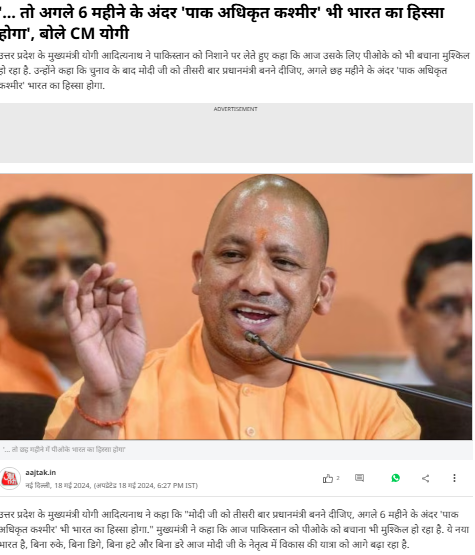
Next, we extracted keyframes from the viral video and ran them through Google Lens. This led us to the official YouTube channel of Yogi Adityanath, where the same video was uploaded on May 18, 2024.
Original video link:

In the original video, Yogi Adityanath clearly makes the statement in reference to Prime Minister Narendra Modi, not himself.Finally, we compared the viral clip with the original footage. The visuals in both videos are identical; however, the viral version has been edited and overlaid with misleading text to change the meaning of the statement.
Conclusion
Our research confirms that the viral video is edited and misleading. The original video is from May 2024, in which Yogi Adityanath was speaking about Prime Minister Narendra Modi, not about himself becoming Prime Minister in 2029. The video has been falsely altered and shared with a deceptive claim on social media.

Related Blogs

Introduction
Meta's bet that smart glasses will succeed the smartphone as the dominant personal computing device is, commercially, already paying off. EssilorLuxottica, the eyewear manufacturer that builds the Ray-Ban and Oakley Meta product lines, reported selling more than seven million pairs of AI-enabled glasses in 2025 alone, more than tripling the previous year's sales. Chief Executive Mark Zuckerberg has framed the shift as inevitable, comparing it in a recent interview to the transition from flip phones to smartphones and predicting that within a few years, eyewear without embedded AI will put its wearer at a disadvantage.
Yet as adoption accelerates, two features in various stages of internal testing have pulled Meta back into a familiar and uncomfortable position: at the centre of a privacy controversy over exactly how much a camera- and microphone-equipped wearable can quietly learn about the people around it.
NameTag and the return of facial recognition
In June 2026, the technology publication Wired reported that it had found dormant code for a facial-recognition system, internally called NameTag, embedded inside the Meta AI companion app that pairs with the company's smart glasses – an app that had by then been downloaded more than 50 million times. According to that reporting, the system relies on a pipeline of on-device AI models that detect a face, store it locally on the wearer's phone, and match it against previously saved "faceprints", alerting the wearer when it recognises someone they met before. Meta's Chief Technology Officer, Andrew Bosworth, has described the intended design as privacy-conscious: identification data would be encrypted locally, accessible only while the glasses are being worn, and would not populate a centralised company database. He has pitched the feature as a solution to the everyday difficulty of recalling names and past conversations.
Privacy researchers and advocacy groups have been considerably less reassured. One technologist with the Electronic Frontier Foundation’s Threat Lab who analysed the code concluded that despite having been deactivated, it appeared to be near-complete, and more recent reporting connected a portion of Meta’s facial recognition software licensing to Rank One Computing, a vendor that has also licensed similar tech to both U.S. law enforcement and military groups. Meta took the code down immediately after the story’s publication and claims no decision has been made regarding a public rollout.
"Super sensing" and always-on capture
A second, less publicised effort has drawn similar concern. The Financial Times reported in July 2026 that Meta is internally prototyping glasses, under the working concept "super-sensing", designed to capture ambient audio continuously and take still images every few seconds throughout the day, building a searchable log that a wearer's AI assistant could later query to recall where an item was left or what was discussed earlier. Notably, that reporting indicated Meta had discussed shipping the feature without activating the small LED indicator that currently signals when the glasses' camera is capturing photos or video the very light Meta had just reinforced against tampering on its existing hardware. Critics point out that the indicator is already a limited safeguard, since it is easily missed and unfamiliar to most bystanders; removing it during continuous, always-on capture would eliminate the one visible cue currently available to people nearby.
A pattern regulators are watching closely
Both features have emerged against a backdrop of substantial legal exposure. Meta has previously paid roughly two billion dollars combined in biometric-privacy settlements tied to earlier facial-recognition systems on Facebook, including $650 million under Illinois's Biometric Information Privacy Act and $1.4 billion to the state of Texas.
A separate class action filed in early 2026 alleges that footage captured by smart-glasses users, including intimate recordings from inside private homes, was reviewed by outside contractors in Kenya for AI-training purposes, a claim that prompted an inquiry from the United Kingdom's Information Commissioner's Office. The Texas Attorney General has opened its own civil investigation into the glasses' data practices. Because U.S. federal privacy law remains fragmented, enforcement of claims like these is likely to continue playing out state by state through statutes such as BIPA, which allow individuals to sue directly, even as the European Union's AI Act imposes separate restrictions on biometric processing within Europe.
Why this matters beyond Meta
For readers focused on cybersecurity and digital privacy, the common thread running through NameTag and super sensing is consent architecture. The smart glasses take in not just what you’re up to but also the location, face, clothes and conversation patterns of anyone within the glasses’ field of vision – all without their consent. Where raising a smartphone to take a photo leaves no ambiguity to nearby observers, glasses made to look like normal eyewear leaves fewer visual and verbal tells of what is actually occurring behind a set of seemingly average lenses. According to security experts and law professors, wiretap laws and the patchwork of existing statutes addressing biometric data aren't prepared for the kind of invisible monitoring that AI-enabled eyeglasses from Meta, and eventually others, are capable of. It's that imbalance between a technology’s unseen power and the limitations of the average person’s awareness that is sure to be the main source of conflict.
CyberPeace Insights
Wearable AI holds real promise for accessibility and everyday convenience, and Meta's continued investment reflects where personal computing is headed. At the same time, features like NameTag and "super-sensing" show why privacy-by-design must stay foundational, not incidental, as this space matures. The core issue isn't innovation itself but consent — ensuring bystanders retain visible, reliable cues when a device is active. Meta's stated moves toward on-device processing and encryption are worth acknowledging as steps in the right direction. CyberPeace believes continued dialogue between industry, regulators, and researchers, rather than adversarial scrutiny alone, is the surest path to public trust.
Conclusion
Meta maintains that both NameTag and Super Sensing remain unreleased and unconfirmed for commercial launch and are subject to further internal review. Executives have publicly disputed characterisations suggesting either feature is further along than the company has described. Even so, the recurring pattern of infrastructure for sensitive capabilities surfacing through independent reporting rather than company disclosure is what has kept privacy advocates, journalists, and regulators paying close attention. It suggests that as smart glasses move from novelty item to mass-market device, the terms of that transition will be shaped as much by courts, regulators, and public pressure as by Meta's own product roadmap.
References
- https://www.magzter.com/stories/newspaper/Mint-Mumbai/METAS-FLOOD-OF-SMARTGLASSES-HAS-PRIVACY-ADVOCATES-UP-IN-ARMS
- Engadget — Wired found code for an unreleased facial recognition feature in Meta's AI app
- Malwarebytes Labs — Meta's face-recognition code raises new concerns about smart glasses
- Kaspersky Daily — What's wrong with Meta's NameTag feature and why you should be wary of it
- Biometric Update — AI glasses reveal widening gap between Meta's privacy safeguards and AI ambitions
- Fortune — Meta added a privacy-safety feature to its AI glasses but is reportedly testing a 'super-sensing' prototype
- MacRumors — Meta's 'Super Sensing' Prototype Glasses Quietly Record Everything
- TechCrunch — Meta sued over AI smart glasses' privacy concerns, after workers reviewed nudity, sex, and other footage

Introduction
Artificial Intelligence (AI) is fast transforming our future in the digital world, transforming healthcare, finance, education, and cybersecurity. But alongside this technology, bad actors are also weaponising it. More and more, state-sponsored cyber actors are misusing AI tools such as ChatGPT and other generative models to automate disinformation, enable cyberattacks, and speed up social engineering operations. This write-up explores why and how AI, in the form of large language models (LLMs), is being exploited in cyber operations associated with adversarial states, and the necessity for international vigilance, regulation, and AI safety guidelines.
The Shift: AI as a Cyber Weapon
State-sponsored threat actors are misusing tools such as ChatGPT to turbocharge their cyber arsenal.
- Phishing Campaigns using AI- Generative AI allows for highly convincing and grammatically correct phishing emails. Unlike the shoddily written scams of yesteryears, these AI-based messages are tailored according to the victim's location, language, and professional background, increasing the attack success rate considerably. Example: It has recently been reported by OpenAI and Microsoft that Russian and North Korean APTs have employed LLMs to create customised phishing baits and malware obfuscation notes.
- Malware Obfuscation and Script Generation- Big Language Models (LLMs) such as ChatGPT may be used by cyber attackers to help write, debug, and camouflage malicious scripts. While the majority of AI instruments contain safety mechanisms to guard against abuse, threat actors often exploit "jailbreaking" to evade these protections. Once such constraints are lifted, the model can be utilised to develop polymorphic malware that alters its code composition to avoid detection. It can also be used to obfuscate PowerShell or Python scripts to render them difficult for conventional antivirus software to identify. Also, LLMs have been employed to propose techniques for backdoor installation, additional facilitating stealthy access to hijacked systems.
- Disinformation and Narrative Manipulation
State-sponsored cyber actors are increasingly employing AI to scale up and automate disinformation operations, especially on election, protest, and geopolitical dispute days. With LLMs' assistance, these actors can create massive amounts of ersatz news stories, deepfake interview transcripts, imitation social media posts, and bogus public remarks on online forums and petitions. The localisation of content makes this strategy especially perilous, as messages are written with cultural and linguistic specificity, making them credible and more difficult to detect. The ultimate aim is to seed societal unrest, manipulate public sentiments, and erode faith in democratic institutions.
Disrupting Malicious Uses of AI – OpenAI Report (June 2025)
OpenAI released a comprehensive threat intelligence report called "Disrupting Malicious Uses of AI" and the “Staying ahead of threat actors in the age of AI”, which outlined how state-affiliated actors had been testing and misusing its language models for malicious intent. The report named few advanced persistent threat (APT) groups, each attributed to particular nation-states. OpenAI highlighted that the threat actors used the models mostly for enhancing linguistic quality, generating social engineering content, and expanding operations. Significantly, the report mentioned that the tools were not utilized to produce malware, but rather to support preparatory and communicative phases of larger cyber operations.
AI Jailbreaking: Dodging Safety Measures
One of the largest worries is how malicious users can "jailbreak" AI models, misleading them into generating banned content using adversarial input. Some methods employed are:
- Roleplay: Simulating the AI being a professional criminal advisor
- Obfuscation: Concealing requests with code or jargon
- Language Switching: Proposing sensitive inquiries in less frequently moderated languages
- Prompt Injection: Lacing dangerous requests within innocent-appearing questions
These methods have enabled attackers to bypass moderation tools, transforming otherwise moral tools into cybercrime instruments.
Conclusion
As AI generations evolve and become more accessible, its application by state-sponsored cyber actors is unprecedentedly threatening global cybersecurity. The distinction between nation-state intelligence collection and cybercrime is eroding, with AI serving as a multiplier of adversarial campaigns. AI tools such as ChatGPT, which were created for benevolent purposes, can be targeted to multiply phishing, propaganda, and social engineering attacks. The cross-border governance, ethical development practices, and cyber hygiene practices need to be encouraged. AI needs to be shaped not only by innovation but by responsibility.
References
- https://www.microsoft.com/en-us/security/blog/2024/02/14/staying-ahead-of-threat-actors-in-the-age-of-ai/
- https://www.bankinfosecurity.com/openais-chatgpt-hit-nation-state-hackers-a-28640
- https://oecd.ai/en/incidents/2025-06-13-b5e9
- https://www.microsoft.com/en-us/security/security-insider/meet-the-experts/emerging-AI-tactics-in-use-by-threat-actors
- https://www.wired.com/story/youre-not-ready-for-ai-hacker-agents/
- https://www.cert-in.org.in/PDF/Digital_Threat_Report_2024.pdf
- https://cdn.openai.com/threat-intelligence-reports/5f73af09-a3a3-4a55-992e-069237681620/disrupting-malicious-uses-of-ai-june-2025.pdf

Introduction
A bill requiring social media companies, providers of encrypted communications, and other online services to report drug activity on their platforms to the U.S. The Drug Enforcement Administration (DEA) advanced to the Senate floor, alarming privacy advocates who claim the legislation transforms businesses into de facto drug enforcement agents and exposes many of them to liability for providing end-to-end encryption.
Why is there a requirement for online companies to report drug activity?
The reason behind the bill is that there was a Kansas teenager died after unknowingly taking a fentanyl-laced pill he purchased on Snapchat. The bill requires social media companies and other web communication providers to provide the DEA with users’ names and other information when the companies have “actual knowledge” that illicit drugs are being distributed on their platforms.
There is an urgent need to look into this matter as platforms like Snapchat and Instagram are the constant applications that netizens use. If these kinds of apps promote the selling of drugs, then it will result in major drug-selling vehicles and become drug-selling platforms.
Threat to end to end encryption
End-to-end encryption has long been criticised by law enforcement for creating a “lawless space” that criminals, terrorists, and other bad actors can exploit for their illicit purposes. End- to end encryption is important for privacy, but it has been criticised as criminals also use it for bad purposes that result in cyber fraud and cybercrimes.
Cases of drug peddling on social media platforms
It is very easy to get drugs on social media, just like calling an Uber. It is that simple to get the drugs. The survey discovered that access to illegal drugs is “staggering” on social media applications, which has contributed to the rising number of fentanyl overdoses, which has resulted in suicide, gun violence, and accidents.
According to another survey, drug dealers use slang, emoticons, QR codes, and disappearing messages to reach customers while avoiding content monitoring measures on social networking platforms. Drug dealers are frequently active on numerous social media platforms, advertising their products on Instagram while providing their WhatApps or Snapchat names for queries, making it difficult for law officials to crack down on the transactions.
There is a need for social media platforms to report these kinds of drug-selling activity on specific platforms to the Drug enforcement administration. The bill requires online companies to report drug cases going on websites, such as the above-mentioned Snapchat case. There are so many other cases where drug dealers sell the drug through Instagram, Snapchat etc. Usually, if Instagram blocks one account, they create another account for the drug selling. Just by only blocking the account does not help to stop drug trafficking on social media platforms.
Will this put the privacy of users at risk?
It is important to report the cybercrime activities of selling drugs on social media platforms. The companies will only detect the activity regarding the drugs which are being sold through social media platforms which are able to detect bad actors and cyber criminals. The detection will be on the particular activities on the applications where it is happening because the social media platforms lack regulations to govern them, and their convenience becomes the major vehicle for the drugs sale.
Conclusion
Social media companies are required to report these kinds of activities happening on their platforms immediately to the Drugs enforcement Administration so that the DEA will take the required steps instead of just blocking the account. Because just blocking does not stop these drug markets from happening online. There must be proper reporting for that. And there is a need for social media regulations. Social media platforms mostly influence people.
