
#FactCheck - Viral Video Falsely Linked to Netanyahu’s Brother’s Death, Old Funeral Clip Misused
Executive Summary:
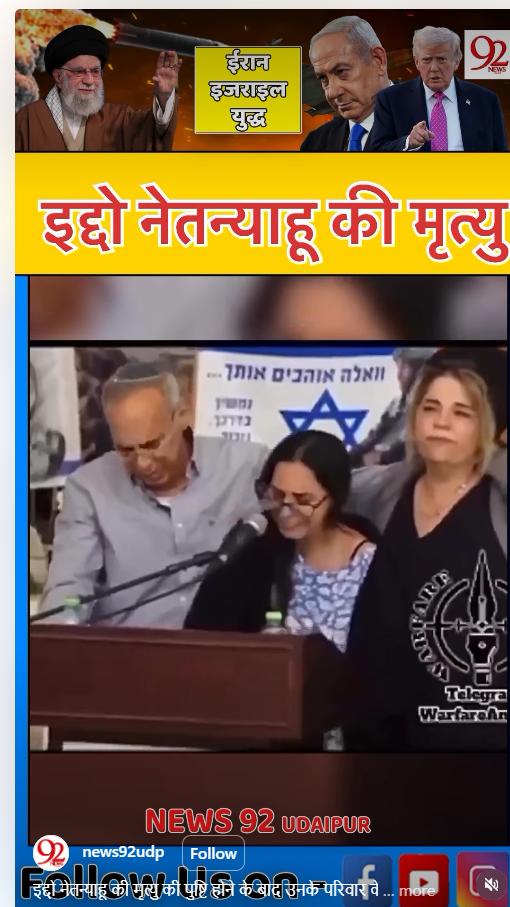
A video is going viral on social media claiming to show family members mourning the death of Iddo Netanyahu, brother of Israeli Prime Minister Benjamin Netanyahu. However, an research by the CyberPeace found that the claim being shared with the video is false. The video has been available on the internet since 2024. According to available information, it shows the funeral of an Israeli soldier who was killed in an attack in the Jabalia area of northern Gaza.Moreover, no credible news reports were found confirming the death of Iddo Netanyahu.
Claim:
An Instagram user shared the viral video with an English caption stating, “Family members are crying after the death of Iddo Netanyahu was confirmed.”
Fact Check:
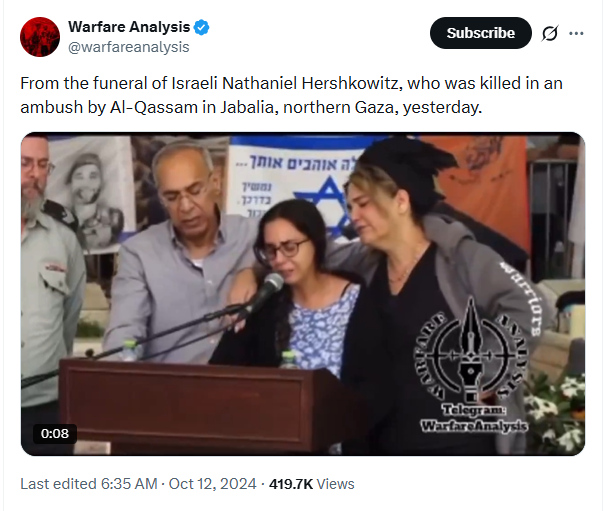
During the investigation, we found the original video on an X (formerly Twitter) account named Warfare Analysis. The video was posted on October 12, 2024, confirming that it predates the recent Iran-Israel conflict. Notably, the “Warfare Analysis” logo is also visible in the viral video. According to the caption, the footage shows the funeral of Israeli soldier Netanel Hershkovit, who was killed on October 11, 2024, in an attack by Al-Qassam in Jabalia, northern Gaza.
A report published by VIN News on October 12, 2024, also covered the funeral of Netanel Hershkovit and included statements from his family members.
Conclusion:
Our research found that the claim shared with the video is false. The video has been online since 2024 and shows the funeral of an Israeli soldier killed in northern Gaza. Additionally, no credible reports confirm the death of Iddo Netanyahu.

Related Blogs
Executive Summary:
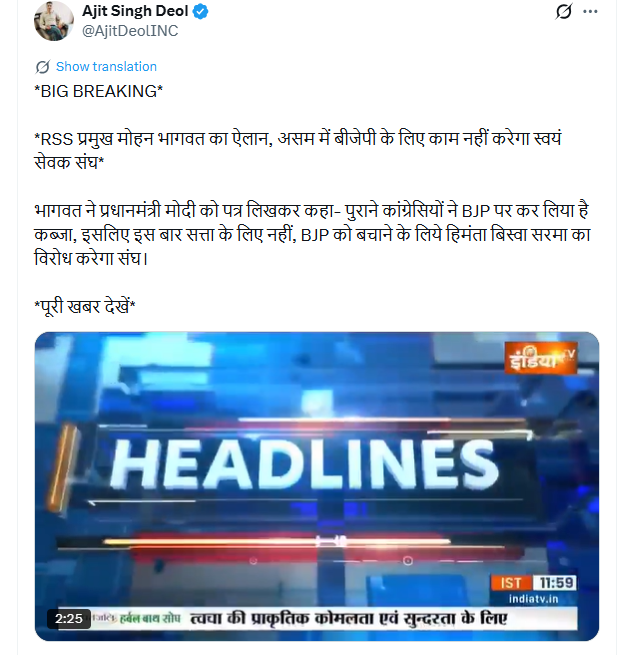
A video from an India TV news show related to the Assam elections is going viral on social media. In the clip, anchor Meenakshi Joshi is allegedly seen claiming that there is a rift between the BJP and the RSS in Assam. The video further suggests that RSS chief Mohan Bhagwat wrote a letter to Prime Minister Narendra Modi stating that former Congress members have taken over the BJP, and that RSS volunteers would not work for the party in Assam. However, a research by the CyberPeace found that the viral video is edited and misleading. The original video contains no such claims.
Claim:
A social media user Ajit Singh shared the video on X with the caption:“The core idea of today’s BJP is to capture power by any means. We have been saying this for long, and now even RSS has accepted that BJP in Assam has been taken over by Congress mindset.”
Fact Check:
To verify the claim, we searched relevant keywords about the alleged letter by RSS chief Mohan Bhagwat to Prime Minister Narendra Modi. However, we found no credible media reports supporting this claim. We then checked the YouTube channel of India TV but could not find the viral clip there. During the search, we did find a similar video from Meenakshi Joshi’s show. In the beginning of that video, the portion seen in the viral clip appears.
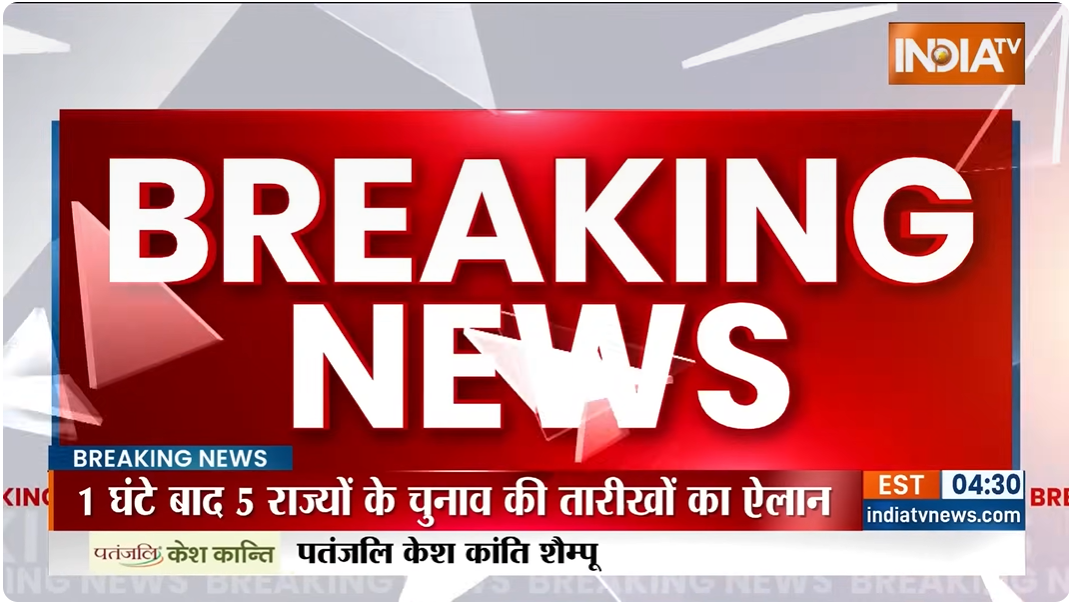
In the original video, the anchor is discussing the announcement of election dates in five states. There is no mention of any rift between the BJP and RSS in Assam.
Conclusion:
The viral India TV video claiming a rift between the BJP and RSS in Assam is edited and misleading. The original broadcast was about election dates in five states and did not include any such claims.
Introduction
In May 2025, at Mumbai’s first-ever World Audio Visual and Entertainment Summit (WAVES), PM Narendra Modi marked a turning point: the rise of what he called India's Orange Economy. Here lies a new path to growth - one built less on factories, more on invention, artistry, and spreading thought globally. While aiming for massive economic scale, India finds its creative industries movies, sound, games, cartoons, clothing design, books, online media stepping forward.
First appearing in a 2013 guide from the Inter-American Development Bank, the phrase 'orange economy' emerged through work by Felipe Buitrago Restrepo and Iván Duque Márquez, suggesting past neglect in defining how culture connects with economic activity. Because orange stands for imagination and heritage in many societies, it became the label for this particular sector of economic life..
According to UNESCO’s 2022 Global Report Reshaping Policies for Creativity, the cultural and creative sectors account for 3.1% of world GDP and employ 6.2% of the global workforce – more than the total number of people employed in car manufacturing in Europe, Japan and the U.S. Meanwhile, UNCTAD's 2024 Creative Economy Outlook shows cross-border trade in creative services hit $1.4 trillion in 2022, up nearly a third from five years ago, demonstrating how imagination is remaking modern commerce.
In his book The Creative Economy, economist John Howkins states that the creative economy is essentially about the relationship between creativity and economics, where ideas themselves are products, and imagination becomes a form of capital.
India’s Slice of Orange
The Scale of Opportunity
Despite its potential, India’s role in the global creative economy remains largely untapped. According to the FICCI-EY Media and Entertainment Report, the country’s media and entertainment sector ranks among the world’s most rapidly expanding, fueled by a youthful demographic that is increasingly online and earning more. Boasting over 600 million people using the internet, it hosts a vibrant network of creators - musicians in Guwahati, podcasters in Kochi, game developers in Bengaluru, filmmakers in Punjab - who together form a rich pool of talent unlike any other.
Now comes a shift at the WAVES Summit, where PM Modi framed content, creativity, and culture as core to an emerging economy. Not just products but ideas take center stage here, he suggested, during what he described as the ideal time to build from India for global impact. While earlier efforts pushed factory output under Make in India, this approach turned toward thinking work - where stories, visual forms, and online expression shape progress. Thought becomes product; imagination fuels industry.
Creative Industries Leading Change
What many people don’t know is that India makes more films than any other country. The films made in Tamil, Telugu, Malayalam or Kannada are also widely circulated outside India, not just the output of Mumbai. Streaming services such as Netflix and Amazon Prime carry these works, reaching far beyond local audiences. Furthermore, India’s gaming industry is nascent but growing rapidly, and is attracting increasing attention from policy makers. Until recently, studios around the world have not relied on Indian teams for animation and visual effects. Now, local creators are slowly building their own game franchises. Momentum is shifting - original ideas once rare now appear more often across the country. Deep within India’s craft traditions handwoven textiles, carved block patterns, intricate metallic threadwork lies a quiet fusion of legacy and modern expression. Viewed anew through the framework of creative enterprise, such practices reveal dual value: access to global markets alongside sustenance for village-based makers. Rather than mere relics, they function as living systems where art meets income. Changes in perception make them economic opportunities, rather than local crafts. Every stitch, every weave, is not just technique but the weight of continuity in the face of change. And today, streaming platforms allow independent musicians in India to connect directly to listeners worldwide.
The Three T’s: Technology Talent Tolerance
Richard Florida, an economist, in his work The Rise of the Creative Class once proposed a model where city progress ties closely to innovation, skilled individuals, and openness. His idea - crafted originally for U.S. urban areas fits well when viewing India today. Growth now depends less on old industries, more on environments that attract capable minds through flexibility. Regions thrive not just by building tech hubs but by welcoming diverse lifestyles. One factor feeds another: talent flows where freedom exists, ideas grow where tools are available. A place gains momentum only if it supports all three at once.
Technology
A tool opens doors. Low-cost internet, budget phones, together with government-backed digital expansion, made making content possible for nearly anyone. The focus should be on accessibility and last mile delivery.
Talent
Home to the youngest population on Earth, it sees countless imaginative minds emerge yearly from schools that now encourage original thinking. Still, despite rising worldwide interest in what these individuals produce, many cannot cover basic needs - a gap highlighted by UNESCO’s 2022 findings. But this contradiction lacks for systems that ensure fair pay, protect ideas, and offer stability beyond fleeting projects.
Tolerance
Openness to difference, trial, and unusual thinking shapes the trickier part of the equation. The wide mix of tongues, beliefs, and cultural expressions in India adds real value. Still, fostering innovation demands systems willing to adapt with rules safeguarding free expression, fair access for women in arts sectors, smoother paths for excluded groups.
Challenges on the Path to “Create in India”
India has millions of creators who influence culture but struggle to make a regular income from their work. Platforms take the lion’s share of profits, but those creating content, especially outside the big cities, often don’t have legal help, fair contracts or links with brands.
Another issue is Intellectual Property Literacy, IP rules such as copyright, trademark and patent systems empower the creative economy. Still, uneven understanding and spotty enforcement across India put many creators at risk of unfair use. Surprisingly, UNESCO’s 2022 assessment points to missing global standards for measuring creative sectors. Because of this gap, India faces challenges in shaping precise policy moves. Without detailed cultural satellite accounts, tracking progress remains uneven. Sector-specific figures would help fill these blind spots. Otherwise, decisions rely on incomplete information.Lastly, across the world, female professionals in artistic fields hold fewer top roles while earning less than men - a gap clearly seen in India too. To shape a fairer cultural sector, intentional strategies must elevate women, indigenous makers, and creators with disabilities.
Conclusion
In India, where young energy meets tradition through digital tools. Stories once shared locally now move across borders, carried by platforms that turn art into income. Because of this shift, music and fashion gain reach but only if creators can protect their work. Without fair pay or legal backing, even brilliant ideas fade quietly. Support systems matter, not just ambition. Recognition from society shapes whether fresh voices endure. In 2022, UNESCO’s report showed that although more people want to do creative work, those who create it still find it hard to make a living. New ideas offer a way forward, not to copy what exists, culture is then voice and value all at once.
References
- https://sprf.in/from-make-in-india-to-create-in-india-charting-indias-orange-economy-frontier/
- https://www.unesco.org/reports/reshaping-creativity/2022/en
- https://iasscore.in/current-affairs/indias-orange-economy
- https://indiasworld.in/the-dawn-of-indias-orange-economy/
- Marta-Christina Suciu, "The Creative Economy" (Academy of Economic Studies, Bucharest)
- John Howkins, The Creative Economy: How People Make Money from Ideas (2001)
- Richard Florida, The Rise of the Creative Class (2002)
- UNCTAD, Creative Economy Outlook 2024
- SPRF, "From Make in India to Create in India" (December 2025)
- IDB, The Orange Economy: An Infinite Opportunity (2013)
Executive Summary
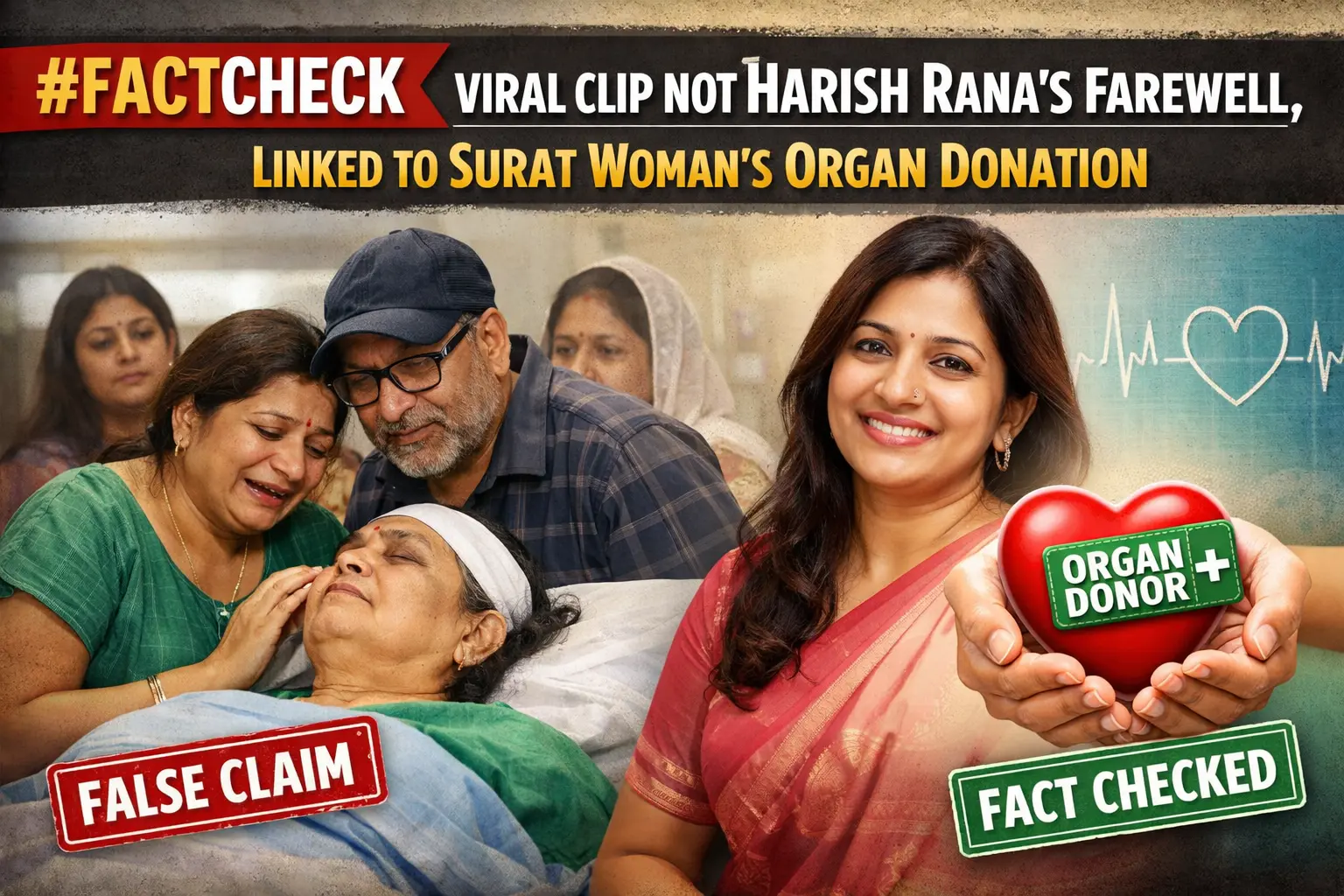
Amid reports that AIIMS Delhi has initiated the process to implement the Supreme Court’s decision allowing passive euthanasia for Harish Rana, a video is being shared on social media claiming to show his emotional farewell. However, research by the CyberPeace found the viral claim to be misleading. Our research revealed that the video has no connection to the Harish Rana case. In reality, the footage is from Surat, Gujarat, where the family of a 45-year-old brain-dead woman donated her organs.
Claim:
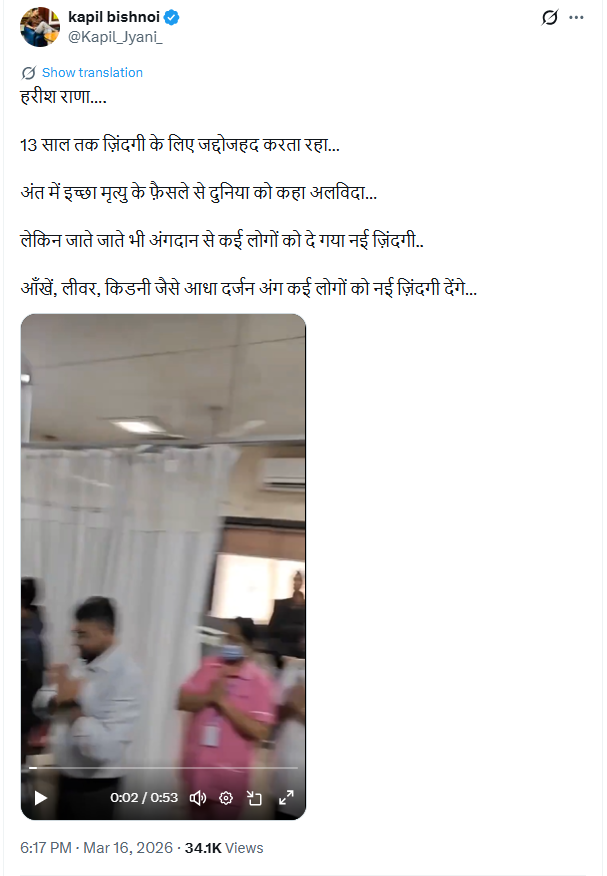
On social media platform X (formerly Twitter), a user shared the viral video on March 16, 2026, with the caption:
“Harish Rana… struggled for life for 13 years… in the end said goodbye to the world through euthanasia… but even while leaving, gave new life to many through organ donation… eyes, liver, kidneys and several other organs will give a new life to many…”
Post link and archive link are given below:
Fact Check
We took screenshots from the viral video and conducted a reverse image search. This led us to an Instagram handle where the same video was uploaded on January 27, 2026.
- https://www.instagram.com/reels/DUAt_42k2ME/
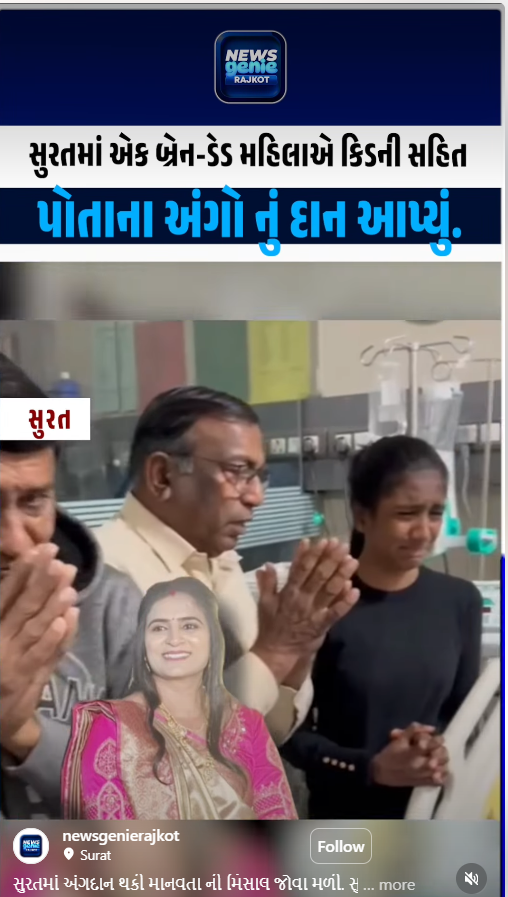
According to the caption on the Instagram post, the video shows a brain-dead woman in Surat whose liver, both kidneys, and eyes were donated. The post also included an image of the woman. Based on clues from the viral video, we conducted a keyword search on Google and found a report on the website of News18 Gujarati.
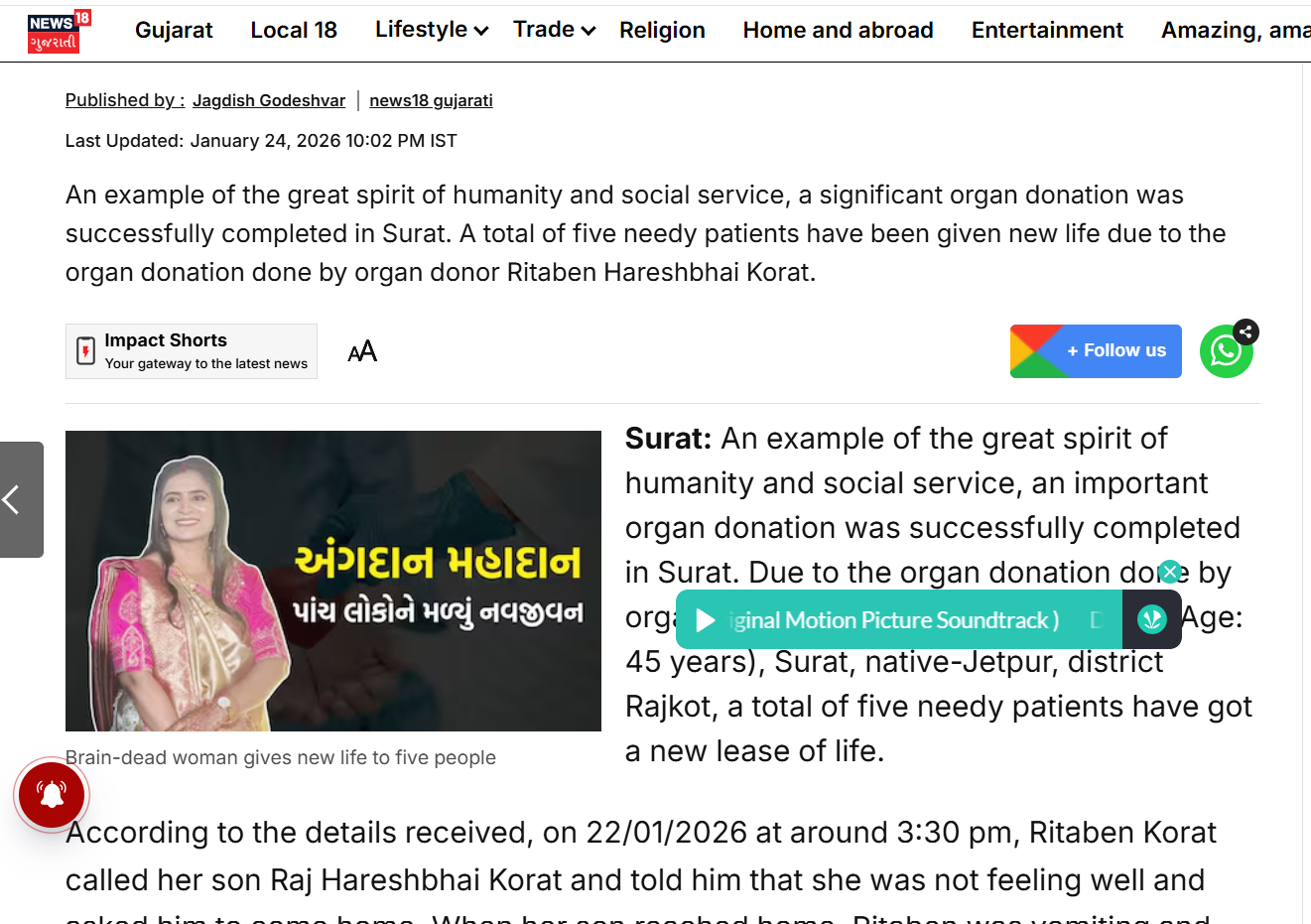
According to the report, organ donation by Ritaben Hareshbhai Korat in Surat gave a new life to five patients. The report also carried her photograph, matching the visuals seen in the viral video.
Conclusion:
Our research found that the viral video has no connection to Harish Rana. It actually shows an incident from Surat, Gujarat, where the family of a 45-year-old brain-dead woman, Ritaben Korat, donated her organs.
