
#FactCheck - Old Bareilly Lathi-Charge Video Falsely Linked to Lucknow Protest
Executive Summary
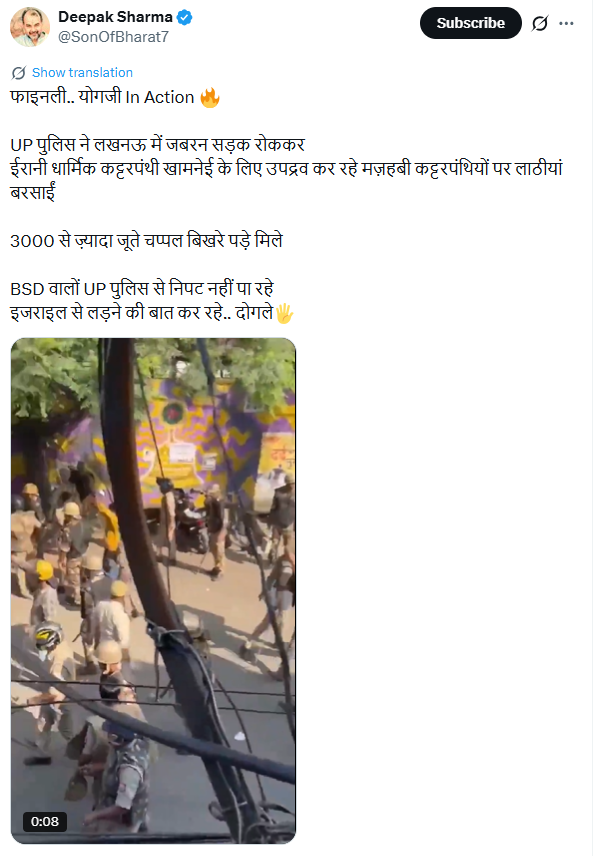
A video is being widely shared on social media and linked to protests that allegedly took place in Lucknow after the reported killing of Iran’s Supreme Leader Ali Khamenei.Users claim that police in the capital of Uttar Pradesh baton-charged people who were protesting against the United States and Israel. The video is being widely circulated across social media platforms with this claim. However, research by CyberPeace found the claim to be false. Our verification revealed that the video is not from Lucknow but from Bareilly, and it is related to an incident that took place on September 26, 2025, when Uttar Pradesh Police baton-charged protesters during a rally held in support of the “I Love Mohammad” campaign.
Claim Post:
On March 3, 2026, an X (formerly Twitter) user shared the viral video claiming that the Uttar Pradesh Police took action against people blocking roads in Lucknow and creating unrest in support of Ali Khamenei.
Fact Check
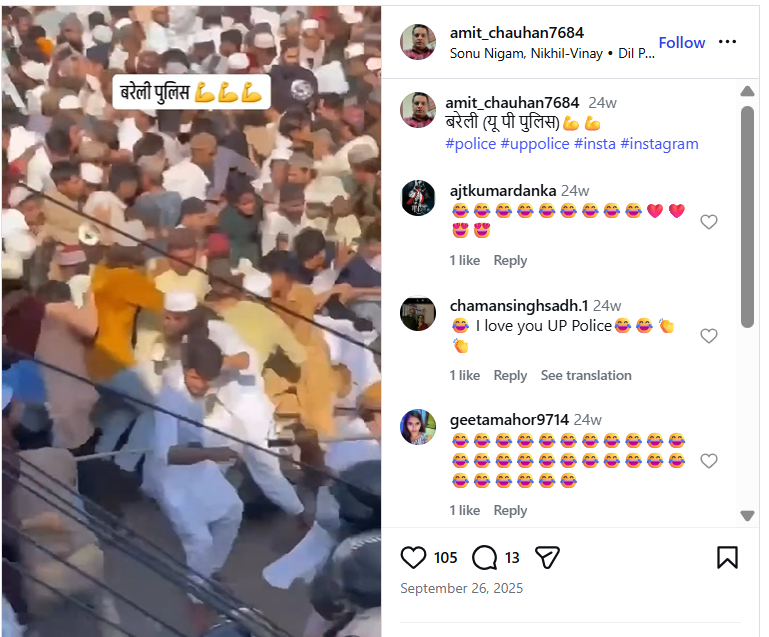
To verify the claim, we extracted key frames from the viral video and conducted a reverse image search using Google Lens. During the search, we found a similar video posted on Instagram on September 26, 2025, indicating that the footage predates the current claim.
Further research led us to the same video on the website of Aaj Tak, where it was published on September 26, 2025.
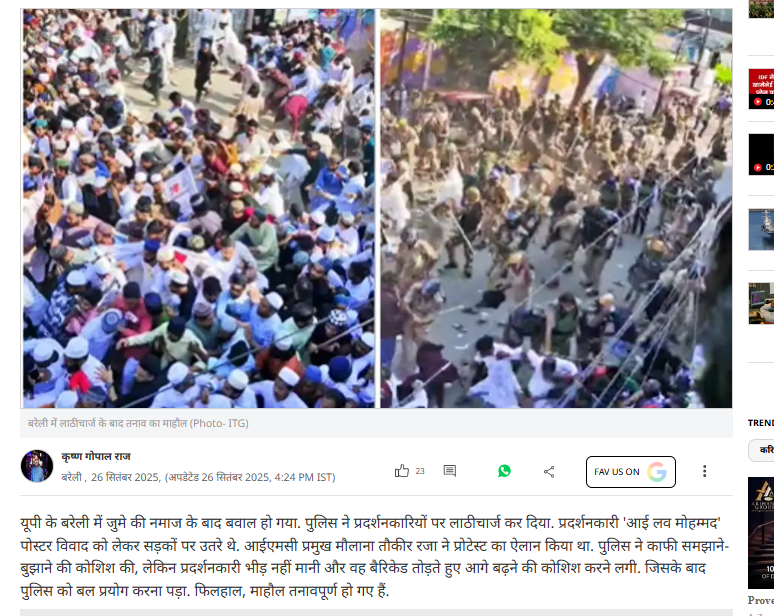
According to the report, protests erupted in Bareilly after Friday prayers over a controversy related to “I Love Mohammad” posters. Hundreds of people took to the streets carrying banners and posters. The report further stated that protesters, responding to a call by cleric Maulana Tauqeer Raza, attempted to break police barricades and move forward. Police initially tried to persuade the crowd to disperse, but when the situation escalated and the crowd refused to back down, officers resorted to baton-charging to control the situation. The incident reportedly led to tension in the area.
Conclusion:
Our research found that the viral video being shared as police action on protesters in Lucknow after the alleged killing of Ali Khamenei is misleading. The footage is actually from Bareilly and shows a police baton-charge during a protest rally held on September 26, 2025 in support of the “I Love Mohammad” campaign.

Related Blogs

Introduction
In a groundbreaking move, India's Reserve Bank has embarked on a transformative journey with its Central Bank Digital Currency (CBDC) project. As the world grapples with the evolving landscape of digital finance, the implications of India's CBDC initiative extend beyond its borders, potentially reshaping global payment systems. The Union Minister of State for Finance, Shri Pankaj Chaudhary, revealed that on October 7, 2022, the Reserve Bank of India released a proposal note on Central Bank Digital Currency (CBDC). Two pilot projects using blockchain-based technology are described in the concept note: Digital Rupee-Wholesale (e₹-W) and Digital Rupee-Retail (e₹-R). Launched on November 1, 2022, the bulk trading pilot aims to increase intermediary competitiveness, particularly in the resolution of trades in the secondary market involving sovereign debt. In parallel, on December 1, 2022, the retail banking pilot, known as e₹-R, got underway in a limited user group with eight banks taking part in stages.
The digital asset known as e₳-R is issued across financial institutions for Person-to-Person (P2P) and Person-to-Merchant (P2M) transactions. It is intended to serve as a virtual currency that represents legal money and exhibits characteristics similar to actual cash. Based on input gathered during the continuing trial phases, the RBI intends to progressively broaden the pilot project's scope.
Central Bank Digital Currency Pilot Projects
Central Bank Digital Currency (CBDC), which the Central Bank of India is promoting, may easily perform an essential part in payments made across borders, according to Reserve Bank Governor Shaktikanta Das. The CBDC is going to be expanded to the international financial markets after being implemented as a trial in both the retail and wholesale industries.
CBDC in International Payments
He emphasized that although physical currency will still exist, the CBDC will eventually replace all forms of money worldwide.
"CBDC is going to be the future currency of the world and it is necessary that every central bank, every country works on CBDC," he stated. He also stated that as worldwide commerce moves more and more around science and technology, CBDCs will play a significant role since they can effectively and affordably speed up payment processing across different countries. Regarding India's foreign exchange reserves, the governor stated that the selection to increase the resources as a safety net and protection versus contagion possibilities was made consciously.
CBDCs' Place in the Transnational Economic Revolution
In certain economies worldwide, having a CBDC internationally accessible could lead to more replacements for foreign currencies rather than the home currencies, which could cause financial aggregates to become volatile and change the mix of instruments of exchange.
CBDC may have benefits related to first-mover savings of scale, and other consequences even in everyday circumstances. If nations with global currencies have established CBDCs, they could strengthen current advantages and disadvantages, including consequences, particularly in terms of revenue. In a similar vein, CBDC might alter the structure of international liquidity while safeguarding asset supply. Additionally, and particularly if imposed abruptly, CBDC may, in certain circumstances, result in significant capital movements and associated repercussions on the foreign exchange rate as well as additional asset prices. Furthermore, nations may encounter difficulties in getting ready for virtual currencies issued by central banks.
The worldwide and international scope of CBDCs accessible to immigrants may become particularly apparent in situations where there is a widespread flight safety concern. In these circumstances, converting a CBDC into a foreign currency would make it possible for capital markets to deleverage more quickly. The elimination of debt challenges could show up as tight finance constraints and abrupt swings in foreign exchange markets if CBDCS expedited its flight from uncertainty.
Deposits of Foreign Exchange and Self-Dependency
Reserve Bank Governor Shaktikanta Das stated "We must rely on ourselves. We must maintain our robust reserves. In order to achieve that goal, we have been amassing quite substantial reserves, and the outside world has come to feel quite confident that India would be able to fulfil its contractual responsibilities to the international community no matter what the obstacles,"
Involvement of RBI in the Currency Market
Given that the trading community was confident that the Reserve Bank of India would be capable of and able to fulfil its contractual responsibilities, the value of the Indian rupee did not decline as dramatically. The RBI governor stated that the RBI does participate in the economy, but that "our engagement operates in two ways," he would not hesitate to acknowledge this.
The Value of Macroeconomic and Budgetary Cooperation
According to RBI Governor Das, the RBI makes purchases and sales of dollars based on the direction in which the financial sector is trending. However, the RBI does not intend to set a certain level for the rupee because it does not consider any specific threshold for the Indian rupee's conversion rate against the US dollar. He also emphasized how crucial it is for both the financial and monetary authorities to work together.
Conclusion
India's CBDC project signals a transformative shift in the global digital finance landscape. Governor Shaktikanta Das envisions CBDCs as the future global currency, emphasizing their role in international payments. The potential impact on financial systems, cross-border transactions, and the need for self-reliance underscore the significance of India's CBDC initiative in shaping the evolving dynamics of the digital economy. As the project progresses, close cooperation between financial and monetary authorities becomes imperative for navigating the challenges and opportunities associated with this groundbreaking venture.
References
- https://economictimes.indiatimes.com/news/economy/policy/central-bank-digital-currency-can-play-important-role-in-cross-border-payment-rbi-guv/articleshow/104706717.cms
- https://www.bis.org/cpmi/publ/d174.pdf
- https://bfsi.economictimes.indiatimes.com/news/fintech/explained-how-rbi-is-leveraging-upi-to-push-the-use-of-retail-cbdc/103591989
- https://www.imf.org/en/News/Articles/2022/02/09/sp020922-the-future-of-money-gearing-up-for-central-bank-digital-currency
- https://www.business-standard.com/economy/news/cbdc-pilot-projects-show-promising-results-rbi-governor-shaktikanta-das-123102601171_1.html
Executive Summary
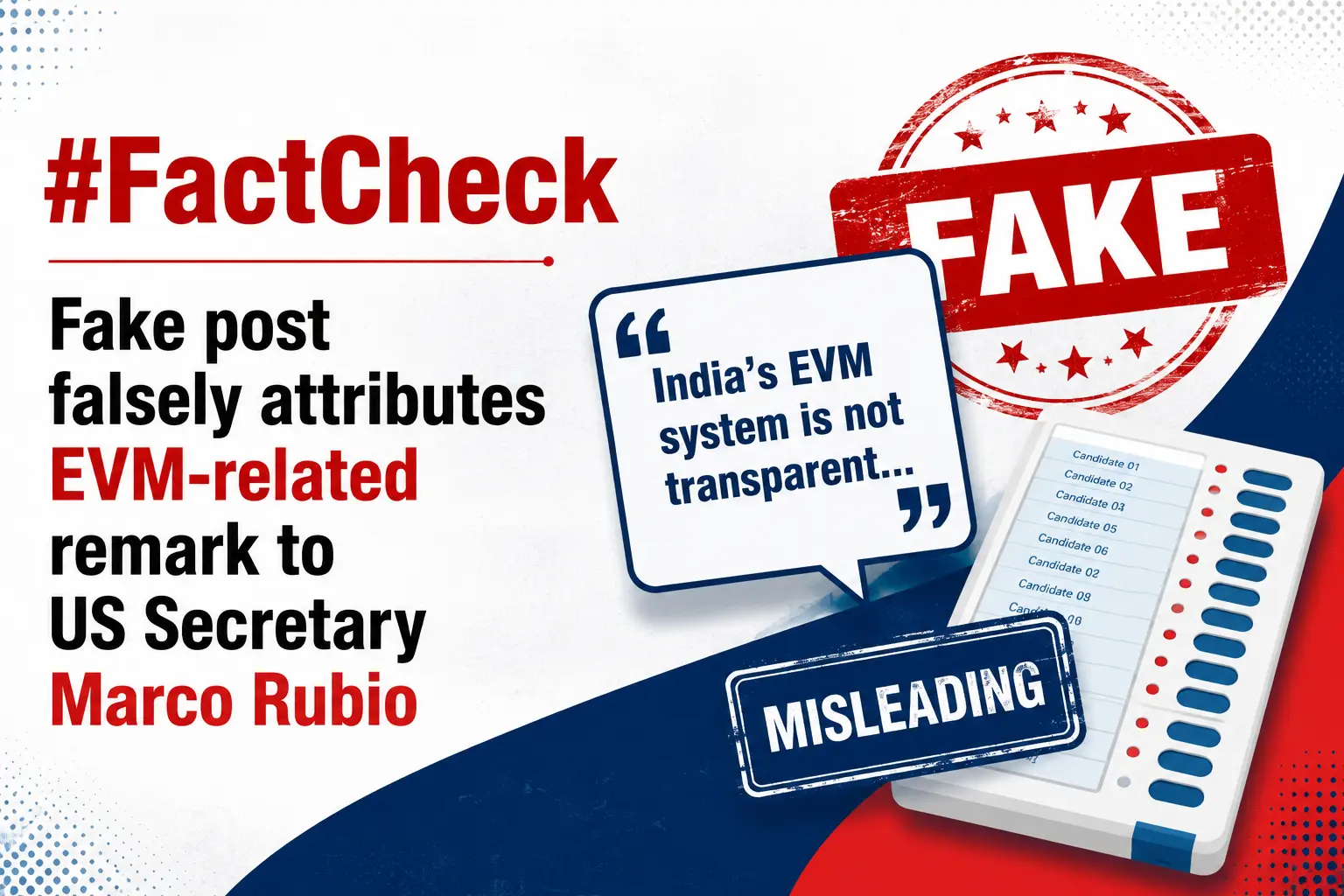
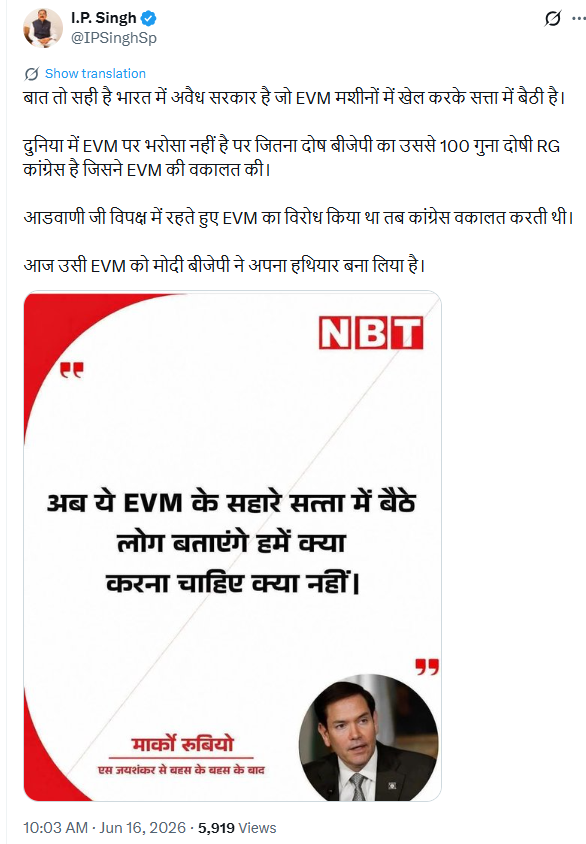
A social media post card featuring a photo of US Secretary of State Marco Rubio, carrying the logo of Navbharat Times, is being widely circulated online. The post claims that Rubio made a remark criticizing the Indian government, allegedly stating that “those in power through EVMs should tell us what to do and what not to do.” CyberPeace Research Wing research found the claim to be false. There is no evidence of Marco Rubio making any such statement, and the viral post card is fabricated.
Claim:
A post shared by SP leader IP Singh alleged that the US Secretary made comments questioning the legitimacy of the Indian government and EVM-based elections, further linking it to broader political criticism of EVMs.
Post link: https://x.com/IPSinghSp/status/2066740933396492706?s=20, https://archive.ph/submit/?url
Fact Check:
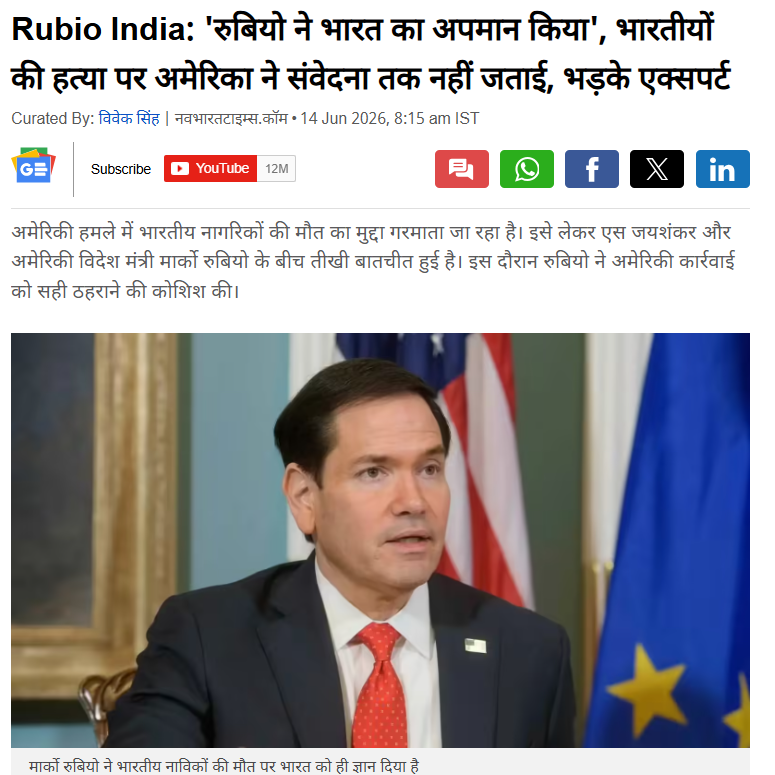
A keyword search of the alleged statement revealed no credible reports or official records of Marco Rubio making any such remark. Additionally, a review of Navbharat Times’ official social media handles did not show any such post card being published, indicating that the viral graphic is not authentic. Further examination of recent statements by Marco Rubio showed no reference to EVMs or the Indian electoral system. Instead, a Navbharat Times report dated June 14 covered a different issue related to tensions in the Hormuz Strait, where Rubio commented on the killing of Indian sailors during a maritime incident and emphasized compliance with US directives for commercial vessels. https://navbharattimes.indiatimes.com/world/america/marco-rubio-remarks-on-killing-of-indian-sailors-in-hormuz-strait-insult-of-india-says
Conclusion:
The research confirms that US Secretary of State Marco Rubio did not make any statement regarding EVMs or the Indian government. The viral post card is fake and misleading.

Introduction
In the age of digital technology, the concept of net neutrality has become more crucial for preserving the equity and openness of the internet. Thanks to net neutrality, all internet traffic is treated equally, without difference or preferential treatment. Thanks to this concept, users can freely access and distribute content, which promotes innovation, competition, and the democratisation of knowledge. India has seen controversy over net neutrality, which has led to a legal battle to protect an open internet. In this blog post, we’ll look at the challenges of the law and the efforts made to safeguard net neutrality in India.
Background on Net Neutrality in India
Net neutrality became a hot topic in India after a major telecom service provider suggested charging various fees for accessing different parts of the internet. Internet users, activists, and organisations in favour of an open internet raised concern over this. Millions of comments were made on the consultation document by the Telecom Regulatory Authority of India (TRAI) published in 2015, highlighting the significance of net neutrality for the country’s internet users.
Legal Battle and Regulatory Interventions
The battle for net neutrality in India acquired notoriety when TRAI released the “Prohibition of Discriminatory Tariffs for Data Services Regulations” in 2016. These laws, often known as the “Free Basics” prohibition, were created to put an end to the usage of zero-rating platforms, which exempt specific websites or services from data expenses. The regulations ensured that all data on the internet would be handled uniformly, regardless of where it originated.
But the legal conflict didn’t end there. The telecom industry challenged TRAI’s regulations, resulting in a flurry of legal conflicts in numerous courts around the country. The Telecom Regulatory Authority of India Act and its provisions of it that control TRAI’s ability to regulate internet services were at the heart of the legal dispute.
The Indian judicial system greatly helped the protection of net neutrality. The importance of non-discriminatory internet access was highlighted in 2018 when the Telecom Disputes Settlement and Appellate Tribunal (TDSAT) upheld the TRAI regulations and ruled in favour of net neutrality. The TDSAT ruling created a crucial precedent for net neutrality in India. In 2019, after several rounds of litigation, the Supreme Court of India backed the principles of net neutrality, declaring that it is a fundamental idea that must be protected. The nation’s legislative framework for preserving a free and open internet was bolstered by the ruling by the top court.
Ongoing Challenges and the Way Forward
Even though India has made great strides towards upholding net neutrality, challenges persist. Because of the rapid advancement of technology and the emergence of new services and platforms, net neutrality must always be safeguarded. Some practices, such as “zero-rating” schemes and service-specific data plans, continue to raise questions about potential violations of net neutrality principles. Regulatory efforts must be proactive and under constant watch to allay these worries. The regulatory organisation, TRAI, is responsible for monitoring for and responding to breaches of the net neutrality principles. It’s crucial to strike a balance between promoting innovation and competition and maintaining a free and open internet.
Additionally, public awareness and education on the issue are crucial for the continuation of net neutrality. By informing users of their rights and promoting involvement in the conversation, a more inclusive and democratic decision-making process is assured. Civil society organisations and advocacy groups may successfully educate the public about net neutrality and gain their support.
Conclusion
The legal battle for net neutrality in India has been a significant turning point in the campaign to preserve an open and neutral internet. A robust framework for net neutrality in the country has been established thanks to legislative initiatives and judicial decisions. However, due to ongoing challenges and the dynamic nature of technology, maintaining net neutrality calls for vigilant oversight and strong actions. An open and impartial internet is crucial for fostering innovation, increasing free speech, and providing equal access to information. India’s attempts to uphold net neutrality should motivate other nations dealing with similar issues. All parties, including politicians, must work together to protect the principles of net neutrality and ensure that the Internet is accessible to everyone.
