
#FactCheck - Viral Postcard Attributing Fake UGC Statement to Keshav Prasad Maurya Is False
Executive Summary
A postcard claiming that Uttar Pradesh Deputy Chief Minister Keshav Prasad Maurya commented on the Supreme Court’s stay on the new UGC regulations is being widely shared on social media. The viral postcard suggests that Maurya stated the Modi government would “fight till its last breath” to implement the UGC law and appealed to Dalit, backward and tribal communities to trust the government as their true well-wisher. However, an research by the CyberPeace has found that the viral postcard is fake. Keshav Prasad Maurya has not made any such statement.
Claim
A Facebook user shared the postcard with the caption:“Now read it yourself. Statement of Deputy CM Keshav Prasad Maurya — the Modi government will fight till its last breath to implement the UGC law. An appeal to Dalit, backward and tribal communities to trust the government, calling it their true well-wisher.”
(Archived version of the post available here.)

Fact Check:
During the research, we did not find any credible news reports mentioning such a statement by Deputy Chief Minister Keshav Prasad Maurya regarding the UGC regulations or the Supreme Court’s order. A closer examination of the viral postcard revealed several inconsistencies. Notably, the text on the postcard lacks proper punctuation, such as commas and full stops, which is unusual for professionally designed news graphics. The postcard carries the logo of Navbharat Times (NBT). However, when compared with genuine NBT postcards, the font style used in the viral image does not match NBT’s official design. We also traced the original NBT postcard that appears to have been edited to create the fake one. In the authentic postcard, shared by NBT on January 20, Keshav Prasad Maurya is quoted as saying: Where the lotus has bloomed, it will continue to bloom, and where it has not, under the guidance of PM Modi and the leadership of Nitin Nabin, the lotus will bloom.”

The original statement was digitally altered, and a fabricated quote was inserted to create the viral postcard.
Conclusion
CyberPeace research clearly establishes that the viral postcard is fake. The original Navbharat Times postcard has been tampered with, and Keshav Prasad Maurya’s actual statement has been replaced with a fabricated quote, which is now being circulated with a misleading claim.

Related Blogs

Executive Summary:
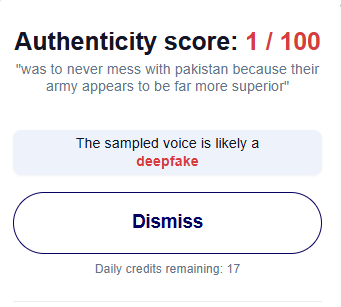
A viral social media claim alleges that India’s Chief of Defence Staff (CDS), General Anil Chauhan, praised Pakistan’s Army as superior during “Operation Sindoor.” Fact-checking confirms the claim is false. The original video, available on The Hindu’s official channel, shows General Chauhan inaugurating Ran-Samwad 2025 in Mhow, Madhya Pradesh. At the 1:22:12 mark, the genuine segment appears, proving the viral clip was altered. Additionally, analysis using Hiya AI Audio identified voice manipulation, flagging the segment as a deepfake with an authenticity score of 1/100. The fabricated statement was: “never mess with Pakistan because their army appears to be far more superior.” Thus, the viral video is doctored and misleading.
Claim:
A viral claim is being shared on social media (archived link) falsely claiming that India’s Chief of Defence Staff (CDS), General Anil Chauhan described Pakistan’s Army as superior and more advanced during Operation Sindoor.

Fact Check:
After performing a reverse image search we found a full clip on the official channel of The Hindu in which Chief of Defence Staff Anil Chauhan inaugurated ‘Ran-Samwad’ 2025 in Mhow, Madhya Pradesh.

In the clip on the time stamp of 1:22:12 we can see the actual part of the video segment which was manipulated in the viral video.
Also, by using Hiya AI Audio tool we got to know that the voice was manipulated in the specific segment of the video. The result shows Deepfake with an authenticity score 1/100, the result also shows the statement which is deepfake which was “ was to never mess with Pakistan because their army appears to be far more superior”.
Conclusion:
The viral video attributing remarks to CDS General Anil Chauhan about Pakistan’s Army being “superior” is fabricated. The original footage from The Hindu confirms no such statement was made, while forensic analysis using Hiya AI Audio detected clear voice manipulation, identifying the clip as a deepfake with minimal authenticity. Hence, the claim is baseless, misleading, and an attempt to spread disinformation.
- Claim: AI Generated audio of CDS admitting that the Pakistan Army is superior to the Indian Army.
- Claimed On: Social Media
- Fact Check: False and Misleading

Introduction
There is a particular kind of fraud that security engineers have struggled with for years, precisely because it defeats every technical safeguard by design. It is the social engineering scam, where a caller poses as your bank's department, your tax office, or a relative in trouble, and walks you, step by step, into making a payment or changing your own account details. Two-factor authentication does not stop this. Strong passwords do not stop it. The account holder is doing everything correctly, except they have been persuaded to do the wrong thing by someone skilled at sounding legitimate. With iOS 27 and iPadOS 27, released in September 2026, Apple has built a feature aimed specifically at that gap, called Impersonation Risk Detection.
What the feature actually does
The mechanism is narrower and more specific than it might first sound. Impersonation Risk Detection does not run continuously in the background scanning for scam calls the way a caller ID app might. Instead, it activates only when a supported app, not Apple's own apps necessarily, but any third party app that chooses to integrate it, requests a real time risk assessment at the exact moment a user attempts a sensitive action. Apple's own examples are specific: making a payment, changing a password, or modifying other critical account security information.
At that moment, the operating system runs an on-device analysis built on what Apple calls its Trust Insights framework. It draws on device use patterns, including the approximate number of recent phone calls and emails, Apple Account information such as app download and purchase history, and what Apple describes as interaction patterns, timing, context and basic sensor data. Crucially, Apple has been explicit that the system does not read the contents of Photos, Messages or Mail, and it does not examine the actual point of intrusion, meaning it cannot tell you whether the phone call you are currently on is itself fraudulent. What it is assessing, instead, is whether the pattern of behaviour surrounding this specific sensitive action looks statistically consistent with how a genuine user behaves, or with the pressured, rushed, coached pattern typical of someone being actively scammed.
The output is deliberately minimal. The requesting app receives only one of three labels, unknown, medium or high risk, never the underlying data that produced it. An "unknown" rating means no suspicious signs were detected, though Apple is careful to note this does not confirm the action is actually safe, only that nothing suspicious surfaced. Apple itself never sees the underlying device data used to generate the assessment either, though it does learn what type of action triggered the request in the first place. What the app then does with that risk label, whether to add a waiting period, prompt identity verification, or display an outright warning, is left entirely to the app's own design, not dictated by Apple.
Why the defaults and the fine print matter
Two details in how Apple shipped this feature are worth paying close attention to, because they reveal a lot about the threat model Apple was actually designing against. First, the feature is off by default. Users must manually navigate to Settings, then Privacy & Security, then Impersonation Risk Detection, and toggle on Share with App Developers, often requiring an Apple Account sign-in to activate. Second, and more tellingly, Apple built in a mandatory 24 hour delay before the toggle, once enabled, can actually be switched off. Apple's own guidance states plainly that if someone contacts you and insists you turn this feature off, treat that as a red flag. That is not a generic privacy disclaimer. It is Apple directly anticipating that scammers, once this feature becomes widely known, will start coaching victims to disable it mid-call, and designing a specific friction point to blunt exactly that manipulation.
Apps that have requested an assessment appear under a Recent Activity log, where users can review the specific actions that triggered each request and revoke access app by app, through a section Apple labels Reasons for Access. As of launch, Apple has not published a list of which apps actually support the feature, meaning its real world usefulness depends entirely on third party developers choosing to integrate it, something Apple cannot mandate.
How this compares to what Google has shipped earlier
Apple is not the first to market here, and the framing in early coverage of this feature, "it was just a matter of time," reflects that fairly accurately. Google began rolling out Scam Detection on Pixel phones in beta in late 2024, expanding it through 2025 using its on-device Gemini Nano model to analyse both phone calls and text messages in real time. The approaches differ in a meaningful way, though. Google's feature listens to an entire live conversation for scam-like conversational patterns, playing an audible beep at the start of a monitored call so both parties know AI analysis is active, and can interrupt mid-call with a warning. Apple's feature does not listen to anything resembling the call itself; it evaluates behavioural and account signals around a specific sensitive action a user is about to take, regardless of whether that action was prompted by a phone call, a text, or an email. Google's model is built around catching the scam as it happens in conversation; Apple's is built around catching the moment the user is about to act, irrespective of the channel that pressured them there. Both are opt-in or off by default, and both emphasise on-device processing and limited data sharing, reflecting a shared industry recognition that scam detection tools built on reading private conversations need unusually strong privacy guarantees to earn user trust.
Why this matters well beyond the US
Google has already signalled that it sees markets like India as a genuine proving ground for this category of tool, having launched Pixel-based scam detection there in November 2025 specifically citing the scale of digital fraud losses in the country, alongside partnerships with Indian financial apps including Google Pay, Paytm and Navi to warn users during risky screen-sharing sessions, a common vector in Indian banking fraud. That context matters for Apple's rollout too. Social engineering scams impersonating banks, government tax departments and law enforcement are a dominant and rapidly growing fraud category across much of Asia, and a feature that specifically targets the moment someone is being walked through a fraudulent payment, rather than relying on the victim recognising the scam themselves, addresses exactly the mechanism that most existing fraud prevention tools miss.
The honest limitation
Apple has been careful, in its own language, to frame this as a supplementary safeguard rather than a complete solution to telecom and online fraud, and that caution lines up with what the broader behavioural analytics industry has already learned the hard way. The feature depends entirely on third party app adoption that has not yet been detailed, it is switched off by default so most users will never encounter it without deliberately enabling it, and an "unknown" risk rating explicitly does not mean an action is safe, only that nothing suspicious happened to surface.
The deeper issue is one every company working on behavioural fraud detection has run into before Apple did: these systems are only as reliable as the baseline of "normal" behaviour they are measuring against, and that baseline is not stable across every type of user. Industry data on behavioural biometrics, the broader category of technology Apple's system belongs to, puts typical false positive rates for flagging new device, location, or timing combinations in the range of 15 to 25 percent before careful tuning, and practitioners in the field note that elderly users in particular tend to show higher variance in their interaction patterns, which makes them statistically harder for these models to read correctly, not easier, despite being exactly the population most targeted by impersonation scams in the first place. The risk is not hypothetical or confined to finance. In eldercare technology more broadly, a documented case from a California pilot programme saw a fall detection system switched off entirely after it generated so many false alarms that it triggered repeated, unwanted social service visits to an older adult's home, a clear illustration of what happens when a protective automated system cannot adequately account for the exact population it was built to protect.
Apple has not published performance data on how Impersonation Risk Detection behaves across these edge cases, new phones, irregular usage patterns, older users less familiar with typical app behaviour, and that silence is worth noting rather than assuming away. What Impersonation Risk Detection represents is not a solved problem, but a genuine, technically serious first attempt by a major platform to intervene at the exact moment social engineering scams succeed, the point of action, rather than relying on users to have correctly identified the deception several steps earlier. Whether it meaningfully reduces fraud losses at scale will depend less on the underlying design, which appears carefully thought through, and more on two things outside Apple's direct control: how many developers actually build it into the apps people use for banking and account security, and how well the system holds up for exactly the users who need it most.
References
- Help Net Security, "Apple's new iOS 27 feature looks for signs you're being scammed." https://www.helpnetsecurity.com/2026/09/24/apple-ios-27-impersonation-risk-detection/
- 9to5Mac, "iOS 27 adds scam-prevention feature to iPhone, here's how to enable it." https://9to5mac.com/2026/09/16/ios-27-adds-scam-prevention-feature-to-iphone-heres-how-to-enable-it/
- 9to5Mac, "Security Bite: iOS 27 now lets apps ask your iPhone if you're being scammed." https://9to5mac.com/2026/09/21/security-bite-ios-27-now-lets-apps-ask-your-iphone-if-youre-being-scammed/
- Engadget, "Apple's new iPhone and iPad security feature can protect you from scammers." https://www.engadget.com/2271157/apple-iphone-ipad-impersonator-risk-detection-new-security-feature/
- gHacks Tech News, "iOS 27 Adds Impersonation Risk Detection to Help Protect Against Social Engineering Scams." https://www.ghacks.net/2026/09/21/ios-27-adds-impersonation-risk-detection-to-help-protect-against-social-engineering-scams/
- BigGo Finance, "Apple Rolls Out On-Device Scam Detection in iOS 27 Ahead of High-Risk Transactions." https://finance.biggo.com/news/89a0ae92-1603-4ac9-aef9-b8b466e6ac40
- MacObserver, "iOS 27 Impersonation Risk Detection: How Apple's anti-scam setting works." https://www.macobserver.com/news/ios-27-impersonation-risk-detection-anti-scam-setting/
- Google Blog, "New AI-Powered Scam Detection Features to Help Protect You on Android." https://blog.google/security/new-ai-powered-scam-detection-features/
- Digital Trends, "Google Pixel 9 is getting a scam detection upgrade you'll want on your phone." https://www.digitaltrends.com/phones/google-pixel-scam-detection-gemini-nano-ai-calls-messages-safety/
- Gulf News, "Google ramps up AI scam protection in India." https://gulfnews.com/technology/media/google-ramps-up-ai-scam-protection-in-india-1.500355149

Executive Summary:
Several videos claiming to show bizarre, mutated animals with features such as seal's body and cow's head have gone viral on social media. Upon thorough investigation, these claims were debunked and found to be false. No credible source of such creatures was found and closer examination revealed anomalies typical of AI-generated content, such as unnatural leg movements, unnatural head movements and joined shoes of spectators. AI material detectors confirmed the artificial nature of these videos. Further, digital creators were found posting similar fabricated videos. Thus, these viral videos are conclusively identified as AI-generated and not real depictions of mutated animals.

Claims:
Viral videos show sea creatures with the head of a cow and the head of a Tiger.


Fact Check:
On receiving several videos of bizarre mutated animals, we searched for credible sources that have been covered in the news but found none. We then thoroughly watched the video and found certain anomalies that are generally seen in AI manipulated images.


Taking a cue from this, we checked all the videos in the AI video detection tool named TrueMedia, The detection tool found the audio of the video to be AI-generated. We divided the video into keyframes, the detection found the depicting image to be AI-generated.


In the same way, we investigated the second video. We analyzed the video and then divided the video into keyframes and analyzed it with an AI-Detection tool named True Media.

It was found to be suspicious and so we analyzed the frame of the video.

The detection tool found it to be AI-generated, so we are certain with the fact that the video is AI manipulated. We analyzed the final third video and found it to be suspicious by the detection tool.


The detection tool found the frame of the video to be A.I. manipulated from which it is certain that the video is A.I. manipulated. Hence, the claim made in all the 3 videos is misleading and fake.
Conclusion:
The viral videos claiming to show mutated animals with features like seal's body and cow's head are AI-generated and not real. A thorough investigation by the CyberPeace Research Team found multiple anomalies in AI-generated content and AI-content detectors confirmed the manipulation of A.I. fabrication. Therefore, the claims made in these videos are false.
- Claim: Viral videos show sea creatures with the head of a cow, the head of a Tiger, head of a bull.
- Claimed on: YouTube
- Fact Check: Fake & Misleading


