
#FactCheck - Viral Video Claiming Attack on Burj Khalifa is AI-Generated
Executive Summary
Amid rising tensions between the United States, Israel, and Iran, a video is circulating on social media claiming that Burj Khalifa in Dubai has been attacked. The clip is being widely shared with users alleging that a strike took place near the iconic skyscraper. However, research by CyberPeace found the claim to be misleading. Our research revealed that the viral video is not real and was generated using artificial intelligence.
Claim
On March 1, 2026, a Facebook user shared the viral clip claiming that an attack had taken place in Dubai. The post was shared with the caption: “Dubai has been attacked.” The link to the post and its archive is provided below along with a screenshot.

Fact Check
To verify the claim, we first searched Google using relevant keywords. During this process, we found a report published on March 1, 2026, by the Indian news outlet Dainik Bhaskar.

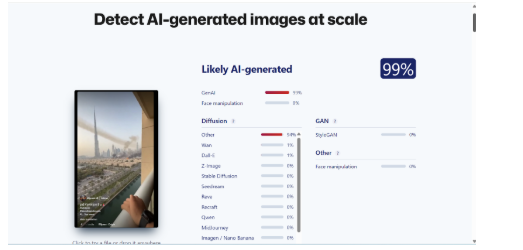
According to the report, tensions in the Middle East escalated amid the Israel–Iran conflict, impacting several countries in the region. A drone incident reportedly occurred near Burj Khalifa, prompting authorities to evacuate the building as a precautionary measure and temporarily switch off its lights. However, the visuals seen in the viral video do not match the details or imagery described in the report. Upon closely examining the viral clip, we noticed several technical inconsistencies and unusual visual elements, raising suspicions that the video might have been generated using artificial intelligence. To verify this, we analyzed the video using the AI detection tool Sightengine. The results indicated a 99% probability that the video was AI-generated.
Conclusion
Our research found that the viral video circulating on social media is not authentic. The footage was created using artificial intelligence and does not depict a real attack on Burj Khalifa.

Related Blogs
.webp)
Introduction
In the fast-paced digital age, misinformation spreads faster than actual news. This was seen recently when inaccurate information on social media was spread, stating that the Election Commission of India (ECI) had taken down e-voter rolls for some states from its website overnight. The rumour confused the public and caused political debate in states like Maharashtra, MP, Bihar, UP and Haryana, resulting in public confusion. But the ECI quickly called the viral information "fake news" and made sure that voters could still get access to the electoral rolls of all States and Union Territories, available at voters.eci.gov.in. The incident shows how electoral information could be harmed by the impact of misinformation and how important it is to verify the authenticity.
The Incident and Allegations
On August 7, 2025, social media posts on platforms like X and WhatsApp claimed that the Election Commission of India had removed e-voter lists from its website. The posts appeared after public allegations about irregularities in certain constituencies. However, the claims about the removal of voter lists were unverified.
The Election Commission’s Response
In a formal tweet posted on X, it stated categorically:
“This is a fake news. Anyone can download the Electoral Roll for any of 36 States/UTs through this link: https://voters.eci.gov.in/download-eroll.”
The Commission clarified that no deletion has been done at all and that all the voters' rolls are intact and accessible to the public. Keeping with the spirit of transparency, the ECI reaffirmed its overall practice of public access to electoral information by clarifying that the system is intact and accessible for inspection.
Importance of Timely Clarifications
By countering factually incorrect information the moment it was spread on a large scale, the ECI stopped possible harm to public trust. Election officials rely upon being trusted, and any speculation concerning their honesty can prove harmful to democracy. Such prompt action stops false information from becoming a standard in public discourse.
Misinformation in the Electoral Space
- How False Narratives Gain Traction
Election misinformation increases in significant political environments. Social media, confirmation bias, and increased emotional states during elections enable rumour spread. On this occasion, the unfounded report struck a chord with widespread political distrust, and hence, people easily believed and shared it without checking if it was true or not.
- Risks to Democratic Integrity
When misinformation impacts election procedures, the consequences can be profound:
- Erosion of Trust: People can lose faith in the neutrality of election administrators quite easily.
- Polarization: Untrue assertions tend to reinforce political divides, rendering constructive communication more difficult.
- The Role of Media Literacy
Combating such mis-disinformation requires more than official statements. Media skills training courses can equip individuals with the ability to recognise warning signs in suspect messages. Even basic actions like checking official sources prior to sharing can move far in keeping untruths from being spread.
Strategies to Counter Electoral Misinformation
Multi-Stakeholder Action
Effective counteracting of electoral disinformation requires coordination among election officials, fact-checkers, media, and platforms. Actions that are suggested include:
- Rapid Response Protocols: Institutions should maintain dedicated monitoring teams for quick rebuttals.
- Confirmed Channels of Communication: Providing official sites and pages for actual electoral news.
- Proactive Transparency: Regular publication of electoral process updates can anticipate rumours.
- Platform Accountability: Social media sites must label or limit the visibility of information found to be false by credentialed fact-checkers.
Conclusion
The recent allegations of e-voter rolls deletion underscore the susceptibility of contemporary democracies to mis-disinformation. Even though the circumstances were brought back into order by the ECI's swift and unambiguous denunciation, the incident itself serves to emphasise the necessity of preventive steps to maintain election faith. Even though fact-checking alone might not work in an environment where the information space is growing more polarised and algorithmic, the long-term solution to such complications is to grow an ironclad democratic culture where everyone, every organisation, and platforms value the truth over clickbait. The lesson is clear: in the age of instant news, accurate communication is vital for maintaining democratic integrity, not extravagances.
References
- https://www.newsonair.gov.in/election-commission-dismisses-fake-news-on-removal-of-e-voter-rolls/
- https://economictimes.indiatimes.com/news/india/eci-dismisses-claims-of-removing-e-voter-rolls-from-its-website-calls-it-fake-news/articleshow/123190662.cms
- https://www.thehindu.com/news/national/vote-theft-claim-of-congress-factually-incorrect-election-commission/article69921742.ece
- https://www.thehindu.com/opinion/editorial/a-crisis-of-trust-on-the-election-commission-of-india/article69893682.ece

Introduction
Somewhere right now, a model is reading a library. It does not read like you or I, savouring a good line or skipping to the end. It does not copy, clean and convert text into numbers at the scale that a human reader could. The copyright questions these models raise are not new, but they are new in scale, and they implicate a legal order that prizes borders. A book written in Lagos can be replicated on a server in Virginia, used to train a model sold in Berlin. Whose laws apply? The honest answer is: we don't know.
A Treaty Written Before Computers
The Berne Convention is one of the most important international agreements on copyright, with over 180 countries being party to it. According to Article 9(1) of the Berne Convention, authors have the exclusive right to allow or prohibit the reproduction of their works in any form or way. Article 9(2) provides that certain countries may implement exceptions to the rights granted by the convention, as long as they are consistent with the three-step test. More specifically, a national law exception should be confined to a certain category of works, not prejudice the work’s normal use, and not unreasonably prejudice the rights of the author.
This explains how the Berne Convention could apply to copyright protection for AI. Developers of such technology often argue that since the output of a given model rarely resembles anything learned from the examples provided, there is no copying occurring. However, the Agreed Statements of the WIPO Copyright Treaty provide that the reproduction of a protected item in digital format also constitutes a reproduction. Therefore, if a work is used to train a model, this can be considered a reproduction, and the question then emerges whether a national exception applies.
Three Jurisdictions, Three Answers
Countries have responded in different ways to that question. The United States draws on its fair use doctrine, a flexible, four-factor test that was never intended for machine learning but dominates AI-related disputes anyway. Japan’s Article 30-4 permits uses of works for the purpose of data analysis where the use is not for the enjoyment of the work’s expression, which captures a lot of what training entails. And the European Union’s approach falls somewhere in the middle: its text and data mining rules allow mining of lawfully accessible works, but rightsholders can specify in a machine-readable manner that they do not want their works mined, and developers are required to seek permission.
A recent roundtable from the Columbia Undergraduate Law Review argues that the EU model fits the three-step test best because the opt-out keeps a licensing market alive and gives authors control before their work is used rather than after. It argues that broad US fair use and Japan's provision both struggle at the second and third steps, since they can undercut a foreseeable licensing market. That is one scholarly view and not settled law. The EU system also has its own weak spot: an opt-out only protects authors who know it exists and have the technical means to use it.
Bartz v. Anthropic in Brief
Bartz v. Anthropic is the case that puts these debates in front of a judge. Three authors, including Andrea Bartz, Charles Graeber and Kirk Wallace Johnson, filed a lawsuit against the Anthropic company for using part of their works to create the central library used by Claude and to train the models used in its creation. In addition, in June 2025, Judge William Alsup approved the separation of the case, considering each instance of use separately.
On training, he granted summary judgement for Anthropic, holding the use was fair and describing it as exceedingly transformative. He compared it to a reader who studies great writing in order to produce something new. It mattered that the authors did not allege Claude's outputs reproduced their books, so the case turned on inputs alone. He also held that buying print books and scanning them into digital copies was fair use, since it only changed the format of copies Anthropic already owned. But he refused to excuse the more than seven million pirated books Anthropic downloaded to build a permanent library. Building that library from pirated copies, he found, was its own use and not a transformative one, and that part was set for trial.
Two observations are worth making in relation to those thinking across borders. First, the court's assumption that there might be a market for training licences, but its observation that this is not a market which the Copyright Act entitles authors to control, is quite inconsistent with Berne's concern for normal exploitation. Moreover, the order makes no reference to Berne at all, bearing out the observation that the US courts apply the domestic statute and not the treaty.
The story did not end there. Anthropic agreed to a $1.5 billion class settlement covering roughly 482,000 works, and the court granted final approval on 20 July 2026. It resolves claims about past acquisition and copying, so the training ruling remains a trial court's view rather than binding precedent.
Where Borders Break the System
The deeper trouble is that none of this travels well. Berne is not self-executing in the United States, so judges apply the domestic statute, and nobody is required to ask whether a fair use ruling passes the three-step test. Meanwhile, training can happen in one country, on work from dozens of others, for a product used everywhere. The same book might be freely usable in Tokyo, subject to an opt-out in Paris and defended as fair use in San Francisco.
The roundtable suggests one way forward: a new WIPO special agreement, along the lines of the WIPO Copyright Treaty, in response to the internet. It would provide guidance on the application of the three-step test to training, regard licensing markets as an ordinary part of exploitation, and require minimum standards for reservations of rights and compensation. There is one major potential obstacle: many of the most influential AI companies are based in the US, which has a record of opposing international obligations that impinge on fair use. A deal would apply only to the extent that it is not controlled by the US, where most of the training takes place. Market forces, in the form of the so-called Brussels effect, may prove more influential than negotiations at WIPO.
Conclusion
Bartz’s analysis illustrates the importance of characterising a specific use at the level of a particular court. While the former had been viewed as an activity and the latter as an acquisition, the distinction between the use of a work and its acquisition appears more likely to transcend borders than the concept of fair use. Berne was designed to create a common ground for authors. Whether this convention would be able to fulfil its function in the era of generative AI depends on the willingness of nations to adopt a joint understanding of what constitutes its foundations for machines.
Executive Summary
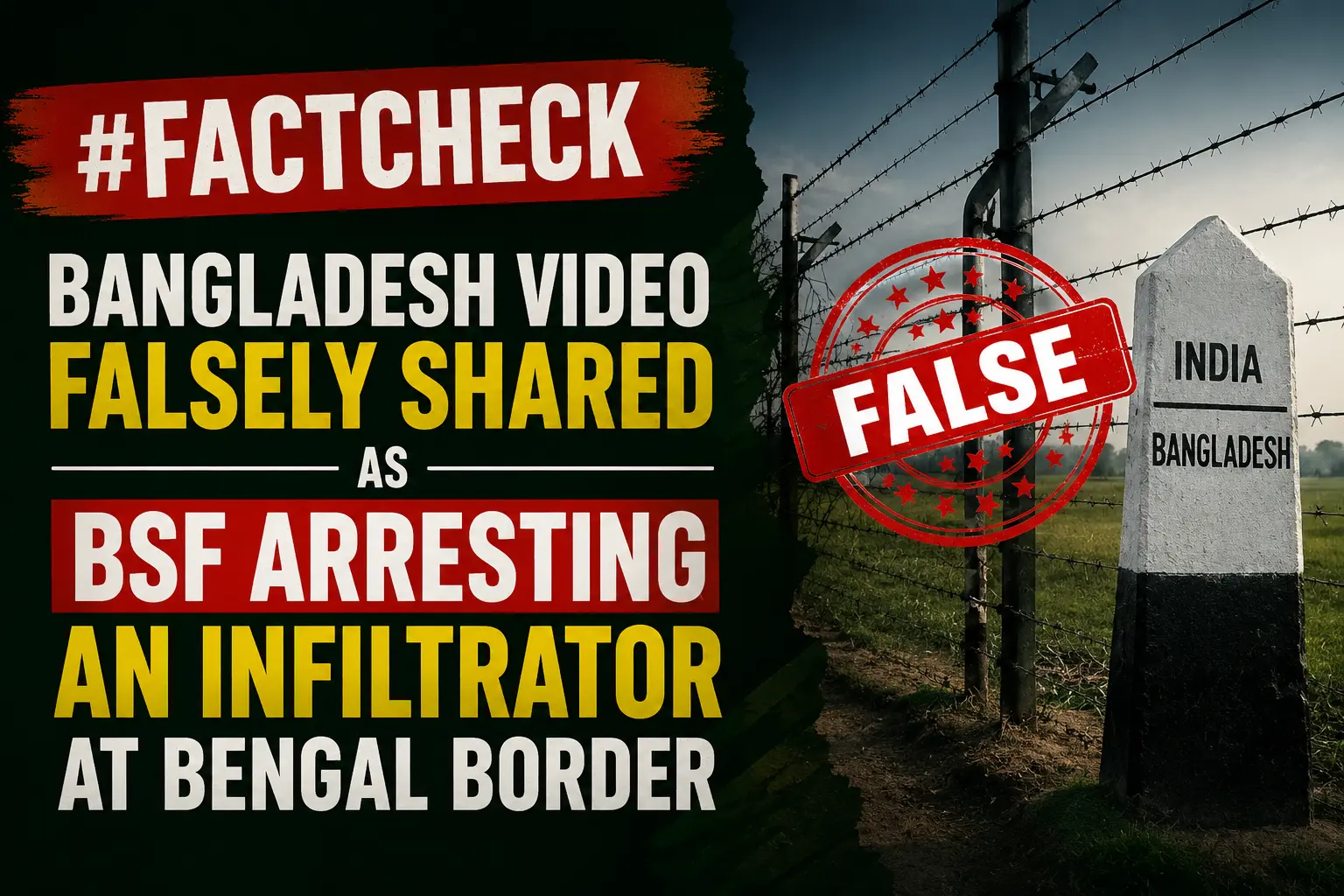
A video showing security personnel overpowering a man is being widely shared on social media with the claim that it shows the Border Security Force (BSF) arresting an infiltrator attempting to cross the India-Bangladesh border in West Bengal. However, research by CyberPeace Research Wing found that the claim is false. The viral video is from Bangladesh and is unrelated to India or the BSF.
Claim
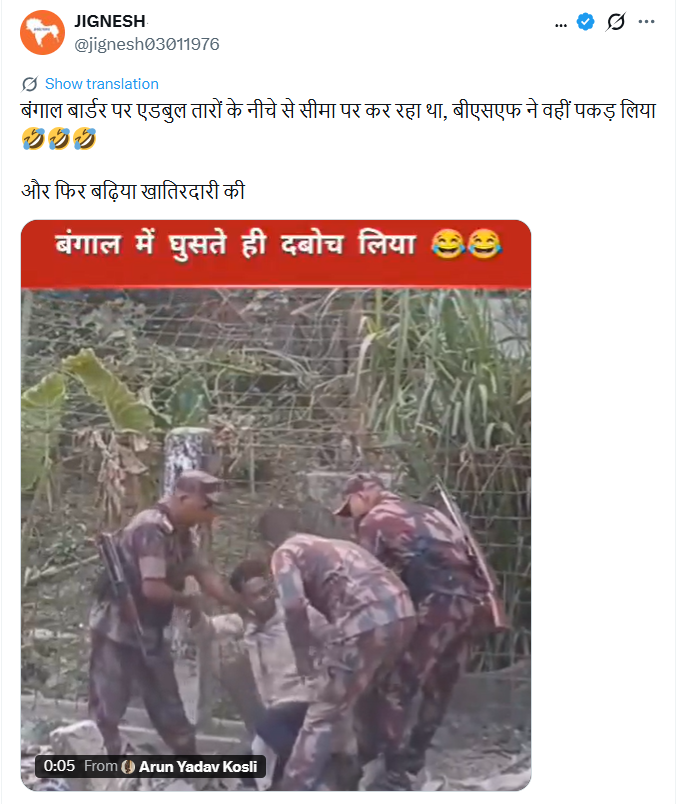
An X user shared the viral video claiming: “He was crossing the Bengal border from beneath the barbed fencing when the BSF caught him on the spot.”
The post was circulated as an incident from the India-Bangladesh border in West Bengal.
Fact Check
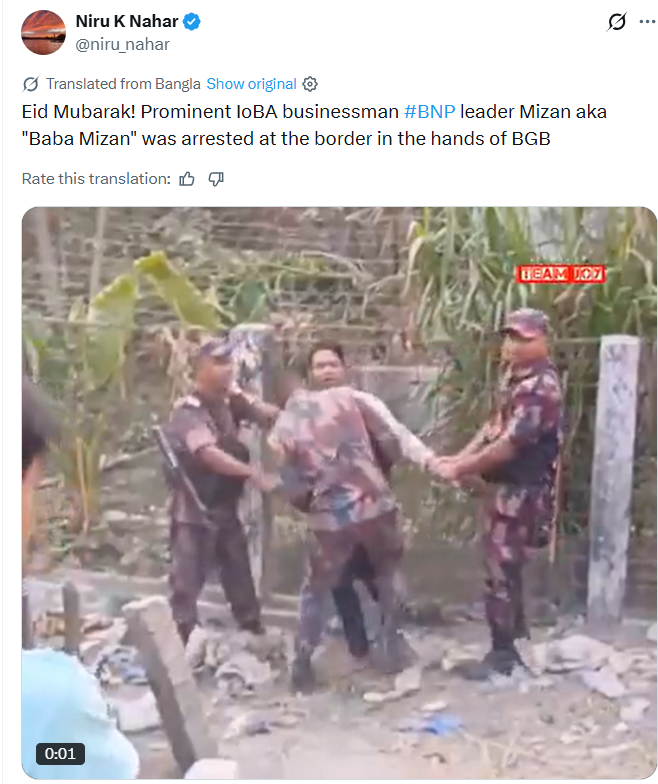
To verify the claim, we extracted keyframes from the viral video and conducted a reverse image search. During the research, we found the same video posted on 21 March 2026 by an X handle named “Niru Nahar.”
According to the caption of that post, the video showed Bangladesh Border Guards arresting BNP leader Mizan, also known as “Baba Mizan,” near the border.
Further research led us to a Facebook post uploaded on 22 March 2026 by Bangladeshi news platform Jono Pulse. The post identified the detained individual as “Juel,” an alleged drug trafficker from Chapainawabganj, and stated that he had been arrested by the Border Guard Bangladesh (BGB).
Chapainawabganj is located in Bangladesh, confirming that the video is unrelated to West Bengal or the BSF.

Conclusion
The viral claim is misleading. The video does not show the BSF arresting an infiltrator at the Bengal border. It is actually from Bangladesh and depicts a separate incident involving Border Guard Bangladesh personnel.
