
Free-Space Quantum Secure Communication: India’s Quantum Jump
Introduction
India is making strides in developing its own quantum communication capabilities, despite being a latecomer compared to nations like China and the US. In the digital age, quantum communication is gradually becoming one of the most important technologies for national security. It promises to transform secure data exchange across government, financial, and military systems by enabling unhackable communication channels through quantum concepts like entanglement and superposition. Scientists from the Defence Research and Development Organisation (DRDO) and IIT Delhi recently demonstrated quantum communication over a distance of over one kilometre in free space. One significant step at a time, India's quantum roadmap is beginning to take shape thanks to strategic partnerships between top research institutes and defence organisations.
Recent Developments
- In February 2022, by DRDO and IIT Delhi, a 100 km Quantum Key Distribution (QKD) link was established between Prayagraj and Vindhyachal using pre-existing commercial-grade optical fibre, with secure key rates of up to 10 kHz. This proved that using India's current telecom infrastructure to implement quantum-secure communication is feasible.
- Scientists at DRDO finished testing a 6-qubit superconducting quantum processor in August 2024, showing complete system integration by submitting quantum circuits through a cloud interface, running them on quantum hardware, and updating the results.
- A free-space QKD demonstration over over 1 km was conducted in June 2025, with a secure key rate of approximately 240 bits/s and a Quantum Bit Error Rate (QBER) of less than 7%. A crucial step towards satellite-based and defence-grade secure networks, this successful outdoor trial demonstrates that quantum-secure communication is now feasible in actual atmospheric conditions.
- India is looking to space as well. Since 2017, the Raman Research Institute (RRI) and ISRO have been collaborating on satellite-based QKD, with funding totalling more than ₹15 crore. In 2025, a specialised QKD-enabled satellite called SAQTI (Secured Applications using Quantum and optical Technologies by ISRO) is anticipated to go into orbit. The initiative's foundation has already been established by ground-based quantum encryption trials up to 300 meters.
- In India, private companies such as QNu Labs are assisting in the commercialisation of quantum communication. QNu, which was founded at IIT Madras, has created the plug-and-play QKD module Armos, the quantum random number generator (QRNG)Tropos, and the integrated platform QShield, which combines QKD, QRNG, and post-quantum cryptography (PQC).
Where India Stands Globally
India is still in its infancy when compared to China's 2,000 km Beijing–Shanghai QKD network and its satellite-based communication accomplishments. Leading nations like the US, UK, and Singapore are also ahead of the curve, concentrating on operationalising QKD trials for government systems and incorporating post-quantum cryptography (PQC) into national infrastructure.
However, considering the nation's limited prior exposure to quantum technologies, India's progress is noteworthy for its rapid pace and indigenous innovation.
Policy Challenges and Priorities
- Strong policy support is required to match India's efforts in quantum communication. The standardisation of PQC algorithms and their incorporation into digital public infrastructure have to be major priorities.
- Scaling innovation from lab to deployment through public-private partnership
- Accelerating satellite QKD to establish a secure communications ecosystem owned by India.
- International standards compliance and worldwide interoperability for secure quantum protocols.
Conclusion
India has made timely strides in quantum communication, spearheaded by DRDO, IITs, and ISRO. Establishing unbreakable communication systems will be essential to national security as digital infrastructure becomes more and more integrated into governance and economic life. India can establish itself as a significant player in the developing quantum-secure world with consistent investment, well-coordinated policy, and international collaboration.
References
- https://www.thehindu.com/sci-tech/science/quantum-communication-iit-delhi-drdo-entanglement-qkd-explained/article69705017.ece
- https://drdo.gov.in/drdo/quantum-technologies
- https://www.indiatoday.in/science/story/the-end-of-hacking-how-isro-and-drdo-are-building-an-unhackable-quantum-future-2743715-2025-06-22
- https://www.pib.gov.in/PressReleasePage.aspx?PRID=2136702
- https://www.pib.gov.in/PressReleasePage.aspx?PRID=1800648
- https://thequantuminsider.com/2024/08/29/indias-drdo-scientists-complete-testing-of-6-qubit-superconducting-quantum-processor/
- https://www.pib.gov.in/PressReleasePage.aspx?PRID=2077600
- https://www.pib.gov.in/PressReleasePage.aspx?PRID=2121617
- https://www.rri.res.in/news/quic-lab-achieves-next-step-towards-realising-secure-satellite-based-quantum-communication#:~:text=QuIC%20lab%20achieves%20the%20next,transactions%2Dsafe%2D2561836.html
- https://www.gsma.com/newsroom/post-quantum-government-initiatives-by-country-and-region/
- https://tech.hindustantimes.com/tech/news/rri-demonstrates-secure-satellite-based-quantum-communication-in-collaboration-with-isro-71680375748247.html

Related Blogs

Executive Summary
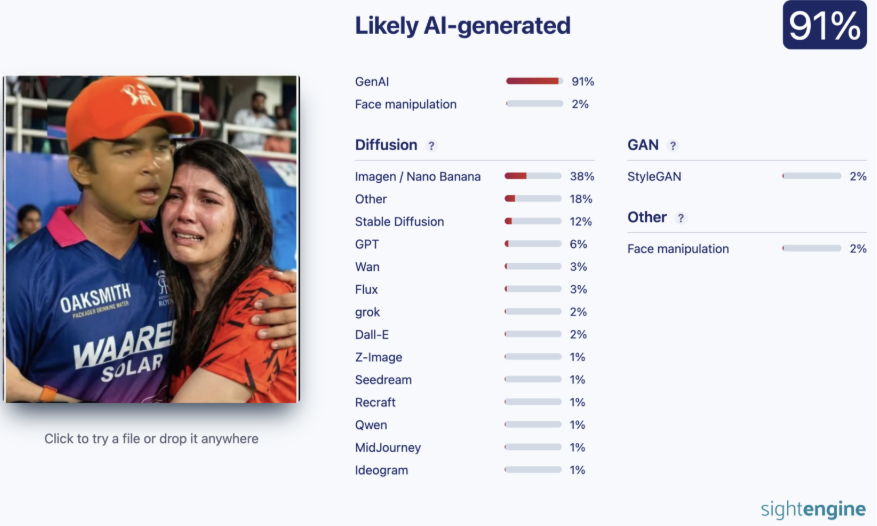
A picture allegedly showing Sunrisers Hyderabad (SRH) owner Kavya Maran emotionally hugging young cricketer Vaibhav Suryavanshi has gone viral on social media. The image is being shared as a genuine photograph from a cricket-related event, with users claiming that Kavya Maran was seen embracing Vaibhav Suryavanshi. However, CyberPeace Research Wing research found the claim to be false. No credible news reports, official statements, or authentic photographs support the incident depicted in the viral image.
Claim
A Facebook user shared the viral image with the caption: “Kavya Maran Hug Vaibhav Suryavanshi 🥰🔥 #cricketnews #RRvsSRH” The link to the post and its screenshot are provided below.

Fact Check
During the research, we found no credible news reports, official statements, or authentic images confirming that Kavya Maran hugged Vaibhav Suryavanshi as shown in the viral picture. To further verify the image, it was analysed using AI detection tools, including Sightengine and Hive Moderation. Both tools indicated a high probability that the image was generated using Artificial Intelligence. The findings suggest that the viral photograph is not a genuine image captured at a real event but a digitally created visual.

Conclusion
Our research found that the viral image showing Kavya Maran emotionally hugging Vaibhav Suryavanshi is not authentic. The picture was generated using AI and does not depict a real incident.
.webp)
In the tapestry of our modern digital ecosystem, a silent, pervasive conflict simmers beneath the surface, where the quest for cyber resilience seems Sisyphean at times. It is in this interconnected cyber dance that the obscure orchestrator, StripedFly, emerges as the maestro of stealth and disruption, spinning a complex, mostly unseen web of digital discord. StripedFly is not some abstract concept; it represents a continual battle against the invisible forces that threaten the sanctity of our digital domain.
This saga of StripedFly is not a tale of mere coincidence or fleeting concern. It is emblematic of a fundamental struggle that defines the era of interconnected technology—a struggle that is both unyielding and unforgiving in its scope. Over the past half-decade, StripedFly has slithered its way into over a million devices, creating a clandestine symphony of cybersecurity breaches, data theft, and unintentional complicity in its agenda. Let's delve deep into this grand odyssey to unravel the odious intricacies of StripedFly and assess the reverberations felt across our collective pursuit of cyber harmony.
The StripedFly malware represents the epitome of a digital chameleon, a master of cyber camouflage, masquerading as a mundane cryptocurrency miner while quietly plotting the grand symphony of digital bedlam. Its deceptive sophistication has effortlessly skirted around the conventional tripwires laid by our cybersecurity guardians for years. The Russian cybersecurity giant Kaspersky's encounter with StripedFly in 2017 brought this ghostly figure into the spotlight—hitherto, a phantom whistling past the digital graveyard of past threats.
How Does it work
Distinctive in its composition, StripedFly conceals within its modular framework the potential for vast infiltration—an exploitation toolkit designed to puncture the fortifications of both Linux and Windows systems. In an emboldened maneuver, it utilizes a customized version of the EternalBlue SMBv1 exploit—a technique notoriously linked to the enigmatic Equation Group. Through such nefarious channels, StripedFly not only deploys its malicious code but also tenaciously downloads binary files and executes PowerShell scripts with a sinister adeptness unbeknownst to its victims.
Despite its insidious nature, perhaps its most diabolical trait lies in its array of plugin-like functions. It's capable of exfiltrating sensitive information, erasing its tracks, and uninstalling itself with almost supernatural alacrity, leaving behind a vacuous space where once tangible evidence of its existence resided.
In the intricate chess game of cyber threats, StripedFly plays the long game, prioritizing persistence over temporary havoc. Its tactics are calculated—the meticulous disabling of SMBv1 on compromised hosts, the insidious utilization of pilfered keys to propagate itself across networks via SMB and SSH protocols, and the creation of task scheduler entries on Windows systems or employing various methods to assert its nefarious influence within Linux environments.
The Enigma around the Malware
This dualistic entity couples its espionage with monetary gain, downloading a Monero cryptocurrency miner and utilizing the shadowy veils of DNS over HTTPS (DoH) to camouflage its command and control pool servers. This intricate masquerade serves as a cunning, albeit elaborate, smokescreen, lulling security mechanisms into complacency and blind spots.
StripedFly goes above and beyond in its quest to minimize its digital footprint. Not only does it store its components as encrypted data on code repository platforms, deftly dispersed among the likes of Bitbucket, GitHub, and GitLab, but it also harbors a bespoke, efficient TOR client to communicate with its cloistered C2 server out of sight and reach in the labyrinthine depths of the TOR network.
One might speculate on the genesis of this advanced persistent threat—its nuanced approach to invasion, its parallels to EternalBlue, and the artistic flare that permeates its coding style suggest a sophisticated architect. Indeed, the suggestion of an APT actor at the helm of StripedFly invites a cascade of questions concerning the ultimate objectives of such a refined, enduring campaign.
How to deal with it
To those who stand guard in our ever-shifting cyber landscape, the narrative of StripedFly is a clarion call. StObjective reminders of the trench warfare we engage in to preserve the oasis of digital peace within a desert of relentless threats. The StripedFly chronicle stands as a persistent, looming testament to the necessity for heeding the sirens of vigilance and precaution in cyber practice.
Reaffirmation is essential in our quest to demystify the shadows cast by StripedFly, as it punctuates the critical mission to nurture a more impregnable digital habitat. Awareness and dedication propel us forward—the acquisition of knowledge regarding emerging threats, the diligent updating and patching of our systems, and the fortification of robust, multilayered defenses are keystones in our architecture of cyber defense. Together, in concert and collaboration, we stand a better chance of shielding our digital frontier from the dim recesses where threats like StripedFly lurk, patiently awaiting their moment to strike.
References:
https://thehackernews.com/2023/11/stripedfly-malware-operated-unnoticed.html?m=1
.webp)
Introduction
In today's era, where the threat from the digital world is growing rapidly, good developments in the war against cybercrimes cannot be ignored when they do happen. The state, which was notorious for being one of the most notorious criminal states in the country concerning digital crimes, has brought about remarkable changes in the law and order situation in the country in the last few years. According to the most recent data released by the Union Ministry of Home Affairs, Assam recorded only 408 cybercrimes in the year 2024, while the figure for the previous year was 909, which means a decline of over 55% in one year. But what is even more notable about the feat is the fact that, on the other hand, the country as a whole witnessed a rise of nearly 18% in the cybercrimes recorded.
Assam's Cybercrime Journey
To understand where Assam is today can only achieve this by understanding how far it has come. In 2021, it was ranked the 5th highest state or union territory in India in the realm of cybercrime, with a staggering number of 4846 cases. The state kept the worrisome numbers continuing in the year 2022, as it ranked 9th with 1,733 cases before sliding down to 13th place in 2023 with 909 cases. However, the steep fall to a minuscule 408 cases in 2024 is an amazing narrative of how a state managed to completely eradicate the cybercrime infrastructure.
This is not a mere coincidence in statistics. This has proved to be a sustained, systematic operation by the law-enforcing agencies. Police sources say the decline is the result of consistent law enforcement action against cybercrime networks and the positive effect of awareness campaigns. Assam recorded 360 arrests under cybercrime-related offences and charge-sheeted 285 in the year 2024.
The National Picture: A Troubling Contrast
While the case of Assam is inspiring, the numbers on a pan-Indian level look bleak. India saw as many as 101,928 cybercrimes registered on its soil in the year 2024; a sharp rise from 2023, when 86,420 incidents had been reported. And it's not just in the number of cases that have seen an alarming rise; the economic implications are equally devastating. As many as 19.18 lakh complaints were lodged on the National Cyber Crime Reporting Portal in 2024. These complaints were an outcome of the financial losses to the tune of almost Rs 22,811.95 crore, according to a statement by the Home Ministry.
In 2024, the states that stood out at the top were Telangana (27,230), Karnataka (21,993), Uttar Pradesh (11,073), Maharashtra (9,922), and Bihar (6,380), among others. This clearly goes on to prove how the occurrences of cybercrime are not uniform across all states in the country due to various local and state-specific factors like the enforcement provided by state police forces, literacy levels of the general public, and the range of awareness campaigns carried out.
Even within Assam, the trend is not uniform, as almost every other Northeastern state has recorded a rise in cybercrimes this year, the figures being Arunachal Pradesh 24 to 78, Mizoram 31 to 50, Meghalaya 64 to 97, and Nagaland 2 to 14. It is only Tripura that saw a dip in reported cybercrimes, from 36 to 33. Considering these statistics, it becomes even more crucial to study and emulate Assam's success.
The Drivers and Disrupters of Cybercrime
It is in understanding how cybercrimes in Assam are committed that one might derive how these should be combatted. Of the 408 cases registered so far in 2024, 253 were registered for transmitting, or publishing, electronically, any obscene or sexually explicit material, and 115 cases were under computer-related offences. As for motive, they vary widely; 121 cases were registered out of revenge, 55 for fraud, 43 for extortion, and 42 for sexual exploitation. Sadly, out of 408 crimes reported so far in 2024, 196 victims are women, and 20 are children; in essence, the real impact is on society's most vulnerable.
This is a useful categorisation for the policymakers. It would not be beneficial if it were an all-encompassing strategy against cybercrimes when the motives and mechanisms behind them differ so widely. Customised campaigns educating women on cyberbullying, educating children on online security, and cautioning the public against online fraudulent schemes would be much more effective than general advice.
On the national front, significant investments have been made by the central government for developing cybercrime-fighting infrastructure. Since the I4C was established in 2018, the launch of NCRP in 2019 provides a reporting and coordination framework against cybercrimes, and it is reported that over 5,489 crore have been saved by freezing illegal transactions, stemming from over 17.88 lakh complaints, through these platforms. Over 9.42 lakh SIM cards and 263,248 International Mobile Equipment Identities (IMEI) numbers have been blocked due to involvement in cybercrime.
The Role of Awareness and Enforcement
The biggest, and perhaps most transferable, lesson learned from Assam is the importance of both enforcement and awareness. Alone, neither proves useful: an enforcement operation without public knowledge leaves the public at risk for the next offence, while a purely informational approach gives criminals the license to proceed. Assam seems to have a more pragmatic approach; at least the statistics support this notion.
As the most persistent weakness, cyber hygiene is still a critical issue for India's cybersecurity. The core problem is the limited public knowledge on the importance of safer online practices, and it has been one of the primary hurdles to reducing crimes online; in instances where crimes were committed and reported, insufficient processes and infrastructure remained challenges in their investigation. Therefore, institutional investment in resources such as local police cyber cells and national coordinating agencies is an integral component to overcoming these challenges.z
Conclusion
By decreasing the rate of cybercrime in Assam by 55%, the successful combination of vigorous prosecution, constant pressure to uphold the law, and thorough public awareness campaigns has demonstrated a viable solution to ever-increasing online threats throughout India. Assam presents an attainable blueprint to diminish cybercrime, although the criminals of this evolving landscape cannot be constrained by individual state borders. To successfully achieve an e-economy that thrives on security and trust, India must adapt and expand the same law enforcement and awareness campaign strategies.
References
- https://assamtribune.com/assam/assam-records-over-55-decline-in-cyber-crime-cases-in-2024-mha-1611895
- https://ddnews.gov.in/en/cybercrime-complaints-cross-19-lakh-in-2024-97-drop-in-spoofed-calls-post-new-measures/
- https://www.medianama.com/2025/08/223-india-cybercrime-500-percent-increase-2021-2024/
- https://statista.com/topics/5054/cyber-crime-in-india
- https://i4c.mha.gov.in
