#FactCheck - Old Video of Khamenei Manipulated With AI Voice, Viral Claim Misleading
Executive Summary
Claims are circulating that Iran’s Supreme Leader Ayatollah Ali Khamenei was killed in a major attack allegedly carried out by Israel and the United States. Amid these claims, a video is being widely shared on social media in which Khamenei can be heard saying, “Beware of fake news, I am alive.” Research conducted by CyberPeace has found the viral claim to be false. Our research revealed that the video being shared is old and that Khamenei’s voice has been altered using artificial intelligence to support a misleading narrative.
Claim
On March 1, 2026, an Instagram user shared the viral video in which Ayatollah Ali Khamenei is heard saying, “Beware of fake news, I am alive.” The link to the post and its archived version are provided above along with a screenshot.

Fact Check:
To verify the authenticity of the claim, we extracted key frames from the viral video and conducted a reverse image search using Google Lens. During the research, we found the same video on the YouTube channel of Sky News Australia, published on June 19, 2025. In the approximately 43-minute-long video, the portion used in the viral clip appears around the 10-minute mark.

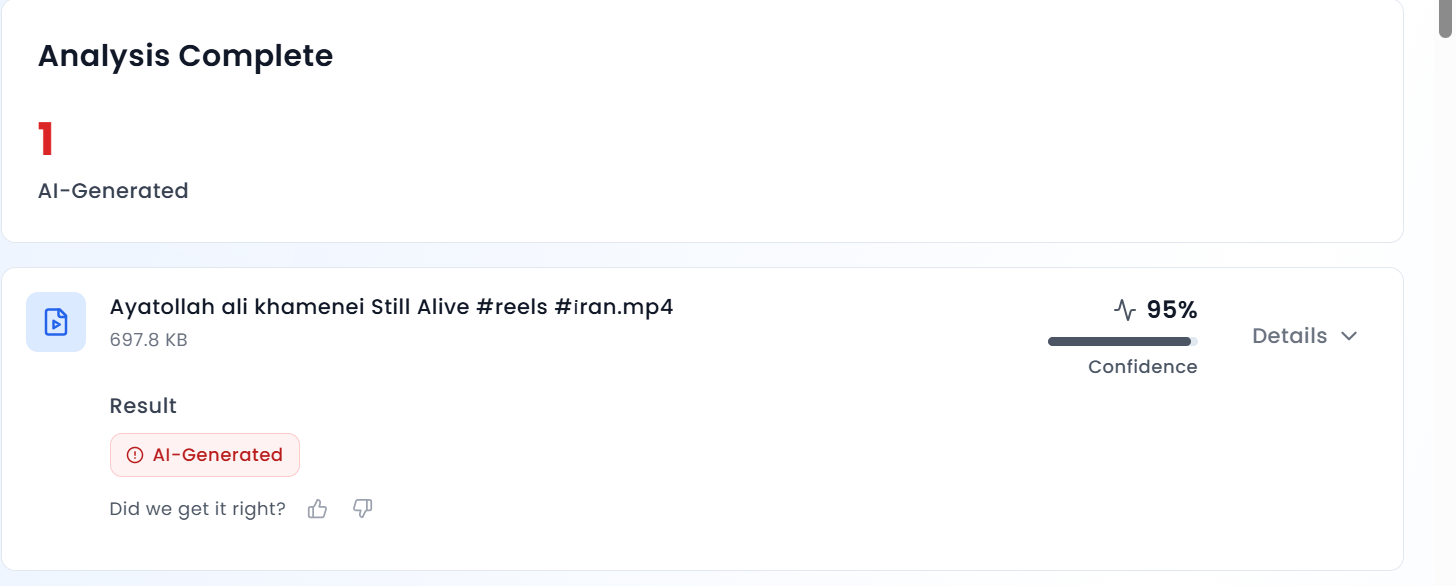
According to Sky News Australia’s report, Iran’s Supreme Leader Ayatollah Ali Khamenei had rejected US President Donald Trump’s demand for unconditional surrender. The Ayatollah regime also warned that any American military intervention would be accompanied by “irreparable damage.” Upon closely listening to the viral clip, we noticed that Khamenei’s voice sounded robotic, raising suspicion that it may have been AI-generated. We then analyzed the video using the AI detection tool AURGIN AI. The results indicated that the viral clip had been generated using artificial intelligence.
Conclusion
Our research establishes that the viral video is old and has been digitally manipulated. Ayatollah Ali Khamenei’s voice has been altered using artificial intelligence and the clip is being shared with a misleading claim.
Related Blogs
Executive Summary:
Microsoft rolled out a set of major security updates in August, 2024 that fixed 90 cracks in the MS operating systems and the office suite; 10 of these had been exploited in actual hacker attacks and were zero-days. In the following discussion, these vulnerabilities are first outlined and then a general analysis of the contemporary cyber security threats is also undertaken in this blog. This blog seeks to give an acquainted and non-acquainted audience about these updates, the threat that these exploits pose, and prevent measures concerning such dangers.
1. Introduction
Nowadays, people and organisations face the problem of cybersecurity as technologies develop and more and more actions take place online. These cyber threats have not ceased to mutate and hence safeguarding organisations’ digital assets requires a proactive stand. This report is concerned with the vulnerabilities fixed by Microsoft in August 2024 that comprised a cumulative of 90 security weaknesses where six of them were zero-day exploits. All these make a terrible risk pose and thus, it is important to understand them as we seek to safeguard virtual properties.
2. Overview of Microsoft’s August 2024 Security Updates
August 2024 security update provided by Microsoft to its products involved 90 vulnerabilities for Windows, Office, and well known programs and applications. These updates are of the latest type which are released by Microsoft under its Patch Tuesday program, a regular cum monthly release of all Patch updates.
- Critical Flaws: As expected, seven of the 90 were categorised as Critical, meaning that these are flaws that could be leveraged by hackers to compromise the targeted systems or bring operations to a halt.
- Zero-Day Exploits: A zero-day attack can be defined as exploits, which are as of now being exploited by attackers while the software vendor has not yet developed a patch for the same. It had managed 10 zero-days with the August update, which underlines that Microsoft and its ecosystems remain at risk.
- Broader Impact: These are not isolated to the products of Microsoft only They still persist Despite this, these vulnerabilities are not exclusive to the Microsoft products only. Other vendors such as Adobe, Cisco, Google, and others also released security advisories to fix a variety of issues which proves today’s security world is highly connected.
3. Detailed Analysis of Key Vulnerabilities
This section provides an in-depth analysis of some of the most critical vulnerabilities patched in August 2024. Each vulnerability is explained in layman’s terms to ensure accessibility for all readers.
3. 1 CVE-2024-38189: Microsoft Project Remote Code Execution Vulnerability (CVSS score:8. 8) :
The problem is in programs that belong to the Microsoft Project family which is known to be a popular project management system. The vulnerability enables an attacker to produce a file to entice an user into opening it and in the process execute code on the affected system. This could possibly get the attacker full control of the user’s system as mentioned in the following section.
Explanation for Non-Technical Readers: Let us assume that one day you received a file which appears to be a normal word document. When it is opened, it is in a format that it secretly downloads a problematic program in the computer and this goes unnoticed. This is what could happen with this vulnerability, that is why it is very dangerous.
3. 2 CVE-2024-38178: Windows Scripting Engine Memory Corruption Vulnerability (CVSS score: 7.5):
Some of the risks relate to a feature known as the Windows Scripting Engine, which is an important system allowing a browser or an application to run scripts in a web page or an application. The weak point can result in corruption of memory space and an attacker can perform remote code execution with the possibility to affect the entire system.
Explanation for Non-Technical Readers: For the purpose of understanding how your computer memory works, imagine if your computer’s memory is a library. This vulnerability corrupts the structure of the library so that an intruder can inject malicious books (programs) which you may read (execute) on your computer and create havoc.
3. 3 CVE-2024-38193: WinSock Elevation of Privilege Vulnerability (CVSS score: 7. 8 )
It opens up a security weakness in the Windows Ancillary Function Driver for WinSock, which is an essential model that masks the communication between the two. It enables the attacker to gain new privileges on the particular system they have attacked, in this case they gain some more privileges on the attacked system and can access other higher activities or details.
Explanation for Non-Technical Readers: This flaw is like somebody gaining access to the key to your house master bedroom. They can also steal all your valuable items that were earlier locked and could only be accessed by you. It lets the attacker cause more havoc as soon as he gets inside your computer.
3. 4 CVE-2024-38106: Windows Kernel Elevation of Privilege Vulnerability (CVSS score: 7. 0)
This vulnerability targets what is known as the Windows Kernel which forms the heart or main frameworks of the operating system that controls and oversees the functions of the computer components. This particular weakness can be exploited and an opponent will be able to get high-level access and ownership of the system.
Explanation for Non-Technical Readers: The kernel can be compared to the brain of your computer. It is especially dangerous that if someone can control the brain he can control all the rest, which makes it a severe weakness.
3. 5 CVE-2024-38213: Windows Mark of the Web Security Feature Bypass Vulnerability (CVSS score: 6.5).
This vulnerability enables the attackers to evade the SmartScreen component of Windows which is used to safeguard users from accessing unsafe files. This weakness can be easily used by the attackers to influence the users to open files that are otherwise malicious.
Explanation for Non-Technical Readers: Usually, before opening a file your computer would ask you in advance that opening the file may harm your computer. This weak point makes your computer believe that this dangerous file is good and then no warning will be given to you.
4. Implications of the Vulnerabilities
These vulnerabilities, importantly the zero-day exploits, have significant implications on all users.
- Data Breaches: These weaknesses can therefore be manipulated to cause exposures of various data, occasioning data leaks that put individual and corporate information and wealth.
- System Compromise: The bad guys could end up fully compromising the impacted systems meaning that they can put in malware, pilfer data or simply shut down a program.
- Financial Loss: The organisations that do not patch these vulnerabilities on the shortest notice may end up experiencing a lot of losses because of having to deal with a lot of downtimes on their systems, having to incur the costs of remediating the systems that have been breached and also dealing with legal repercussions.
- Reputation Damage: Security breaches and IT system corruptions can result in loss of customer and partner confidence in an organisation’s ability to protect their information affecting its reputation and its position in the market.
5. Recommendations for Mitigating Risks
Immediate measures should be taken regarding the risks linked to these issues since such weaknesses pose a rather high threat. The following are recommendations suitable for both technical and non-technical users.
5. 1 Regular Software Updates
Make it a point that all the software, particularly operating systems and all Microsoft applications are updated. Any system out there needs to update it from Microsoft, and its Patch Tuesday release is crucial.
For Non-Technical Users: As much as possible, reply ‘yes’ to updates whenever your computer or smartphone prompts for it. These updates correct security matters and secure your instruments.
5. 2 Realisation of Phishing Attacks
Most of the risks are normally realised through phishing techniques. People should be taught diversifiable actions that come with crazy emails like clicking on links and opening attachments.
For Non-Technical Users: Do not respond to emails from unknown people and if they make you follow a link or download a file, do not do it. If it looks like spam, do not click on it.
5. 3 Security Software
Strong and reliable antivirus and anti-malware software can be used to identify and avoid the attacks that might have high chances of using these vulnerabilities.
For Non-Technical Users: Ensure you download a quality antivirus and always update it. This works like a security guard to your computer by preventing bad programs.
5. 4 Introduce Multi Factor Authentication (MFA)
MFA works in a way to enforce a second factor of authentication before the account can be accessed; for instance, a user will be asked to input a text message or an authentication application.
For Non-Technical Users: NS is to make use of two-factor authentication on your accounts. It is like increasing the security measures that a man who has to burgle a house has to undergo by having to hammer an additional lock on the door.
5. 5 Network segmentations and Privileges management
Network segmentation should be adopted by organisations to prevent the spread of attacks while users should only be granted the privileges required to do their activities.
For Non- Technical Users: Perform the assessments of user privileges and the networks frequently and alter them in an effort of reducing the extent of the attacks.
6. Global Cybersecurity Landscape and Vendor Patches
The other major vendors have also released patches to address security vulnerabilities in their products. The interdependent nature of technology has the effect on the entire digital ecosystem.
- Adobe, Cisco, Google, and Others: These companies have released updates to address the weaknesses in their products that are applied in different sectors. These patches should be applied promptly to enhance cybersecurity.
- Collaboration and Information Sharing:Security vendors as well as researchers and experts in the cybersecurity domain, need to remain vigilant and keep on sharing information on emerging threats in cyberspace.
7. Conclusion
The security updates companies such as Microsoft and other vendors illustrate the present day fight between cybersecurity experts and cybercriminals. All the vulnerabilities addressed in this August 2024 update cycle are a call for prudence and constant protection of digital platforms. These vulnerabilities explain the importance of maintaining up-to-date systems, being aware of potential threats, and implementing robust security practices. Therefore, it is important to fortify our shield in this ever expanding threat domain, in order to be safe from attackers who use this weakness for their malicious purposes.

Introduction
As the world seemingly shrinks under the vast, ever-stretching canopy of the internet, the channels through which information flows are becoming increasingly enigmatic and tangled. In the digital world, the gulf between fact and fabrication narrows dramatically, with the veracity of information too often lost in the flood. Amidst the torrents of data, platforms like YouTube, a veritable Goliath in the video streaming sphere, are finding themselves at the forefront of a critical battle against the dark forces of fake news and disinformation—a war that is waged with the intensity of any historical conflict over truth and influence.
It is in this volatile theatre that Google's video behemoth, YouTube, under the scrutiny of the global eye, announces its strategic campaign to shield against the onslaught of misinformation. With India, the world's most populous democracy, on the cusp of its monumental general elections, the stakes could hardly be higher. YouTube's involvement thus evolves beyond corporate social responsibility—it becomes a crusade for the integrity of information, a paladin for the democratic process, and a protector of the public’s right to factual reporting.
The Campaign
The campaign envisioned by YouTube India's vanguard is multifaceted and robust, aimed at rooting out the insidious tendrils of fake news where they lie. At the heart of this mission are two pivotal strategies that form the backbone of YouTube's defense. Firstly, a rigorous misinformation policy, which heralds as a bastion against content designed with duplicitous intent. YouTube Indian Head Ishan Chatterjee elucidates, 'Our misinformation policies clearly state that if the content has been technically manipulated with the intent to deceive a user and there's a danger of real-world harm...we will act against that content.' It is an exhortation of YouTube's commitment to a culture of truth and an acknowledgement of the platform's influence and responsibility. This process, however, is more complex than it appears; it is tangled in socio-political nuances and demands an uncompromising vigilance to identify and dispel falsehoods.
Yet, this is merely the foundation upon which YouTube’s strategy rests. The second prong of their stratagem is even more ambitious—intending not only to eradicate the chaff of misinformation but also to till the soil with the seeds of verifiable, authoritative news content. This is an initiative to resuscitate the public's faith in digital information sources. By allying with credible news publishers and fostering a symbiosis with independent journalists, YouTube has taken up the mantle of an institution that not just police content, but cultivates it, transforming the barren desert of online falsehoods into an oasis of enlightenment.
News on YouTube is symbiotic with the larger consciousness of its users, driving content consumption and engaging millions who seek out current affairs, investigative reports, and in-depth analysis on the platform. The democratisation of news, once the hallowed ground of traditional broadcast and print media, now finds its theatre online. Chatterjee insightfully notes the ascending trend of news story engagement on YouTube Shorts and Connected TV (CTV)—two emergent platforms that have revolutionised content delivery and consumption. CTV, in particular, has skyrocketed in popularity within the past five years, boasting over 58 million viewers in India consuming YouTube content from the comfort of their living rooms as of June 2023, per analytics.
This phenomenon is acutely observed by YouTube's Director and Global Head of Responsibility, Tim Katz, who delineates a portrait of the Indian market's distinctive hunger for live content, particularly news, on CTV. Katz's observations carry an air of fascination, 'The other two things that have been exciting to see are that we've seen a lot of growth, particularly during sensitive moments, with large news stories occurring certainly during an election cycle, and we just see very large growth from many of our authoritative partners.'
The Implications of the Campaign
The tapestry of YouTube's news ecosystem is a rich mosaic of diversity, including independent journalists, broadcasters, legacy print publications, and digital-first media organisations. Katz underscores the gravity of nurturing such a broad and dynamic news environment on the platform, a gesture of YouTube's commitment to a holistic information landscape.
An illuminating report from the Google News Initiative, forged in cooperation with Kantar, reiterates the dominance of video as the consummate medium for news consumption across a spectrum of languages and formats in India. It paints a picture of a nation of insatiable news consumers, with nearly every second Indian language internet user engaging with news content, a substantial proportion hailing from urban locales. Of particular resonance is hyperlocal news, which plucks the chords of local interests and concerns, touching the lives of seven out of ten citizens.
Moreover, the economic impetus behind YouTube’s role in the media firmament is brought to light in the Oxford Economics Impact Report, revealing a staggering 70% of Indian media and music companies with a YouTube presence acknowledge the platform as a crucial revenue stream.
Conclusion
Poised upon the sharp edge of an electric election season—a season that will no doubt be drenched in a spectrum of information, both fact and fable—YouTube's convictions stand as a beacon of reliability. Their initiative is more than a method—it's a philosophy, a dedication to purifying the information sphere. In the digital epoch, where the battle lines for truth are drawn in bytes and bandwidth, YouTube’s rallying cry for responsibility, its vow to safeguard democratic ideals, and its unyielding commitment to illuminating the corridors of knowledge are more than strategies; they are pillars on which a well-informed, engaged, and enlightened citizenry can lean.
Reference

India is the world's largest democracy, and conducting free and fair elections is a mammoth task shouldered by the Election Commission of India. But technology is transforming every aspect of the electoral process in the digital age, with Artificial Intelligence (AI) being integrated into campaigns, voter engagement, and election monitoring. In the upcoming Bihar elections of 2025, all eyes are on how the use of AI will influence the state polls and the precedent it will set for future elections.
Opportunities: Harnessing AI for Better Elections
Breaking Language Barriers with AI:
AI is reshaping political outreach by making speeches accessible in multiple languages. At the Kashi Tamil Sangamam in 2024, the PM’s Hindi address was AI-dubbed in Tamil in real time. Since then, several speeches have been rolled out in eight languages, ensuring inclusivity and connecting with voters beyond Hindi-speaking regions more effectively.
Monitoring and Transparency
During Bihar’s Panchayat polls, the State Election Commission used Staqu’s JARVIS, an AI-powered system that connects with CCTV cameras to monitor EVM screens in real time. By reducing human error, JARVIS brought greater accuracy, speed, and trust to the counting process.
AI for Information Access on Public Service Delivery
NaMo AI is a multilingual chatbot that citizens can use to inquire about the details of public services. The feature aims to make government schemes easy to understand, transparent, and help voters connect directly with the policies of the government.
Personalised Campaigning
AI is transforming how campaigns connect with voters. By analysing demographics and social media activity, AI builds detailed voter profiles. This helps craft messages that feel personal, whether on WhatsApp, a robocall, or a social media post, ensuring each group hears what matters most to them. This aims to make political outreach sharper and more effective.
Challenges: The Dark Side of AI in Elections
Deepfakes and Disinformation
AI-powered deepfakes create hyper-realistic videos and audio that are nearly impossible to distinguish from the real. In elections, they can distort public perception, damage reputations, or fuel disharmony on social media. There is a need for mandatory disclaimers stating when content is AI-generated, to ensure transparency and protect voters from manipulative misinformation.
Data Privacy and Behavioural Manipulation
Cambridge Analytica’s consulting services, provided by harvesting the data of millions of users from Facebook without their consent, revealed how personal data can be weaponised in politics. This data was allegedly used to “microtarget” users through ads, which could influence their political opinions. Data mining of this nature can be supercharged through AI models, jeopardising user privacy, trust, safety, and casting a shadow on democratic processes worldwide.
Algorithmic Bias
AI systems are trained on datasets. If the datasets contain biases, AI-driven tools could unintentionally reinforce stereotypes or favor certain groups, leading to unfair outcomes in campaigning or voter engagement.
The Road Ahead: Striking a Balance
The adoption of AI in elections opens a Pandora's box of uncertainties. On the one hand, it offers solutions for breaking language barriers and promoting inclusivity. On the other hand, it opens the door to manipulation and privacy violations.
To counter risks from deepfakes and synthetic content, political parties are now advised to clearly label AI-generated materials and add disclaimers in their campaign messaging. In Delhi, a nodal officer has even been appointed to monitor social media misuse, including the circulation of deepfake videos during elections. The Election Commission of India constantly has to keep up with trends and tactics used by political parties to ensure that elections remain free and fair.
Conclusion
With Bihar’s pioneering experiments with JARVIS in Panchayat elections to give vote counting more accuracy and speed, India is witnessing both sides of this technological revolution. The challenge lies in ensuring that AI strengthens democracy rather than undermining it. Deepfakes algorithms, bias, and data misuse remind us of the risk of when technology oversteps. The real challenge is to strike the right balance in embracing AI for elections to enhance inclusivity and transparency, while safeguarding trust, privacy, and the integrity of democratic processes.
References
- https://timesofindia.indiatimes.com/india/how-ai-is-rewriting-the-rules-of-election-campaign-in-india/articleshow/120848499.cms#
- https://m.economictimes.com/news/elections/lok-sabha/india/2024-polls-stand-out-for-use-of-ai-to-bridge-language-barriers/articleshow/108737700.cms
- https://www.ndtv.com/india-news/namo-ai-on-namo-app-a-unique-chatbot-that-will-answer-everything-on-pm-modi-govt-schemes-achievements-5426028
- https://timesofindia.indiatimes.com/gadgets-news/staqu-deploys-jarvis-to-facilitate-automated-vote-counting-for-bihar-panchayat-polls/articleshow/87307475.cms
- https://www.drishtiias.com/daily-updates/daily-news-editorials/deepfakes-in-elections-challenges-and-mitigation
- https://internetpolicy.mit.edu/blog-2018-fb-cambridgeanalytica/
- https://www.deccanherald.com/elections/delhi/delhi-assembly-elections-2025-use-ai-transparently-eci-issues-guidelines-for-political-parties-3357978#