
#FactCheck - Misleading Viral Video Targets Rubika Liyaquat, Original Footage Tells Different Story
Executive Summary
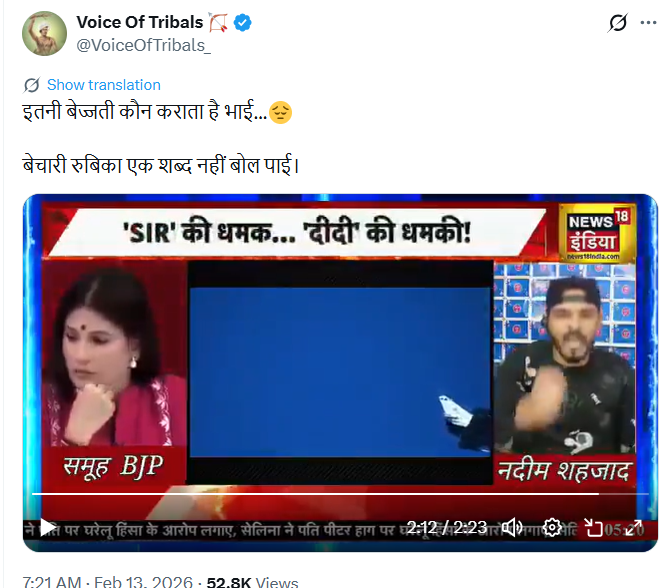
A video circulating on social media claims that a Pakistani man misbehaved with TV anchor Rubika Liyaquat during a live television debate. Users sharing the clip alleged that the Pakistani participant silenced the anchor on live TV.
However, research by CyberPeace found the viral claim to be false and revealed that the video being shared on social media is edited. In the original video, published on YouTube on November 26, 2025, the alleged Pakistani man was not present in the TV debate.
Claim
On February 13, 2026, a user shared the viral clip on X (formerly Twitter), claiming that the anchor was insulted during the debate and was left speechless. Another user on February 11, 2026, asked News18 India to verify the video and questioned who allowed such behaviour towards the journalist on air.
Fact Check:
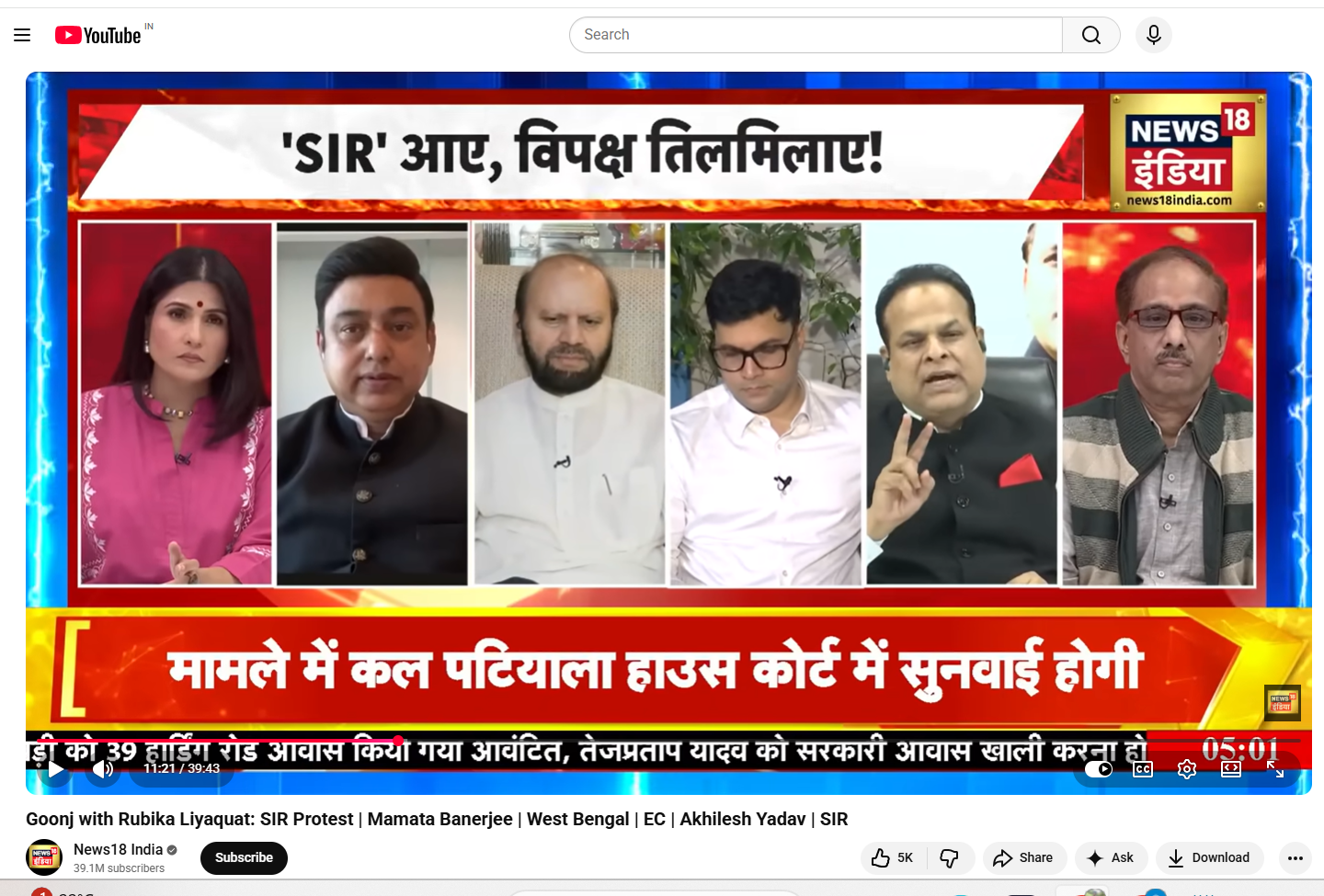
To verify the claim, we extracted key frames from the viral video and conducted a reverse image search using Google Lens. During the research, we found the full version of the debate uploaded on the official YouTube channel of News18 India on November 26, 2025. The nearly 40-minute original broadcast featured anchor Rubika Liyaquat along with panelists Zafar Islam, Varun Purohit, Prateek Kumar, Arvind Kumar Vajpayee, Tausif Ahmed Khan, and Aziz Khan. However, the person seen misbehaving with the anchor in the viral clip was not present in the original video.
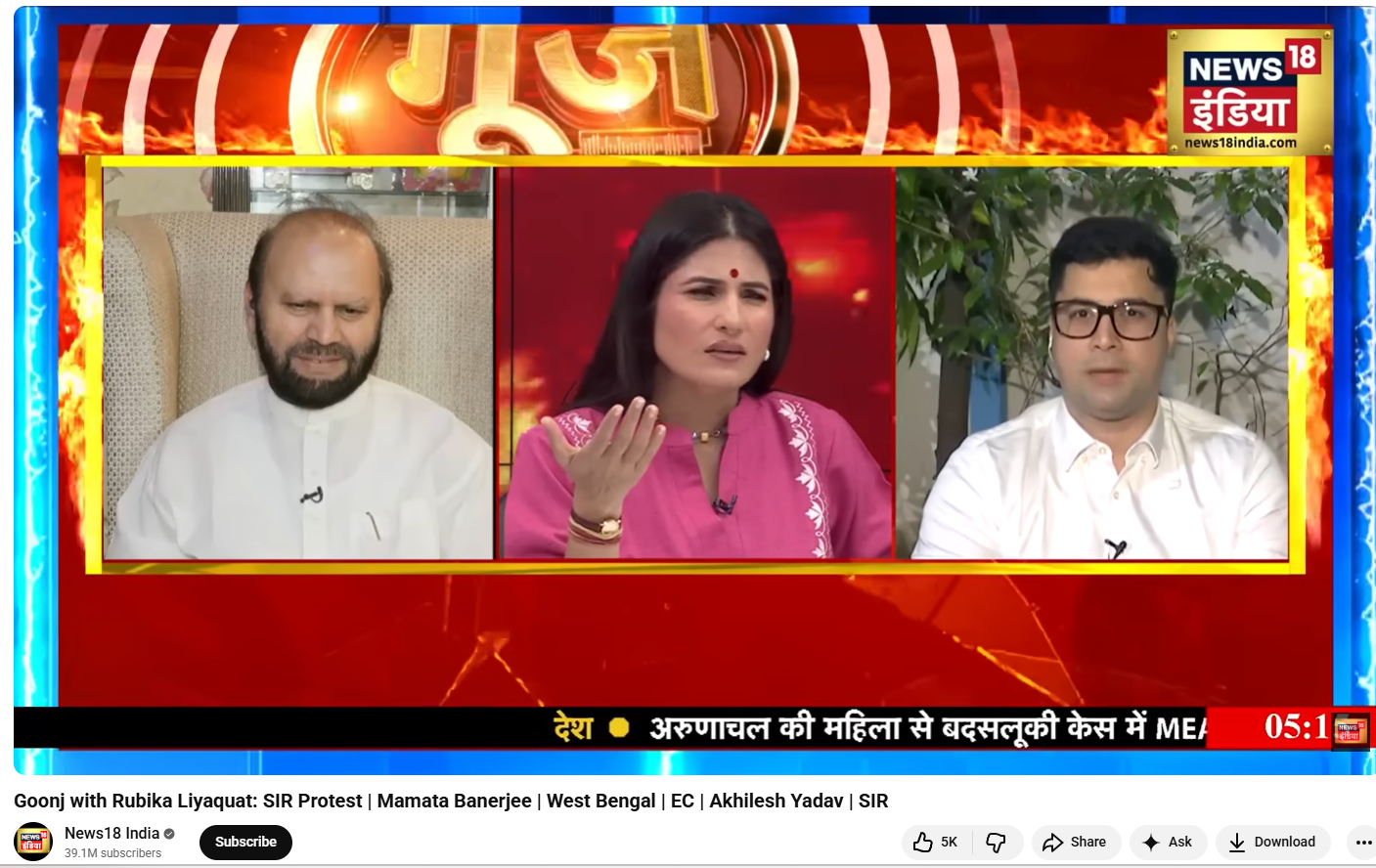
Upon carefully reviewing the footage, we located the actual segment around the 25-minute 40-second mark. In this portion, the anchor can be heard asking panelist Tausif Ahmed Khan to leave the show, using the same words heard in the viral clip. However, the original broadcast does not feature any Pakistani participant or any individual named “Nadeem Shahzad.”
Conclusion
Our research found that the viral claim is false. The circulating video has been edited, and the alleged Pakistani participant does not appear in the original debate uploaded on November 26, 2025.

Related Blogs

Executive Summary:
A video circulating on social media claims to show a live elephant falling from a moving truck due to improper transportation, followed by the animal quickly standing up and reacting on a public road. The content may raise concerns related to animal cruelty, public safety, and improper transport practices. A detailed examination using AI content detection tools, visual anomaly analysis indicates that the video is not authentic and is likely AI generated or digitally manipulated.
Claim:
The viral video (archive link) shows a disturbing scene where a large elephant is allegedly being transported in an open blue truck with barriers for support. As the truck moves along the road, the elephant shifts its weight and the weak side barrier breaks. This causes the elephant to fall onto the road, where it lands heavily on its side. Shortly after, the animal is seen getting back on its feet and reacting in distress, facing the vehicle that is recording the incident. The footage may raise serious concerns about safety, as elephants are normally transported in reinforced containers, and such an incident on a public road could endanger both the animal and people nearby.

Fact Check:
After receiving the video, we closely examined the visuals and noticed some inconsistencies that raised doubts about its authenticity. In particular, the elephant is seen recovering and standing up unnaturally quickly after a severe fall, which does not align with realistic animal behavior or physical response to such impact.
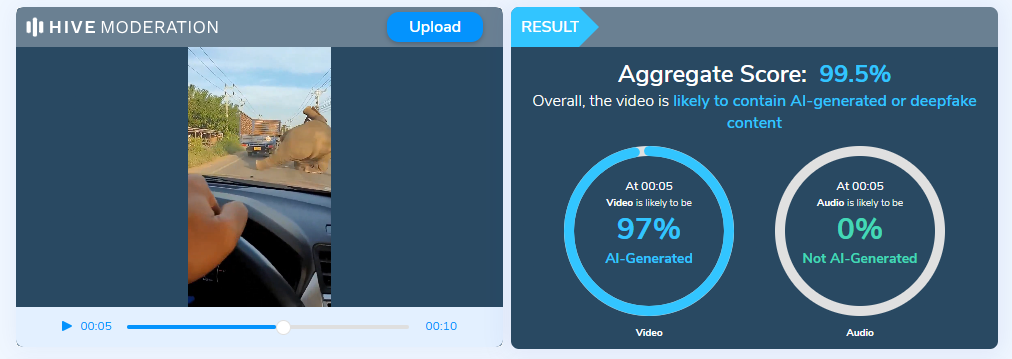
To further verify our observations, the video was analyzed using the Hive Moderation AI Detection tool, which indicated that the content is likely AI generated or digitally manipulated.
Additionally, no credible news reports or official sources were found to corroborate the incident, reinforcing the conclusion that the video is misleading.
Conclusion:
The claim that the video shows a real elephant transport accident is false and misleading. Based on AI detection results, observable visual anomalies, and the absence of credible reporting, the video is highly likely to be AI generated or digitally manipulated. Viewers are advised to exercise caution and verify such sensational content through trusted and authoritative sources before sharing.
- Claim: The viral video shows an elephant allegedly being transported, where a barrier breaks as it moves, causing the animal to fall onto the road before quickly getting back on its feet.
- Claimed On: X (Formally Twitter)
- Fact Check: False and Misleading
.webp)
Introduction
Meta Platforms is experiencing a long-term surge of lawsuits that not only question particular practices, but also the very design and governance of its platforms, across the United States and beyond. This range of privacy breaches to youth mental health damages and antitrust issues are all indicative of a new era of judicial, regulatory, and civil society scrutiny of the duties of big tech firms. The main question is no longer whether harmful content is placed on platforms, but to what extent they are actively creating harm-producing environments.
From Content to Conduct: A Turning Point in Legal Strategy
Over the years, Meta and other sites have depended on legal safeguards like the US Communications Decency Act, Section 230, which protects companies against liability due to user-created content. New ways of testing that protection are now being tried.
Recent incidents have shifted off the blame of particular content and has placed the emphasis on the design of the platform. Courts are becoming more receptive to consider whether the characteristics of infinite scroll, algorithmic amplification, and engagement-based ranking systems are contributing to quantifiable harm.
In March 2026, a California jury declared that Meta and Google were negligent in creating platforms that led to youth addiction and mental health problems. The jury decided that Meta and Google were to pay off a joint sum of 6 million dollars in damages, with 70 percent of the sum being charged on Meta. It is a bellwether case, which means that it is related to about 2,000 other pending cases by parents and school districts. This change is important as it avoids legal barriers. When the liability is linked to the design decisions instead of user-created content, accountability begins to shift.
The Youth Harm Cases: A Big Tobacco Moment
Social media are becoming the subject of increased scrutiny by courts and regulators as products that have quantifiable psychological impacts. The most impactful group of lawsuits against Meta is, perhaps, the one concerning youth mental health.
A day prior to the California verdict, a New Mexico jury ordered Meta to pay $375 million in damages due to failure to safeguard young users against child predators on Instagram and Facebook, and found that the company had lied to consumers about the safety of its products and violated state consumer protection laws.
Similar arguments have been presented in other lawsuits filed by attorneys general in over 30 states, and the cases reflect previous regulatory turning points in other industries such as tobacco. The question that courts are not merely asking is whether there is harm or not. They are questioning whether businesses were aware of creating systems that capitalize on behavioral weaknesses. It has been reported in internal documents and accounts of former employees that Meta made a profit by intentionally turning its platforms into addictions to children, with algorithmic functions tailored to drive users into engagement loops, maximising time on platform to the detriment of wellbeing.
Meta has refuted these characterisations, claiming that teen mental health is multifaceted and cannot be blamed on an individual app. The companies have indicated that they will appeal the verdicts.
Privacy and Data Misuse: An Ongoing Fault Line
Platform design is not the only issue that Meta faces in legal matters. Cases centered on privacy have been a recurrent problem in the last ten years, and previous cases have claimed that Facebook monitored users even after they have logged out, scanned personal messages, and utilized personal data in a manner that was beyond user expectations. In more recent times, in April 2026, a class action suit was filed claiming that WhatsApp messages were accessed by Meta employees and third-party contractors, despite the long-standing end-to-end encryption guarantees of the platform.
These instances indicate a structural problem that is consistent. Consent mechanisms and privacy policies tend to be out of date with the reality of data use, and the gap between legal compliance and what users actually know or expect.
Antitrust: A Win, But Not a Clean One
One of the legal fronts was Meta all the way. In November 2025, a judge in the US District Court, James Boasberg, declared that Meta was not a social networking monopoly, finding that the FTC did not demonstrate that the acquisitions of Instagram and WhatsApp by the company were against the antitrust law. The decision has since been appealed by the FTC, which continues to argue that "Meta broke our antitrust laws by acquiring Instagram and WhatsApp, and that American consumers have been harmed by it.
The case also demonstrates a significant drawback of the antitrust law as a form of regulation of tech companies. By the time the trial occurred five years after the lawsuit was initiated, the social media market had evolved such that Tik Tok was a major competitor, undermining the market definition claims of the FTC. The structural issue of whether a few platforms are too powerful in the communication of the masses is not answered, although the legal claim in this instance might have been unsuccessful.
Policy Takeaways: What This Means Going Forward
The accumulating number of lawsuits against Meta provides a number of valuable lessons to policymakers.
- Platform design has become a regulatory topic. Laws should go beyond content regulation and deal with the construction of systems. Engagement maximising features can also increase harm, and this trade-off must be governed explicitly.
- Transparency should be mandatory and not discretionary. Privacy policies and disclosures on platforms are usually too complicated or ambiguous. Regulators might be required to make more transparent and standardised disclosures regarding the use of data and the operation of recommendation systems.
- Section 230 safeguards are under reinterpretation. Courts are becoming open to restrict immunity in cases where the harm is associated with the conduct of the platform and not the content of the user. This would redefine the law of all digital platforms, and not only Meta.
- Cross-border coordination is needed. Meta is an international company, yet the regulatory reaction is still divided. This will require more coordination among jurisdictions to guarantee uniform enforcement and to eliminate regulatory arbitrage.
Conclusion
The lawsuits of Meta are not single cases. They are a more general reconsideration of the regulation of digital platforms and the accountability of those responsible when design decisions have harm at scale. In the wider context of the technology ecosystem, the implications are structural. Courts are starting to question not only what is hosted on them, but how they work and why they are constructed in the manner they are.
The age of minimal responsibility is being supplanted by a more challenging requirement: that platforms should foresee, quantify, and alleviate the harms they produce. The result of these cases will not only decide the future of Meta in terms of legal matters. They will influence the regulations of the digital economy in the years to come.
References
- https://www.npr.org/2026/03/25/nx-s1-5746125/meta-youtube-social-media-trial-verdict
- https://www.pbs.org/newshour/show/jury-finds-meta-and-youtube-liable-in-landmark-youth-addiction-case
- https://www.cbsnews.com/news/meta-ftc-whatsapp-instagram/
- https://www.cnbc.com/2026/01/20/ftc-appeals-metaruling-antitrust-instagram-whatsapp.html
- https://www.bbc.com/news/articles/czjw0zgz9zyo
Introduction
A policy, no matter how artfully conceived, is like a timeless idiom, its truth self-evident, its purpose undeniable, standing in silent witness before those it vows to protect, yet trapped in the stillness of inaction, where every moment of delay erodes the very justice it was meant to serve. This is the case of the Digital Personal Data Protection Act, 2023, which holds in its promise a resolution to all the issues related to data protection and a protection framework at par with GDPR and Global Best Practices. While debates on its substantive efficacy are inevitable, its execution has emerged as a site of acute contention. The roll-out and the decision-making have been making headlines since late July on various fronts. The government is being questioned by industry stakeholders, media and independent analysts on certain grounds, be it “slow policy execution”, “centralisation of power” or “arbitrary amendments”. The act is now entrenched in a never-ending dilemma of competing interests under the DPDP Act.
The change to the Right to Information Act (RTI), 2005, made possible by Section 44(3) of the DPDP Act, has become a focal point of debate. This amendment is viewed by some as an attack on weakening the hard-won transparency architecture of Indian democracy by substituting an absolute exemption for personal information for the “public interest override” in Section 8(1)(j) of the RTI Act.
The Lag Ledger: Tracking the Delays in DPDP Enforcement
As per a news report of July 28, 2025, the Parliamentary Standing Committee on Information and Communications Technology has expressed its concern over the delayed implementation and has urged the Ministry of Electronics and Information Technology (MeitY) to ensure that data privacy is adequately ensured in the nation. In the report submitted to the Lok Sabha on July 24, the committee reviewed the government’s reaction to the previous recommendations and concluded that MeitY had only been able to hold nine consultations and twenty awareness workshops about the Draft DPDP Rules, 2025. In addition, four brainstorming sessions with academic specialists were conducted to examine the needs for research and development. The ministry acknowledges that this is a specialised field that urgently needs industrial involvement. Another news report dated 30th July, 2025, of a day-long consultation held where representatives from civil society groups, campaigns, social movements, senior lawyers, retired judges, journalists, and lawmakers participated on the contentious and chilling effects of the Draft Rules that were notified in January this year. The organisers said in a press statement the DPDP Act may have a negative impact on the freedom of the press and people’s right to information and the activists, journalists, attorneys, political parties, groups and organisations “who collect, analyse, and disseminate critical information as they become ‘data fiduciaries’ under the law.”
The DPDP Act has thus been caught up in an uncomfortable paradox: praised as a significant legislative achievement for India’s digital future, but caught in a transitional phase between enactment and enforcement, where every day not only postpones protection but also feeds worries about the dwindling amount of room for accountability and transparency.
The Muzzling Effect: Diluting Whistleblower Protections
The DPDP framework raises a number of subtle but significant issues, one of which is the possibility that it would weaken safeguards for whistleblowers. Critics argue that the Act runs the risk of trapping journalists, activists, and public interest actors who handle sensitive material while exposing wrongdoing because it expands the definition of “personal data” and places strict compliance requirements on “data fiduciaries.”One of the most important checks on state overreach may be silenced if those who speak truth to power are subject to legal retaliation in the absence of clear exclusions of robust public-interest protections.
Noted lawyer Prashant Bhushan has criticised the law for failing to protect whistleblowers, warning that “If someone exposes corruption and names officials, they could now be prosecuted for violating the DPDP Act.”
Consent Management under the DPDP Act
In June 2025, the National e-Governance Division (NeGD) under MeitY released a Business Requirement Document (BRD) for developing consent management systems under the DPDP Act, 2023. The document supports the idea of “Consent Manager”, which acts as a single point of contact between Data Principals and Data Fiduciaries. This idea is fundamental to the Act, which is now being operationalised with the help of MeitY’s “Code for Consent: The DPDP Innovation Challenge.” The government has established a collaborative ecosystem to construct consent management systems (CMS) that can serve as a single, standardised interface between Data Principals and Data Fiduciaries by choosing six distinct entities, such as Jio Platforms, IDfy, and Zoop. Such a framework could enable people to have meaningful control over their personal data, lessen consent fatigue, and move India’s consent architecture closer to international standards if it is implemented precisely and transparently.
There is no debate to the importance of this development however, there are various concerns associated with this advancement that must be considered. Although effective, a centralised consent management system may end up being a single point of failure in terms of political overreach and technical cybersecurity flaws. Concerns are raised over the concentration of power over the framing, seeking, and recording of consent when big corporate entities like Jio are chosen as key innovators. Critics contend that the organisations responsible for generating revenue from user data should not be given the responsibility for designing the gatekeeping systems. Furthermore, the CMS can create opaque channels for data access, compromising user autonomy and whistleblower protections, in the absence of strong safeguards, transparency mechanisms and independent oversight.
Conclusion
Despite being hailed as a turning point in India’s digital governance, the DPDP Act is still stuck in a delayed and unequal transition from promise to reality. Its goals are indisputable, but so are the conundrum it poses to accountability, openness, and civil liberties. Every delay increases public mistrust, and every safeguard that remains unsolved. The true test of a policy intended to safeguard the digital rights of millions lies not in how it was drafted, but in the integrity, pace, and transparency with which it is to be implemented. In the digital age, the true cost of delay is measured not in time, but in trust. CyberPeace calls for transparent, inclusive, and timely execution that balances innovation with the protection of digital rights.
References
- https://www.storyboard18.com/how-it-works/parliamentary-committee-raises-concern-with-meity-over-dpdp-act-implementation-lag-77105.htm
- https://thewire.in/law/excessive-centralisation-of-power-lawyers-activists-journalists-mps-express-fear-on-dpdp-act
- https://www.medianama.com/2025/08/223-jio-idfy-meity-consent-management-systems-dpdpa/
- https://www.downtoearth.org.in/governance/centre-refuses-to-amend-dpdp-act-to-protect-journalists-whistleblowers-and-rti-activists
