
#FactCheck – Human Helicopter or AI Illusion? The Truth Behind the Viral Flying Man Video
Executive Summary:
A viral video circulating on social media shows a man attempting to fly using a helicopter like fan attached to his body, followed by a crash onto a parked car. The clip was widely shared with humorous captions, suggesting it depicts a real life incident. Given the unusual nature of the visuals, the video was subjected to technical verification using AI content detection tools. Analysis using the AI detection platform indicates that the video is AI generated, and not a genuine real world event.
Claim:
A viral video (archive link) claims to show a person attempting to fly using a self made helicopter fan mechanism, briefly lifting off before crashing onto a car in a public setting. The video shows a man attempting to fly by strapping a helicopter like rotating fan to himself, essentially trying to imitate a human helicopter using a DIY mechanism. For a brief moment, it appears as if the device might work, but the attempt quickly fails due to lack of control, engineering support, and safety measures. Within seconds, the man loses balance and crashes down, landing on top of a parked car. The scene highlights a mix of overconfidence, unregulated experimentation, and risk taking carried out in a public space, with bystanders watching rather than intervening. The clip is shared humorously with the caption “India is not for beginners”.

Fact Check:
To verify the authenticity of the video, it was analyzed using the Hive Moderation AI detection tool, a widely used platform for identifying synthetic and AI generated media. The tool flagged the video with a high probability of AI generation, indicating that the visuals are not captured from a real physical event. Additional indicators such as unrealistic motion physics, inconsistent human object interaction further support the conclusion that the clip was artificially generated or heavily manipulated using generative AI techniques. No credible news reports or independent eyewitness sources corroborate the occurrence of such an incident.

Conclusion:
The claim that the video shows an individual attempting and failing to fly using a helicopter like device is false. Technical analysis confirms that the video is AI generated, and it should be treated as synthetic or fictional content rather than a real life incident. This case highlights how AI generated videos, when shared without context, can mislead audiences and be mistaken for real events, reinforcing the need for verification tools and critical evaluation of viral content.
- Claim: A viral video claims to show a person attempting to fly using a self made helicopter fan mechanism, briefly lifting off before crashing onto a car in a public setting
- Claimed On: X (Formally Twitter)
- Fact Check: False and Misleading

Related Blogs
.webp)
Introduction
The Digital Personal Data Protection (DPDP) Act, of 2023, introduces a framework for the protection of personal data in India. Data fiduciaries are the entity that essentially determines the purpose and means of processing of personal data. The small-scale industries also fall within the ambit of the term. Startups/Small companies and Micro, Small, and Medium Enterprises (MSMEs) while determining the purpose of processing of personal data in the capacity of ‘data fiduciary’ are also required to comply with the DPDP Act provisions. The obligations set for the data fiduciary will apply to them unilaterally, though compliance with this Act and can be challenging due to resource constraints and limited expertise in data protection.
DPDP Act, 2023 Section 17(3) gives power to the Central Government to exempt Startups from being obligated to comply with the Act, taking into account the volume and nature of personal data processed. It is the nation's first standalone law on data protection and privacy, which sets forth strict rules on how data fiduciaries can collect and process personal data, focusing on consent-based mechanisms and personal data protection. Small-scale industries are given more time to comply with the DPDP Act. The detailed provisions to be notified in further rulemaking called ‘DPDP rules’.
Obligations on Data Fiduciary under the DPDP Act, 2023
The DPDP Act focuses on processing digital personal data in a manner that recognizes both the right of individuals to protect their personal data and the need to process such personal data for lawful purposes and for matters connected therewith or incidental thereto. Hence, small-scale industries also need to comply with provisions aimed at protecting digital personal data.
The key requirements to be considered:
- Data Processing Principles: Ensuring that data processing is done lawfully, fairly, and transparently. Further, the collection and processing of personal data is only for specific, clear, and legitimate purposes and only the data necessary for the stated purpose. Ensuring that the data is accurate and up to date is also necessary. An important part is that the data is not retained longer than necessary and appropriate security measures are taken to protect the said data.
- Consent Management: Clear and informed consent should be obtained from individuals before collecting their personal data. Further, individuals have the option to withdraw their consent easily.
- Rights of Data Principals: Data principals (individuals) whose data is being collected have the right to Information, the right to correction and erasure of data, the right to grievance redressa, Right to nominate.the right to access, correct, and delete their personal data. Data fiduciaries need to be mindful of mechanisms to handle requests from data principals regarding their concerns.
- Data Breach Notifications: Data fiduciaries are required to notify the data protection board and the affected individuals in case a data breach has occurred.
- Appropriate technical and organisational measures: A Data Fiduciary shall implement appropriate technical and organisational measures to ensure effective observance of the provisions of this Act and the rules made thereunder.Cross-border Data Transfers: Compliance with regulations in relation to the transfer of personal data outside of India should be ensured.
Challenges for Small Scale Industries for the DPDP Act Compliance
While small-scale industries have high aims for their organisational growth and now in the digital age they also need to place reliance on online security measures and handling of personal data, with the DPDP act in the picture it becomes an obligation to consider and comply with. As small-scale industries including MSMEs, they might face certain challenges in fulfilling these obligations but digital data protection measures will also boost the competitive market and customer growth in their business. Bringing reforms in methods aimed at better data governance in today's digital era is significant.
One of the major challenges for small-scale industries could be ensuring a skilled workforce that understands and educates internal stakeholders about the DPDP Act compliances. This could undoubtedly become an additional burden.
Further, the limited resources can make the implementation of data protection, which is oftentimes complex for a layperson in the case of a small-scale industry, difficult to implement. Limitations in resources are often financial or human resources.
Cybersecurity, cyber awareness, and protection from cyber threats need some form of expertise, which is lacking in small enterprises. The outsourcing of such expertise is a decision that is sometimes taken too late, and some form of harm can take place between the periods by which an incident can occur.
Investment in the core business or enterprise many times doesn't include technology other than the basic requirements to run the business, nor towards ensuring that the data is secure and all compliances are met. However, in the fast-moving digital world, all industries need to be mindful of their efforts to protect personal data and proper data governance.
Recommendations
To ensure the proper and effective personal data handling practices as per the provisions of the act, the small companies/startups need to work backend and frontend and ensure that they take adequate measures to comply with the act. While such industries have been given more time to ensure compliance, there are some suggestions for them to be compliant with the new law.
Small companies can ensure compliance with the DPDP Act by implementing robust data protection policies, investing in and providing employee training on data privacy, using age-verification mechanisms, and adopting privacy-by-design principles. Conduct a gap analysis to identify areas where current practices fall short of DPDP Act requirements. Regular audits, secure data storage solutions, and transparent communication with users about data practices are also essential. Use cost-effective tools and technologies for data protection and management.
Conclusion
Small-scale industries must take proactive steps to align with the DPDP Act, 2023 provisions. By understanding the requirements, leveraging external expertise, and adopting best practices, small-scale industries can ensure compliance and protect personal data effectively. In the long run, complying with the new law would lead to greater trust and better business for the enterprises, resulting in a larger revenue share for them.
References
- https://pib.gov.in/PressReleaseIframePage.aspx?PRID=1959161
- https://www.financialexpress.com/business/digital-transformation-dpdp-act-managing-data-protection-compliance-in-businesses-3305293/
- https://economictimes.indiatimes.com/tech/technology/big-tech-coalition-seeks-12-18-month-extension-to-comply-with-indias-dpdp-act/articleshow/104726843.cms?from=mdr

Executive Summary
Following the tragic cruise accident at Bargi Dam in Jabalpur, a heartbreaking image of a woman lying unconscious in a river with a child resting on top of her has gone viral on social media. Users are claiming that the picture shows victims of the recent Bargi Dam accident. Research by CyberPeace Research Wing found that the viral claim is false. The circulating image was created using AI (Artificial Intelligence) and is now being misleadingly linked to the real tragedy. However, reports indicate that a similar real-life image of a mother and child did emerge after the accident.
Claim
An X user shared the viral image on May 1, 2026, claiming that despite wearing a life jacket, the mother lost her life while trying to save her child. The emotional post praised mothers’ sacrifice and linked the image directly to the Bargi Dam cruise mishap An X user shared the viral image on May 1, 2026, claiming that despite wearing a life jacket, the mother lost her life while trying to save her child. The emotional post praised mothers’ sacrifice and linked the image directly to the Bargi Dam cruise mishap
Fact Check
To verify the claim, we searched relevant keywords on Google but found no credible news reports connecting the viral image to the Bargi Dam accident. A closer examination of the image revealed multiple visual inconsistencies. The hands of the woman and child appear unnaturally merged at one point, while the woman’s eyebrows seem split into two sections. Such distortions are common indicators of AI-generated imagery.
We then analyzed the picture using AI detection tool Hive Moderation, which estimated nearly a 90% probability that the image was AI-generated.

During the research , we also found a clarification post from the official Facebook account of the Jabalpur District Collector, who stated that the viral image was AI-generated or sourced elsewhere and had no connection with the Bargi cruise accident.

According to a report published by NDTV on May 2, 2026, the accident occurred on April 30 near Khamaria Island when an overloaded tourist cruise capsized amid strong winds, heavy rain, and rising waves. At least nine people died, while 28 others were rescued.

Conclusion
Our research confirms that the viral mother-child image being linked to the Bargi Dam tragedy is fake. The picture was created using AI and falsely circulated in connection with the real cruise accident.

Executive Summary
A set of two images is being widely circulated on social media claiming that the Enforcement Directorate (ED) recently raided a church in Kerala and seized ₹7000 crore in black money. The viral post also alleges that the media deliberately suppressed the news. CyberPeace Research Wing research found the claim to be misleading. The visuals are not recent and are linked to an Income Tax Department action conducted in 2020 at the Believers Eastern Church in Kerala.
Claim:
A Facebook user shared the viral post claiming that ₹7000 crore in black money was seized from a Kerala-based church run by a bishop named Yohannan, and alleged that mainstream media ignored the incident.
Post link: https://www.facebook.com/reel/2143680196569943 , https://archive.ph/submit/

Fact Check:
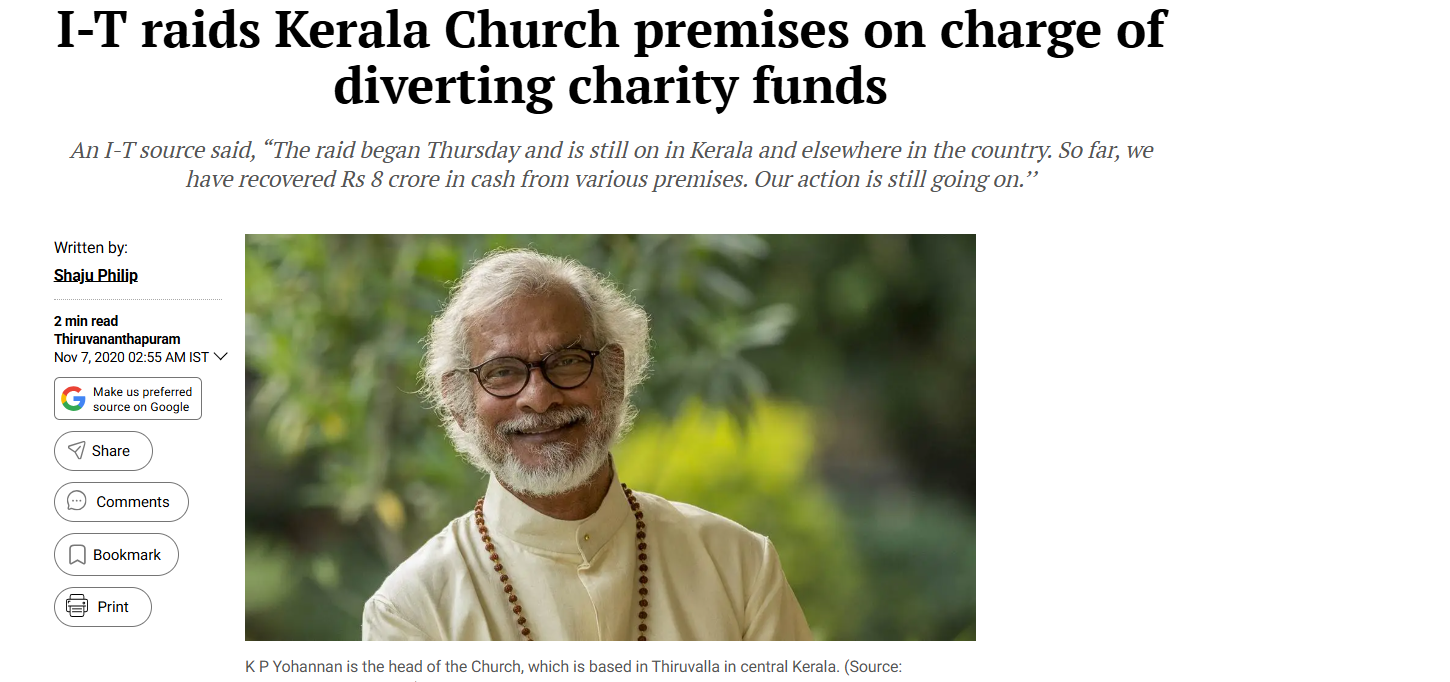
A keyword search related to the alleged raid on Believers Church in Kerala led to several news reports published in November 2020. A report published in The Hindu on November 6, 2020 stated that a crackdown by the Income Tax Department on the Thiruvalla-based Believers Eastern Church had reportedly uncovered several irregularities. https://www.thehindu.com/news/national/kerala/raids-bring-to-light-shady-deals-of-believers-church/article33041420.ece

Further verification from the official Income Tax Department website confirmed details of the search operation. According to the press release, approximately ₹6 crore in unexplained cash was recovered during the raid, including ₹3.85 crore from a place of worship in Delhi. https://www.incometaxindia.gov.in/Lists/Press%20Releases/Attachments/872/PressRelease_ITD_conducts_searches_in_Kerala_6_11_20.pdf
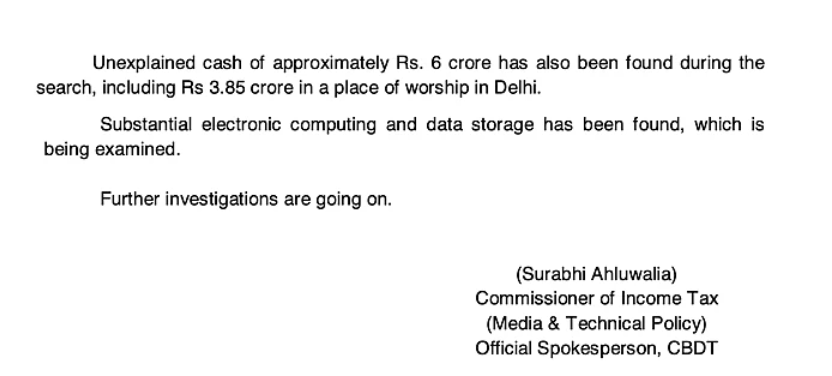
The release also noted that evidence suggested possible cash siphoning running into hundreds of crores of rupees.Additional media reports, including The Indian Express, stated that the total seizure amounted to around ₹14 crore. https://indianexpress.com/article/india/kerala/i-t-raids-kerala-church-premises-on-charge-of-diverting-charity-funds-6984466/
Conclusion:
The research confirms that the viral claim is misleading. The incident is from 2020 and not recent. During the Income Tax Department raid on the Believers Eastern Church in Kerala, around ₹6 crore in cash was recovered, with total seizures reported up to ₹14 crore in media reports. There is no evidence of any ₹7000 crore seizure as claimed in the viral post.
