
#FactCheck- Old Manipur Convoy Video Falsely Linked to CRPF Deployment in West Bengal
Executive Summary
A video showing a military convoy moving along a road is being widely circulated on social media with the claim that the entry of CRPF forces into West Bengal has changed the situation on the ground, suggesting strict action is underway during the ongoing elections. However, research by CyberPeace found the claim to be misleading. The video is not recent and has been available online since February 2025.
Claim
The 12-second viral clip shows multiple heavy vehicles moving in a convoy on a road. It has been shared on X (formerly Twitter) with a caption claiming that CRPF’s entry into West Bengal has led to a shift from dialogue to strong action, along with communal assertions.
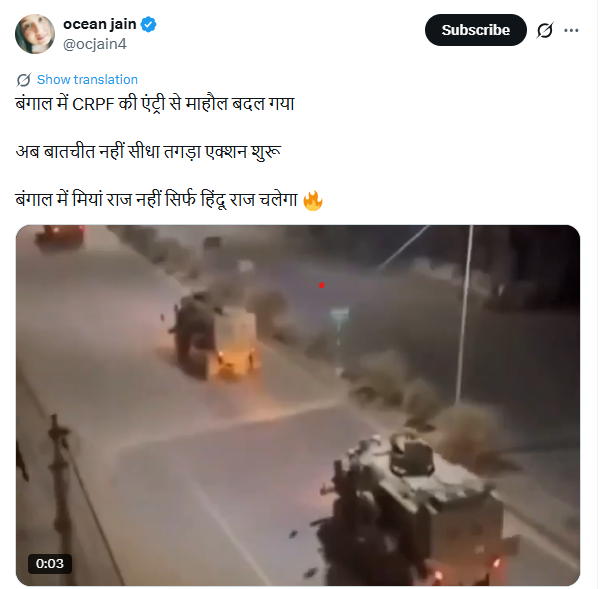
Fact Check
During the verification process, we found that the same video had been posted by several X users around February 17, 2025. In those earlier posts, the video was described as being from Manipur, not West Bengal.
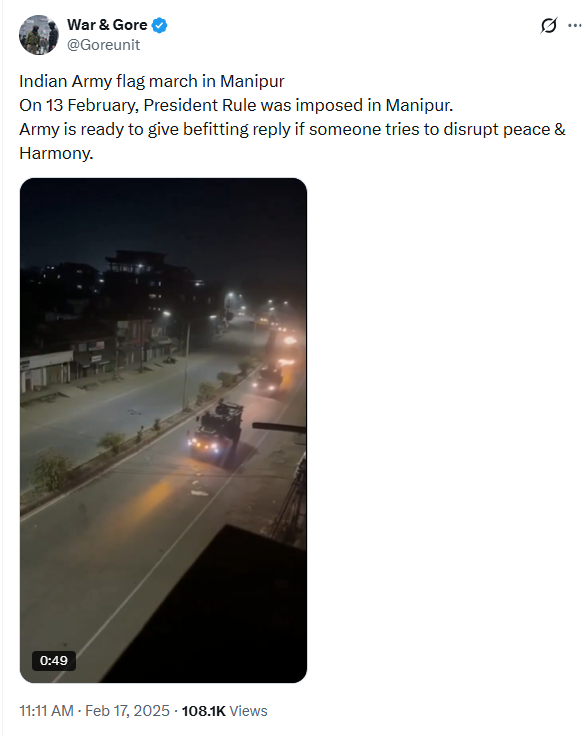
Further analysis revealed that the video contains background audio in the Manipuri language. To confirm this, we contacted a Manipuri journalist, who stated that the audio includes announcements asking people to stay indoors and avoid gathering on the streets. Notably, this audio is missing in the currently viral version of the clip.Although we could not independently verify the exact date and precise location of the footage, visual elements such as road dividers and streetlight patterns closely resemble those found in Imphal, the capital city of Manipur.

Additionally, reports confirm that central armed police forces have indeed been deployed in West Bengal for election duties in multiple phases. However, there is no evidence linking this specific video to those deployments.

Conclusion
The viral claim is misleading. The video does not show CRPF deployment in West Bengal during the ongoing elections. Instead, it appears to be an older clip from Manipur, likely recorded in early 2025, and has been shared with a false and communal narrative. There is no credible evidence to support the claim made alongside the video. Users are advised to verify content before sharing, especially during sensitive events like elections.

Related Blogs

Executive Summary
A postcard featuring BJP leader Manoj Tiwari is being widely shared on social media with a purported statement attributed to him. The viral postcard claims that Tiwari suggested that if people stopped using the ₹1 coin and treated ₹2 as ₹1, the value of the dollar would automatically come down to ₹45. Users are sharing the post claiming that the BJP leader made the bizarre suggestion to strengthen the Indian rupee against the US dollar.
However, research by the CyberPeace Research Wing found the claim to be false. Manoj Tiwari never made any such statement regarding the rupee and the dollar. The BJP MP himself has dismissed the viral claim as fake.
Claim
TMC leader Kirti Azad shared the viral postcard on X and wrote, “As received on X, forwarded as it is. India is truly blessed with such brilliant minds.”
https://x.com/KirtiAzaad/status/2055905987115233473?s=20

Fact Check
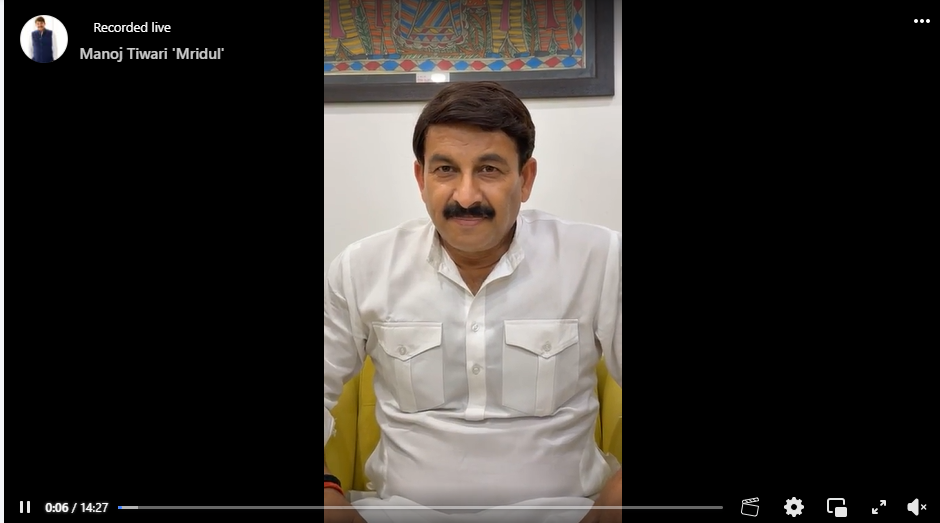
A keyword search on Google did not yield any credible media reports suggesting that Manoj Tiwari had made such a statement. No reliable source was found to support the viral claim. Further research led to a clarification posted on Manoj Tiwari’s official Facebook page. In the video statement, Tiwari categorically denied making any such remark about the rupee and the dollar. He stated that the viral claim being circulated in his name was completely fake.
Manoj Tiwari’s clarification video on Facebook
Conclusion
The viral claim is false. Manoj Tiwari never made any statement suggesting that stopping the use of ₹1 and treating ₹2 as ₹1 would strengthen the rupee against the dollar. He has himself denied the claim and called it fake.
Executive Summary
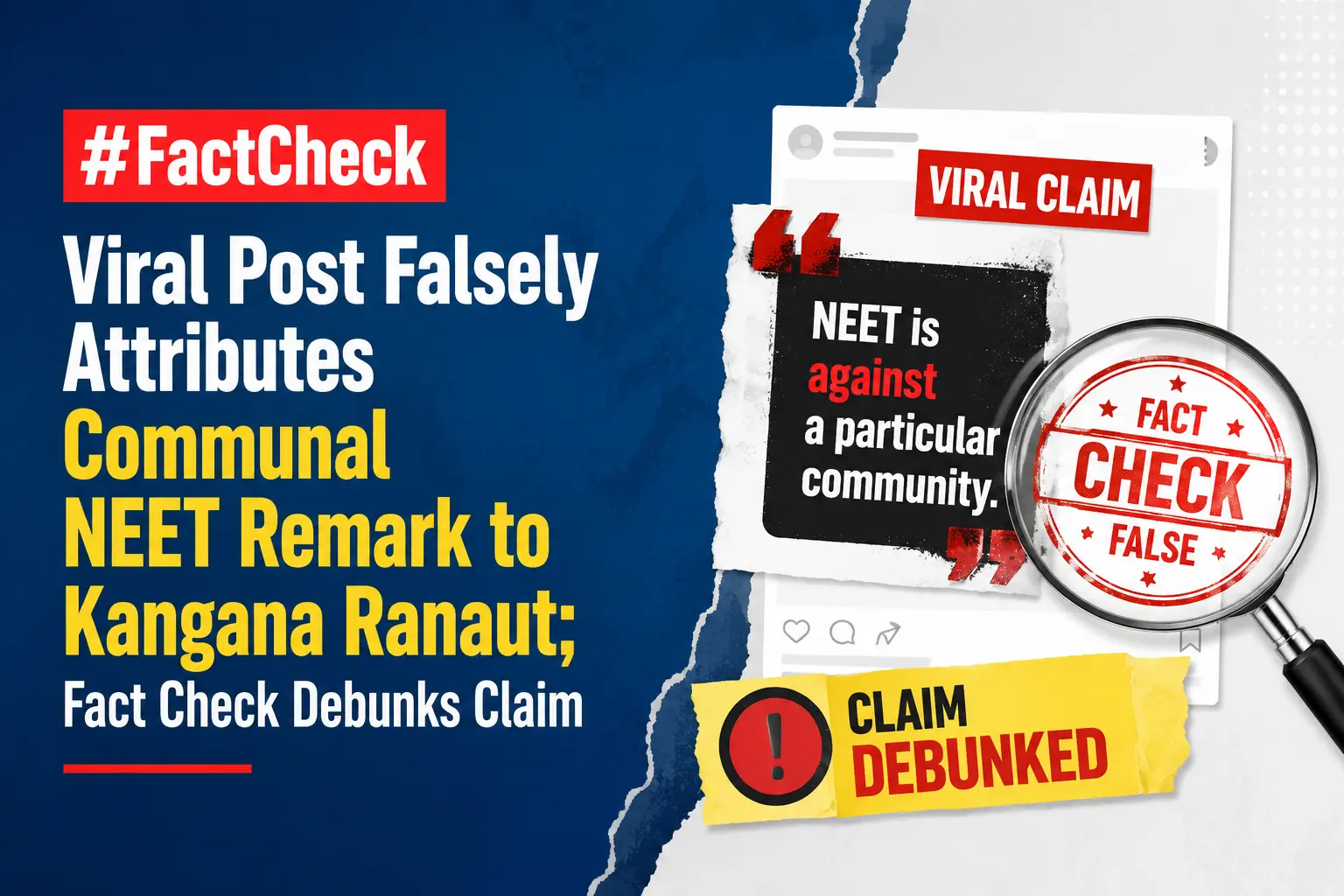
A post claiming to be a statement by BJP MP Kangana Ranaut regarding the NEET paper leak is going viral on social media. The post allegedly quotes her as saying:“Hindus are in danger here and you are worried about the NEET exam. If Hindus do not exist, who will take the NEET exam?” The CyberPeace Research Wing research found this claim to be fake. Kangana Ranaut herself has also denied the viral post through her official X (formerly Twitter) account.
Claim
A user on X shared the viral graphic and wrote that Hindus are in danger and questioned the relevance of the NEET exam, further linking it to political criticism of the BJP government.

Fact Check
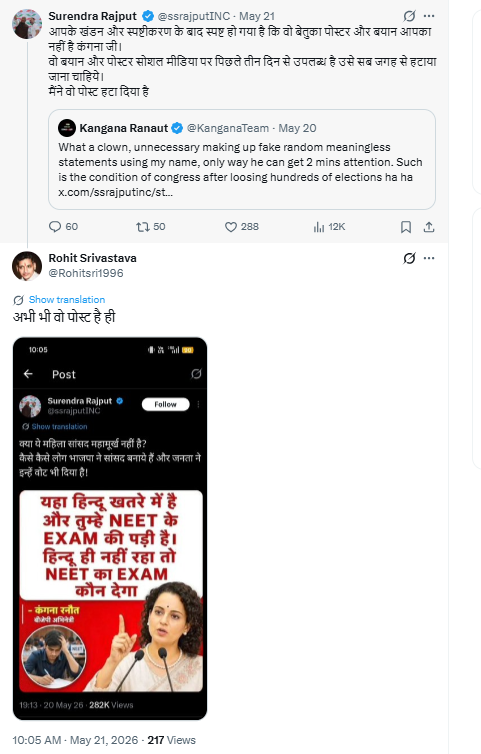
During the research, keyword-based searches revealed no credible reports linking Kangana Ranaut to any such statement regarding NEET paper leaks or Hindus. We also reviewed Kangana Ranaut’s official social media accounts. On May 20, 2026, she tagged Congress leader Surendra Singh Rajput in an X post and clearly termed the viral statement as fake. She also criticized Rajput and the Congress party over the spread of misinformation. Notably, Surendra Rajput later deleted his original post.

On May 21, Rajput reposted Kangana’s clarification, stating that after her denial it was clear that the poster and statement were not hers. He also said he had deleted his post. Under his post, a user shared screenshots of the deleted content.
Conclusion
Our research confirms that Kangana Ranaut has not made any such statement related to the NEET paper leak or Hindus. The viral claim is fake.

Introduction
A zero-click cyber attack solely relies on software and hardware flaws, bypassing any human factor to infect a device and take control over its data. It is almost impossible to discover the attack and know that the device is hacked unless someone on your side is closely monitoring your network traffic data.
At Kaspersky, security analysts used their SIEM solution KUMA to monitor their corporate WiFi network traffic and discovered this mysterious attack. They took necessary actions to investigate it and even went a step further to dive right into the action and uncover the entire attack chain.
A few months ago, Kaspersky shared their findings about this attack on iOS devices. They shared how these zero-click vulnerabilities were being exploited by the attackers and called this attack ‘Operation Triangulation’.
A zero-click exploit in the network
Kaspersky detected a zero-click attack on the iPhones of their colleagues while monitoring their corporate WiFi network traffic. They managed to get detailed information on all the stages of the attack by simply identifying a pattern in the domain names flowing through their network. Although the attackers were quite experienced, their mistakes helped Kaspersky detect critical vulnerabilities in all iOS devices.
The name-pattern
These previously unsuspected domains had a similar name-style which consisted of two names and ended with ‘.com’, such as ‘backuprabbit.com’ and ‘cloudsponcer.com’. They were used in pairs, one for an exportation process and the other served as a command and control server. These domains showed high outbound traffic, they were registered with NameCheap and protected with Cloudflare.
The network pattern
Each time a connection to these suspicious domains was made, it was preceded by an iMessage connection which indicated these domains are being accessed by iOS devices. It was observed that the devices connected to these domains, downloaded attachments, performed a few requests to a first level domain which was an exploitation framework server, then made regular connections with the second level domain which was a command and control server controlled by the attackers.
Getting more information
To get more information about the attack all the infected devices were collected and backed up after carefully informing the device owners. Although the attackers had managed to clean their artefacts, the backed up data was used to perform digital forensic procedures and find traces of the attacks. This helped Kaspersky to figure out how the infection might be taking place.
The attacker’s mistakes
The attackers deleted all the attachment files and exploits but did not delete the modified SMS attachment folder. That folder had no files left inside it. The attackers removed evidence from other databases as well, like the ‘SMS.db’ database, however another database called ‘datausage.sqlite’ was not sanitised.
The ‘datausage.sqlite’ database is the most important database when it comes to iOS forensics as its contents can be used to track applications and network usage. Upon examination of this database, a process logged as ‘BackupAgent’ was found to be making network connections at the same time the device was making connections to the suspicious domains.
The indicator of compromise
‘BackupAgent’ stood out in this scenario because although it is a legitimate binary, it has been deprecated since iOS4 and it should not have been making any network connections. This identified the ‘BackupAgent’ process as the first solid indicator of compromise in Operation Triangulation. The indicator is termed as- ‘Data usage by process BackupAgent’, and was used to determine if any specific device was infected.
Taking it a step ahead
The team at Kaspersky successfully identified the indicator of compromise and determined which devices were infected, but as the attackers were experienced enough to delete their payloads, they decided to set a trap and perform a man-in-the-middle attack. When they did, the attackers were unable to detect it.
The man-in the-middle attack
Kaspersky prepared a server with ‘WireGuard’ and ‘mitmproxy’. They installed root certificates on devices that could be used as targets for the attackers and routed all the network traffic to that server. They also developed a ‘Telegram’ bot to notify them about new infections as they decrypted the network traffic.
Setting up a bot proved to be an effective way of real time monitoring while modifying all the network packets on-the-fly with ‘mitmproxy’, this gave them unlimited power! Their trap was successful in capturing a payload sent by the attackers and it was analysed in detail.
The name was in the payload
The payload was an HTML page with obfuscator javascript which performed various code checks and canvas footprinting. It rendered a yellow triangle and calculated its hash value. This is why the operation was named Operation Triangulation.
The team at Kaspersky started cracking various layers of asymmetric cryptography with regular expressions. They patched the stages one-by-one on the fly to move the logic from each stage to ‘mitmproxy’ and finally implemented a 400 line ‘mitmproxy’ add-on. This add-on decrypted all the validators, exploits, spyware and additional modules.
The mystery
It is remarkable how Kaspersky detected the attack and identified multiple vulnerabilities, set up a trap to capture a payload and decrypted it completely. They shared all their findings with the device manufacturer and Apple responded by sending out a security patch update addressing four zero-day vulnerabilities.
A zero-click vulnerability
Traditionally any spyware relies on the user to to click on a compromised link or file to initiate the infection. However a zero-click vulnerability is a specific flaw in the device software or hardware that the attacker can use to infect the device without the need for a click or tap from the user.
The vulnerabilities identified
- Tricky Font Flaw (CVE-2023-41990): A clandestine method involving the manipulation of font rendering on iPhones, akin to a secret code deciphered by the attackers.Apple swiftly addressed this vulnerability in versions iOS 15.7.8 and iOS 16.3.
- Kernel Trick (CVE-2023-32434): Exploiting a hidden language understood only by the iPhone's core, the attackers successfully compromised the kernel's integrity.Apple responded with fixes implemented in iOS 15.7.7, iOS 15.8, and iOS 16.5.1.
- Web Sneakiness (CVE-2023-32435): Leveraging a clever ploy in the interpretation of web content by iPhones, the attackers manipulated the device's behaviour.Apple addressed this vulnerability in iOS 15.7.7 and iOS 16.5.1.
- Kernel Key (CVE-2023-38606): The pinnacle of the operation, the attackers discovered a covert method to tamper with the iPhone's core, the kernel.Apple responded with a fix introduced in iOS 16.6, thwarting the intrusion into the most secure facets of the iPhone
Still, how these attackers were able to find this critical vulnerability in a device which stands out for it’s security features is still unknown.
CyberPeace Advisory
Zero-click attacks are a real threat, but you can defend yourself. Being aware of the risks and taking proactive steps can significantly reduce vulnerability. Regularly installing the latest updates for your operating system, apps, and firmware helps patch vulnerabilities before attackers can exploit them.
- Keep your software updated as they contain crucial security patches that plug vulnerabilities before attackers can exploit them.
- Use security software to actively scan for suspicious activity and malicious code, acting as a first line of defence against zero-click intrusions.
- Be cautious with unsolicited messages if the offer seems too good to be true or the link appears suspicious as it can contain malware that can infect your device.
- Disable automatic previews as it can potentially trigger malicious code hidden within the content.
- Be mindful of what you install and avoid unverified apps and pirated software, as they can be Trojan horses laden with malware.
- Stay informed about the latest threats and updates by following reliable news sources and security blogs to stay ahead of the curve, recognize potential zero-click scams and adjust your behaviour accordingly.
Check out our (advisory report)[add report link] to get in depth information.
Conclusion
Operation Triangulation stands as a testament to the continuous cat-and-mouse game between cybercriminals and tech giants. While the covert spy mission showcased the vulnerabilities present in earlier iPhone versions, Apple's prompt response underscores the commitment to user security. As the digital landscape evolves, vigilance, timely updates, and collaborative efforts remain essential in safeguarding against unforeseen cyber threats.
References:
- Operation Triangulation: iOS devices targeted with previously unknown malware | Securelist, 1 June, 2023
- Operation Triangulation: The last (hardware) mystery | Securelist, 27 December, 2023.
- 37C3 - Operation Triangulation: What You Get When Attack iPhones of Researchers (youtube.com), 29 December,2023
