
‘Cyber Mitra’ AI Chatbot launched by Surat Police
Introduction
In the age of digital advancement, where technology continually grows, so does the method of crime. The rise of cybercrime has created various threats to individuals and organizations, businesses, and government agencies. To combat such crimes law enforcement agencies are looking out for innovative solutions against these challenges. One such innovative solution is taken by the Surat Police in Gujarat, who have embraced the power of Artificial Intelligence (AI) to bolster their efforts in reducing cybercrimes.
Key Highlights
Surat, India, has launched an AI-based WhatsApp chatbot called "Surat Police Cyber Mitra Chatbot" to tackle growing cybercrime. The chatbot provides quick assistance to individuals dealing with various cyber issues, ranging from reporting cyber crimes to receiving safety tips. The initiative is the first of its kind in the country, showcasing Surat Police's dedication to using advanced technology for public safety. Surat Police Commissioner-in-Charge commended the use of AI in crime control as a positive step forward, while also stressing the need for continuous improvements in various areas, including technological advancements, data acquisition related to cybercrime, and training for police personnel.
The Surat Cyber Mitra Chatbot, available on WhatsApp number 9328523417, offers round-the-clock assistance to citizens, allowing them to access crucial information on cyber fraud and legal matters.
Surat Police's AI Chatbot: Cyber Mitra
- Surat Police in Gujarat, India, has launched an AI-based WhatsApp chatbot, "Surat Police Cyber Mitra Chatbot," to combat growing cybercrime.
- The chatbot provides assistance to individuals dealing with various cyber issues, from reporting cyber crimes to receiving safety tips.
- The initiative is the first of its kind in the country, showcasing Surat Police's dedication to using advanced technology for public safety.
- The Surat Cyber Mitra Chatbot, available on WhatsApp number 9328523417, offers round-the-clock assistance to citizens, providing crucial information on cyber fraud.
The Growing Cybercrime Threat
With the advancement of technology, cybercrime has become more complex due to the interconnectivity of digital devices and the internet. The criminals exploit vulnerabilities in software, networks, and human behavior to perpetrate a wide range of malicious activities to fulfill their illicit gains. Individuals and organizations face a wide range of cyber risks that can cause significant financial, reputational, and emotional harm.
Surat Police’s Strategic Initiative
Surat Police Cyber Mitra Chatbot is an AI-powered tool for instant problem resolution. This innovative approach allows citizens to address any issue or query at their doorstep, providing immediate and accurate responses to concerns. The chatbot is accessible 24/7, 24 hours a day, and serves as a reliable resource for obtaining legal information related to cyber fraud.
The use of AI in police initiatives has been a topic of discussion for some time, and the Surat City Police has taken this step to leverage technology for the betterment of society. The chatbot promises to boost public trust towards law enforcement and improve the legal system by addressing citizen issues within seconds, ranging from financial disputes to cyber fraud incidents.
This accessibility extends to inquiries such as how to report financial crimes or cyber-fraud incidents and understand legal procedures. The availability of accurate information will not only enhance citizens' trust in the police but also contribute to the efficiency of law enforcement operations. The availability of accurate information will lead to more informed interactions between citizens and the police, fostering a stronger sense of community security and collaboration.
The utilisation of this chatbot will facilitate access to information and empower citizens to engage more actively with the legal system. As trust in the police grows and legal processes become more transparent and accessible, the overall integrity and effectiveness of the legal system are expected to improve significantly.
Conclusion
The Surat Police Cyber Mitra Chatbot is an AI-powered tool that provides round-the-clock assistance to citizens, enhancing public trust in law enforcement and streamlining access to legal information. This initiative bridges the gap between law enforcement and the community, fostering a stronger sense of security and collaboration, and driving improvements in the efficiency and integrity of the legal process.
References:
- https://www.ahmedabadmirror.com/surat-first-city-in-india-to-launch-ai-chatbot-to-tackle-cybercrime/81861788.html
- https://government.economictimes.indiatimes.com/news/secure-india/gujarat-surat-police-adopts-ai-to-check-cyber-crimes/107410981
- https://www.timesnownews.com/india/chatbot-and-advanced-analytics-surat-police-utilising-ai-technology-to-reduce-cybercrime-article-107397157
- https://www.grownxtdigital.in/technology/surat-police-ai-cyber-mitra-chatbot-gujarat/

Related Blogs

Introduction
The commercialization of synthetic fraud has rapidly transformed from an abstract threat into a multi-billion-dollar shadow economy. As per the recent threat intelligence data from firms like identifAI, synthetic media and deepfakes now amounts to an estimated $40 billion in global financial fraud. The need for advanced coding skills are no longer required to bypass secure perimeters, as the Cybercriminals can now readily purchase real-time customised voice clones, face swapping software and other such identity morphing plugins from highly structured digital marketplaces.
The democratisation of advanced generative AI tools marks a fundamental pivot from traditional text-based phishing to real time synthetic fraud. Synthetic fraud operates on a heavily commercialized, “as a service” business model, by buying access to specialised tools developed by a smaller tier of highly skilled Engineers. According to the industry tracking, synthetic attacks are primarily split across three key mediums: audio-voice cloning (21.9%), Video Synthesis (42.7%), and identity morphing & fabrication (17.6%).
What does the data shows
The report finds that the United States is the largest target or source market (34.1%), followed by India (7.7%) and the UK (6.6%).Social media serves as the primary source for attackers to gather the personal audio and video data used in these schemes, with X accounting for 42.1% of reconnaissance activity and LinkedIn for 14.5% as executives’ public files are harvested.
While US generative AI-enabled fraud losses are projected by Deloitte to rise from $12.3 billion in 2023 to $40 billion by 2027, this trajectory is mirrored by Javelin’s 2025 estimate of $38 billion in total US identity fraud. Entrust’s 2026 finding that deepfakes account for one in five biometric fraud attempts, underscoring a consistent upward trend despite varying methodologies.
Emerging Trends
The landscape of digital fraud is shifting rapidly due to four emerging trends. Firstly, the industrialization of cybercrime allows attackers to use ready-made toolkits and virtual camera injection software to bypass biometric and identity checks. Second, these threats are targeting financial controls, moving past simple consumer hoaxes into remote onboarding and internal payment systems. Third, attackers are conducting reconnaissance at scale, using just seconds of public audio to clone executive voices. Finally, the rise of agentic AI means manipulated inputs can deceive automated software agents before a transaction even reaches the bank, shifting the primary security challenge from verifying identity to confirming data authenticity.
Risks and Implications
Bengaluru police data shows deepfake and “deep nude” cases rising from none in 2022 to 37 in 2025, with 32 recorded by 30 June 2026. Nationally, Indian Cybercrime Coordination Centre (I4C) data records 12.71 lakh cyber-fraud complaints and losses above Rs 10,178 crore in January–June 2026 (all fraud types, not deepfake-specific), driven by investment fraud, “digital arrest” scams and impersonation. An ORF survey found 47% of Indian adults had experienced or knew someone affected by an AI voice-cloning or deepfake scam, against a 25% global average. Recovery lags: of Rs 64,447 crore lost between 2021 and May 2026, about Rs 10,718 crore was frozen and only Rs 323 crore refunded.
Faces and voices have long served as informal proof of identity. Both identity systems and human instinct were built for a pre-generative era. identifAI argues that losses are being passed to consumers through higher banking fees and insurance premiums, and that the same attack works on hospitals and councils as readily as on banks.
As fakes proliferate, genuine evidence can be dismissed as fabricated. Deloitte’s 2025 survey, found nearly 70% of respondents worried about being deceived by synthetic content and nearly 60% struggling to tell it from human-made material.
Detection is necessary but not sufficient as detectors can lag generators, and vendors publishing market estimates have commercial interests. Any defence relying on a single classifier is brittle.
Policy Perspectives
India’s IT Rules amendment, notified on 10 February 2026 and effective from 20 February, brought “synthetically generated information” into the due-diligence framework: prominent labelling, provenance metadata, user declarations, and compressed takedown windows of as little as three hours for certain unlawful content and two hours for non-consensual intimate imagery.
As per EU’s AI Act, Article 50, applicable since 02 August 2026, requires deepfake disclosure, with fines up to EUR 15 million or 3% of worldwide turnover. In the US, identifAI points to the FTC Impersonation Rule and the TAKE IT DOWN Act, which points towards policy agenda in lieu of synthetic deception.
These measures matter, but a gap remains. Labelling regimes govern public content on compliant platforms, whereas fraud unfolds in private calls, messaging apps (mostly through Over-The-Top Platforms) and onboarding sessions where criminals will not label their output. Provenance rules reduce the supply of deceptive content; they do not authenticate a transaction. Financial-sector standards for onboarding verification, liability allocation and rapid fund recovery are the next policy frontier.
The Way Forward
For Organisations:
- Never let a single call or message authorise a transfer. Require callbacks to known numbers and dual approval for high-value or unusual payments.
- Layer identity defences: injection-attack detection, device and session signals, and deepfake detection embedded in workflows, not face matching alone.
- Limit executive media exposure and run realistic simulations in staff training.
For Individuals:
- Pause when urgency, secrecy and money appear together. Verify through a second channel, agree a family code word, and report quickly to 1930 or cybercrime.gov.in, as early reporting improves the chance of freezing funds.
For Policymakers and platforms:
- Harmonise provenance standards, set clear financial-sector verification obligations, speed up fund freezing and refunds, and invest in public digital literacy.
Conclusion
The $40 billion USD figure is an estimate, but the direction it describes is indisputable. Deepfakes have turned perception, once our most reliable tool, into an attack surface, and attackers are adapting faster than the controls built to stop them. While labelling and provenance rules help, they cannot authenticate a payment or an onboarding session on their own. Rebuilding digital trust requires moving from "trust what you see" to "trust what you can verify." This shift demands layered identity checks, out-of-band confirmation, and faster fund recovery, all backed by shared accountability across industry, regulators, and citizens.
References
- Bacudo, K. J. (2026, October 14). Deepfake fraud market hits USD $40 billion, report says. SecurityBrief Australia. https://securitybrief.com.au/story/deepfake-fraud-market-hits-usd-40-billion-report-says
- Entrust. (2025). 2026 identity fraud report. https://www.entrust.com/resources/reports/identity-fraud-report
- Investment frauds surge in Bengaluru. (2026, August 3). Deccan Herald. https://www.deccanherald.com/india/karnataka/bengaluru/investment-frauds-surge-in-bengaluru-4096890
- Javelin Strategy & Research. (2026, April 21). 2026 identity fraud study: The illusion of progress. https://javelinstrategy.com/node/35385
- Lalchand, S., Srinivas, V., Maggiore, B., & Henderson, J. (2024, May 29). Generative AI is expected to magnify the risk of deepfakes and other fraud in banking. Deloitte Insights. https://www.deloitte.com/us/en/insights/industry/financial-services/deepfake-banking-fraud-risk-on-the-rise.htm
.webp)
Executive Summary:
Footage of the Afghanistan cricket team singing ‘Vande Mataram’ after India’s triumph in ICC T20 WC 2024 exposed online. The CyberPeace Research team carried out a thorough research to uncover the truth about the viral video. The original clip was posted on X platform by Afghan cricketer Mohammad Nabi on October 23, 2023 where the Afghan players posted the video chanting ‘Allah-hu Akbar’ after winning the ODIs in the World Cup against Pakistan. This debunks the assertion made in the viral video about the people chanting Vande Mataram.

Claims:
Afghan cricket players chanted "Vande Mataram" to express support for India after India’s victory over Australia in the ICC T20 World Cup 2024.

Fact Check:
Upon receiving the posts, we analyzed the video and found some inconsistency in the video such as the lip sync of the video.
We checked the video in an AI audio detection tool named “True Media”, and the detection tool found the audio to be 95% AI-generated which made us more suspicious of the authenticity of the video.


For further verification, we then divided the video into keyframes. We reverse-searched one of the frames of the video to find any credible sources. We then found the X account of Afghan cricketer Mohammad Nabi, where he uploaded the same video in his account with a caption, “Congratulations! Our team emerged triumphant n an epic battle against ending a long-awaited victory drought. It was a true test of skills & teamwork. All showcased thr immense tlnt & unwavering dedication. Let's celebrate ds 2gether n d glory of our great team & people” on 23 Oct, 2023.

We found that the audio is different from the viral video, where we can hear Afghan players chanting “Allah hu Akbar” in their victory against Pakistan. The Afghan players were not chanting Vande Mataram after India’s victory over Australia in T20 World Cup 2014.
Hence, upon lack of credible sources and detection of AI voice alteration, the claim made in the viral posts is fake and doesn’t represent the actual context. We have previously debunked such AI voice alteration videos. Netizens must be careful before believing misleading information.
Conclusion:
The viral video claiming that Afghan cricket players chanted "Vande Mataram" in support of India is false. The video was altered from the original video by using audio manipulation. The original video of Afghanistan players celebrating victory over Pakistan by chanting "Allah-hu Akbar" was posted in the official Instagram account of Mohammad Nabi, an Afghan cricketer. Thus the information is fake and misleading.
- Claim: Afghan cricket players chanted "Vande Mataram" to express support for India after the victory over Australia in the ICC T20 World Cup 2024.
- Claimed on: YouTube
- Fact Check: Fake & Misleading
Executive Summary
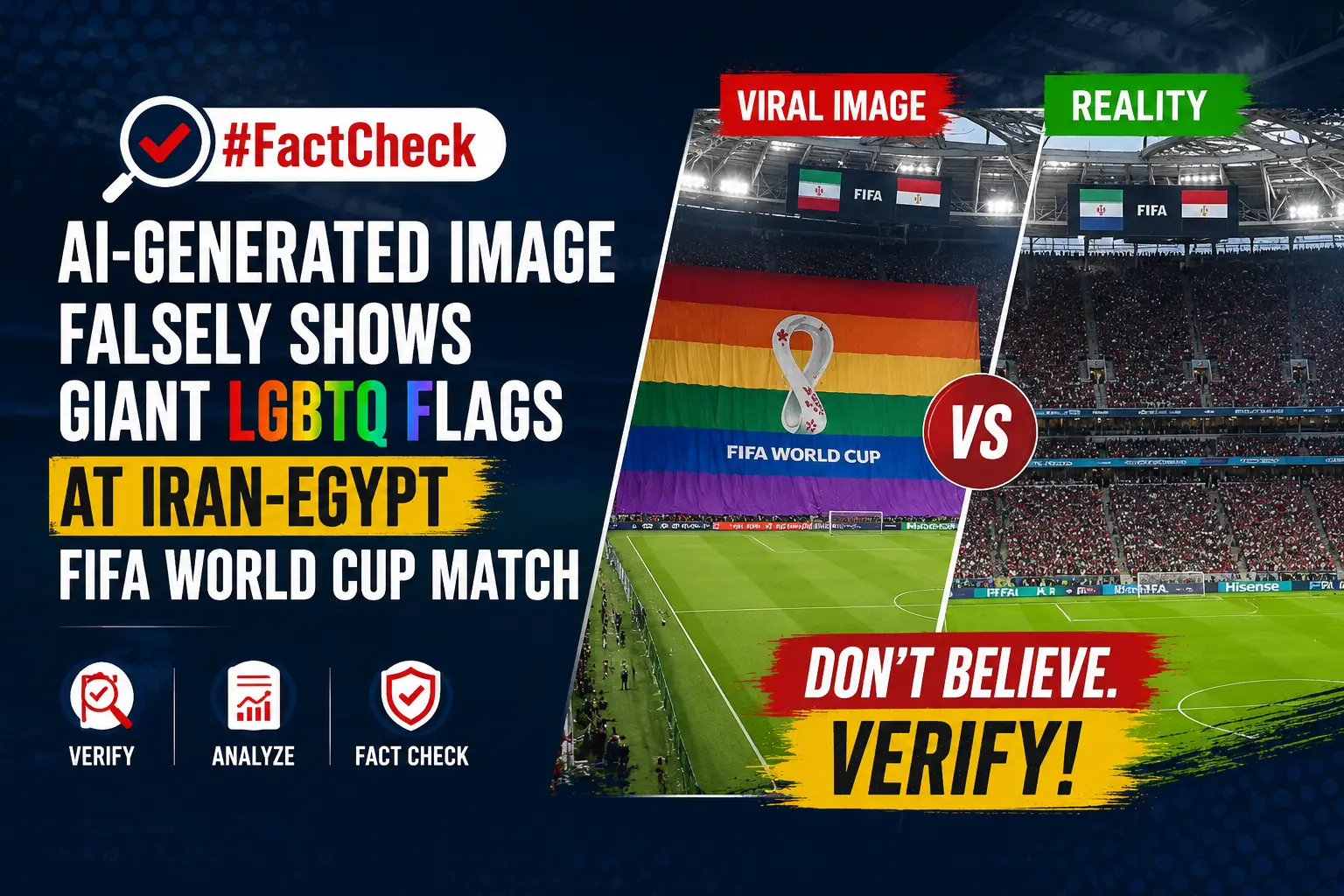
An image is being widely shared on social media claiming that during the 2026 FIFA World Cup match between Iran and Egypt in Seattle, Washington, the stadium hosted a “Pride Match,” with massive LGBTQ rainbow flags spread across the pitch before kickoff. Users claim the image shows FIFA allowing rainbow flags inside the stadium during the match. CyberPeace Research Wing's research found the claim to be misleading. There is no evidence that FIFA or the official organizers displayed giant rainbow flags across the pitch during the pre-match ceremony. The viral image has been digitally altered and does not depict an actual scene from the event.
Claim
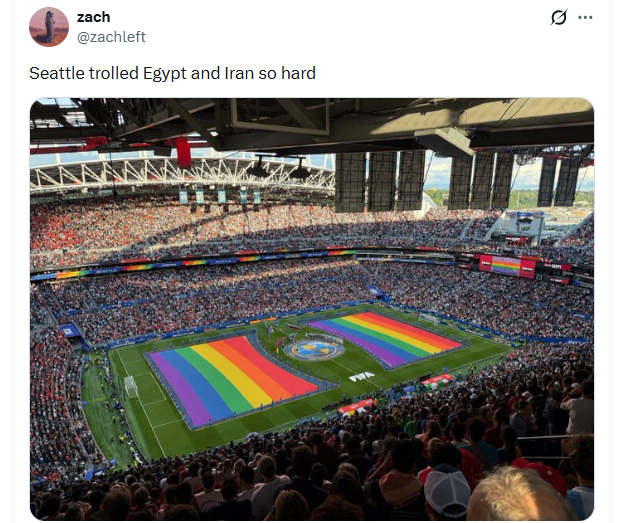
On June 27, 2026, an X (formerly Twitter) user shared the image with the caption, “Seattle trolled Egypt and Iran so hard.” Similar posts were also circulated on Facebook and other social media platforms in Spanish and Arabic. https://perma.cc/9QUF-Y7LG ,https://x.com/zachleft/status/2070727350288068687/
FactCheck
The image began circulating after the June 26 FIFA World Cup match between Iran and Egypt ended in a 1-1 draw. Iran (Team Melli) had a stoppage-time goal disallowed, leaving the team short of qualifying for the tournament’s 32-team knockout stage, while Egypt advanced alongside Belgium from the top of Group G. https://www.abs-cbn.com/sports/othersports/2026/6/29/iran-team-to-fly-home-monday-following-world-cup-exit-1334

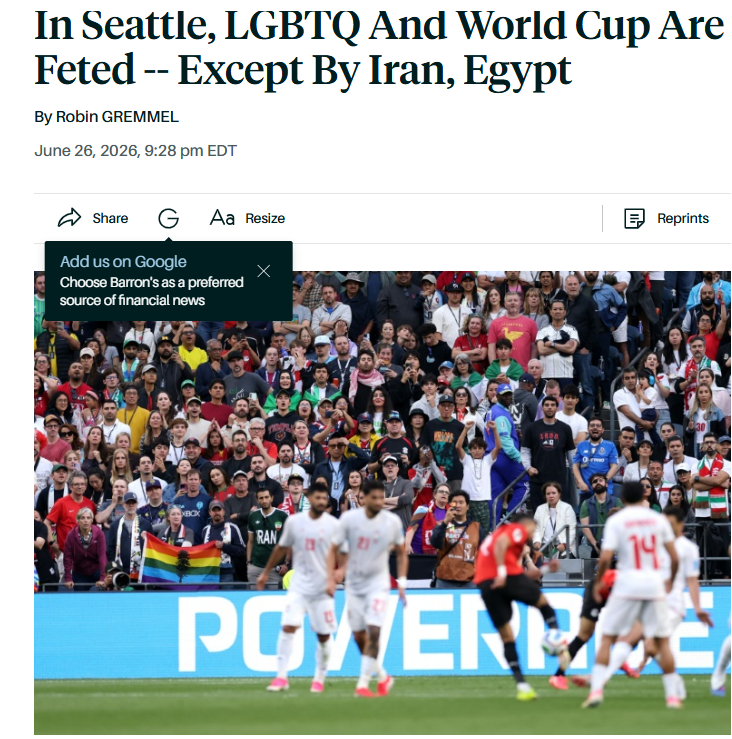
Further research found that Egyptian and Iranian officials had objected to pro-LGBTQ celebrations surrounding the fixture. Seattle authorities had designated the match as part of the city's Pride celebrations well before the World Cup draw determined which teams would play there. Under Iranian Islamic law, homosexuality is illegal and can be punishable by death. In Egypt, same-sex relations are often prosecuted under broadly worded laws relating to "debauchery" or "immorality. https://www.barrons.com/news/in-seattle-lgbtq-and-world-cup-are-feted-except-by-iran-egypt-f6d970dc.
We also examined the viral image using OpenAI’s image verification tool, which detected the presence of SynthID—an invisible watermark embedded by Google in AI-generated content. This indicates that the image was created or modified using AI tools.

In addition, we reviewed the live broadcasts of the match by Fox Sports and Universo. Both broadcasts showed only the national flags of Iran and Egypt displayed on the pitch before kickoff. No giant rainbow flags appeared during the pre-match ceremony.

Conclusion
Our research found the viral claim to be misleading. There is no evidence that FIFA or the official organizers displayed massive rainbow flags across the pitch during the Iran vs Egypt World Cup match. The viral image is digitally altered, contains indicators of AI generation, and does not represent an actual moment from the event.
