
#Fact Check: AI Video Falsely Shows Afghanistan Downing Pakistani Fighter Jet
Executive Summary:
Amid escalating tensions between Afghanistan and Pakistan, a video is being widely shared on social media claiming that Afghanistan has shot down a Pakistani fighter jet. The posts further allege that the incident marks the formal beginning of a war between the two countries. However, research conducted by the CyberPeace found the viral claim to be false and the research revealed that the circulating video is not authentic but AI-generated.
Claim
On February 24, 2026, a user on X (formerly Twitter) shared the viral video with the caption: “Afghanistan has shot down a Pakistani fighter jet! Afghanistan announces that war with Pakistan has begun.”
- Original post link: https://x.com/JyotiDevSpeaks/status/2026348257186545914
- Archived link: https://ghostarchive.org/archive/7l00Y

Fact Check:
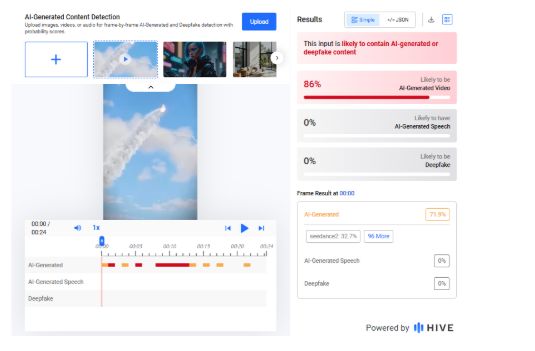
A careful review of the viral video revealed unusual visual patterns and artificial-looking effects, raising suspicions that it may have been created using artificial intelligence.We analyzed the video using the AI detection tool Hive Moderation, which indicated an 86 percent probability that the video was AI-generated.
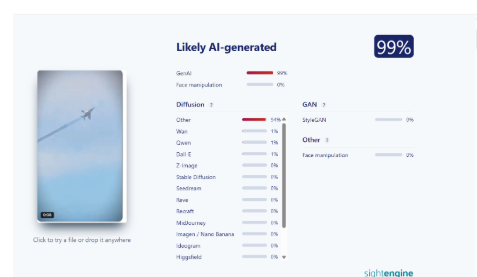
To further verify the findings, we scanned the footage using another AI detection platform, Sightengine. The results showed a 99 percent likelihood that the video was AI-generated.
To understand the broader context of the ongoing tensions, we conducted a keyword search and found a report published on February 22, 2026, by BBC Hindi. According to the report, Pakistan claimed it had targeted “seven terrorist hideouts and camps” along the Pakistan–Afghanistan border based on intelligence inputs. Meanwhile, a spokesperson for the Taliban government in Afghanistan stated that Pakistani airstrikes in Nangarhar and Paktika provinces resulted in the deaths of dozens of people, including women and children.
- https://www.bbc.com/hindi/articles/clyz8141397o
Conclusion
Our research confirms that the viral video claiming Afghanistan shot down a Pakistani fighter jet and formally declared war on Pakistan is fake. The footage is AI-generated and is being circulated with a false and misleading narrative.

Related Blogs

Introduction
The Data Security Council of India’s India Cyber Threat Report 2025 calculates that a staggering 702 potential attacks happened per minute on average in the country in 2024. Recent alleged data breaches on organisations such as Star Health, WazirX, Indian Council of Medical Research (ICMR), BSNL, etc. highlight the vulnerabilities of government organisations, critical industries, businesses, and individuals in managing their digital assets. India is the second most targeted country for cyber attacks globally, which warrants the development and adoption of cybersecurity governance frameworks essential for the structured management of cyber environments. The following global models offer valuable insights and lessons that can help strengthen cybersecurity governance.
Overview of Global Cybersecurity Governance Models
Cybersecurity governance frameworks provide a structured strategy to mitigate and address cyber threats. Different regions have developed their own governance models for cybersecurity, but they all emphasize risk management, compliance, and cross-sector collaboration for the protection of digital assets. Four such major models are:
- NIST CSF 2.0 (U.S.A): The National Institute of Standards and Technology Cyber Security Framework provides a flexible, voluntary, risk-based approach rather than a one-size-fits-all solution to manage cybersecurity risks. It endorses six core functions, which are: Govern, Identify, Protect, Detect, Respond, and Recover. This is a widely adopted framework used by both public and private sector organizations even outside the U.S.A.
- ISO/IEC 27001: This is a globally recognized standard developed jointly by the International Organization for Standardization (ISO) and the International Electrotechnical Commission (IEC). It provides a risk-based approach to help organizations of all sizes and types to identify, assess, and mitigate potential cybersecurity threats to Information Security Management Systems (ISMS) and preserve the confidentiality, integrity, and availability of information. Organizations can seek ISO 27001 certification to demonstrate compliance with laws and regulations.
- EU NIS2 Directive: The Network and Information Security Directive 2 (NIS2) is an updated EU cybersecurity law that imposes strict obligations on critical services providers in four overarching areas: risk management, corporate accountability, reporting obligations, and business continuity. It is the most comprehensive cybersecurity directive in the EU to date, and non-compliance may attract non-monetary remedies, administrative fines up to at least €10 million or 2% of the global annual revenue (whichever is higher), or even criminal sanctions for top managers.
- GDPR: The General Data Protection Regulation (GDPR)of the EU is a comprehensive data privacy law that also has major cybersecurity implications. It mandates that organizations must integrate cybersecurity into their data protection policies and report breaches within 72 hours, and it prescribes a fine of up to €20 million or 4% of global turnover for non-compliance.
India’s Cybersecurity Governance Landscape
In light of the growing nature of cyber threats, it is notable that the Indian government has taken comprehensive measures along with efforts by relevant agencies such as the Ministry of Electronics and Information Technology, Reserve Bank of India (RBI), National Payments Corporation (NPCI) and Indian Cyber Crime Coordination Centre (I4C), CERT-In. However, there is still a lack of an overarching cybersecurity governance framework or comprehensive law in this area. Multiple regulatory bodies in India oversee cybersecurity for various sectors. Key mechanisms are:
- CERT-In Guidelines: The Indian Computer Emergency Response Team, under the Ministry of Electronics and Information Technology (MeitY), is the nodal agency responsible for cybersecurity incident response, threat intelligence sharing, and capacity building. Organizations are mandated to maintain logs for 180 days and report cyber incidents to CERT-In within six hours of noticing them according to directions under the Information Technology Act, 2000 (IT Act).
- IT Act & DPDP Act: These Acts, along with their associated rules, lay down the legal framework for the protection of ICT systems in India. While some sections mandate that “reasonable” cybersecurity standards be followed, specifics are left to the discretion of the organisations. Enforcement frameworks are vague, which leaves sectoral regulators to fill the gaps.
- Sectoral regulations: The Reserve Bank of India (RBI), the Insurance Regulatory and Development Authority of India (IRDAI), the Department of Telecommunications, the Securities Exchange Board of India (SEBI), National Critical Information Infrastructure Protection Centre (NCIIPC) and other regulatory bodies require that cybersecurity standards be maintained by their regulated entities.
Lessons for India & Way Forward
As the world faces unprecedented security and privacy threats to its digital ecosystem, the need for more comprehensive cybersecurity policies, awareness, and capacity building has perhaps never been greater. While cybersecurity practices may vary with the size, nature, and complexity of an organization (hence “reasonableness” informing measures taken), there is a need for a centralized governance framework in India similar to NIST2 to unify sectoral requirements for simplified compliance and improve enforcement. India ranks 10th on the World Cybercrime Index and was found to be "specialising" in scams and mid-tech crimes- those which affect mid-range businesses and individuals the most. To protect them, India needs to strengthen its enforcement mechanisms across more than just the critical sectors. This can be explored by penalizing bigger organizations handling user data susceptible to breaches more stringently, creating an enabling environment for strong cybersecurity practices through incentives for MSMEs, and investing in cybersecurity workforce training and capacity building. Finally, there is a scope for increased public-private collaboration for real-time cyber intelligence sharing. Thus, a unified, risk-based national cybersecurity governance framework encompassing the current multi-pronged cybersecurity landscape would give direction to siloed efforts. It would help standardize best practices, streamline compliance, and strengthen overall cybersecurity resilience across all sectors in India.
References
- https://cdn.prod.website-files.com/635e632477408d12d1811a64/676e56ee4cc30a320aecf231_Cloudsek%20Annual%20Threat%20Landscape%20Report%202024%20(1).pdf
- https://strobes.co/blog/top-data-breaches-in-2024-month-wise/#:~:text=In%20a%20large%2Dscale%20data,emails%2C%20and%20even%20identity%20theft.
- https://www.google.com/search?q=nist+2.0&oq=nist+&gs_lcrp=EgZjaHJvbWUqBggBEEUYOzIHCAAQABiPAjIGCAEQRRg7MgYIAhBFGDsyCggDEAAYsQMYgAQyBwgEEAAYgAQyBwgFEAAYgAQyBwgGEAAYgAQyBggHEEUYPNIBCDE2MTJqMGo3qAIAsAIA&sourceid=chrome&ie=UTF-8
- https://www.iso.org/standard/27001
- https://nis2directive.eu/nis2-requirements/
- https://economictimes.indiatimes.com/tech/technology/india-ranks-number-10-in-cybercrime-study-finds/articleshow/109223208.cms?from=mdr

Introduction
In the era of the internet where everything is accessible at your fingertip, a disturbing trend is on the rise- over 90% of websites containing child abuse material now have self-generated images, obtained from victims as young as three years old. A shocking revelation, shared by the (IWF) internet watch foundation, The findings of the IWF have caused concern about the increasing exploitation of children below the age of 10. The alarming trend highlights the increasing exploitation of children under the age of 10, who are coerced, blackmailed, tricked, or groomed into participating in explicit acts online. The IWF's data for 2023 reveals a record-breaking 275,655 websites hosting child sexual abuse material, with 92% of them containing such "self-generated" content.
Disturbing Tactics Shift
Disturbing numbers came that, highlight a distressing truth. In 2023, 275,655 websites were discovered to hold child sexual abuse content, reaching a new record and reflecting an alarming 8% increase over the previous year. What's more concerning is that 92% of these websites had photos or videos generated by the website itself. Surprisingly, 107,615 of these websites had content involving children under the age of ten, with 2,500 explicitly featuring youngsters aged three to six.
Profound worries
Deep concern about the rising incidence of images taken by extortion or coercion from elementary school-aged youngsters. This footage is currently being distributed on very graphic and specialised websites devoted to child sexual assault. The process begins in a child's bedroom with the use of a camera and includes the exchange, dissemination, and gathering of explicit content by devoted and determined persons who engage in sexual exploitation. These criminals are ruthless. The materials are being circulated via mail, instant messaging, chat rooms, and social media platforms, (WhatsApp, Telegram, Skype, etc.)
Live Streaming of such material involves real-time broadcast which again is a major concern as the nature of the internet is borderless the access to such material is international, national, and regional, which even makes it difficult to get the predators and convict them. With the growth, it has become easy for predators to generate “self-generated “images or videos.
Financial Exploitation in the Shadows: The Alarming Rise of Sextortion
Looking at the statistics globally there have been studies that show an extremely shocking pattern known as “sextortion”, in which adolescents are targeted for extortion and forced to pay money under the threat of exposing images to their families or relatives and friends or on social media. The offender's goal is to obtain sexual gratification.
The financial variation of sextortion takes a darker turn, with criminals luring kids into making sexual content and then extorting them for money. They threaten to reveal the incriminating content unless their cash demands, which are frequently made in the form of gift cards, mobile payment services, wire transfers, or cryptocurrencies, are satisfied. In this situation, the predators are primarily driven by money gain, but the psychological impact on their victims is as terrible. A shocking case was highlighted where an 18-year-old was landed in jail for blackmailing a young girl, sending indecent images and videos to threaten her via Snapchat. The offender was pleaded guilty.
The Question on Security?
The introduction of end-to-end encryption in platforms like Facebook Messenger has triggered concerns within law enforcement agencies. While enhancing user privacy, critics argue that it may inadvertently facilitate criminal activities, particularly the exploitation of vulnerable individuals. The alignment with other encrypted services is seen as a potential challenge, making it harder to detect and investigate crimes, thus raising questions about finding a balance between privacy and public safety.
One of the major concerns in the online safety of children is the implementation of encryption by asserting that it enhances the security of individuals, particularly children, by safeguarding them from hackers, scammers, and criminals. They underscored their dedication to enforcing safety protocols, such as prohibiting adults from texting teenagers who do not follow them and employing technology to detect and counteract bad conduct.
These distressing revelations highlight the urgent need for comprehensive action to protect our society's most vulnerable citizens i.e., children, youngsters, and adolescents throughout the era of digital progress. As experts and politicians grapple with these troubling trends, the need for action to safeguard kids online becomes increasingly urgent.
Role of Technology in Combating Online Exploitation
With the rise of technology, there has been a rise in online child abuse, technology also serves as a powerful tool to combat it. The advanced algorithms and use of Artificial intelligence tools can be used to disseminate ‘self-generated’ images. Additional tech companies can collaborate and develop some effective solutions to safeguard every child and individual.
Role of law enforcement agencies
Child abuse knows no borders, and addressing the issues requires legal intervention at all levels. National, regional, and international law enforcement agencies investigate online child sexual exploitation and abuse and cooperate in the investigation of these cybercrimes, Various investigating agencies need to have mutual legal assistance and extradition, bilateral, and multilateral conventions to conduct to identify, investigate, and prosecute perpetrators of online child sexual exploitation and abuse. Apart from this cooperation between private and government agencies is important, sharing the database of perpetrators can help the agencies to get them caught.
How do you safeguard your children?
Looking at the present scenario it has become a crucial part of protecting and safeguarding our children online against online child abuse here are some practical steps that can help in safeguarding your loved one.
- Open communication: Establish open communication with your children, make them feel comfortable, and share your experiences with them, make them understand what good internet surfing is and educate them about the possible risks without generating fear.
- Teach Online Safety: educate your children about the importance of privacy and the risks associated with it. Teach them strong privacy habits like not sharing any personal information with a stranger on any social media platform. Teach them to create some unique passwords and to make them aware not to click on any suspicious links or download files from unknown sources.
- Set boundaries: As a parent set rules and guidelines for internet usage, set time limits, and monitor their online activities without infringing their privacy. Monitor their social media platforms and discuss inappropriate behaviour or online harassment. As a parent take an interest in your children's online activities, websites, and apps inform them, and teach them online safety measures.
Conclusion
The predominance of self-generated' photos in online child abuse content necessitates immediate attention and coordinated action from governments, technology corporations, and society as a whole. As we negotiate the complicated environment of the digital age, we must be watchful, modify our techniques, and collaborate to defend the innocence of the most vulnerable among us. To combat online child exploitation, we must all work together to build a safer, more secure online environment for children all around the world.
References
- https://www.the420.in/over-90-of-websites-containing-child-abuse-feature-self-generated-images-warns-iwf/
- https://news.sky.com/story/self-generated-images-found-on-92-of-websites-containing-child-sexual-abuse-with-victims-as-young-as-three-13049628
- https://www.firstpost.com/world/russia-rejects-us-proposal-to-resume-talks-on-nuclear-arms-control-13630672.html
- https://www.news4hackers.com/iwf-warns-that-more-than-90-of-websites-contain-self-generated-child-abuse-images/

Executive Summary:
A video claiming to show the plane crash that allegedly killed Maharashtra Deputy Chief Minister Ajit Pawar has been widely circulated on social media. The circulation began soon after reports emerged of a tragic aircraft accident in Baramati, Maharashtra, on January 28, 2026, in which Ajit Pawar and five others were reported to have died. The viral video shows a plane crashing to the ground moments after take-off. Social media users have claimed that the footage captures the exact incident in which Ajit Pawar was on board. However, an research by the CyberPeacehas found that this claim is false.
Claim:
An Instagram user shared the video on January 28, 2026, claiming that it showed the plane crash in Maharashtra in which Deputy Chief Minister Ajit Pawar and others allegedly lost their lives. The caption accompanying the video read:“This morning, Deputy CM Ajit Pawar and six others tragically died in a plane crash in Maharashtra.”
Links to the post and its archived version are provided below.

Fact Check:
To verify the authenticity of the viral video, the CyberPeaceconducted a reverse image search of its keyframes. During this process, the same visuals were found in a video report uploaded on News9 Live’s official YouTube channel on October 23, 2025.

According to the report, the footage shows a plane crash in Venezuela, not India. The incident occurred shortly after a Piper Cheyenne aircraft took off from Paramillo Airport in Táchira, Venezuela. The aircraft crashed within seconds of take-off, killing both occupants on board. The deceased were identified as pilot José Bortone and co-pilot Juan Maldonado. Further confirmation came from a report published on October 22, 2025, by Latin American news outlet El Tiempo. The Spanish-language report also featured the same video visuals and stated that a small aircraft lost control and crashed on the runway at Paramillo Airport in Venezuela, resulting in the deaths of the pilot and co-pilot.

Conclusion
The CyberPeace’s research clearly establishes that the viral video being shared as footage of Ajit Pawar’s alleged plane crash in Baramati is misleading. The video actually shows a plane crash that occurred in Venezuela in October 2025 and has been falsely linked to a tragic claim in India.
