
#FactCheck: Viral Video Falsely Linked to September 4 Anak Krakatau Eruption Is AI-Generated
Executive Summary
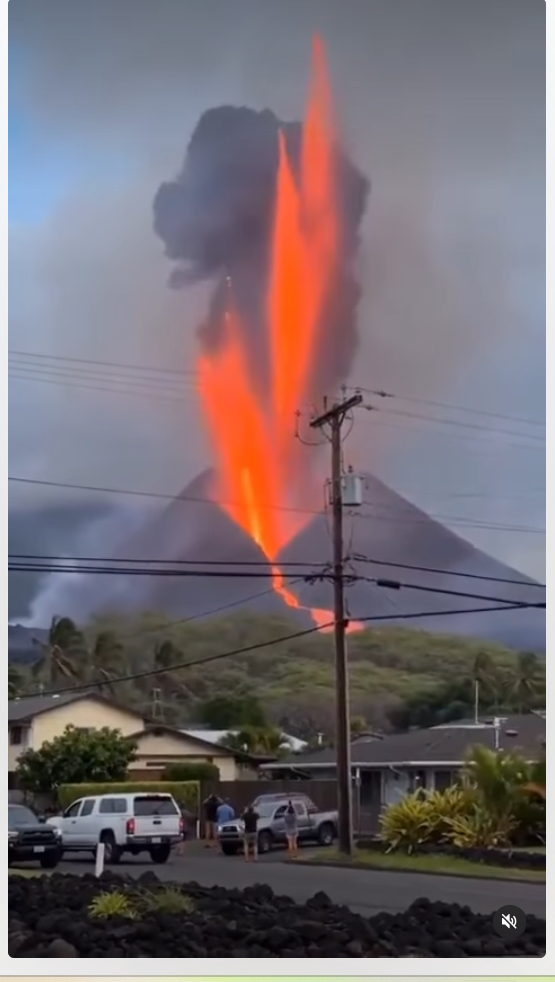
A volcano erupted at Indonesia’s Anak Krakatau on the night of September 4, 2026. A video is being shared on social media in connection with the eruption. The video shows lava rising high into the air following a volcanic eruption, with people seen fleeing the area. Some social media users are sharing the video claiming that it shows the eruption of Indonesia’s Anak Krakatau volcano. Research by CyberPeace found that the viral video is AI-generated. The video was created with the help of AI tools. However, four volcanoes, including Anak Krakatau, have erupted in Indonesia.
Claim
An Instagram user shared the viral video with the caption: “Indonesia’s Anak Krakatau volcano erupted Friday night. According to MAGMA Indonesia, lava fountains were seen rising from the volcano’s crater, while ash plumes reached a height of up to 400 metres. The volcano remains at Level III, with authorities enforcing a 3-kilometre exclusion zone around the crater.”
https://www.instagram.com/reels/DdBfQprThPA/
Fact Check
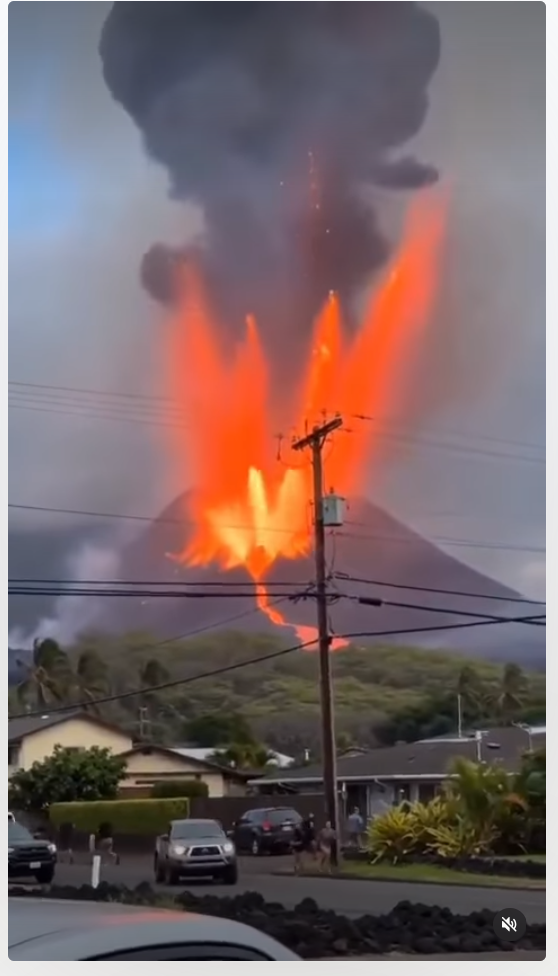
To investigate the viral video, we examined it closely and noticed several inconsistencies. At the beginning of the video, people can be seen standing calmly as the volcanic eruption takes place. Shortly afterward, the vehicles parked there suddenly begin moving. In one of the cars, no driver is visible. Meanwhile, the legs of a person running on the road disappear, and the person appears to merge into the background. These visual inconsistencies raised suspicions that the viral video had been created using AI tools.
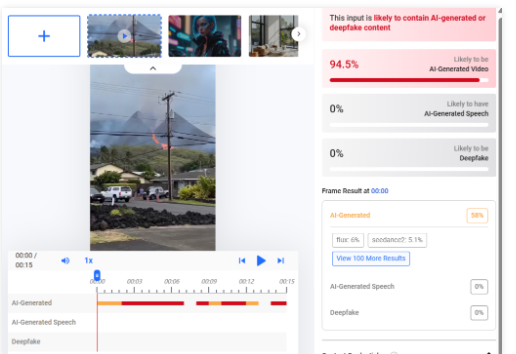
We checked the video using the AI detection tool Hive Moderation, which indicated that there was a more than 94 percent likelihood that the video was AI-generated.
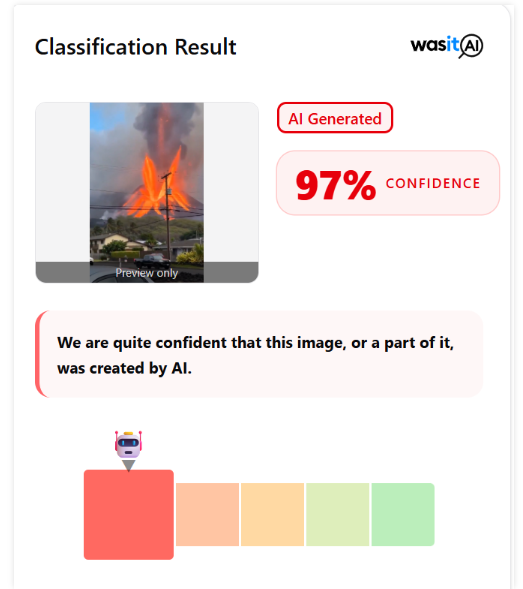
We checked the keyframes of the video using the AI detection tool Was It AI, which identified the video as 97 percent likely to be AI-generated.
Conclusion
The Anak Krakatau volcano in Indonesia erupted on the night of September 4, 2026. However, our research found that the video being shared in connection with the eruption was created using AI tools. Visual inconsistencies in the footage, along with the results of AI detection tools, indicate that the video is AI-generated and does not show genuine footage of the Anak Krakatau eruption. Therefore, the claim that the viral video shows the September 4 eruption of Indonesia’s Anak Krakatau volcano is false.

Related Blogs

Executive Summary
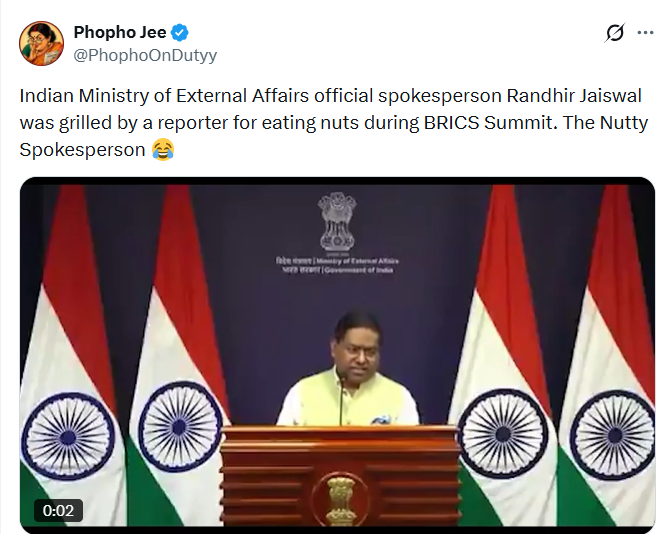
A video is being shared on social media with the claim that Ministry of External Affairs spokesperson Randhir Jaiswal was seen eating nuts during the BRICS Summit. The post claims that a reporter questioned him about eating nuts during the event. The video is also being shared with the sarcastic caption, “The Nutty Spokesperson.” Through the post, an attempt is being made to suggest that a reporter questioned Randhir Jaiswal about eating nuts during a press briefing. CyberPeace Research found that in the original video, Ministry of External Affairs spokesperson Randhir Jaiswal was responding to a question about Pakistan’s announcement of a 7 million Pakistani rupee bounty on Jaish-e-Mohammed chief Masood Azhar. Jaiswal addressed the announcement during the regular media briefing held on September 15, 2026. In his response, Jaiswal said that such announcements by Pakistan were not new and that the country should take concrete action against terrorism. However, the video being circulated on social media has been digitally edited using the original footage to falsely suggest that a reporter had questioned Jaiswal about eating nuts.
Claim:
During the BRICS Summit, a reporter questioned Ministry of External Affairs spokesperson Randhir Jaiswal about eating nuts and confronted him over it.
https://x.com/PhophoOnDutyy/status/2099940769876640084?s=20
Fact Check
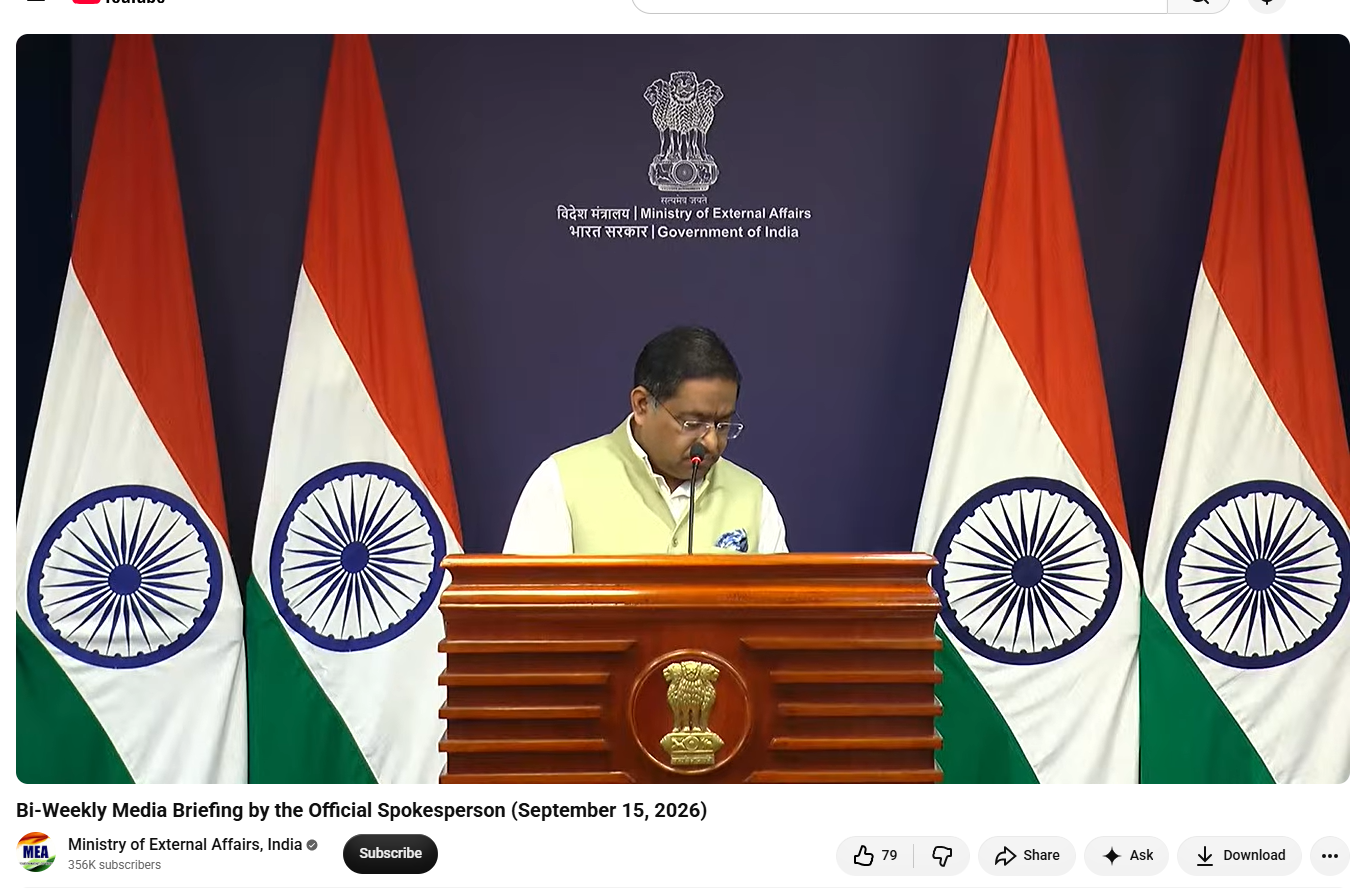
To verify the claim, we conducted a Google search using relevant keywords. During the search, we did not find any credible media report supporting the claim.As part of our research, we conducted a reverse image search of keyframes from the video. We found the original video on the YouTube channel of the Ministry of External Affairs, India. In the original video, Randhir Jaiswal was responding to a question about Pakistan’s announcement of a 7 million Pakistani rupee bounty on Masood Azhar.The reporter does not question Jaiswal about eating nuts anywhere in the original video. This establishes that the original footage has been edited and presented with a false context. Therefore, the claim being circulated on social media is false.
https://www.youtube.com/live/dw-qqLolRgc
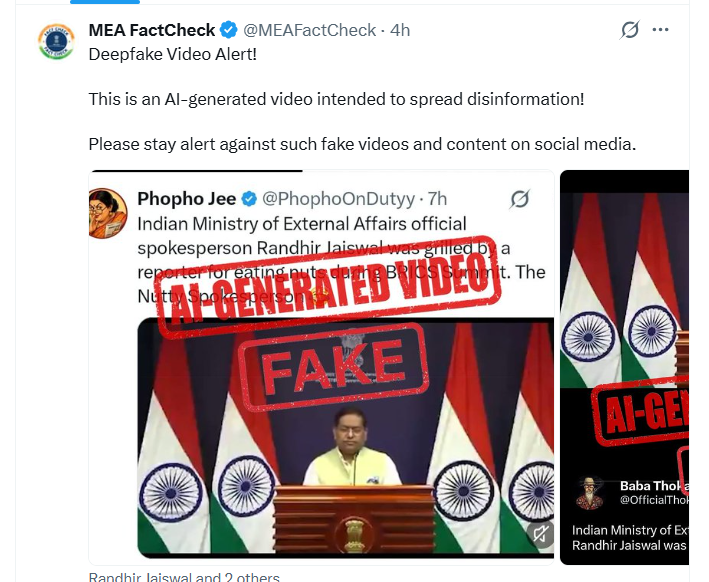
As part of our further research, we checked the official X account of MEA FactCheck. It also identified the video as AI-generated.
https://x.com/MEAFactCheck/status/2100076244805255501?s=20
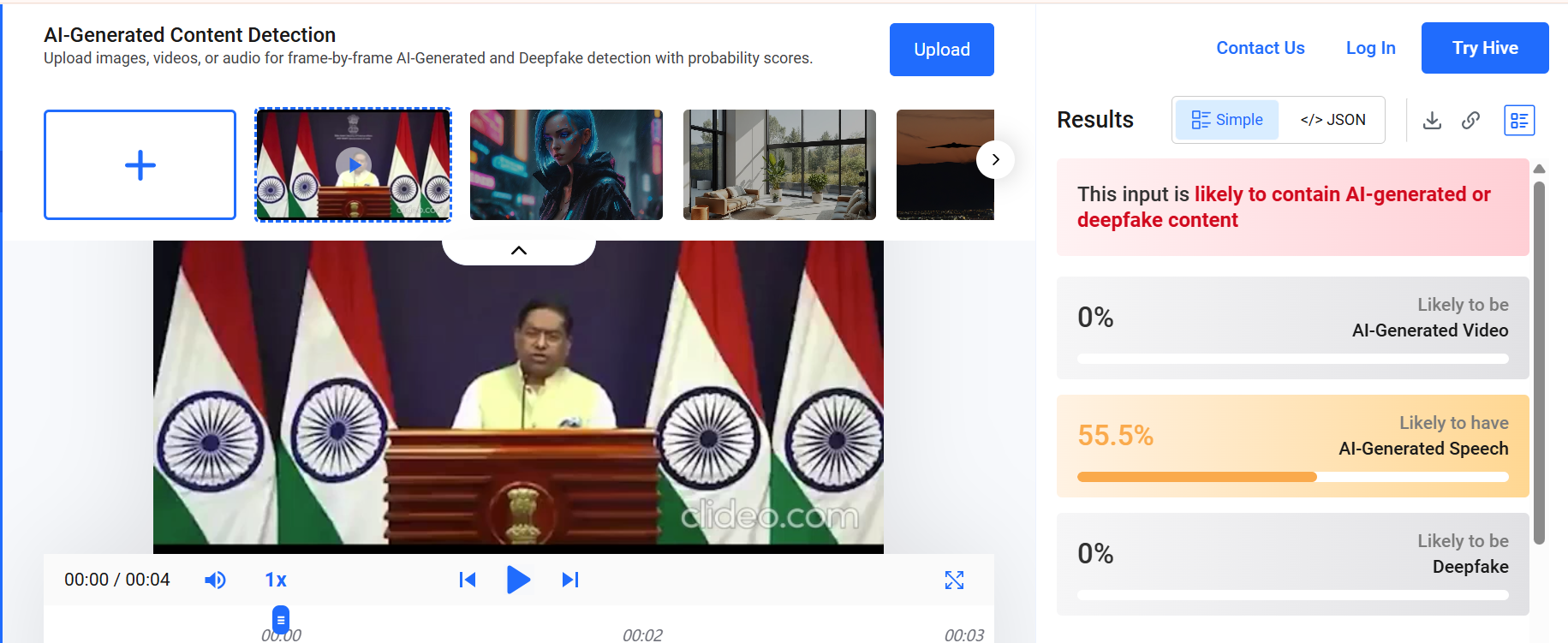
The video was scanned using the AI detection tool Hive Moderation. According to the results, the video has a 55% probability of being AI-generated.
Conclusion
Our research found that the video being shared on social media is fake and edited. In the original video, Ministry of External Affairs spokesperson Randhir Jaiswal was responding to a question about Pakistan’s announcement of a 7 million Pakistani rupee bounty on Masood Azhar.At no point in the original video does the reporter question Jaiswal about eating nuts.
The footage being circulated has been digitally manipulated and presented in a different context. The official X account of MEA FactCheck also identified the video as AI-generated. Therefore, the claim that Jaiswal was questioned by a reporter about eating nuts is false and misleading.

Introduction
The Telecom Regulatory Authority of India (TRAI), on March 13 2023, published a new rule to regulate telemarketing firms. Trai has demonstrated strictness when it comes to bombarding users with intrusive marketing pitches. In a report, TRAI stated that 10-digit mobile numbers could not be utilised for advertising. In reality, different phone numbers are given out for regular calls and telemarketing calls. Hence, it is an appropriate and much-required move in order to suppress and eradicate phishing scammers and secure the Indian Cyber-ecosystem at large.
What are the new rules?
The rules state that now 10-digit unregistered mobile numbers for promotional purposes would be shut down over the following five days. The rule claim that calling from unregistered mobile numbers had been banned was published on February 16. In this case, using 10-digit promotional messages for promotional calling will end within the following five days. This step by TRAI has been seen after nearly 6-8 months of releasing the Telecommunication Bill, 2022, which has focused towards creating a stable Indian Telecom market and reducing the phoney calls/messages by bad actors to reduce cyber crimes like phishing. This is done to distinguish between legitimate and promotional calls. According to certain reports, some telecom firms allegedly break the law by using 10-digit mobile numbers to make unwanted calls and send promotional messages. All telecom service providers must execute the requirements under the recent TRAI directive within five days.
How will the new rules help?
The promotional use of a cellphone number with 10 digits was allowed since the start, however, with the latest NCRB report on cyber crimes and the rising instances and reporting of cyber crimes primarily focused towards frauds related to monetary gains by the bad actors points to the issue of unregulated promotional messages. This move will act as a critical step towards eradicating scammers from the cyber-ecosystem, TRAI has been very critical in understanding the dynamics and shortcomings in the regulation of the telecom spectrum and network in India and has shown keen interest towards suppressing the modes of technology used by the scammers. It is a fact that the invention of the technology does not define its use, the policy of the technology does, hence it is important to draft ad enact policies which better regulate the existing and emerging technologies.
What to avoid?
In pursuance of the rules enacted by TRAI, the business owners involved in promotional services through 10-digit numbers will have to follow these steps-
- It is against the law to utilise a 10-digit cellphone number for promotional calls.
- You should stop doing so right now.
- Your mobile number will be blocked in the following five days if not.
- Users employed by telemarketing firms are encouraged to refrain from using the system in such circumstances.
- Those working for telemarketing firms are encouraged not to call from their mobile numbers.
- Users should phone the company’s registered mobile number for promotional purposes.
Conclusion
The Indian netizen has been exposed to the technology a little later than the western world. However, this changed drastically during the Covid-19 pandemic as the internet and technology penetration rates increased exponentially in just a couple of months. Although this has been used as an advantage by the bad actors, it was pertinent for the government and its institutions to take an effective and efficient step to safeguard the people from financial fraud. Although these frauds occur in high numbers due to a lack of knowledge and awareness, we need to work on preventive solutions rather than precautionary steps and the new rules by TRAI point towards a safe, secured and sustainable future of cyberspace in India.

Overview:
In today’s digital landscape, safeguarding personal data and communications is more crucial than ever. WhatsApp, as one of the world’s leading messaging platforms, consistently enhances its security features to protect user interactions, offering a seamless and private messaging experience
App Lock: Secure Access with Biometric Authentication
To fortify security at the device level, WhatsApp offers an app lock feature, enabling users to protect their app with biometric authentication such as fingerprint or Face ID. This feature ensures that only authorized users can access the app, adding an additional layer of protection to private conversations.
How to Enable App Lock:
- Open WhatsApp and navigate to Settings.
- Select Privacy.
- Scroll down and tap App Lock.
- Activate Fingerprint Lock or Face ID and follow the on-screen instructions.

Chat Lock: Restrict Access to Private Conversations
WhatsApp allows users to lock specific chats, moving them to a secured folder that requires biometric authentication or a passcode for access. This feature is ideal for safeguarding sensitive conversations from unauthorized viewing.
How to Lock a Chat:
- Open WhatsApp and select the chat to be locked.
- Tap on the three dots (Android) or More Options (iPhone).
- Select Lock Chat
- Enable the lock using Fingerprint or Face ID.

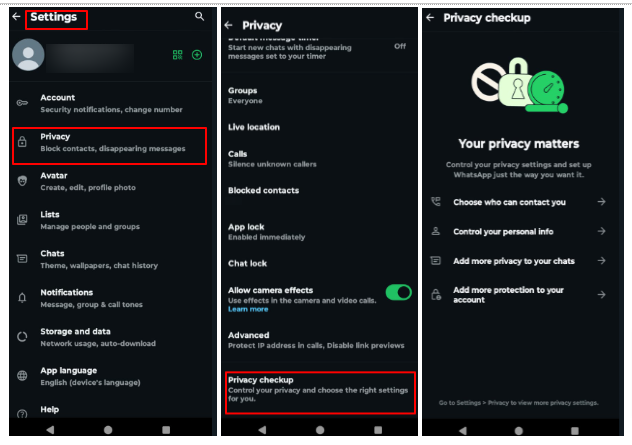
Privacy Checkup: Strengthening Security Preferences
The privacy checkup tool assists users in reviewing and customizing essential security settings. It provides guidance on adjusting visibility preferences, call security, and blocked contacts, ensuring a personalized and secure communication experience.
How to Run Privacy Checkup:
- Open WhatsApp and navigate to Settings.
- Tap Privacy.
- Select Privacy Checkup and follow the prompts to adjust settings.
Automatic Blocking of Unknown Accounts and Messages
To combat spam and potential security threats, WhatsApp automatically restricts unknown accounts that send excessive messages. Users can also manually block or report suspicious contacts to further enhance security.
How to Manage Blocking of Unknown Accounts:
- Open WhatsApp and go to Settings.
- Select Privacy.
- Tap to Advanced
- Enable Block unknown account messages

IP Address Protection in Calls
To prevent tracking and enhance privacy, WhatsApp provides an option to hide IP addresses during calls. When enabled, calls are routed through WhatsApp’s servers, preventing location exposure via direct connections.
How to Enable IP Address Protection in Calls:
- Open WhatsApp and go to Settings.
- Select Privacy, then tap Advanced.
- Enable Protect IP Address in Calls.

Disappearing Messages: Auto-Deleting Conversations
Disappearing messages help maintain confidentiality by automatically deleting sent messages after a predefined period—24 hours, 7 days, or 90 days. This feature is particularly beneficial for reducing digital footprints.
How to Enable Disappearing Messages:
- Open the chat and tap the Chat Name.
- Select Disappearing Messages.
- Choose the preferred duration before messages disappear.

View Once: One-Time Access to Media Files
The ‘View Once’ feature ensures that shared photos and videos can only be viewed a single time before being automatically deleted, reducing the risk of unauthorized storage or redistribution.
How to Send View Once Media:
- Open a chat and tap the attachment icon.
- Choose Camera or Gallery to select media.
- Tap the ‘1’ icon before sending the media file.

Group Privacy Controls: Manage Who Can Add You
WhatsApp provides users with the ability to control group invitations, preventing unwanted additions by unknown individuals. Users can restrict group invitations to ‘Everyone,’ ‘My Contacts,’ or ‘My Contacts Except…’ for enhanced privacy.
How to Adjust Group Privacy Settings:
- Open WhatsApp and go to Settings.
- Select Privacy and tap Groups.
- Choose from the available options: Everyone, My Contacts, or My Contacts Except

Conclusion
WhatsApp continuously enhances its security features to protect user privacy and ensure safe communication. With tools like App Lock, Chat Lock, Privacy Checkup, IP Address Protection, and Disappearing Messages, users can safeguard their data and interactions. Features like View Once and Group Privacy Controls further enhance confidentiality. By enabling these settings, users can maintain a secure and private messaging experience, effectively reducing risks associated with unauthorized access, tracking, and digital footprints. Stay updated and leverage these features for enhanced security.
