
#FactCheck-Viral Claim That Modi’s Jhalmuri Vendor Was an SPG Commando Is False
Executive Summary
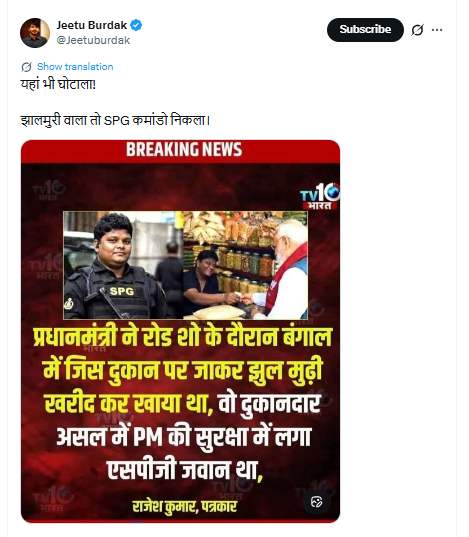
A collage of two images circulating on social media is falsely claiming that the street vendor who served jhalmuri to Prime Minister Narendra Modi during an election campaign in Jhargram was actually a personnel from the Special Protection Group (SPG). Research by the CyberPeace Research Wing found the claim to be false and misleading, indicating that it is being shared as part of election-related misinformation. The vendor and the SPG personnel seen in the viral collage are two different individuals.
Claim
An X (formerly Twitter) user, “@Jeetuburdak,” shared the viral collage on April 21, 2026, with the caption: “Another scam! The jhalmuri seller turned out to be an SPG commando.” The post quickly gained traction online.
Fact Check
A close examination of the two images used in the collage shows clear visual differences between the individuals. The person seen in SPG uniform does not match the street vendor who served food to the prime minister. Reverse image searches were conducted using multiple tools to trace the origin of the images. While no verifiable source was found linking the SPG personnel’s image to the vendor, several credible reports and videos featured the actual jhalmuri seller from the campaign event.
- https://x.com/ANI/status/2045859146508177911?s=20
- https://news24online.com/cities/kolkata/who-is-the-man-that-served-jhalmuri-to-pm-modi-know-his-daily-income-and-what-he-talked-about-with-pm/811123/


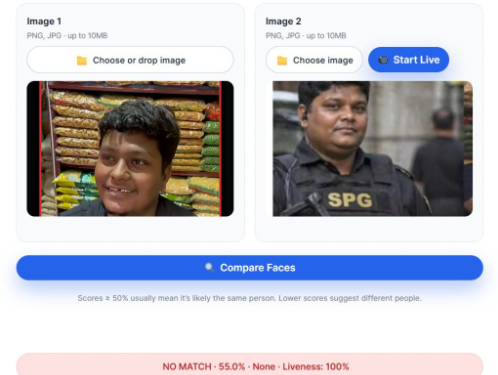
According to media reports, the prime minister briefly stopped at a roadside stall during the campaign in Jhargram and interacted with the vendor while enjoying jhalmuri. The vendor was later interviewed by multiple outlets, further confirming his identity as a local seller. Additionally, technical facial comparison analysis using online tools also indicated that the two individuals in the viral collage are not the same person.
Conclusion
The claim that the jhalmuri vendor was an SPG commando is false and misleading. The viral collage shows two different individuals, and there is no evidence to support the allegation.

Related Blogs
Introduction
Global cybersecurity spending is expected to breach USD 210 billion in 2025, a ~10% increase from 2024 (Gartner). This is a result of an evolving and increasingly critical threat landscape enabled by factors such as the proliferation of IoT devices, the adoption of cloud networks, and the increasing size of the internet itself. Yet, breaches, misuse, and resistance persist. In 2025, global attack pressure rose ~21% Y-o-Y ( Q2 averages) (CheckPoint) and confirmed breaches climbed ~15%( Verizon DBIR). This means that rising investment in cybersecurity may not be yielding proportionate reductions in risk. But while mechanisms to strengthen technical defences and regulatory frameworks are constantly evolving, the social element of trust and how to embed it into cybersecurity systems remain largely overlooked.
Human Error and Digital Trust (Individual Trust)
Human error is consistently recognised as the weakest link in cybersecurity. While campaigns focusing on phishing prevention, urging password updates and using two-factor authentication (2FA) exist, relying solely on awareness measures to address human error in cyberspace is like putting a Band-Aid on a bullet wound. Rather, it needs to be examined through the lens of digital trust. As Chui (2022) notes, digital trust rests on security, dependability, integrity, and authenticity. These factors determine whether users comply with cybersecurity protocols. When people view rules as opaque, inconvenient, or imposed without accountability, they are more likely to cut corners, which creates vulnerabilities. Therefore, building digital trust means shifting from blaming people to design: embedding transparency, usability, and shared responsibility towards a culture of cybersecurity so that users are incentivised to make secure choices.
Organisational Trust and Insider Threats (Institutional Trust)
At the organisational level, compliance with cybersecurity protocols is significantly tied to whether employees trust employers/platforms to safeguard their data and treat them with integrity. Insider threats, stemming from both malicious and non-malicious actors, account for nearly 60% of all corporate breaches (Verizon DBIR 2024). A lack of trust in leadership may cause employees to feel disengaged or even act maliciously. Further, a 2022 study by Harvard Business Review finds that adhering to cybersecurity protocols adds to employee workload. When they are perceived as hindering productivity, employees are more likely to intentionally violate these protocols. The stress of working under surveillance systems that feel cumbersome or unreasonable, especially when working remotely, also reduces employee trust and, hence, compliance.
Trust, Inequality, and Vulnerability (Structural Trust)
Cyberspace encompasses a social system of its own since it involves patterned interactions and relationships between human beings. It also reproduces the social structures and resultant vulnerabilities of the physical world. As a result, different sections of society place varying levels of trust in digital systems. Women, rural, and marginalised groups often distrust existing digital security provisions more, and with reason. They are targeted disproportionately by cyber attackers, and yet are underprotected by systems, since these are designed prioritising urban/ male/ elite users. This leads to citizens adopting workarounds like password sharing for “safety” and disengaging from cyber safety discourse, as they find existing systems inaccessible or irrelevant to their realities. Cybersecurity governance that ignores these divides deepens exclusion and mistrust.
Laws and Compliances (Regulatory Trust)
Cybersecurity governance is operationalised in the form of laws, rules, and guidelines. However, these may often backfire due to inadequate design, reducing overall trust in governance mechanisms. For example, CERT-In’s mandate to report breaches within six hours of “noticing” it has been criticised as the steep timeframe being insufficient to generate an effective breach analysis report. Further, the multiplicity of regulatory frameworks in cross-border interactions can be costly and lead to compliance fatigue for organisations. Such factors can undermine organisational and user trust in the regulation’s ability to protect them from cyber attacks, fuelling a check-box-ticking culture for cybersecurity.
Conclusion
Cybersecurity is addressed primarily through code, firewall, and compliance today. But evidence suggests that technological and regulatory fixes, while essential, are insufficient to guarantee secure behaviour and resilient systems. Without trust in institutions, technologies, laws or each other, cybersecurity governance will remain a cat-and-mouse game. Building a trust-based architecture requires mechanisms to improve accountability, reliability, and transparency. It requires participatory designs of security systems and the recognition of unequal vulnerabilities. Thus, unless cybersecurity governance acknowledges that cyberspace is deeply social, investment may not be able to prevent the harms it seeks to curb.
References
- https://www.gartner.com/en/newsroom/press-releases/2025-07-29
- https://blog.checkpoint.com/research/global-cyber-attacks-surge-21-in-q2-2025
- https://www.verizon.com/business/resources/reports/2024-dbir-executive-summary.pdf
- https://www.verizon.com/business/resources/reports/2025-dbir-executive-summary.pdf
- https://insights2techinfo.com/wp-content/uploads/2023/08/Building-Digital-Trust-Challenges-and-Strategies-in-Cybersecurity.pdf
- https://www.coe.int/en/web/cyberviolence/cyberviolence-against-women
- https://www.upguard.com/blog/indias-6-hour-data-breach-reporting-rule

CERT-In, India's national cybersecurity agency, operates under mounting pressure. Cyberattacks in the country have doubled from 1.4 million in FY2022 to 2.9 million in FY2026, even as the window between a vulnerability's discovery and its exploitation continues to narrow. Rather than wait for access to the most advanced AI security tools, some of which face export restrictions, the agency has spent recent months building its own solution.
CERT-In has developed a new sandbox platform built with open-source AI, designed to identify cybersecurity gaps in public-sector systems. The sandbox functions as an isolated testing environment, allowing teams to safely evaluate software and applications without exposing the broader system to risk. Officials have framed this as a foundation rather than a substitute. MeitY Secretary S Krishnan described the platform as a step toward building a secure environment for eventual access to international AI models — suggesting the current approach is understood as an interim measure, not a permanent alternative to global tools.
This effort sits within a broader policy push: encouraging domestic AI development and tightening oversight of AI use in finance and online content. Taken together, these moves suggest a deliberate strategy of capacity-building through incremental, self-reliant steps, rather than a story about capability gaps or resource shortfalls.
A Crisis Measured in Millions
It helps to look at why this matters so much right now. A joint study by the Data Security Council of India and BCG found that recorded cyberattacks in the country roughly doubled in four years, from about 1.4 million in FY22 to 2.9 million in FY26. What's more worrying is how little time defenders now have to react to the average time it takes attackers to exploit a newly found vulnerability dropped from 745 days in FY22 to just 44 days in FY26, largely because attackers are using AI themselves to scout targets and build exploits faster. Banking, financial services, healthcare, telecom and government portals bear the brunt of this, with ransomware-as-a-service groups and state-linked actors increasingly slipping in through vendor portals and supply-chain weak points.
Turning Existing AI Into a Working Defence
CERT-In's Sandbox in Action
Instead of treating the lack of any one frontier model as a dealbreaker, CERT-In simply built its own closed trial platform officials have taken to calling it a "war room" where open-source and other AI models are set loose on software code to find vulnerabilities and shape secure workflows for India's top public sector companies, including in financial services. At a press conference, Meity secretary S. Krishnan pointed out that these substitute models already match roughly 60 to 70 per cent of the performance of the most advanced security-focused systems out there globally. That's a fairly substantial chunk of the capability, and it's coming from tools India can actually access today. The testing has stretched to core digital infrastructure like Aadhaar and government login systems, while some of the country's biggest tech firms are already using currently available AI models to patch widely used enterprise software, banking platforms included. The logic is simple enough: build the muscle now with whatever's on hand, so the enterprise environment is already in better shape by the time more capable tools eventually arrive.
Investing in Sovereign Capability
Arguably the more important move here is a longer-term one , India's bet on building its own frontier-grade security AI. The Centre has reportedly asked domestic AI developers Sarvam AI and BharatGen to build advanced cybersecurity capabilities of their own, hosted on the government's isolated computer infrastructure and eventually put to work protecting critical infrastructure. There's no public timeline yet for when these indigenous models will be ready, but the intent behind the move isn't hard to read: cut India's reliance on any single foreign provider for defending the systems that underpin banking, identity and public administration, while keeping sensitive testing and deployment on Indian soil. Officials have also signalled a preference for on-premises deployment of high-capability AI tools where the stakes are highest, rather than leaning entirely on overseas cloud infrastructure. It's a choice that points toward building lasting, self-reliant capacity rather than making a one-off purchase.
A Tightening Regulatory Net
RBI's Model Risk Guardrails
None of this is happening in a vacuum. On 24 June 2026, the Reserve Bank of India released draft guidance on model risk management that, for the first time, brings AI and machine learning systems used by banks, NBFCs and other regulated entities under a single, board-level governance framework. The draft asks institutions to keep a full inventory of every model they use, rank each one by risk, and build in human override and "kill-switch" mechanisms so a malfunctioning AI system can be shut down immediately. It also makes one thing very clear: banks can't shrug off accountability just because the technology came from a vendor.
MeitY's Deepfake and Synthetic-Content Rules
Around the same time, the Ministry of Electronics and Information Technology notified amendments to the IT Rules that formally define "synthetically generated information," require deepfakes and AI-altered media to carry clear, persistent labels and embedded provenance metadata, and cut the takedown window for unlawful synthetic content down to just three hours. Taken together, the RBI and MeitY rules form the regulatory backbone that CERT-In's technical sandbox is meant to plug into giving India a more coordinated response to both the defensive and the deceptive sides of AI.
One Chain of Command
Officials have gone out of their way to stress that all these moving parts aren't creating confusion in India's cybersecurity reporting structure. CERT-In director general Sanjay Bahl has said the National Security Council Secretariat remains the overarching body, with CERT-In as the top cyber reporting and investigations organisation across sectors, and that sectoral regulators like the RBI and SEBI still report into this one structure rather than running their own parallel systems.
Conclusion
Look at CERT-In's sandbox, the push for sovereign AI, and the tightening regulatory net together, and a clearer picture forms. This isn't really a story about a piece of technology India doesn't have. It's a story about capability being built, deliberately and in the open. The country is using the AI tools available right now to close real security gaps, backing homegrown alternatives for the long haul, and pairing both with governance rules that keep banks, platforms and public infrastructure honest. If there's a lesson in all this, it's that real resilience against a fast-moving cyberthreat landscape rarely arrives all at once. It gets built the way most lasting capability does piece by piece, mostly at home, without waiting for any single outside breakthrough to show up first.
References
- https://inc42.com/buzz/centre-asks-sarvam-ai-bharatgen-to-develop-mythos-like-cyber-ai-models/
- https://inc42.com/buzz/centre-asks-sarvam-ai-bharatgen-to-develop-mythos-like-cyber-ai-models/
- https://www.newkerala.com/news/a/govt-prioritises-access-anthropics-mythos-ai-model-strengthen-475.htm
- https://blog.qualys.com/product-tech/2026/06/24/cert-in-ai-vulnerability-blueprint-machine-speed-risk-operations
- https://www.business-standard.com/technology/tech-news/mythos-threat-govt-tech-firms-test-their-softwares-for-vulnerabilities-126052700386_1.html
- https://inc42.com/buzz/centre-asks-sarvam-ai-bharatgen-to-develop-mythos-like-cyber-ai-models/
- https://www.finextra.com/blogposting/32142/rbis-model-risk-management-guidance-2026--summary
- https://www.medianama.com/2026/06/223-rbi-ai-guidelines-2026-banks-kill-switch/
- https://www.freshfields.com/en/our-thinking/blogs/technology-quotient/india-targets-deepfakes-and-ai-generated-content-key-changes-under-meitys-2026-102mjwn

Introduction
Recently, a Consultation Paper on Regulatory Mechanisms for Over-The-Top (OTT) Communication Services was published by the Telecom Regulatory Authority of India (TRAI). The paper explores several OTT regulation-related challenges and solicits input from stakeholders on a suggested regulatory framework. We’ll summarise the paper’s main conclusions in this blog.
Structure of the Paper
The Telecom Regulatory Authority of India’s Consultation Paper on Regulatory Mechanism for Over-The-Top (OTT) Communication Services and Selective Banning of OTT Services intends to solicit comments and recommendations from stakeholders about the regulation of OTT services in India. The paper is broken up into five chapters that cover the introduction and background, issues with regulatory mechanisms for OTT communication services, issues with the selective banning of OTT services, a summary of the issues for consultation, and an overview of international practices on the topic. Written comments from interested parties are requested and may be sent electronically to the Advisor (Networks, Spectrum and Licencing) at TRAI. These comments will also be posted on the TRAI website.
Overview of the Paper
- Chapter 1: Introduction and Background
- The first chapter of the essay introduces the subject of OTT communication services and argues why regulatory frameworks are necessary. The chapter also gives a general outline of the topics and the paper’s organisation that will be covered in the following chapters.
- Chapter 2: Examination of the Issues Related to Regulatory Mechanism for Over-The-Top Communication Services
- The second chapter of the essay looks at the problems with OTT communication service regulation. It talks about the many kinds of OTT services and how they affect the conventional telecom sector. The chapter also looks at the regulatory issues raised by OTT services and the various strategies used by various nations to address them.
- Chapter 3: Examination of the Issues Related to Selective Banning of OTT Services
- The final chapter of the essay looks at the problems of selectively outlawing OTT services. It analyses the justifications for government restrictions on OTT services as well as the possible effects of such restrictions on consumers and the telecom sector. The chapter also looks at the legal and regulatory structures that determine how OTT services are prohibited in various nations.
- Chapter 4: International Practices
- An overview of global OTT communication service best practices is given in the paper’s fourth chapter. It talks about the various regulatory strategies used by nations throughout the world and how they affect consumers and the telecom sector. The chapter also looks at the difficulties regulators encounter when trying to create efficient regulatory frameworks for OTT services.
- Chapter 5: Issues for Consultation
- This chapter is the spirit of the consultation paper as it covers the points and questions for consultation. This chapter has been classified into two sub-sections – Issues Related to Regulatory Mechanisms for OTT Communication Services and Issues Related to the Selective Banning of OTT Services. The inputs will be entirely focused on these sub headers, and the scope, extent, and ambit of the consultation paper rests on these questions and necessary inputs.
Conclusion
An important publication that aims to address the regulatory issues raised by OTT services is the Consultation Paper on Regulatory Mechanisms for Over-The-Top Communication Services. The paper offers a thorough analysis of the problems with OTT service regulation and requests input from stakeholders on the suggested regulatory structure. In order to make sure that the regulatory framework is efficient and advantageous for everyone, it is crucial for all stakeholders to offer their opinion on the document.
