
#FactCheck-Video of UKD Veterans’ Press Conference Falsely Shared as Indian Army’s Opposition to Modi Government
Executive Summary
A video is being shared on social media with the claim that the Indian Army has launched a front against the Modi government over the Agniveer scheme. CyberPeace Research found that all the individuals seen in the video are former military personnel associated with Uttarakhand Kranti Dal, a political party in Uttarakhand. The person addressing the press conference is retired Colonel Sunil Kotnala, the party’s national vice-president.
Claim
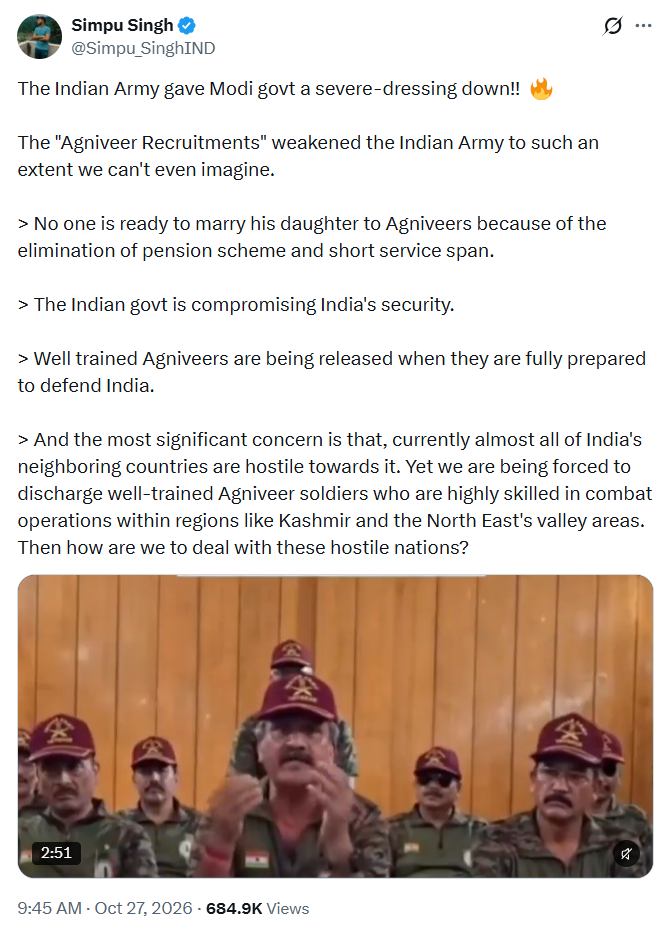
The video is being shared on X with an English caption claiming that the Indian Army has reprimanded the Modi government over the Agniveer scheme and other issues.
https://x.com/Simpu_SinghIND/status/2114933972870570140?s=20
Fact Check
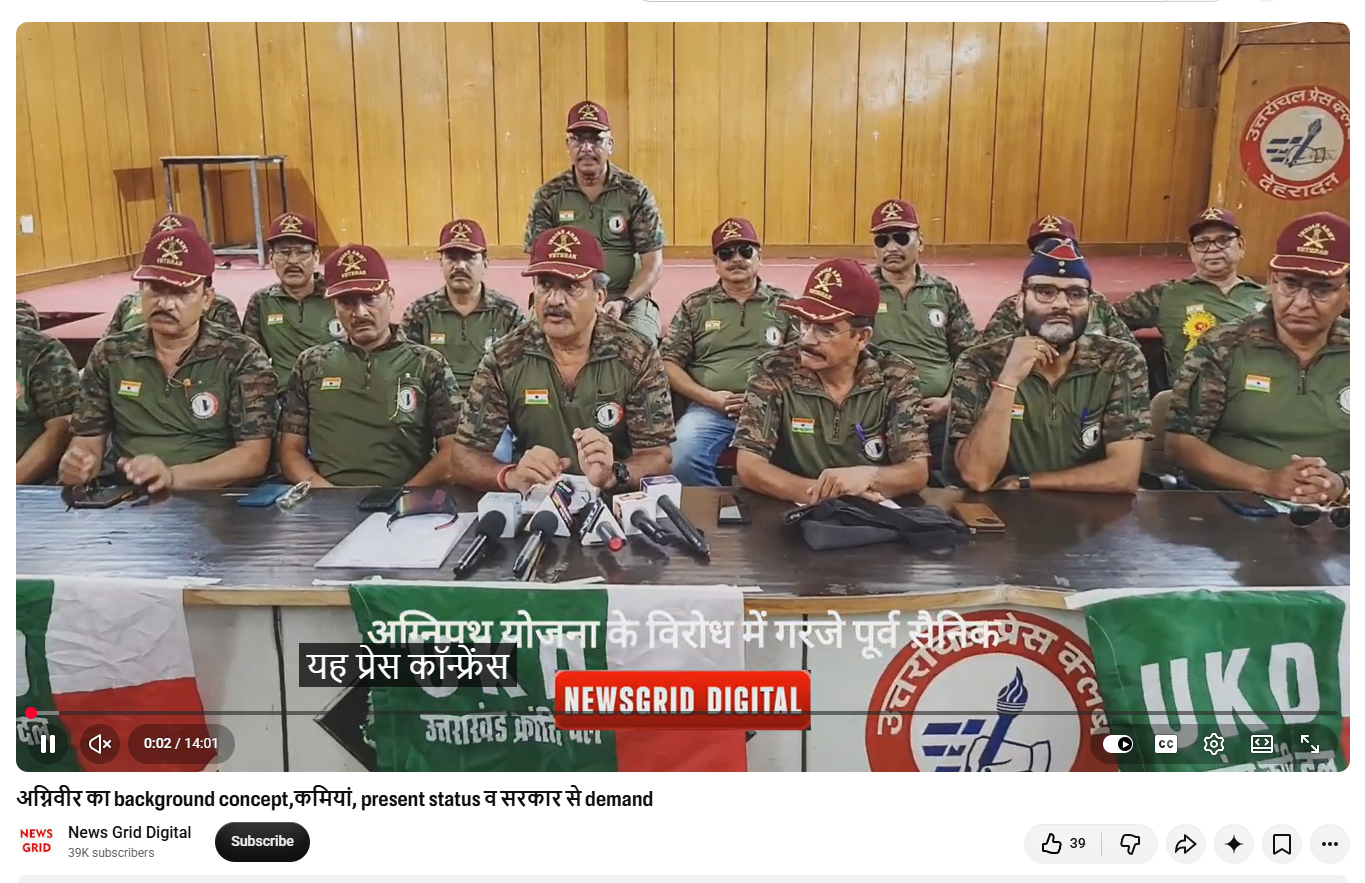
To verify the viral video claiming that the Indian Army has launched a front against the Modi government, we conducted a reverse image search using keyframes from the footage. This led us to a video uploaded on the YouTube account named News Grid Digital on August 22, 2026. It was a longer version of the viral video. According to the visuals and description of the video, the press conference was held by former military personnel associated with Uttarakhand Kranti Dal (UKD), a political party in Uttarakhand, at the Uttaranchal Press Club in Dehradun. The press conference addressed issues related to the Agniveer scheme.We also observed that the caps worn by all the individuals in the video bore the words “Indian Army Veteran,” indicating that they were retired military personnel.
https://www.youtube.com/watch?v=PU0TL590mso
Meanwhile, we also found a video of the same press conference uploaded on August 22, 2026, on the Facebook account of a local media outlet in Uttarakhand. According to the information provided with the video, the press conference was organised by the soldiers’ wing of Uttarakhand Kranti Dal (UKD). The press conference was addressed by the party’s national vice-president, retired Colonel Sunil Kotnala, who raised several issues concerning the first batch of Agniveers scheduled to leave military service in December and their rehabilitation.
https://www.facebook.com/reel/929185246900919

Conclusion
The evidence gathered during our research establishes that the viral video, shared with the claim that the Indian Army has launched a front against the Modi government, shows a press conference organised by the soldiers’ wing of a regional political party in Uttarakhand. All the individuals seen in the video are former military personnel.

Related Blogs

"Cybercriminals are unleashing a surprisingly high volume of new threats in this short period of time to take advantage of inadvertent security gaps as organizations are in a rush to ensure business continuity.”
Cyber security firm Fortinet on Monday announced that over the past several weeks, it has been monitoring a significant spike in COVID-19 related threats.
An unprecedented number of unprotected users and devices are now online with one or two people in every home connecting remotely to work through the internet. Simultaneously there are children at home engaged in remote learning and the entire family is engaged in multi-player games, chatting with friends as well as streaming music and video. The cybersec firm’s FortiGuard Labs is observing this perfect storm of opportunity being exploited by cybercriminals as the Threat Report on the Pandemic highlights:
A surge in Phishing Attacks: The research shows an average of about 600 new phishing campaigns every day. The content is designed to either prey on the fears and concerns of individuals or pretend to provide essential information on the current pandemic. The phishing attacks range from scams related to helping individuals deposit their stimulus for Covid-19 tests, to providing access to Chloroquine and other medicines or medical device, to providing helpdesk support for new teleworkers.
Phishing Scams Are Just the Start: While the attacks start with a phishing attack, their end goal is to steal personal information or even target businesses through teleworkers. Majority of the phishing attacks contain malicious payloads – including ransomware, viruses, remote access trojans (RATs) designed to provide criminals with remote access to endpoint systems, and even RDP (remote desktop protocol) exploits.
A Sudden Spike in Viruses: The first quarter of 2020 has documented a 17% increase in viruses for January, a 52% increase for February and an alarming 131% increase for March compared to the same period in 2019. The significant rise in viruses is mainly attributed to malicious phishing attachments. Multiple sites that are illegally streaming movies that were still in theatres secretly infect malware to anyone who logs on. Free game, free movie, and the attacker is on your network.
Risks for IoT Devices magnify: As users are all connected to the home network, attackers have multiple avenues of attack that can be exploited targeting devices including computers, tablets, gaming and entertainment systems and even online IoT devices such as digital cameras, smart appliances – with the ultimate goal of finding a way back into a corporate network and its valuable digital resources.
Ransomware like attack to disrupt business: If the device of a remote worker can be compromised, it can become a conduit back into the organization’s core network, enabling the spread of malware to other remote workers. The resulting business disruption can be just as effective as ransomware targeting internal network systems for taking a business offline. Since helpdesks are now remote, devices infected with ransomware or a virus can incapacitate workers for days while devices are mailed in for reimaging.
“Though organizations have completed the initial phase of transitioning their entire workforce to remote telework and employees are becoming increasingly comfortable with their new reality, CISOs continue to face new challenges presented by maintaining a secure teleworker business model. From redefining their security baseline, or supporting technology enablement for remote workers, to developing detailed policies for employees to have access to data, organizations must be nimble and adapt quickly to overcome these new problems that are arising”, said Derek Manky, Chief, Security Insights & Global Threat Alliances at Fortinet – Office of CISO.

Introduction
Misinformation is a major issue in the AI age, exacerbated by the broad adoption of AI technologies. The misuse of deepfakes, bots, and content-generating algorithms have made it simpler for bad actors to propagate misinformation on a large scale. These technologies are capable of creating manipulative audio/video content, propagate political propaganda, defame individuals, or incite societal unrest. AI-powered bots may flood internet platforms with false information, swaying public opinion in subtle ways. The spread of misinformation endangers democracy, public health, and social order. It has the potential to affect voter sentiments, erode faith in the election process, and even spark violence. Addressing misinformation includes expanding digital literacy, strengthening platform detection capabilities, incorporating regulatory checks, and removing incorrect information.
AI's Role in Misinformation Creation
AI's growth in its capabilities to generate content have grown exponentially in recent years. Legitimate uses or purposes of AI many-a-times take a backseat and result in the exploitation of content that already exists on the internet. One of the main examples of misinformation flooding the internet is when AI-powered bots flood social media platforms with fake news at a scale and speed that makes it impossible for humans to track and figure out whether the same is true or false.
The netizens in India are greatly influenced by viral content on social media. AI-generated misinformation can have particularly negative consequences. Being literate in the traditional sense of the word does not automatically guarantee one the ability to parse through the nuances of social media content authenticity and impact. Literacy, be it social media literacy or internet literacy, is under attack and one of the main contributors to this is the rampant rise of AI-generated misinformation. Some of the most common examples of misinformation that can be found are related to elections, public health, and communal issues. These issues have one common factor that connects them, which is that they evoke strong emotions in people and as such can go viral very quickly and influence social behaviour, to the extent that they may lead to social unrest, political instability and even violence. Such developments lead to public mistrust in the authorities and institutions, which is dangerous in any economy, but even more so in a country like India which is home to a very large population comprising a diverse range of identity groups.
Misinformation and Gen AI
Generative AI (GAI) is a powerful tool that allows individuals to create massive amounts of realistic-seeming content, including imitating real people's voices and creating photos and videos that are indistinguishable from reality. Advanced deepfake technology blurs the line between authentic and fake. However, when used smartly, GAI is also capable of providing a greater number of content consumers with trustworthy information, counteracting misinformation.
Generative AI (GAI) is a technology that has entered the realm of autonomous content production and language creation, which is linked to the issue of misinformation. It is often difficult to determine if content originates from humans or machines and if we can trust what we read, see, or hear. This has led to media users becoming more confused about their relationship with media platforms and content and highlighted the need for a change in traditional journalistic principles.
We have seen a number of different examples of GAI in action in recent times, from fully AI-generated fake news websites to fake Joe Biden robocalls telling the Democrats in the U.S. not to vote. The consequences of such content and the impact it could have on life as we know it are almost too vast to even comprehend at present. If our ability to identify reality is quickly fading, how will we make critical decisions or navigate the digital landscape safely? As such, the safe and ethical use and applications of this technology needs to be a top global priority.
Challenges for Policymakers
AI's ability to generate anonymous content makes it difficult to hold perpetrators accountable due to the massive amount of data generated. The decentralised nature of the internet further complicates regulation efforts, as misinformation can spread across multiple platforms and jurisdictions. Balancing the need to protect the freedom of speech and expression with the need to combat misinformation is a challenge. Over-regulation could stifle legitimate discourse, while under-regulation could allow misinformation to propagate unchecked. India's multilingual population adds more layers to already-complex issue, as AI-generated misinformation is tailored to different languages and cultural contexts, making it harder to detect and counter. Therefore, developing strategies catering to the multilingual population is necessary.
Potential Solutions
To effectively combat AI-generated misinformation in India, an approach that is multi-faceted and multi-dimensional is essential. Some potential solutions are as follows:
- Developing a framework that is specific in its application to address AI-generated content. It should include stricter penalties for the originator and spreader and dissemination of fake content in proportionality to its consequences. The framework should establish clear and concise guidelines for social media platforms to ensure that proactive measures are taken to detect and remove AI-generated misinformation.
- Investing in tools that are driven by AI for customised detection and flagging of misinformation in real time. This can help in identifying deepfakes, manipulated images, and other forms of AI-generated content.
- The primary aim should be to encourage different collaborations between tech companies, cyber security orgnisations, academic institutions and government agencies to develop solutions for combating misinformation.
- Digital literacy programs will empower individuals by training them to evaluate online content. Educational programs in schools and communities teach critical thinking and media literacy skills, enabling individuals to better discern between real and fake content.
Conclusion
AI-generated misinformation presents a significant threat to India, and it is safe to say that the risks posed are at scale with the rapid rate at which the nation is developing technologically. As the country moves towards greater digital literacy and unprecedented mobile technology adoption, one must be cognizant of the fact that even a single piece of misinformation can quickly and deeply reach and influence a large portion of the population. Indian policymakers need to rise to the challenge of AI-generated misinformation and counteract it by developing comprehensive strategies that not only focus on regulation and technological innovation but also encourage public education. AI technologies are misused by bad actors to create hyper-realistic fake content including deepfakes and fabricated news stories, which can be extremely hard to distinguish from the truth. The battle against misinformation is complex and ongoing, but by developing and deploying the right policies, tools, digital defense frameworks and other mechanisms, we can navigate these challenges and safeguard the online information landscape.
References:
- https://economictimes.indiatimes.com/news/how-to/how-ai-powered-tools-deepfakes-pose-a-misinformation-challenge-for-internet-users/articleshow/98770592.cms?from=mdr
- https://www.dw.com/en/india-ai-driven-political-messaging-raises-ethical-dilemma/a-69172400
- https://pure.rug.nl/ws/portalfiles/portal/975865684/proceedings.pdf#page=62
Introduction
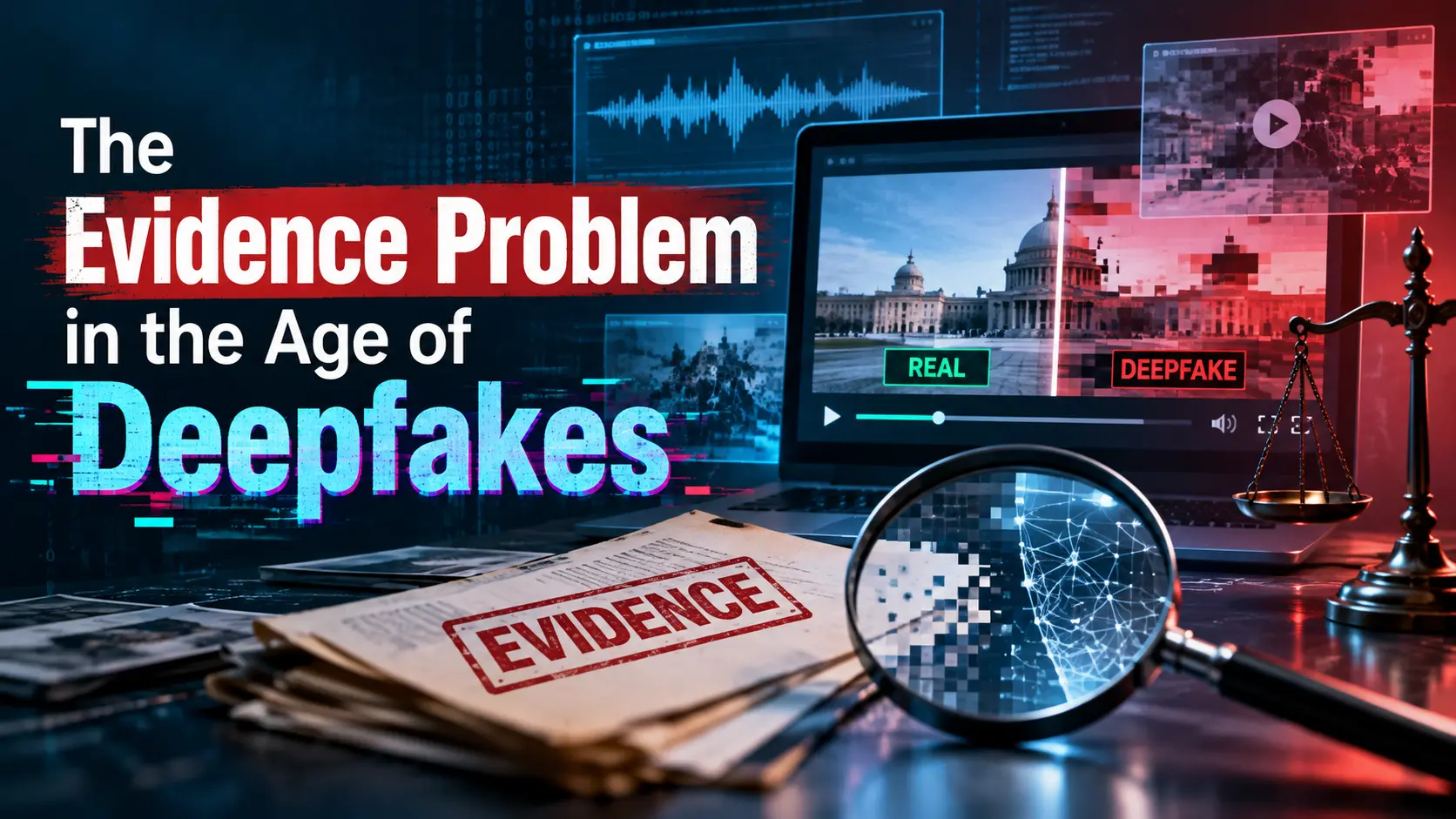
Digital evidence has become part of almost every modern investigation. A photograph can place a person at a location, an audio recording can capture a conversation, and a video can appear to show an event as it happened. For years, the main forensic concern was whether such material had been altered. The rapid growth of generative artificial intelligence has added a harder question: even when a file is preserved exactly as received, can investigators still trust what it appears to show?
Deepfakes have made this question practical rather than theoretical. Synthetic or manipulated audio, video and images can imitate real people and real events with increasing realism. CERT-In describes deepfakes as a high-risk threat because they can support disinformation, fraud, social engineering and reputational harm.[1] NIST research likewise treats AI-generated media as a digital-forensics challenge that requires systematic evaluation of detection technologies.[2]
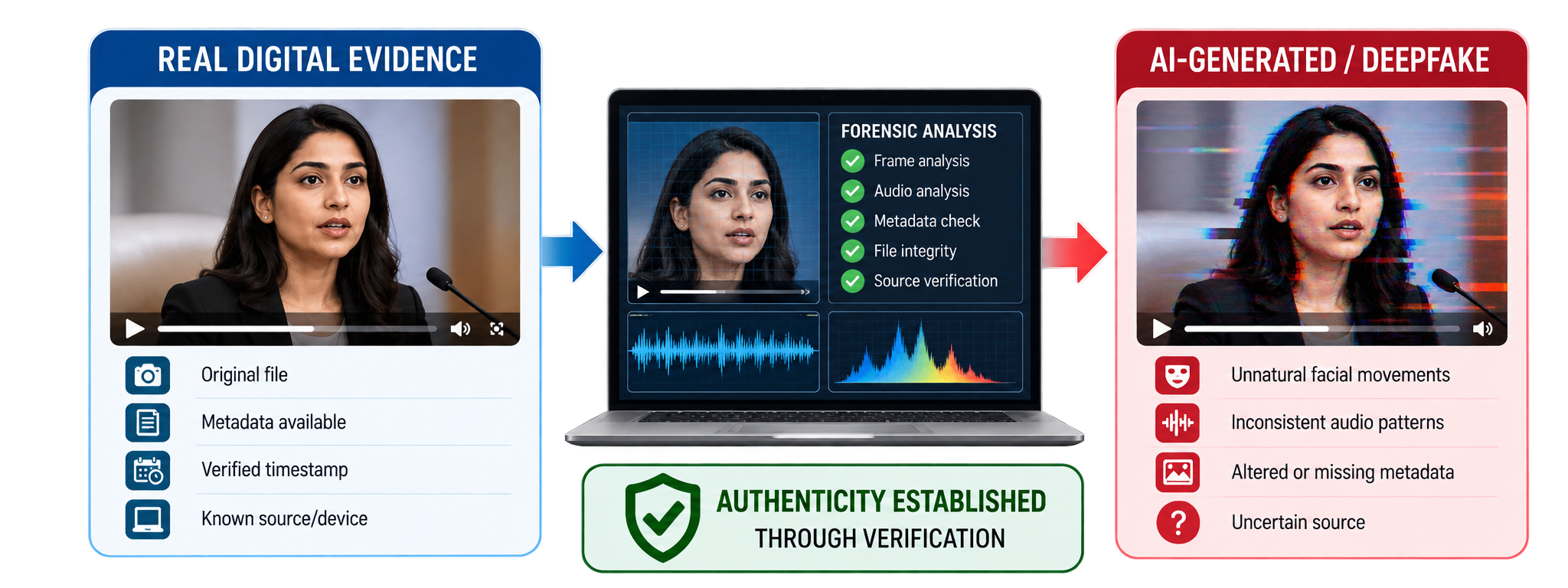
The result is an evidence problem. The answer is not to stop trusting digital evidence, but to become more disciplined about establishing its origin, integrity, context and authenticity.
The evidence problem begins before the laboratory
When a suspicious video reaches an investigator through WhatsApp, Telegram, email or social media, the file may already have passed through several transformations. It may have been compressed, re-encoded, cropped, renamed or stripped of metadata. A screenshot may preserve what is visible but lose the original file structure. A forwarded audio clip may contain no reliable information about where it was first recorded.
For that reason, forensic examination should begin with acquisition and provenance, not with a quick “deepfake detector” result. Investigators should ask: Who supplied the file? Where was it obtained? Is there an original version? What device or account produced it? What happened to the file before it reached the investigator?
Cryptographic hashing remains important because it can demonstrate that an acquired working copy has not changed during examination. But a valid hash does not prove that the underlying event was genuine. A perfectly preserved fake is still a fake.
What a professional examination should look for
A reliable assessment combines several forms of evidence rather than relying on one technical indicator.
Source and acquisition. The original artefact should be preserved whenever possible. Investigators should record the acquisition method, date and time, source account or device, and any known transformations before collection. A documented chain of custody is essential when material may later support a legal, disciplinary or regulatory decision.
Metadata and file structure. Metadata may provide useful clues about creation, encoding, editing software and timestamps. File structure, compression behaviour and related technical characteristics can also reveal inconsistencies. However, these indicators are supporting evidence, not proof on their own, because metadata can be removed or rewritten during normal processing.
Content-level examination. Forensic analysis can include frame-by-frame video review, audio waveform and spectral examination, and inspection for inconsistencies in lighting, reflections, facial movement, lip synchronisation or background elements. Such signs may help guide an investigation, but they are not a permanent checklist. Generative systems continue to improve.
Independent corroboration. This is often the strongest step. If a recording allegedly shows that a person was in a particular place at a particular time, investigators can compare it with CCTV, access-control records, device artefacts, communications, location information, eyewitness accounts or other independent records. The goal is to determine whether the wider evidence supports the event represented by the media.
A real-world lesson: the Pikesville case
The 2024 Pikesville High School incident in Maryland provides a practical example of why authenticity cannot be assumed from appearance alone. An audio recording circulated online that was presented as the principal making racist and antisemitic comments. On January 17, 2024, Baltimore County Public Schools said it could not yet confirm the recording’s veracity and opened an investigation.[3]
Several months later, the school district reported that investigators, with assistance from the FBI and other experts, had verified that the audio had been created using artificial intelligence.[4] Police subsequently arrested the school’s former athletic director in connection with the fabricated recording.[5]
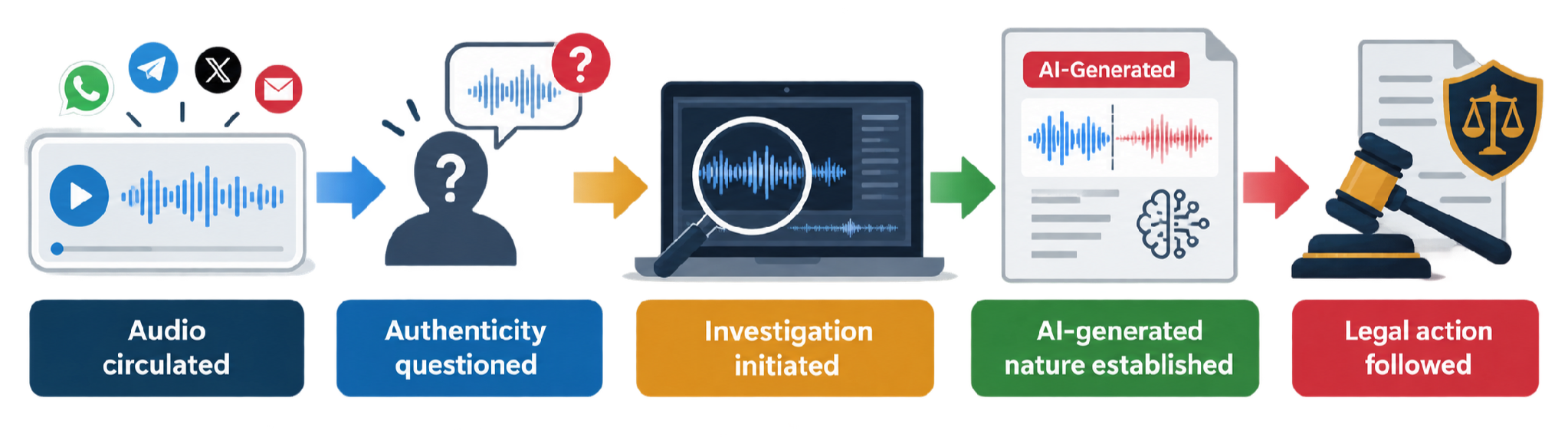
The forensic lesson is larger than the incident itself. The recording had social consequences before its authenticity was established. In a fast-moving online environment, the first version of an event can travel much further than the later correction. Deepfake investigations therefore have to consider not only whether media is authentic, but also how quickly unverified material can influence decisions.
From deepfake detection to content provenance
Detection tools will remain useful, but they should be treated as part of an examination rather than an automatic verdict. NIST’s Guardians of Forensic Evidence work reflects the need to evaluate how analytic systems perform against changing forms of AI-generated media and how well they generalise beyond controlled conditions.[2]
Another important direction is content provenance. The Coalition for Content Provenance and Authenticity (C2PA) has developed a technical framework for recording verifiable information about how digital content was created and changed. Content Credentials can bind provenance information to an asset using cryptographic techniques, allowing later users to inspect a recorded content history when that information is available.[6]
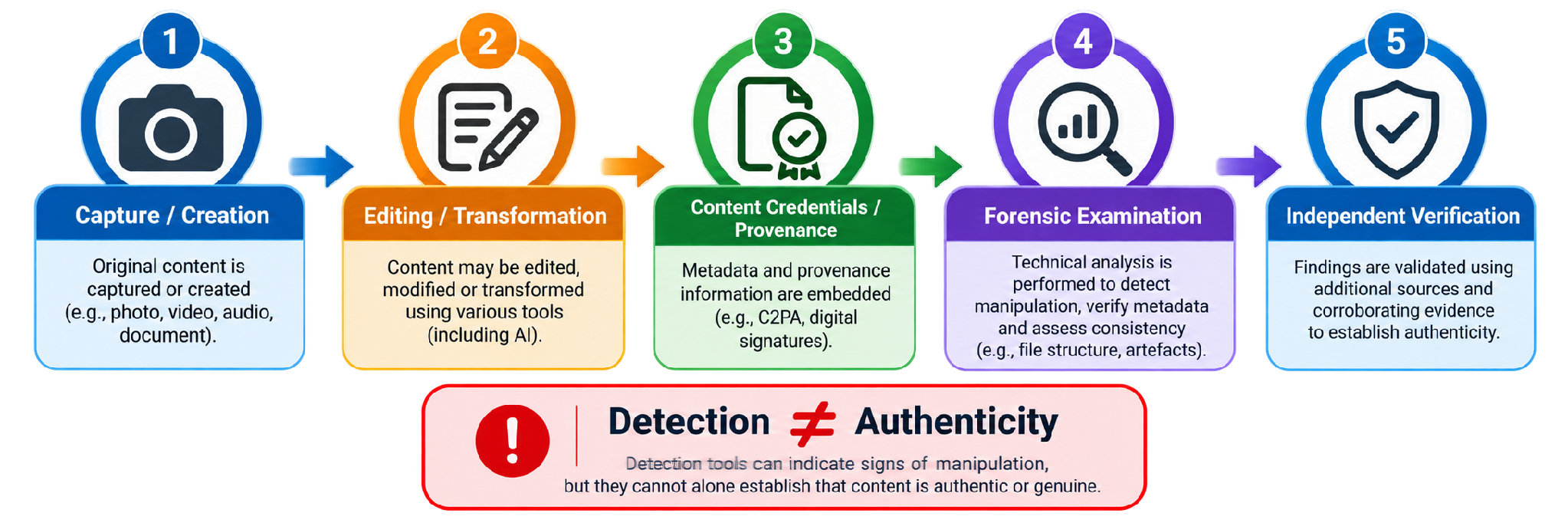
Provenance does not mean that every claim associated with a file is automatically true. It adds context: who created it, what actions were taken and how the asset changed. In a deepfake environment, that context can be as important as the content itself.
Why this matters in India
The issue is especially relevant to India’s fast-growing digital environment. CERT-In’s 2024 advisory identifies misinformation, fraud and reputational damage among the risks associated with synthetic media.[1] In August 2026, the Government of India stated that the regulatory framework addresses AI-generated deepfakes and noted amendments to the IT Rules in February 2026 concerning harms arising from synthetically generated information, including requirements related to labelling and traceable metadata for permissible AI-generated content.[7]
For organisations, deepfake response should therefore not be treated only as a media or public-relations issue. It can become an incident-response and forensic issue. A suspicious executive voice note, a manipulated employee video or a fabricated screen recording may require preservation, technical examination and independent corroboration before any action is taken.
Conclusion
Deepfakes do not make digital evidence useless. Deepfakes make handling of evidence more dangerous. The professional response is not to believe everything or to doubt everything. The professional response is to build a process around evidence: preserve the original where possible document how evidence was acquired, calculate and record hashes, examine metadata and technical characteristics use detection tools while understanding their limitations compare media with independent evidence and examine provenance information where it is available.
Importantly investigators and decision-makers should separate three questions: Is the file intact? Is the content authentic? Does the content actually prove the event being alleged? Deepfakes can pass the test while failing the other two.
In the age of AI evidence will increasingly be judged not only by how convincing it looks but, by how well its origin, integrity, context and history can be demonstrated. That is the standard that can help preserve trust when seeing and hearing're no longer enough.
References
1. CERT-In, “Deepfakes - Threats and Countermeasures,” Advisory CIAD-2024-0060, 27 November 2024. View source
2. NIST, “Guardians of Forensic Evidence: Evaluating Analytic Systems Against AI-Generated Deepfakes,” 27 January 2025. View source
3. Baltimore County Public Schools, “January 17, 2024, Community Update: Message from Superintendent Dr. Myriam Rogers Regarding Pikesville High School.” View source
4. Baltimore County Public Schools, “April 24, 2024 Staff and Community Update: Message from Superintendent Dr. Myriam Rogers Regarding Pikesville High School Investigation.” View source
5. The Baltimore Banner / WYPR, “Ex-athletic director framed principal with AI-generated voice, police say,” 25 April 2024. View source
6. Coalition for Content Provenance and Authenticity (C2PA), “Content Credentials: C2PA Technical Specification,” Version 2.1. View source
7. Government of India, Ministry of Electronics & Information Technology, “Government Strengthens Regulatory Framework to Address AI-Generated Deepfakes,” 6 August 2026. View source
