
#FactCheck: Video of IAS officer Tukaram Munde addressing students at Mumbai college falsely shared as support for protests seeking Gyanesh Kumar’s resignation
Executive Summary
A video of Maharashtra’s well-known IAS officer Tukaram Munde is going viral on social media. In the viral video, Tukaram Munde can be seen at an event where a large crowd of young people is present. It is being claimed that Munde is supporting protesters demanding the resignation of Chief Election Commissioner Gyanesh Kumar. CyberPeace Research found the claim to be misleading. Our research found that the viral video is from Management Conclave 26, organised at Sydenham College in Mumbai, where Tukaram Munde was addressing young students.
Claim
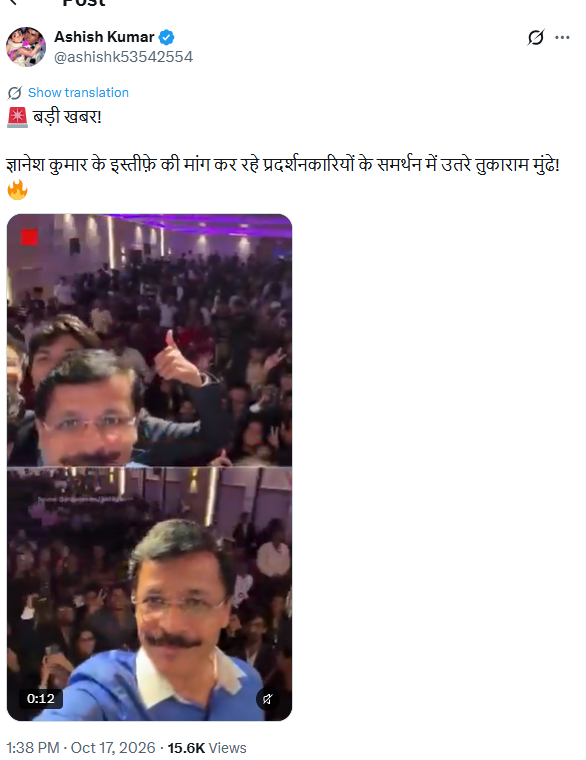
An X account named Ashish Kumar shared the video with the caption: “Big news! Tukaram Munde has come out in support of protesters demanding the resignation of Gyanesh Kumar!”
https://x.com/ashishk53542554/status/2111368692508275129?s=20
Fact Check:
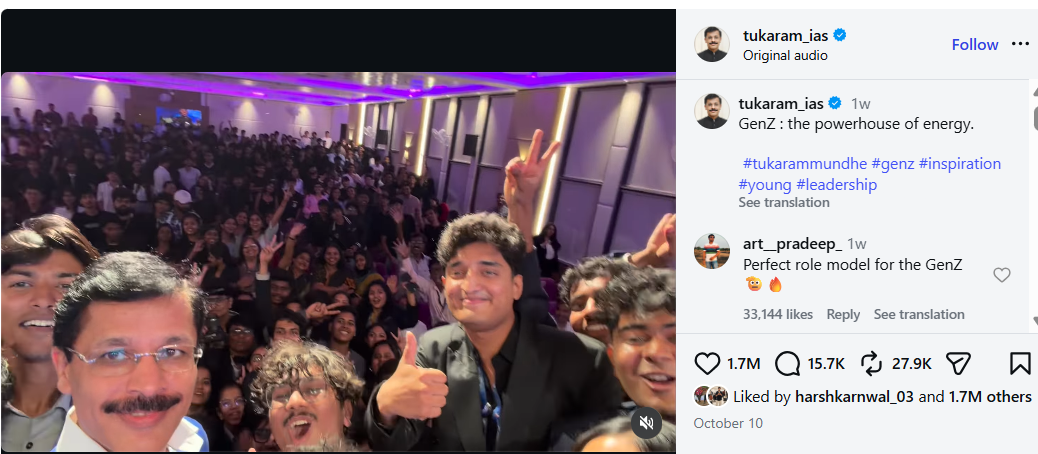
To verify the viral video, we conducted a reverse search of its keyframes. During our research, we found the video uploaded to Tukaram Munde’s official Instagram account on October 10. The caption read, “GenZ: The Powerhouse of Energy.
https://www.instagram.com/tukaram_ias/reel/DeUKM0UqsLl/
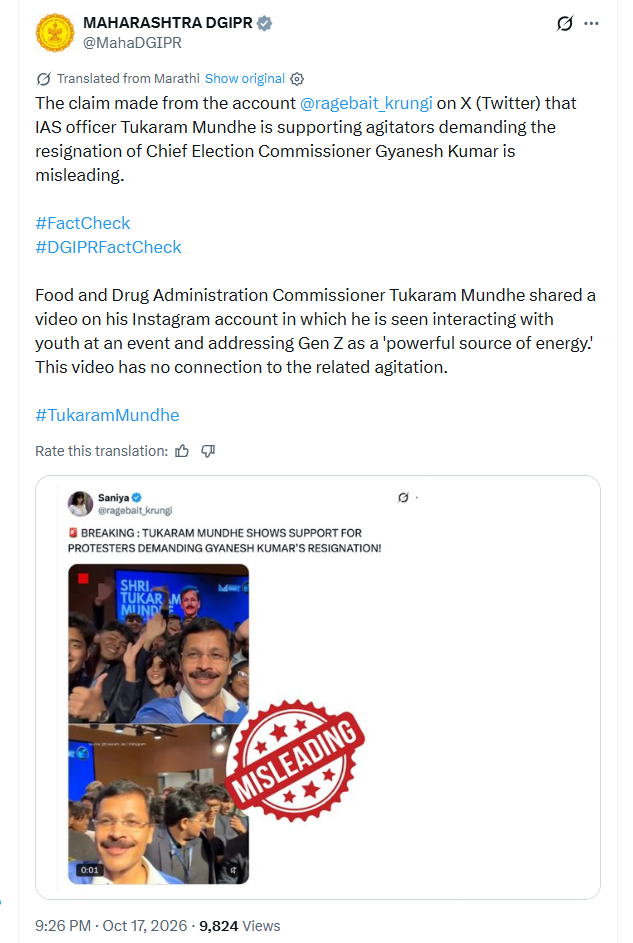
Further research led us to a clarification posted on the official X account of Maharashtra’s Directorate General of Information and Public Relations (DGIPR), which refuted the viral claim. The post clarified that IAS officer Tukaram Munde was not supporting protesters demanding the resignation of Chief Election Commissioner Gyanesh Kumar. Instead, the viral video is from an event where Munde was interacting with young people and describing Gen Z as a “powerhouse of energy.”
https://x.com/MahaDGIPR/status/2111486619111039072?s=20
Further research led us to a post shared by a Facebook account named Mumbai-TODAY. According to the post, Tukaram Munde addressed students at an event organised at Sydenham College in Mumbai, urging the younger generation to remain vigilant against misinformation and fake news. He emphasised the importance of critical thinking and verifying information before believing or sharing it.
He also conveyed to the youth that, in an era when misleading information can spread rapidly through social media, it is essential to be responsible and informed citizens.

Conclusion
Our research found the claim to be misleading. The viral video is from Management Conclave 26, organised at Sydenham College in Mumbai, where Tukaram Munde was addressing young people.

Related Blogs

Executive Summary
A video of former Chief of Defence Staff (CDS) General Anil Chauhan is going viral on social media. The video is being shared with the claim that, referring to the losses suffered by India during Operation Sindoor, he said, “Even if we lose four aircraft or 40 aircraft, India will still remain a larger economy. What matters is your ability to recover from the losses. Whatever losses we suffered, we can recover much faster than Pakistan.” A research done by the Research Wing of the CyberPeace examined the claims made in the video and compared them with General Anil Chauhan’s original remarks at the event.The research found that the viral video’s audio has been digitally manipulated. The alleged statement heard in the viral clip does not appear in the original footage.
Claim:
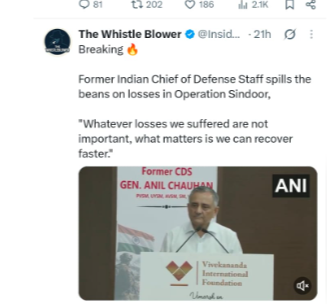
A Pakistani user on social media platform X shared the viral video with the caption: “BREAKING: Former Indian Chief of Defence Staff revealed details about the losses suffered during Operation Sindoor, saying, ‘Whatever losses we suffered are not important. What matters is that we can recover quickly.’”
The link to the post and a screenshot are provided below.
https://x.com/InsiderWB/status/2092559622225940952
Fact Check
Upon closely examining the viral video, we noticed the ANI logo. We then conducted a reverse image search of keyframes from the viral clip. During the search, we found the original video published by ANI, in which General Chauhan discusses the relationship between political objectives and military strategy.
https://x.com/ANI/status/2092217553355743409
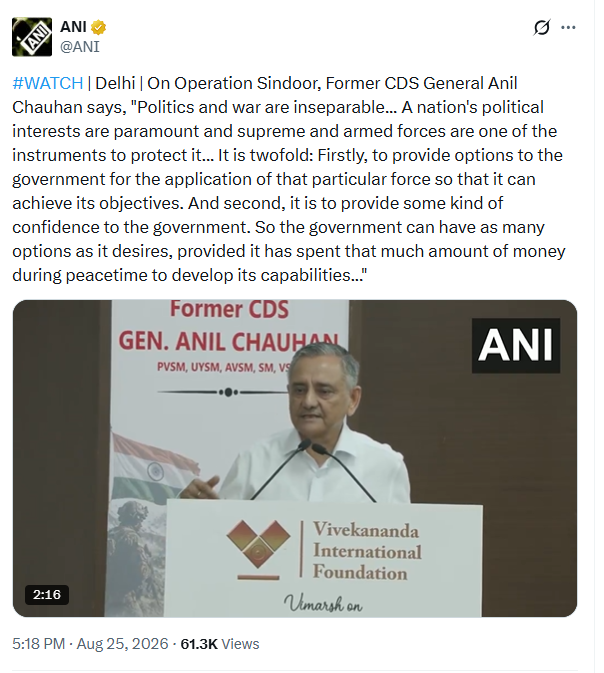
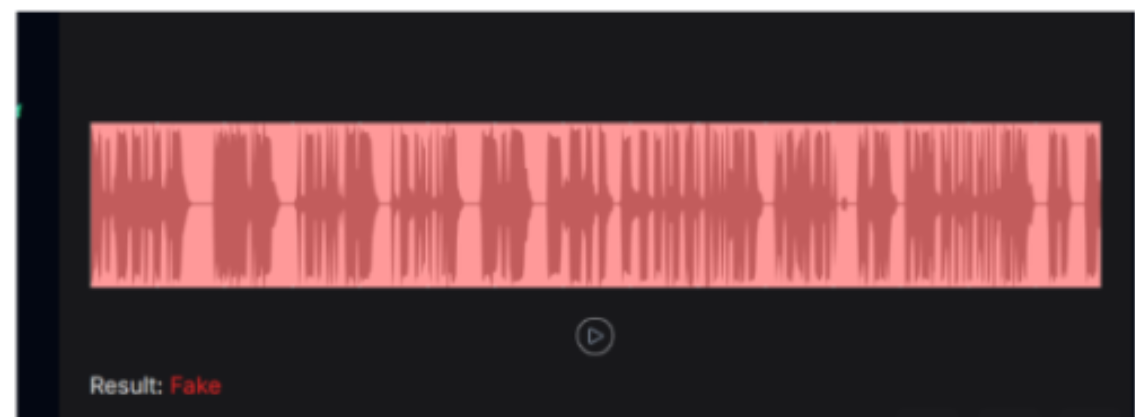
He said, “Politics and war are inseparable.” He further explained that a nation’s political interests are paramount, while the armed forces are one of several instruments used to safeguard those interests. General Chauhan also discussed the role of military leadership in presenting various options to the political leadership, as well as the importance of peacetime preparedness and training. He also spoke about training, contingency planning, and the need to balance military risks with political objectives. Notably, the statement attributed to him in the viral video,“Whatever losses we suffered are not important. What matters is that we can recover quickly” — does not appear anywhere in the original video. Additionally, the audio used in the viral video was also analysed using Resemble AI. The tool’s analysis identified the audio as AI-generated, indicating that the audio in the viral clip had been manipulated.
Conclusion
The research found that General Chauhan’s voice in the viral video has been digitally manipulated. The alleged statement heard in the viral clip does not appear in the original video.

Introduction
Recently in July 2026, India's Cyber Crime Coordination Centre (I4C) under the Ministry of Home Affairs quietly tried to do something almost no government has managed before: switch off an app that doesn't need the internet to work. On July 23, 2026, I4C sent takedown notices to Google, Apple and GitHub, ordering them to pull three offline messaging apps – like BitChat, Briar and Bridgefy – from the Play Store, App Store and GitHub's code repository, respectively, giving a three-hour deadline. The notices followed a period of student-led demonstrations at Jantar Mantar, New Delhi, associated with a group "Cockroach Janata Party," a period that also saw a mobile internet shutdown in parts of central Delhi. When Twitter co-founder Jack Dorsey, who built and open-sourced BitChat, publicised the GitHub notice on X, the episode made international news. Google and Apple got near-identical orders the same night, and telecom operators were reportedly told, and then just as quickly untold, to block the apps at the network level. By July 29, all three apps were still live on both app stores, and BitChat's code was still on GitHub. This incident is worth unpacking carefully, because it sits at the intersection of three things most people care about but rarely see explained together: how this technology actually works, what the law actually allows, and why an app can be "banned" on paper while still working perfectly on your phone.
What makes these apps different
Ordinary apps like WhatsApp or Telegram are centralised: your message travels from your phone to a company's server, and then to the recipient's phone. Block or seize the server, and communication stops. BitChat, Briar and Bridgefy are built differently. They use Bluetooth mesh networking, a system where nearby phones talk directly to each other, and each device also relays messages onwards to phones further away, like a bucket brigade. No message ever touches a central server. Briar adds a further layer by routing traffic over Tor, an anonymity network, when internet access is available, and falls back to Bluetooth or Wi-Fi Direct when it isn't. Bridgefy is tuned for larger crowds, useful during concerts, natural disasters, or protests where thousands of phones are packed into a small area and cellular networks buckle under the load. This design, often called decentralised or peer-to-peer communication, is precisely why these apps are useful during disasters and precisely why they worry law enforcement: they keep working when the internet doesn't, whether that's because a cyclone knocked out cell towers or because the government itself ordered a shutdown.
The legal machinery behind a takedown notice
India's power to block online content mainly comes from Section 69A of the Information Technology Act, 2000, which lets the central government order blocking on grounds like sovereignty, public order or preventing incitement to an offence but only through a defined process set out in the IT (Blocking) Rules, 2009: a designated officer, a review committee, and recorded written reasons. The Supreme Court examined this exact provision in its landmark 2015 ruling, Shreya Singhal v. Union of India. While the judgement is best remembered for striking down the vague "offensive speech" law under Section 66A, it separately upheld Section 69A specifically because it came with procedural guardrails, a reasoned order, an opportunity to be heard, and the possibility of judicial review that stopped it from becoming an unchecked censorship tool. The July 23 notices, however, reportedly leaned on a different lever: Section 79(3)(b) of the IT Act, read with Rule 3(1)(d) of the IT Intermediary Guidelines and Digital Media Ethics Code Rules, 2021. That provision governs when an intermediary loses its legal immunity ("safe harbour") for user content if it fails to act on a government or court order, a mechanism built for content takedowns, not necessarily for pulling an entire app off a store shelf within three hours. Legal commentators have flagged this as significant, since Shreya Singhal itself read down Section 79(3)(b) to require action only pursuant to a court order or a properly authorised government direction, not an informal notice. This isn't the first time a mesh-messaging app has run into this machinery. In 2023, following an I4C request, the government blocked Briar and thirteen other apps in Jammu and Kashmir under Section 69A, citing use, the first known instance of Section 69A being used for a regional block. Briar's developers challenged this in the Delhi High Court; in 2024, the court dismissed the challenge, holding that principles of natural justice can give way in matters of national security.
Why you can't easily switch off a mesh network
Here's the technical wrinkle that made the July order largely symbolic: removing an app from the Play Store stops new downloads, but it does nothing to phones that already have it installed, and it does nothing at all to the Bluetooth radios exchanging messages between those phones. Unlike an internet shutdown, which works by controlling the pipes that all traffic must pass through, a mesh network has no chokepoint, no server to seize, no IP address to blacklist, and no single company to compel.
GitHub, for its part, said it followed its standard process of notifying the account holder and offering an appeal before taking any action, which is one reason BitChat's source code stayed publicly accessible throughout. Within a day, officials reportedly told the companies orally that enforcement wasn't necessary after all, though no public clarification or official document has been released explaining why the notices were issued or withdrawn.
Two legitimate, competing interests
None of this means the government's underlying worry is baseless. Law enforcement agencies genuinely lose visibility when communication moves off networks they can lawfully intercept, and coordination of unlawful assembly or violence is a real concern during volatile protests.
The transparency gap
The single biggest problem with how this played out isn't the underlying concern it's the absence of a public, reasoned order. Under the blocking rules, disclosure is restricted, and courts, including the Supreme Court in Anuradha Bhasin v. Union of India, have said that when access is restricted, reasons must be recorded and, where possible, made available. A three-hour notice, issued and then informally withdrawn without explanation, sits uneasily with that standard. A more durable approach, one that CyberPeace and other digital-rights researchers have called for, would combine clearly identified statutory authority; published (even if redacted) reasoning; proportionality review; and investment in lawful digital forensics, rather than blanket app-store takedowns that decentralised technology is, by design, built to survive.
CyberPeace's policy recommendations
Alongside the legal analysis above, CyberPeace puts forward a ten-point framework for how India should approach decentralised communication technologies going forward, instead of defaulting to blanket takedowns:
- Strengthen transparency in blocking decisions
- Ensure statutory clarity
- Apply legality, necessity and proportionality
- Differentiate technology from misuse
- Invest in advanced investigative capabilities
- Establish a multi-stakeholder advisory mechanism
- Develop a framework for emerging decentralised technologies
- Promote responsible innovation
- Enhance public awareness
- Foster international cooperation
Conclusion
The referred incident illustrates that regulating decentralised technologies requires more than swift takedown notices. As communication networks become increasingly resilient and distributed, effective governance must combine legal certainty, technical realism, transparency, and proportionate enforcement. India's challenge is not simply to regulate emerging technologies but to develop a kind of regulatory framework that safeguards national security and the constitutional values of privacy, free expression, and due process.
Sources
- MediaNama — Bitchat was not the only mesh-messaging app targeted by a government takedown notice
- Outlook Business — Beyond GitHub, Govt Also Directed Google To Take Down Bitchat, Briar And Bridgefy
- The Wire — Government Asks GitHub to Remove Bluetooth Messaging App Bitchat Over Concerns of 'Misuse'
- The Tech Trace (Substack) — The Indian govt's crackdown on Bluetooth-enabled messaging apps that wasn't?
- Bar and Bench — Section 69A IT Act and the expanding architecture of digital censorship in India
- Supreme Court Observer — X relies on 'Shreya Singhal' in arbitrary content-blocking case in Karnataka HC
- LiveLaw — Internet Freedom, Shreya Singhal v Union of India, IT Act, Blocking Rules 2009
- Manupatra — Full text, Shreya Singhal v. Union of India (2015) 5 SCC 1
- Open Magazine — CJP Protests at Jantar Mantar: How Offline Mesh Messaging Apps Powered a Network of Resistance

As technological advancements continue to shape the future, the rise of artificial intelligence brings with it significant potential benefits, yet also raises concerns about the spread of misinformation. Recognising the need for accountability on both ends, on 5th May, during the three-day World News Media Congress 2025 in Kraków, Poland the European Broadcasting Union (EBU) and the World Association of News Publishers (WAN-IFRA) have announced to the public the five core principles for their joint initiative called News Integrity in the Age of AI. The initiative is aimed at fostering dialogue and cooperation between media organisations and technology platforms, and the principles announced are to be a code of practice to be followed by all those taking part. With thousands of public and private media outlets around the world joining the effort, the initiative highlights the shared responsibility of AI developers to ensure that AI systems are trustworthy, safe, and supportive of a reliable news ecosystem. It represents a global call to action to uphold the integrity of news in this age of major influx and curb the growing challenge of misinformation.
The five core principles released focus on:
1. Authorisation of content by the originators is a must prior to its usage in Generative AI tools and models
2. High-quality and up-to-date news content must be recognised by third parties that are benefiting from it
3. There must be a focus on accuracy and attribution, making the original sources of news apparent to the public, promoting transparency
4. Harnessing the plural nature of the news perspectives, which will help AI-driven tools perform better and
5. An invitation to tech companies for an open dialogue with news outlets, facilitating conversation to collaborate and develop standards of transparency, accuracy, and safety.
As this initiative provides a unified platform to address and deliberate on issues affecting the integrity of news, there are also some other technical ways in which misinformation in news caused by AI can be curbed:
1. Encourage the usage of Smaller Generative AI Models: The Large Language Models (LLMs) have to be trained on a range of topics. Businesses don’t require such an expanse of information but just a little that is relevant. A narrower context of information to be sourced from allows better content navigation and a reduced chance of mix-up.
2. Fighting AI hallucination: This is a phenomenon that causes generative AI (such as chatbots and computer vision tools) to present nonsensical and inaccurate outputs as the system perceives objects or patterns that are imperceptible or non-existent to human observers. This occurs as a result of the system trying to focus on both language fluency and stitching information from different sources together. In order to deal with this, one can deploy retrieval augmented generation (RAG). This enables connection with external sources of data that include academic journals, a company’s organisational data, among other things, that would help in providing more accurate, domain-specific content.
Conclusion
This global call to action marks an important step toward fostering unified efforts to combat misinformation. The set of principles introduced is designed to be adaptable, providing a flexible framework that can evolve to address emerging challenges (through dialogue and discussion), including issues like copyright infringement. While AI offers powerful tools to support the news industry, it is essential to emphasise that human oversight remains crucial. These technological advancements are meant to enhance and augment the work of journalists, not replace it, ensuring that the core values of journalism, such as accuracy and integrity, are preserved in the age of AI.
References
● https://www.techtarget.com/searchenterpriseai/tip/Generative-AI-ethics-8-biggest-concerns
● https://trilateralresearch.com/responsible-ai/using-responsible-ai-to-combat-misinformation
● https://www.omdena.com/blog/the-ethical-role-of-ai-in-media-combating-misformation
● https://2024.jou.ufl.edu/page/ai-and-misinformation
● https://techxplore.com/news/2025-05-ai-counter-misinformation-fact-based.html
● https://www.advanced-television.com/2025/05/06/media-outlets-call-for-ai-companies-news-integrity-protection/https://www.ibm.com/think/insights/ai-misinformation
