
#FactCheck: Video of Bangladesh Restaurant Vandalism Falsely Shared as RSS Volunteers Attacking Restaurant in West Bengal
Executive Summary
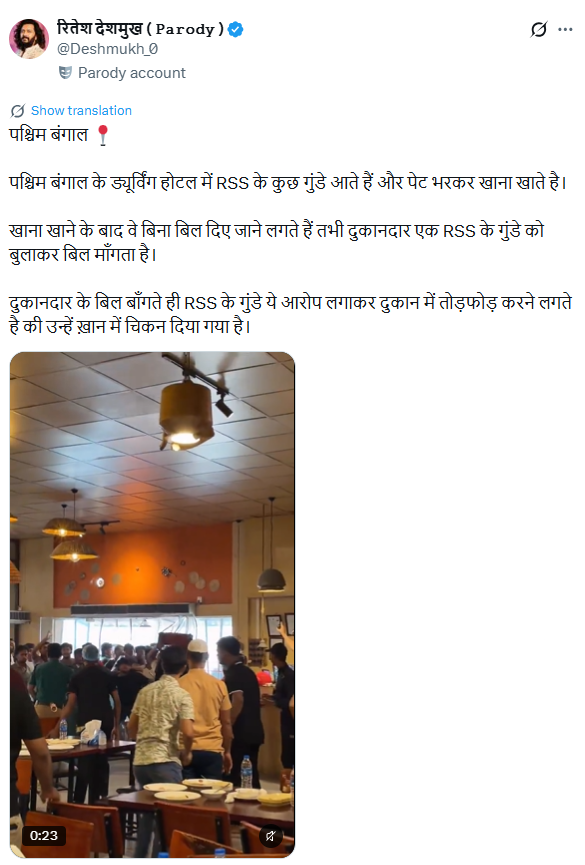
A video showing several people vandalising a restaurant is going viral on social media. Some users are sharing it with the claim that Rashtriya Swayamsevak Sangh (RSS) volunteers vandalised a restaurant in West Bengal after being asked to pay the bill. CyberPeace Research found that the video is from Bangladesh. Students had vandalised a restaurant in Dhaka following a minor dispute. The footage of that incident is being falsely shared as showing RSS volunteers vandalising a restaurant in West Bengal.
Claim:
An X user, ‘Deshmukh_0’, posted the video on November 13, 2026 (archive link), with the caption: “Some RSS goons enter the Dewrving Hotel in West Bengal and eat to their heart’s content. After finishing their meal, they try to leave without paying the bill. When the shopkeeper asks one of the RSS goons to pay, they start vandalising the restaurant, alleging that they were served chicken instead of mutton.”
https://x.com/Deshmukh_0/status/2121220869460812137?a=N5xOXlH6zM57KQrKgqY&s=20
Fact Check
To verify the viral claim, we conducted a Google Lens search using keyframes from the video. We found a news report related to the viral footage, published on November 13, 2026, on the YouTube channel of Bangladeshi news portal ‘Jago News’. The viral clip can also be seen in the report.According to the report, students of Titumir College vandalised a restaurant in Mohakhali following a delay in serving food.
https://www.youtube.com/shorts/hBEyYWDLXzA

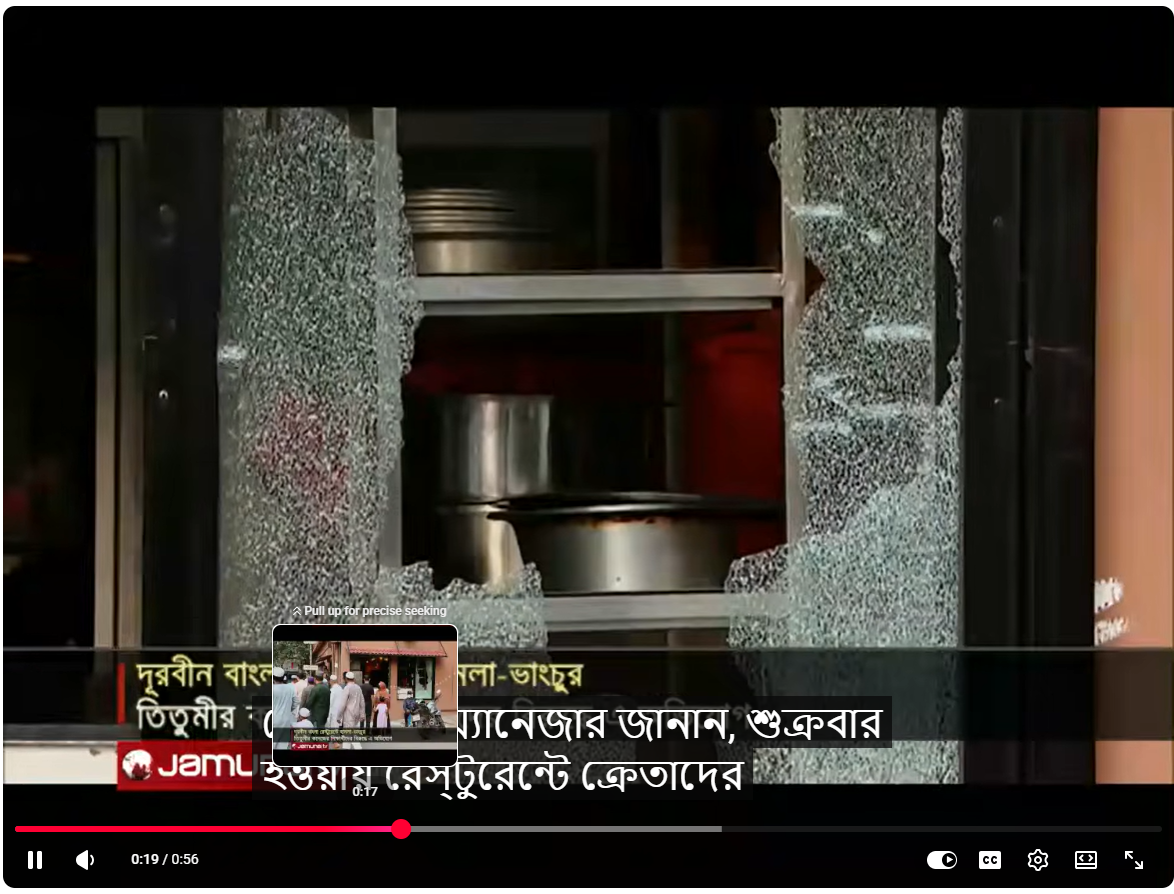
A related video report was also uploaded on November 14, 2026, on the YouTube channel of Bangladeshi news channel ‘Jamuna TV’.According to the report, “Students of Titumir College were accused of attacking restaurant staff and vandalising the ‘Durobin Bangla’ restaurant in Dhaka’s Mohakhali area following a dispute over seating arrangements. A clash subsequently broke out between the students and restaurant staff, leaving several employees and one student injured.”
https://www.youtube.com/watch?v=Qou7dobaISQ
Conclusion:
Students vandalised a restaurant in Dhaka, Bangladesh, following a minor dispute. However, the video of the incident is being falsely shared as showing RSS volunteers vandalising a restaurant in West Bengal.

Related Blogs

At Semicon India 2025 held recently, the Prime Minister declared, “when the chips are down, you can bet on India”. The event showcased the country’s first indigenous microprocessor, Vikram, developed by ISRO’s Semiconductor Lab, and announced that commercial chip production will begin by the end of 2025. India aims to become a global player in semiconductor production, and build self-reliance in a world where global supply chains are shifting rapidly.
Why Semiconductors Matter
Semiconductors power almost everything around us, from laptops and air conditioners to cars and even the tiniest gadget we hardly notice . They’ve rightly been called the “oil of the digital age” because our entire digital world depends on them. But the global supply chain for chips is heavily concentrated. Taiwan alone makes over 60% of the world’s semiconductors and nearly 90% of the most advanced ones. Rising tensions between China and Taiwan have only shown how fragile and risky this dependence can be for the rest of the world. For India, building its own semiconductor base is not just about technology, it is about economic security and reduced dependence on imports.
India’s Push: The Numbers and Projects
The government has committed nearly US$18 billion across 10 projects, making it one of the country’s largest industrial bets in decades. Under the Production Linked Incentive (PLI) scheme, ₹76,000 crore (about US$9.1 billion) was set aside, of which most has already been allocated.
Key developments include:
- Vikram processor – developed at ISRO’s Semiconductor Lab, fabricated on 180nm technology.
- CG Power facility in Sanand, Gujarat – launched in 2024, scaling chip assembly and testing.
- Micron’s investment – ₹22,500+ crore in Gujarat for packaging and testing.
- Tata Electronics–PSMC partnership – ₹91,000 crore tie-up with Taiwan’s Powerchip for fabs.
The domestic market, valued at US$38 billion in 2023, is expected to touch US$100–110 billion by 2030 if growth sustains.
The Technology Gap
While the Vikram chip, a 32 bit microprocessor, is a proud milestone, it highlights the technology gap India faces. The chip was fabricated using a 180nm CMOS process, a process that was cutting-edge back in the early 2000s. Today, companies like TSMC and Samsung are already producing 3nm chips for smartphones and AI servers, whereas those like Nvidia and Apple have developed chips 2ith 64-bit processing capabilities.
This means India's main focus, to become self-reliant in the mature end of the spectrum useful for space, defense, and automotives and electronics, is far from the global cutting edge. Bridging this gap will require both time and deep technical expertise.
Talent and Design Strengths
On the positive side, India already contributes around 20% of global semiconductor design talent. Two advanced design centers—one in Noida and another in Bengaluru—are working on 3nm designs. The government’s Design Linked Incentive scheme has cleared 20+ projects to nurture startups in chip design.
Over 60,000 engineers have been trained under various programs, but scaling this to the hundreds of thousands needed for fabs remains a challenge. Unlike software development, semiconductor fabrication demands highly specialised skills in process engineering, yield optimization, and supply chain logistics.
Lessons from Global Players
Countries like Taiwan, South Korea, and the US didn’t build their chip industries overnight. Taiwan’s TSMC spent decades and billions of dollars mastering yield rates and building trust with clients. The US recently passed the CHIPS and Science Act to revive domestic production, while the EU has its own Chips Act. Japan, too, has pledged billions, including ¥10 trillion in cooperation with India.
These examples show that success depends not just on funding , but also on harmony between government and private players, consistent execution, ecosystem building, and global partnerships.
The Challenges Ahead
India’s ambitions face several hurdles:
- Capital intensity – A single leading-edge fab costs US$10–20 billion, and requires constant upgrades.
- Supply chain complexity – Hundreds of chemicals, gases, and precision tools are needed, many of which India doesn’t yet produce domestically.
- Technology transfer – Advanced lithography machines (from ASML in the Netherlands, for example) are tightly controlled and not easily available.
- Execution risks – Moving from announcements to commercially viable fabs with competitive yields is where many countries have stumbled.
The Way Forward
India has big ambitions in the field of semi-conductor design and manufacturing, with the goal of becoming a major global exporter instead of importer. The country appears to be adopting a step-by-step approach, starting with assembly, testing, and mature-node fabs, while simultaneously investing in design, research, and talent. Every successful global power in this industry first mastered older nodes before advancing to cutting-edge levels.
At the same time, international collaborations with players like Micron, Tata-PSMC, and Japan will be critical for technology transfer and capacity building. If India can combine its engineering talent, rising domestic demand, and government backing with the PLI scheme, and drive global collaborations, the outlook can be promising.
Conclusion
India’s semiconductor story is just beginning, but the direction is clear. The Vikram processor and investment announcement at Semicon 2025 shows the intent of the government. The hard part now lies ahead: moving from prototypes to large-scale production and globally competitive fabs in an industry that demands substantial investment, flawless execution, and years of patience.
Yet the stakes couldn’t be higher. Semiconductors will shape the future of economies and national security . If India plays its cards right by nurturing talent, innovating and researching, and driving global partnerships, the dream of becoming a global semiconductor hub may well move from ambition to reality.
References
- https://www.ndtv.com/india-news/when-chips-are-down-bet-on-india-pm-narendra-modis-big-semiconductor-push-6539317
- https://www.indiatoday.in/science/story/what-is-vikram-32-bit-chip-presented-to-pm-modi-at-semicon-india-2025-2780582-2025-09-02#
- https://www.visionofhumanity.org/the-worlds-dependency-on-taiwans-semiconductor-industry-is-increasing/
- https://m.economictimes.com/tech/artificial-intelligence/tata-electronics-and-powerchip-semiconductor-manufacturing-corporation-to-build-indias-first-semiconductor-fab/articleshow/113694273.cms
- https://www.business-standard.com/economy/news/10-trillion-yen-in-10-years-japan-pledges-big-investment-in-india-125082901564_1.html
- https://www.oecd.org/content/dam/oecd/en/publications/reports/2023/06/vulnerabilities-in-the-semiconductor-supply-chain_f4de7491/6bed616f-en.pdf
- https://techwireasia.com/2025/09/semiconductor-india-commercial-production-2025/

Introduction
The recent events in Mira Road, a bustling suburb on the outskirts of Mumbai, India, unfold like a modern-day parable, cautioning us against the perils of unverified digital content. The Mira Road incident, a communal clash that erupted into the physical realm, has been mirrored and magnified through the prism of social media. The Maharashtra Police, in a concerted effort to quell the spread of discord, issued stern warnings against the dissemination of rumours and fake messages. These digital phantoms, they stressed, have the potential to ignite law and order conflagrations, threatening the delicate tapestry of peace.
The police's clarion call came in the wake of a video, mischievously edited, that falsely claimed anti-social elements had set the Mira Road railway station ablaze. This digital doppelgänger of reality swiftly went viral, its tendrils reaching into the ubiquitous realm of WhatsApp, ensnaring the unsuspecting in its web of deceit.
In this age of information overload, where the line between fact and fabrication blurs, the police urged citizens to exercise discernment. The note they issued was not merely an advisory but a plea for vigilance, a reminder that the act of sharing unauthenticated messages is not a passive one; it is an act that can disturb the peace and unravel the fabric of society.
The Massacre
The police's response to this crisis was multifaceted. Administrators and members of social media groups found to be the harbingers of such falsehoods would face legal repercussions. The Thane District, a mosaic of cultural and religious significance, has been marred by a series of violent incidents, casting a shadow over its storied history. The police, in their role as guardians of order, have detained individuals, scoured social media for inauthentic posts, and maintained a vigilant presence in the region.
The Maharashtra cyber cell, a digital sentinel, has unearthed approximately 15 posts laden with videos and messages designed to sow discord among the masses. These findings were shared with the Mira-Bhayandar, Vasai-Virar (MBVV) police, who stand ready to take appropriate action. Inspector General Yashasvi Yadav of the Maharashtra cyber cell issued an appeal to the public, urging them to refrain from circulating such unverified messages, reinforcing the notion that the propagation of inauthentic information is, in itself, a crime.
The MBVV police, in their zero-tolerance stance, have formed a team dedicated to scrutinizing social media posts. The message is clear: fake news will be met with strict action. The right to free speech on social media comes with the responsibility not to share information that could incite mischief. The Indian Penal Code and Information Technology Act serve as the bulwarks against such transgressions.
The Aftermath
In the aftermath of the clashes, the police have worked tirelessly to restore calm. A young man, whose video replete with harsh and obscene language went viral, was apprehended and has since apologised for his actions. The MBVV police have also taken to social media to reassure the public that the situation is under control, urging them to avoid circulating messages that could exacerbate tensions.
The Thane district has witnessed acts of vandalism targeting shops, further escalating tensions. In response, the police have apprehended individuals linked to these acts, hoping that such measures will expedite the return of peace. Advisories have been issued, warning against the dissemination of provocative messages and rumours.
In total, 19 individuals have been taken into custody in relation to numerous incidents of violence. The Mira-Bhayandar and Vasai-Virar police have underscored their commitment to legal action against those who spread rumours through fake messages. The authorities have also highlighted the importance of brotherhood and unity, reminding citizens that above all, they are Indians first.
Conclusion
In a world where old videos, stripped of context, can fuel tensions, the police have issued a note referring to the aforementioned fake video message. They urge citizens to exercise caution, to neither believe nor circulate such messages. Police Authorities have assured that no one involved in the violence will be spared, and peace committees are being convened to restore harmony. The Mira Road incident serves as a sign of the prowess of information and responsibility that comes with it. In the digital age, where the ephemeral and the eternal collide, we must navigate the waters of truth with care. Ultimately, it is not just the image of a locality that is at stake, but the essence of our collective humanity.
References
- https://youtu.be/gK2Ac1qP-nE?feature=shared
- https://www.mid-day.com/mumbai/mumbai-crime-news/article/mira-road-communal-clash-those-spreading-fake-messages-to-face-strict-action-say-mira-bhayandar-vasai-virar-cops-23331572
- https://www.mid-day.com/mumbai/mumbai-news/article/mira-road-communal-clash-cybercops-on-alert-for-fake-clips-23331653
- https://www.theweek.in/wire-updates/national/2024/01/24/bom43-mh-shops-3rdld-vandalism.html

Introduction
In a groundbreaking move, India's Reserve Bank has embarked on a transformative journey with its Central Bank Digital Currency (CBDC) project. As the world grapples with the evolving landscape of digital finance, the implications of India's CBDC initiative extend beyond its borders, potentially reshaping global payment systems. The Union Minister of State for Finance, Shri Pankaj Chaudhary, revealed that on October 7, 2022, the Reserve Bank of India released a proposal note on Central Bank Digital Currency (CBDC). Two pilot projects using blockchain-based technology are described in the concept note: Digital Rupee-Wholesale (e₹-W) and Digital Rupee-Retail (e₹-R). Launched on November 1, 2022, the bulk trading pilot aims to increase intermediary competitiveness, particularly in the resolution of trades in the secondary market involving sovereign debt. In parallel, on December 1, 2022, the retail banking pilot, known as e₹-R, got underway in a limited user group with eight banks taking part in stages.
The digital asset known as e₳-R is issued across financial institutions for Person-to-Person (P2P) and Person-to-Merchant (P2M) transactions. It is intended to serve as a virtual currency that represents legal money and exhibits characteristics similar to actual cash. Based on input gathered during the continuing trial phases, the RBI intends to progressively broaden the pilot project's scope.
Central Bank Digital Currency Pilot Projects
Central Bank Digital Currency (CBDC), which the Central Bank of India is promoting, may easily perform an essential part in payments made across borders, according to Reserve Bank Governor Shaktikanta Das. The CBDC is going to be expanded to the international financial markets after being implemented as a trial in both the retail and wholesale industries.
CBDC in International Payments
He emphasized that although physical currency will still exist, the CBDC will eventually replace all forms of money worldwide.
"CBDC is going to be the future currency of the world and it is necessary that every central bank, every country works on CBDC," he stated. He also stated that as worldwide commerce moves more and more around science and technology, CBDCs will play a significant role since they can effectively and affordably speed up payment processing across different countries. Regarding India's foreign exchange reserves, the governor stated that the selection to increase the resources as a safety net and protection versus contagion possibilities was made consciously.
CBDCs' Place in the Transnational Economic Revolution
In certain economies worldwide, having a CBDC internationally accessible could lead to more replacements for foreign currencies rather than the home currencies, which could cause financial aggregates to become volatile and change the mix of instruments of exchange.
CBDC may have benefits related to first-mover savings of scale, and other consequences even in everyday circumstances. If nations with global currencies have established CBDCs, they could strengthen current advantages and disadvantages, including consequences, particularly in terms of revenue. In a similar vein, CBDC might alter the structure of international liquidity while safeguarding asset supply. Additionally, and particularly if imposed abruptly, CBDC may, in certain circumstances, result in significant capital movements and associated repercussions on the foreign exchange rate as well as additional asset prices. Furthermore, nations may encounter difficulties in getting ready for virtual currencies issued by central banks.
The worldwide and international scope of CBDCs accessible to immigrants may become particularly apparent in situations where there is a widespread flight safety concern. In these circumstances, converting a CBDC into a foreign currency would make it possible for capital markets to deleverage more quickly. The elimination of debt challenges could show up as tight finance constraints and abrupt swings in foreign exchange markets if CBDCS expedited its flight from uncertainty.
Deposits of Foreign Exchange and Self-Dependency
Reserve Bank Governor Shaktikanta Das stated "We must rely on ourselves. We must maintain our robust reserves. In order to achieve that goal, we have been amassing quite substantial reserves, and the outside world has come to feel quite confident that India would be able to fulfil its contractual responsibilities to the international community no matter what the obstacles,"
Involvement of RBI in the Currency Market
Given that the trading community was confident that the Reserve Bank of India would be capable of and able to fulfil its contractual responsibilities, the value of the Indian rupee did not decline as dramatically. The RBI governor stated that the RBI does participate in the economy, but that "our engagement operates in two ways," he would not hesitate to acknowledge this.
The Value of Macroeconomic and Budgetary Cooperation
According to RBI Governor Das, the RBI makes purchases and sales of dollars based on the direction in which the financial sector is trending. However, the RBI does not intend to set a certain level for the rupee because it does not consider any specific threshold for the Indian rupee's conversion rate against the US dollar. He also emphasized how crucial it is for both the financial and monetary authorities to work together.
Conclusion
India's CBDC project signals a transformative shift in the global digital finance landscape. Governor Shaktikanta Das envisions CBDCs as the future global currency, emphasizing their role in international payments. The potential impact on financial systems, cross-border transactions, and the need for self-reliance underscore the significance of India's CBDC initiative in shaping the evolving dynamics of the digital economy. As the project progresses, close cooperation between financial and monetary authorities becomes imperative for navigating the challenges and opportunities associated with this groundbreaking venture.
References
- https://economictimes.indiatimes.com/news/economy/policy/central-bank-digital-currency-can-play-important-role-in-cross-border-payment-rbi-guv/articleshow/104706717.cms
- https://www.bis.org/cpmi/publ/d174.pdf
- https://bfsi.economictimes.indiatimes.com/news/fintech/explained-how-rbi-is-leveraging-upi-to-push-the-use-of-retail-cbdc/103591989
- https://www.imf.org/en/News/Articles/2022/02/09/sp020922-the-future-of-money-gearing-up-for-central-bank-digital-currency
- https://www.business-standard.com/economy/news/cbdc-pilot-projects-show-promising-results-rbi-governor-shaktikanta-das-123102601171_1.html
