
#FactCheck-Old Parliament Video Falsely Shared as Kangana Ranaut Backing CJP Protest
Executive Summary
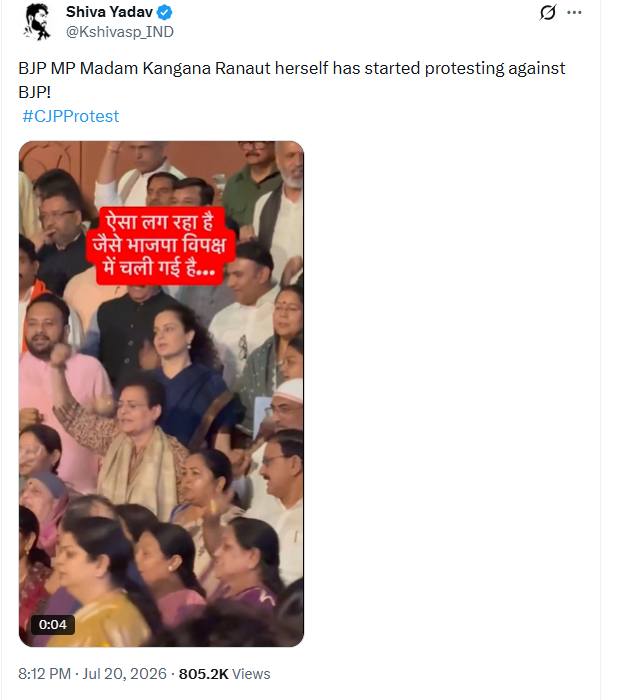
A video from the Parliament complex is being widely shared on social media with the claim that Bharatiya Janata Party (BJP) MP Kangana Ranaut has come out in support of the ongoing Cockroach Janata Party (CJP)-led protest at Delhi’s Jantar Mantar. The viral post claims that Ranaut can be seen raising slogans in support of the protesters. CyberPeace Research Wing’s research found the claim to be misleading. The viral footage is not related to the ongoing CJP protest. It dates back to April 2026, when BJP women MPs staged a demonstration outside Parliament after the 131st Constitutional Amendment Bill failed to pass. The old video is now being falsely linked to the current protest.
Claim:
On July 20, 2026, an X (formerly Twitter) user shared the viral video claiming that “BJP MP Kangana Ranaut has now started protesting against her own party.”
The post link, archive link and screenshot are provided below.
https://x.com/Kshivasp_IND/status/2079215438664233391
Fact Check:
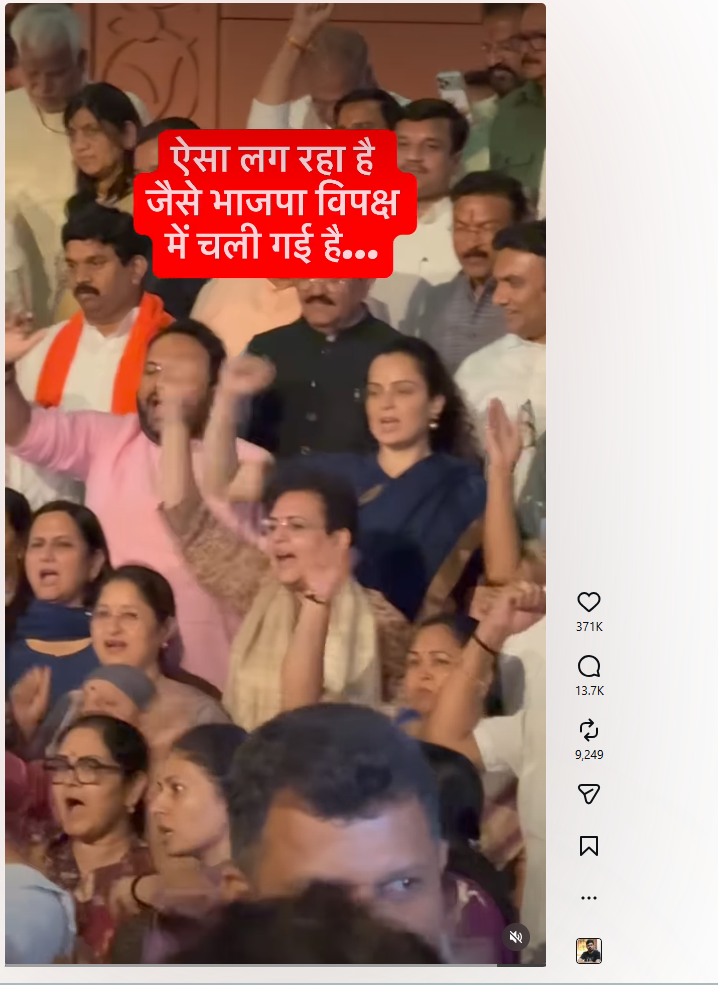
To verify the claim, the Desk extracted keyframes from the viral video and conducted a reverse image search using Google Lens. This led to the same video uploaded on the Instagram account ashutoshjourno on April 17, 2026. The caption accompanying the post read, “Aaj Makar Dwar ka nazara alag tha” (The scene at Makar Dwar was different today).
https://www.instagram.com/reels/DXPQoIAiQ3L/
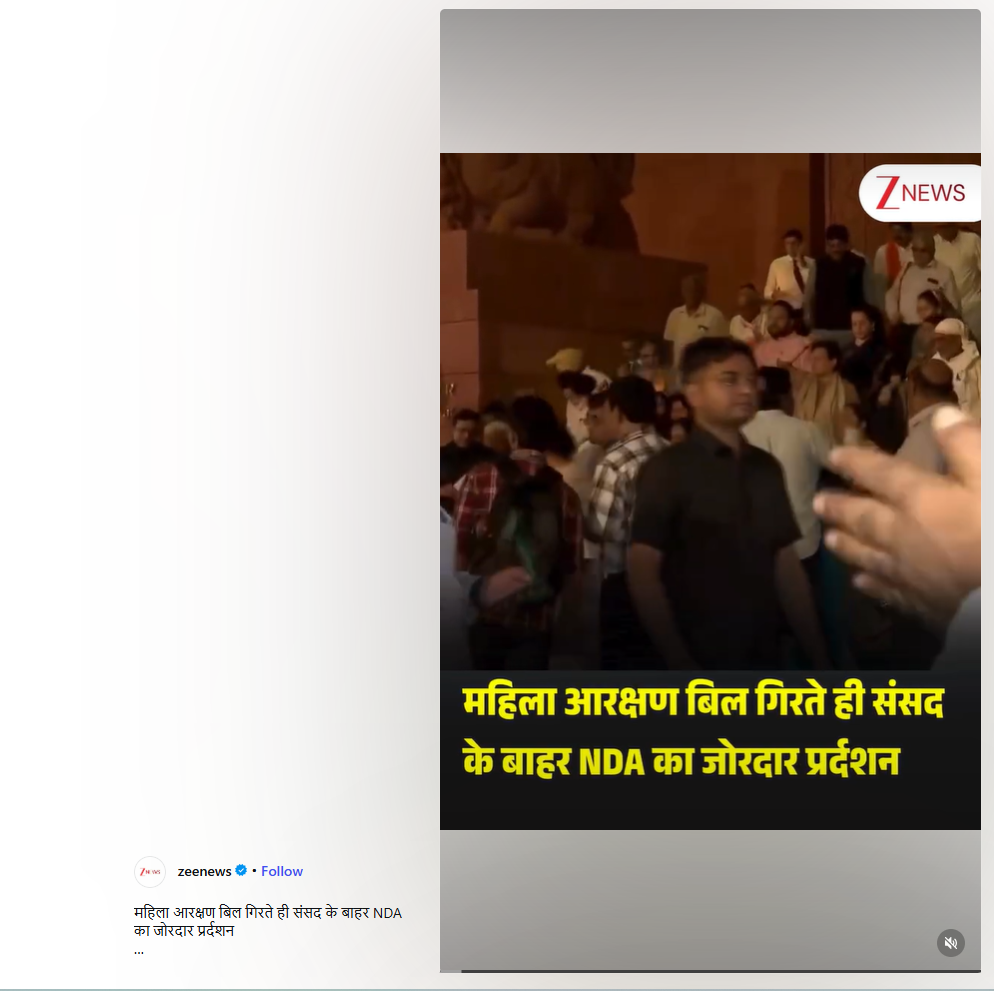
In the next stage of the research, the Desk carried out a keyword search based on the clues obtained from the Instagram post. This led to a Zee News report published on April 17, 2026, which reported that NDA MPs staged a protest outside Parliament after the 131st Constitutional Amendment Bill failed to pass. The visuals in the report matched those seen in the viral video.
https://www.instagram.com/reels/DXPL4tOky5P/
Conclusion:
CyberPeace Research Wing’s research found the viral claim to be misleading. The video is unrelated to the ongoing CJP protest at Jantar Mantar. It was recorded in April 2026, when BJP women MPs protested outside Parliament following the failure of the 131st Constitutional Amendment Bill to pass. The old footage is now being falsely shared as a recent video of Kangana Ranaut supporting the CJP protest.

Related Blogs
Executive Summary
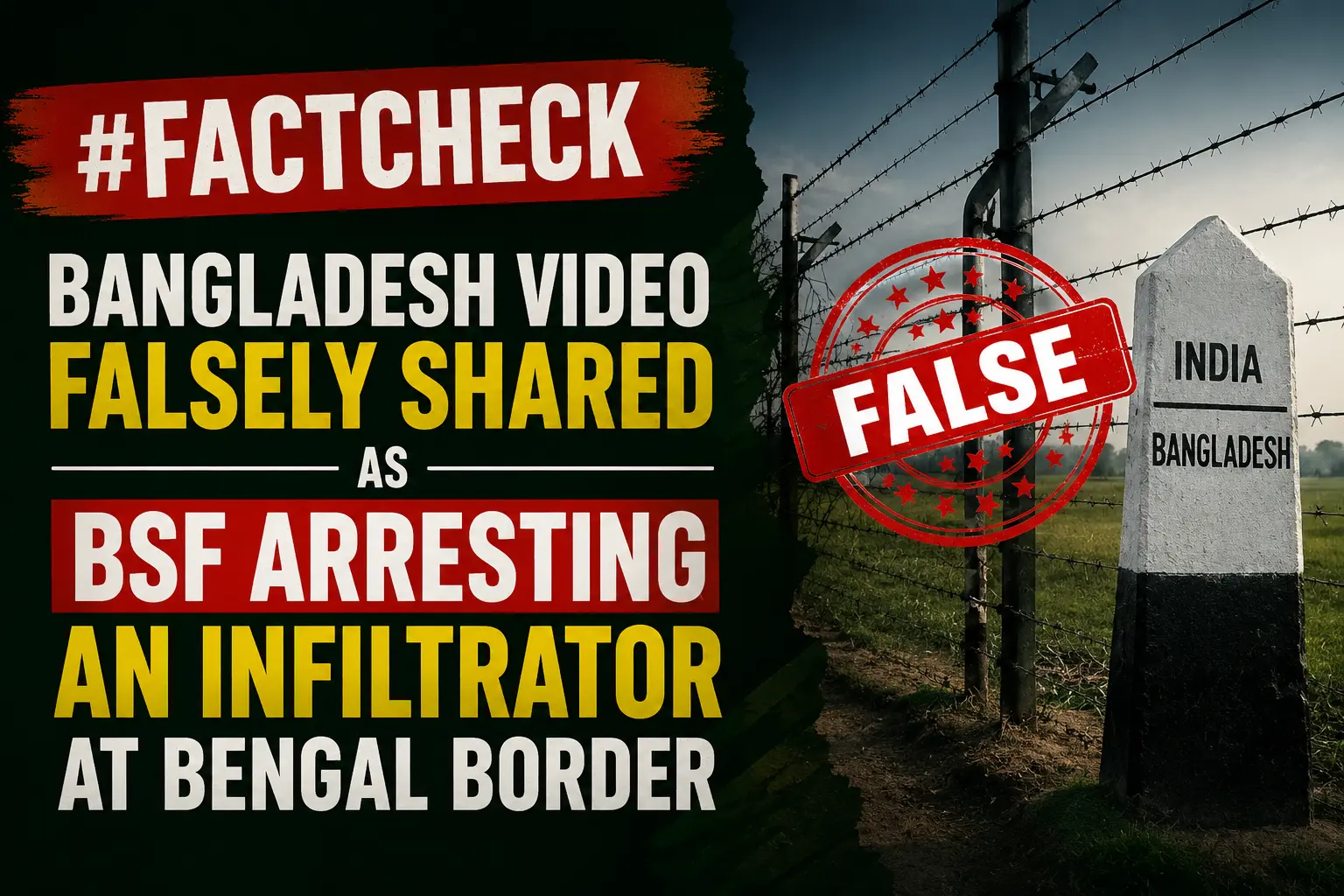
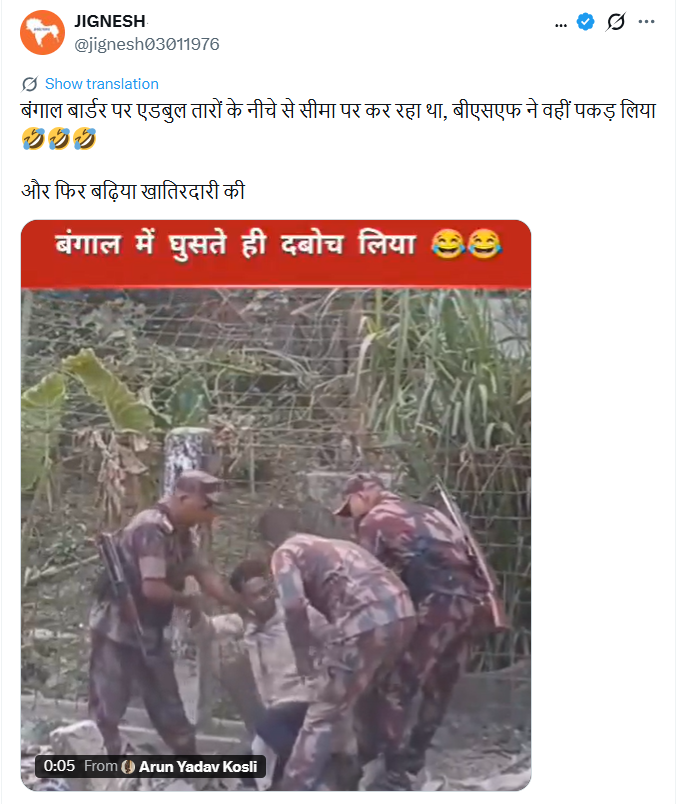
A video showing security personnel overpowering a man is being widely shared on social media with the claim that it shows the Border Security Force (BSF) arresting an infiltrator attempting to cross the India-Bangladesh border in West Bengal. However, research by CyberPeace Research Wing found that the claim is false. The viral video is from Bangladesh and is unrelated to India or the BSF.
Claim
An X user shared the viral video claiming: “He was crossing the Bengal border from beneath the barbed fencing when the BSF caught him on the spot.”
The post was circulated as an incident from the India-Bangladesh border in West Bengal.
Fact Check
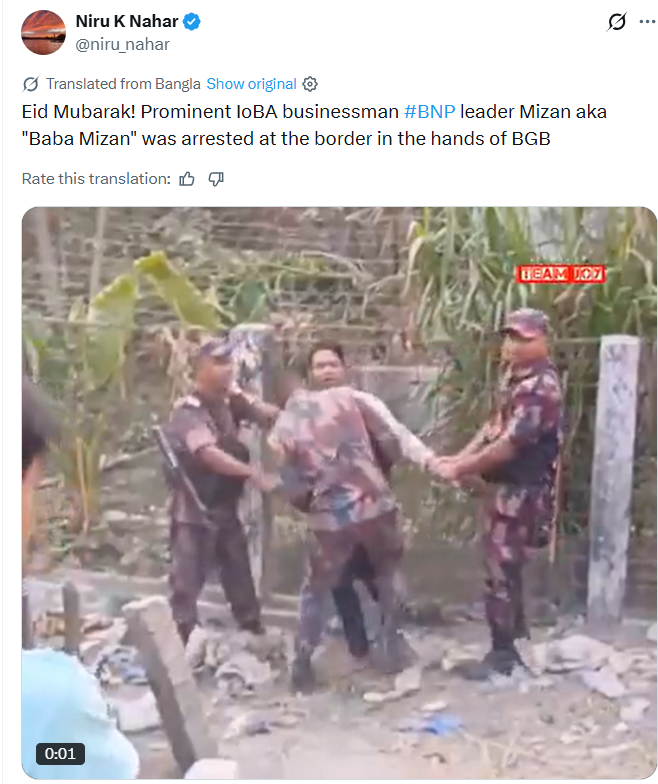
To verify the claim, we extracted keyframes from the viral video and conducted a reverse image search. During the research, we found the same video posted on 21 March 2026 by an X handle named “Niru Nahar.”
According to the caption of that post, the video showed Bangladesh Border Guards arresting BNP leader Mizan, also known as “Baba Mizan,” near the border.
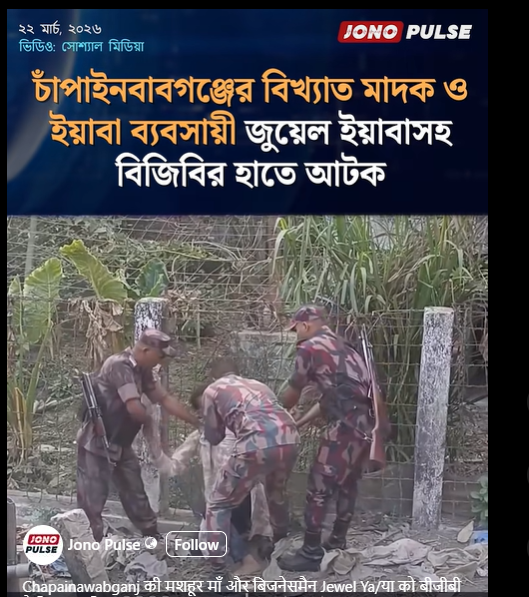
Further research led us to a Facebook post uploaded on 22 March 2026 by Bangladeshi news platform Jono Pulse. The post identified the detained individual as “Juel,” an alleged drug trafficker from Chapainawabganj, and stated that he had been arrested by the Border Guard Bangladesh (BGB).
Chapainawabganj is located in Bangladesh, confirming that the video is unrelated to West Bengal or the BSF.
Conclusion
The viral claim is misleading. The video does not show the BSF arresting an infiltrator at the Bengal border. It is actually from Bangladesh and depicts a separate incident involving Border Guard Bangladesh personnel.

Executive Summary:
A video is circulating on social media claiming to be footage of the aftermath of Iran's missile strikes on Israel. The video shows destruction, damaged infrastructure, and panic among civilian casualties. After our own digital verification, visual inspection, and frame-by-frame inspection, we have determined that the video is fake. The video is just AI-generated clips and not related to any incident.

Claim:
The viral video claims that a recent military strike by Iran resulted in the destruction of parts of Israel, following an initial missile attack launched by Iran. The footage appears current and depicts significant destruction of buildings and widespread chaos in the streets.

FACT CHECK:
We conducted our research on the viral video to determine if it was AI-generated. During the research we broke the video into individual still frames, and upon closely examining the frames, several of the visuals he showed us had odd-shaped visual features, abnormal body proportions, and flickering movements that don't occur in real footage. We took several still frames and checked them in image search sites to see if they had appeared before. The search results revealed that several clips in the video had appeared previously, in separate and unrelated circumstances, which indicates that they are neither recent nor original.

While examining the Instagram profile, we noticed that the account frequently shares visually dramatic AI content that appears digitally created. Many earlier posts from the same page include scenes that are unrealistic, such as wrecked aircraft in desolate areas or buildings collapsing in unnatural ways. In the current video, for instance, the fighter jets shown have multiple wings, which is not technically or aerodynamically possible in real life. The profile’s bio, which reads "Resistance of Artificial Intelligence," suggests that the page intentionally focuses on sharing AI-generated or fictional content.

We also ran the viral post through Tenorshare.AI for Deep-Fake detection, and the result came 94% AI. All findings resulting from our research established that the video is synthetic and unrelated to any event occurring in Israel, and therefore debunked a false narrative propagated on social media.

Conclusion:
Our research found that the video is fake and contains AI-generated images and is not related to any real missile strike or destruction occurring in Israel. The source is specific to fuel the panic and misinformation in a context of already-heightened geopolitical tension. We call on viewers not to share this unverified information and to rely on trusted sources. When there are sensitive international developments, the dissemination of fake imagery can promote fear, confusion, and misinformation on a global scale.
- Claim: Real Footage of Iran’s Missile Strikes on Israel
- Claimed On: Social Media
- Fact Check: False and Misleading

Introduction
The misinformation crisis has evolved from being merely an abstract risk to a clear-cut and measurable danger to individuals, families, institutions and the whole information ecosystem. The recent death hoax with the famous actor Dharmendra is a perfect illustration of how the monster of falsehoods rises, conquers the world and does damage before the mechanisms of correction have a chance to operate. The first week of November 2025 saw the first wave of reports from different social media accounts and even some online news outlets that claimed Dharmendra had died at the age of 89. The news travelled like wildfire, causing confusion, grief and emotional suffering in large circles of fans, one could say the whole world. But then, the family came to the scene with the loudest, clearest, and most conclusive denial of them all. This case is not a one-time event. It is part of a cycle of misinformation that goes through the stages from one unverified claim to the next due to the emotional value, the virality of platforms, and the accelerating online engagement.
How One Wrong Post Can Create Worry and Fear
This kind of false news spreads fast on social media because people share emotional posts without checking the source, and automated accounts often repeat the same claim which makes it look true. Such hoaxes create fear, sadness and stress for fans, and they place sudden pressure on the family who must deal with public worry at a time when they need calm and privacy. The message shared by Hema Malini who is the wife of the actor shows how hurtful and careless misinformation can be, and it reminds everyone that even one false post can create real emotional damage for many people.

Why This Hoax Spread So Quickly
- Sensationalism Drives Engagement: Rumours regarding the passing of a public figure, particularly someone who is universally loved, cause an immediate outburst of feelings. Such news is practically taken for granted by the online public, who are very likely to share it, most of the time without checking its authenticity, which, in turn, leads to viral spread.
- Very Fast Weaving-in on social media: Social media networks are very much made for swift sharing. Long before the official sources were able to either confirm or dismiss the matter, posts, reels, and messages ripped through the networks.
- Digital Users Not Verifying Source: A large part of the audience depends on screenshots, forwards, and unverified posts for keeping up with the news. This opens a very nice environment for the spreading of hoaxes.
- Weak Verification Protocols: Although there have been measures to inform the public about misinformation, most news companies still give priority to the speed of reporting rather than its correctness, though not all the time, especially for the more entertaining and attractive topics like the health or death of famous people.
- Algorithmic Amplification Risks: The engagement is mainly driven by algorithms that bring to the surface the posts that evoke strong emotions. In a way, it is very unfair because the false or sensational claims are getting in front at the same time as the corrective updates, hence, the public is getting misled. In the absence of algorithmic safeguards, misinformation is on the rise and becoming stronger.
Best Practices For Users:
- Make sure to verify before sharing, especially if the topic is about health or death.
- Get updates by following official accounts rather than through sharing of viral forwards.
- Be aware of the emotional manipulation tactics used in misleading information.
Conclusion
The rumour surrounding Dharmendra's death is yet another example that misinformation, whether promptly corrected or not, can still inflict distress, cause loss of trust and damage to reputation. It also emphasises the need for stronger information governance, responsible digital journalism, and platform intervention mechanisms as a matter of urgency. This incident, from clicks to consequences, points to a basic truth: misinformation in the digital age is quicker to spread than facts, and the responsibility of putting a stop to it falls on all the stakeholders’ platforms, media, and users.
References
- https://timesofindia.indiatimes.com/entertainment/hindi/bollywood/news/esha-deol-and-hema-malini-dismiss-dharmendras-fake-death-news-relieved-fans-pray-for-actors-speedy-recovery-aap-jld-se-jld-apne-ghar-aye/articleshow/125242843.cms
- https://www.altnews.in/media-misreport-bollywood-actor-dharmendra-hasnt-passed-away-yet/
- https://economictimes.indiatimes.com/news/india/dharmendra-death-news-bollywoods-veeru-and-he-man-passes-away-at-89/articleshow/125238900.cms
