
#FactCheck-AI-Generated Image Falsely Shows Donald Trump Raising Fist During Washington Incident
Executive Summary
A photo of Donald Trump is going viral on social media, showing him raising his fist. Users claim the image was taken during a press event in Washington, when security personnel were escorting him out amid reports of gunfire. Research by CyberPeace Research Wing found that the viral image is AI-generated and is being shared with misleading claims.
Claim
On April 26, 2026, an X user shared the image with the caption: “Thank You, Lord our God, for protecting our President.” The post suggests that Trump made the gesture during a chaotic evacuation at a Washington event.
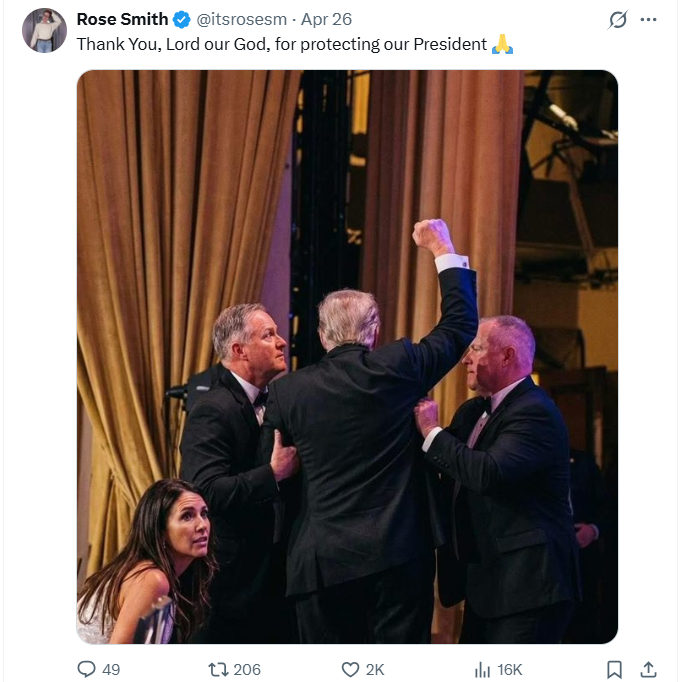
Fact Check
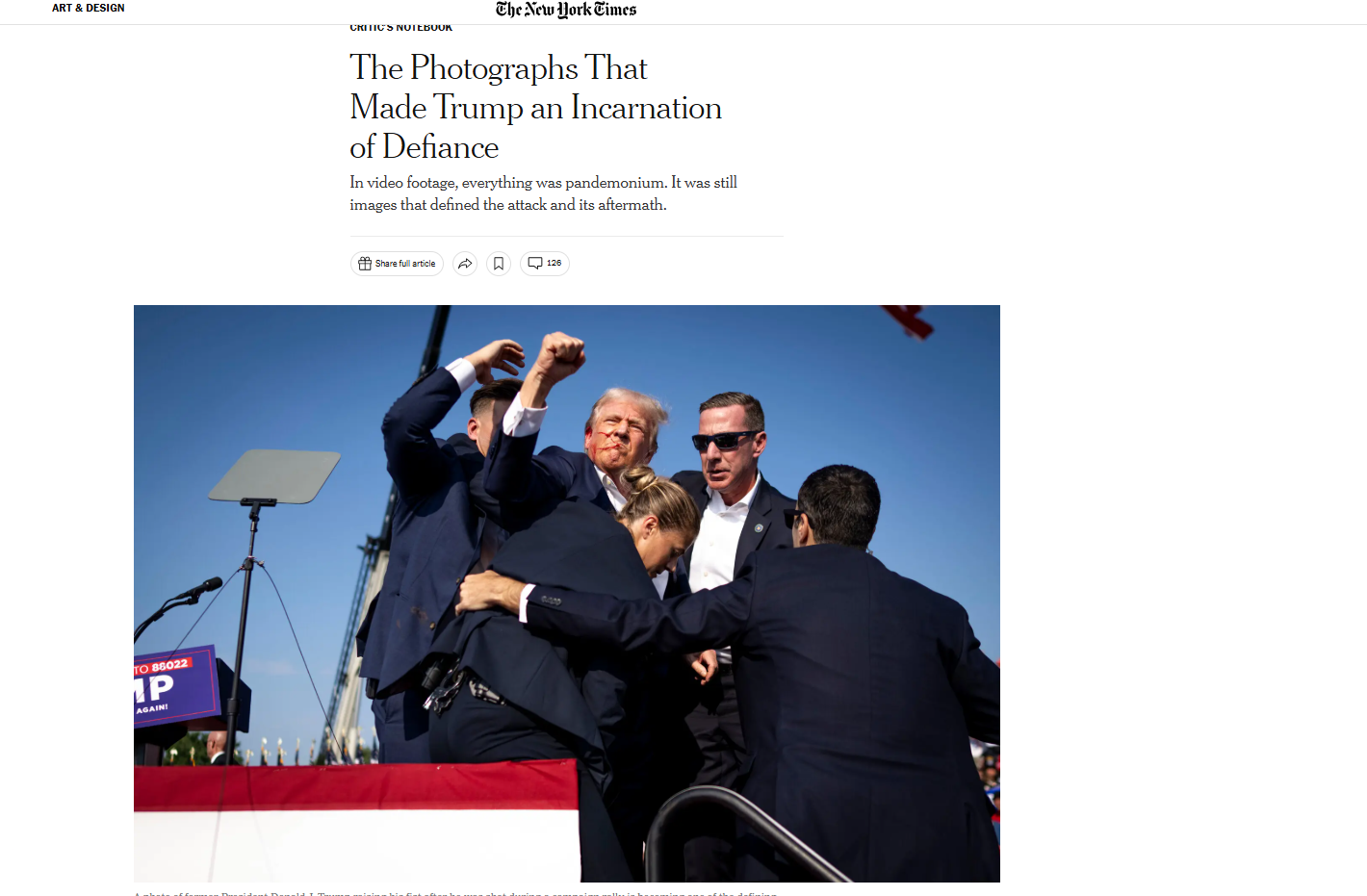
Reports confirm that Trump and senior officials were hurried away from the White House Correspondents’ Association dinner on April 25 after gunshots were reportedly heard from a floor above the ballroom. However, no authentic visuals show Trump raising his fist during the evacuation.
- https://www.nytimes.com/2024/07/14/arts/design/trump-photo-raised-fist.html
- https://edition.cnn.com/2025/04/11/politics/trump-obama-portrait-white-house

Further analysis of the viral image indicates signs of digital manipulation. Google’s SynthID detection tool flagged the file as containing SynthID—an invisible watermark embedded in content generated using Google’s AI tools.

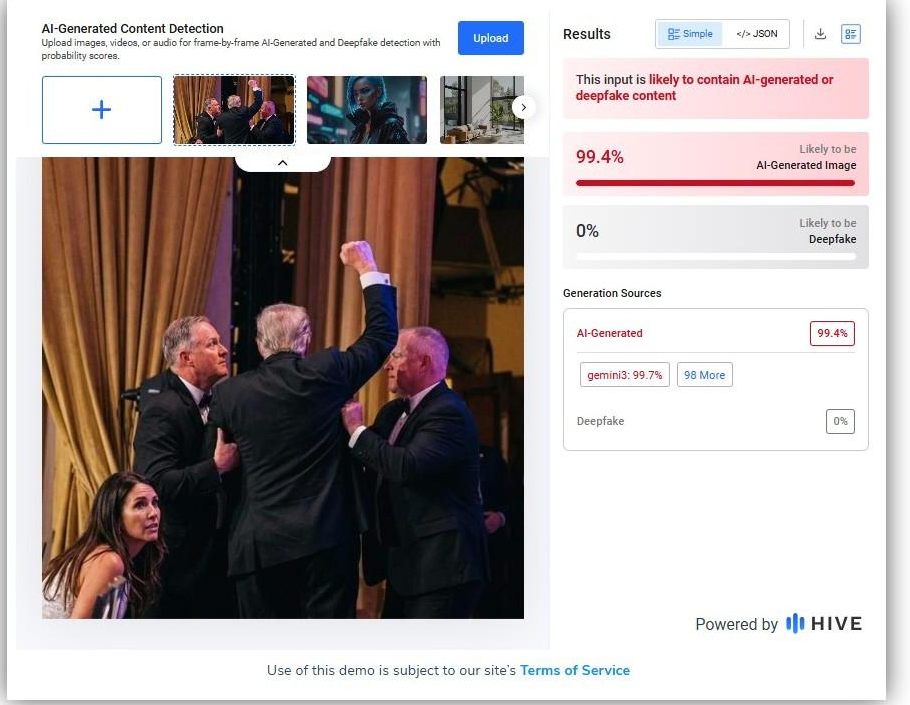
Additionally, AI detection platform Hive Moderation assessed that the image is likely AI-generated or a deepfake.
Conclusion
The research confirms that the viral image of Donald Trump raising his fist during a Washington incident is not real. It was created using AI and is being circulated with a misleading narrative.

Related Blogs

Introduction
Cybercrimes have been traversing peripheries and growing at a fast pace. Cybercrime is known to be an offensive action that either targets or operates through a computer, a computer network or a networked device, according to Kaspersky. In the “Era of globalisation” and a “Digitally coalesced world”, there has been an increase in International cybercrime. Cybercrime could be for personal or political objectives. Nevertheless, Cybercrime aims to sabotage networks for motives other than gain and be carried out either by organisations or individuals. Some of the cybercriminals have no national boundaries and are considered a global threat. They are likewise inordinately technically adept and operate avant-garde strategies.
The 2023 Global Risk Report points to exacerbating geopolitical apprehensions that have increased the advanced persistent threats (APTs), which are evolving globally as they are ubiquitous. Christine Lagarde, the president of the European Central Bank and former head of the International Monetary Fund (IMF), in 2020 cautioned that a cyber attack could lead to a severe economic predicament. Contemporary technologies and hazardous players have grown at an exceptional gait over the last few decades. Also, cybercrime has heightened on the agenda of nation-states, establishments and global organisations, as per the World Economic Forum (WEF).
The Role of the United Nations Ad Hoc Committee
In two shakes, the United Nations (UN) has a major initiative to develop a new and more inclusive approach to addressing cybercrime and is presently negotiating a new convention on cybercrime. The following convention seeks to enhance global collaboration in the combat against cybercrime. The UN has a central initiative to develop a unique and more inclusive strategy for addressing cybercrime. The UN passed resolution 74/247, which designated an open-ended ad hoc committee (AHC) in December 2019 entrusted with setting a broad global convention on countering the use of information and Communication Technologies (ICTs) for illicit pursuits.
The Cybercrime treaty, if adopted by the UN General Assembly (UNGA) would be the foremost imperative UN mechanism on a cyber point. The treaty could further become a crucial international legal framework for global collaboration on arraigning cyber criminals, precluding and investigating cybercrime. There have correspondingly been numerous other national and international measures to counter the criminal use of ICTs. However, the UN treaty is intended to tackle cybercrime and enhance partnership and coordination between states. The negotiations of the Ad Hoc Committee with the member states will be completed by early 2024 to further adopt the treaty during the UNGA in September 2024.
However, the following treaty is said to be complex. Some countries endorse a treaty that criminalises cyber-dependent offences and a comprehensive spectrum of cyber-enabled crimes. The proposals of Russia, Belarus, China, Nicaragua and Cuba have included highly controversial recommendations. Nevertheless, India has backed for criminalising crimes associated with ‘cyber terrorism’ and the suggestions of India to the UN Ad Hoc committee are in string with its regulatory strategy in the country. Similarly, the US, Japan, the UK, European Union (EU) member states and Australia want to include core cyber-dependent crimes.
Nonetheless, though a new treaty could become a practical instrument in the international step against cybercrime, it must conform to existing global agencies and networks that occupy similar areas. This convention will further supplement the "Budapest Cybercrime Convention" on cybercrime that materialised in the 1990s and was signed in Budapest in the year 2001.
Conclusion
According to Cyber Security Ventures, global cybercrime is expected to increase by 15 per cent per year over the next five years, reaching USD 10.5 trillion annually by 2025, up from USD 3 trillion in 2015. The UN cybercrime convention aims to be more global. That being the case, next-generation tools should have state-of-the-art technology to deal with new cyber crimes and cyber warfare. The global crevasse in nation-states due to cybercrime is beyond calculation. It could lead to a great cataclysm in the global economy and threaten the political interest of the countries on that account. It is crucial for global governments and international organisations. It is necessary to strengthen the collaboration between establishments (public and private) and law enforcement mechanisms. An “appropriately designed policy” is henceforward the need of the hour.
References
- https://www.kaspersky.co.in/resource-center/threats/what-is-cybercrime
- https://www.cyberpeace.org/
- https://www.interpol.int/en/Crimes/Cybercrime
- https://www.bizzbuzz.news/bizz-talk/ransomware-attacks-on-startups-msmes-on-the-rise-in-india-cyberpeace-foundation-1261320
- https://www.financialexpress.com/business/digital-transformation-cyberpeace-foundation-receives-4-million-google-org-grant-3282515/
- https://www.chathamhouse.org/2023/08/what-un-cybercrime-treaty-and-why-does-it-matter
- https://www.weforum.org/agenda/2023/01/global-rules-crack-down-cybercrime/
- https://www.weforum.org/publications/global-risks-report-2023/
- https://www.imf.org/external/pubs/ft/fandd/2021/03/global-cyber-threat-to-financial-systems-maurer.htm
- https://www.eff.org/issues/un-cybercrime-treaty#:~:text=The%20United%20Nations%20is%20currently,of%20billions%20of%20people%20worldwide.
- https://cybersecurityventures.com/hackerpocalypse-cybercrime-report-2016/
- https://www.coe.int/en/web/cybercrime/the-budapest-convention
- https://economictimes.indiatimes.com/tech/technology/counter-use-of-technology-for-cybercrime-india-tells-un-ad-hoc-group/articleshow/92237908.cms?utm_source=contentofinterest&utm_medium=text&utm_campaign=cppst
- https://consultation.dpmc.govt.nz/un-cybercrime-convention/principlesandobjectives/supporting_documents/Background.pdf
- https://unric.org/en/a-un-treaty-on-cybercrime-en-route/

Misinformation is a scourge in the digital world, making the most mundane experiences fraught with risk. The threat is considerably heightened in conflict settings, especially in the modern era, where geographical borders blur and civilians and conflict actors alike can take to the online realm to discuss -and influence- conflict events. Propaganda can complicate the narrative and distract from the humanitarian crises affecting civilians, while also posing a serious threat to security operations and law and order efforts. Sensationalised reports of casualties and manipulated portrayals of military actions contribute to a cycle of violence and suffering.
A study conducted by MIT found the mere thought of sharing news on social media reduced the ability to judge whether a story was true or false; the urge to share outweighed the consideration of accuracy (2023). Cross-border misinformation has become a critical issue in today's interconnected world, driven by the rise of digital communication platforms. To effectively combat misinformation, coordinated international policy frameworks and cooperation between governments, platforms, and global institutions are created.
The Global Nature of Misinformation
Cross-border misinformation is false or misleading information that spreads across countries. Out-of-border creators amplify information through social media and digital platforms and are a key source of misinformation. Misinformation can interfere with elections, and create serious misconceptions about health concerns such as those witnessed during the COVID-19 pandemic, or even lead to military conflicts.
The primary challenge in countering cross-border misinformation is the difference in national policies, legal frameworks and governance policies of social media platforms across various jurisdictions. Examining the existing international frameworks, such as cybersecurity treaties and data-sharing agreements used for financial crimes might be helpful to effectively address cross-border misinformation. Adapting these approaches to the digital information ecosystem, nations could strengthen their collective response to the spread of misinformation across borders. Global institutions like the United Nations or regional bodies like the EU and ASEAN can work together to set a unified response and uniform international standards for regulation dealing with misinformation specifically.
Current National and Regional Efforts
Many countries have taken action to deal with misinformation within their borders. Some examples include:
- The EU’s Digital Services Act has been instrumental in regulating online intermediaries and platforms including marketplaces, social networks, content-sharing platforms, app stores, etc. The legislation aims to prevent illegal and harmful activities online and the spread of disinformation.
- The primary legislation that governs cyberspace in India is the IT Act of 2000 and its corresponding rules (IT Rules, 2023), which impose strict requirements on social media platforms to counter misinformation content and enable the traceability of the creator responsible for the origin of misinformation. Platforms have to conduct due diligence, failing which they risk losing their safe harbour protection. The recently-enacted DPDP Act of 2023 indirectly addresses personal data misuse that can be used to contribute to the creation and spread of misinformation. Also, the proposed Digital India Act is expected to focus on “user harms” specific to the online world.
- In the U.S., the Right to Editorial Discretion and Section 230 of the Communications Decency Act place the responsibility for regulating misinformation on private actors like social media platforms and social media regulations. The US government has not created a specific framework addressing misinformation and has rather encouraged voluntary measures by SMPs to have independent policies to regulate misinformation on their platforms.
The common gap area across these policies is the absence of a standardised, global framework for addressing cross-border misinformation which results in uneven enforcement and dependence on national regulations.
Key Challenges in Achieving International Cooperation
Some of the key challenges identified in achieving international cooperation to address cross-border misinformation are as follows:
- Geopolitical tensions can emerge due to the differences in political systems, priorities, and trust issues between countries that hinder attempts to cooperate and create a universal regulation.
- The diversity in approaches to internet governance and freedom of speech across countries complicates the matters further.
- Further complications arise due to technical and legal obstacles around the issues of sovereignty, jurisdiction and enforcement, further complicating matters relating to the monitoring and removal of cross-border misinformation.
CyberPeace Recommendations
- The UN Global Principles For Information Integrity Recommendations for Multi-stakeholder Action, unveiled on 24 June 2024, are a welcome step for addressing cross-border misinformation. This can act as the stepping stone for developing a framework for international cooperation on misinformation, drawing inspiration from other successful models like climate change agreements, international criminal law framework etc.
- Collaborations like public-private partnerships between government, tech companies and civil societies can help enhance transparency, data sharing and accountability in tackling cross-border misinformation.
- Engaging in capacity building and technology transfers in less developed countries would help to create a global front against misinformation.
Conclusion
We are in an era where misinformation knows no borders and the need for international cooperation has never been more urgent. Global democracies are exploring solutions, both regulatory and legislative, to limit the spread of misinformation, however, these fragmented efforts fall short of addressing the global scale of the problem. Establishing a standardised, international framework, backed by multilateral bodies like the UN and regional alliances, can foster accountability and facilitate shared resources in this fight. Through collaborative action, transparent regulations, and support for developing nations, the world can create a united front to curb misinformation and protect democratic values, ensuring information integrity across borders.
References
- https://economics.mit.edu/sites/default/files/2023-10/A%20Model%20of%20Online%20Misinformation.pdf
- https://www.indiatoday.in/global/story/in-the-crosshairs-manufacturing-consent-and-the-erosion-of-public-trust-2620734-2024-10-21
- https://laweconcenter.org/resources/knowledge-and-decisions-in-the-information-age-the-law-economics-of-regulating-misinformation-on-social-media-platforms/
- https://www.article19.org/resources/un-article-19-global-principles-for-information-integrity/

Executive Summary
A shocking video claiming to show snakes raining down from the sky is going viral on social media. The clip shows what appear to be cobras and pythons falling in large numbers instead of rain, while people are seen running in panic through a marketplace. The video is being shared with the claim that it is the result of “tampering with nature” and that sudden snake rainfall occurred in an unidentified country. (Links and archived versions provided)
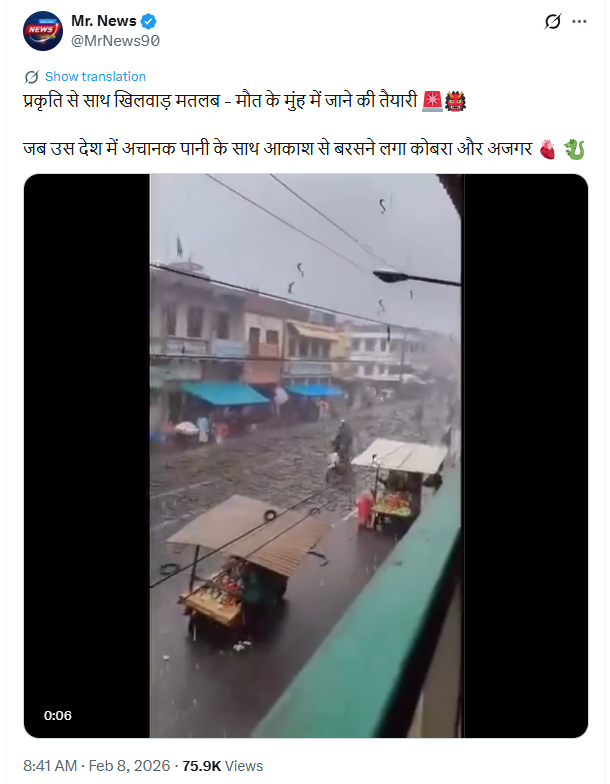
CyberPeace researched the viral claim and found it to be false. The video does not depict a real incident. Instead, it has been generated using artificial intelligence (AI).
Fact Check
To verify the authenticity of the video, we extracted keyframes and conducted a reverse image search using Google Lens. However, we did not find any credible media report linked to the viral footage. We also searched relevant keywords on Google but found no reliable national or international news coverage supporting the claim. If snakes had genuinely rained from the sky in any country, the incident would have received widespread media attention globally. A frame-by-frame analysis of the video revealed multiple inconsistencies and visual anomalies:
In the first two seconds, a massive snake appears to fall onto electric wires, yet its body passes unrealistically through the wires — something that is physically impossible. The snakes falling from the sky and crawling on the ground move in an unnatural manner. Instead of falling under gravity, they appear to float mid-air. Around the 9–10 second mark, a person lying on the ground has a visibly distorted hand structure, a common artifact seen in AI-generated videos.
Such irregularities are typical indicators of AI-generated content. The viral video was further analyzed using the AI detection tool Hive Moderation, which indicated a 96.5% probability that the video was AI-generated.
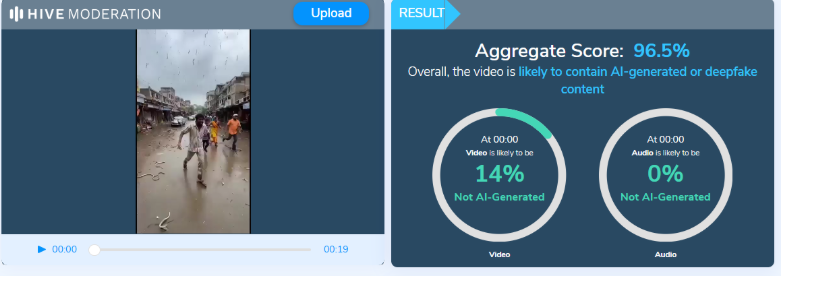
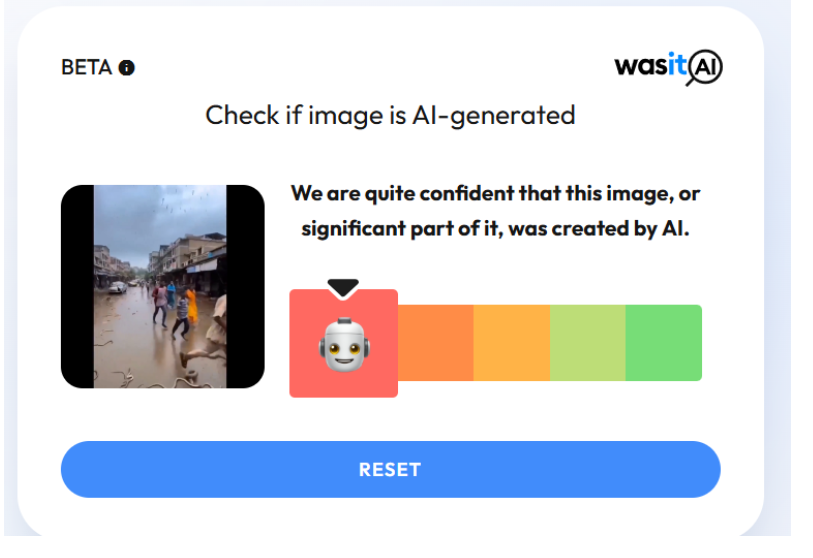
Additionally, image detection tool WasitAI also classified the visuals in the viral clip as highly likely to be AI-generated.
Conclusion
CyberPeace ’s research confirms that the viral video claiming to show snakes raining from the sky is not authentic. The footage has been created using artificial intelligence and does not depict a real event.
