
#FactCheck :Old Dance Clip Falsely Passed Off as ‘Leaked Video of FBI Chief Kash Patel After Hack
Executive Summary
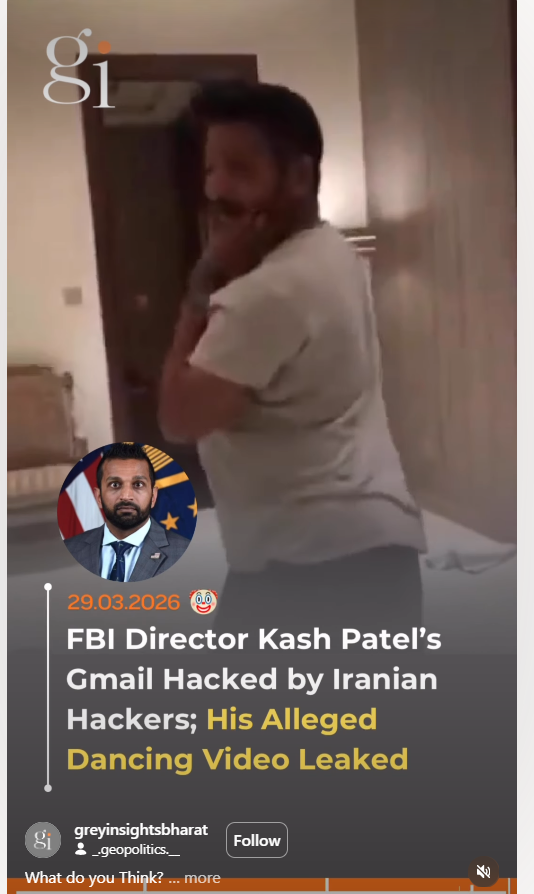
A video is rapidly circulating on social media showing a man enthusiastically dancing to the Hindi song Sun Sahiba Sun. The clip is being shared with a sensational claim that it is a private video leaked from the hacked email account of FBI Director Kash Patel. In the video, a man can be seen dancing in a casual setting while people in the background cheer him on. Several users have linked the clip to an alleged cyberattack by Iran-linked hackers, attempting to connect it with ongoing international developments.
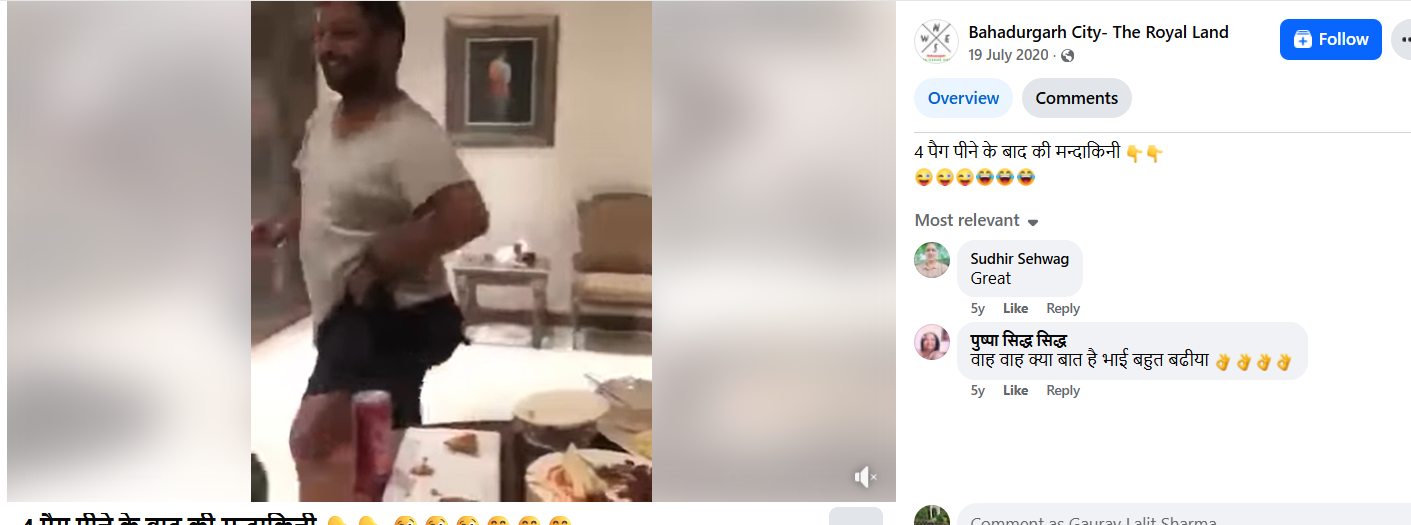
However, research by the CyberPeace found that the video has been available online since at least 2020. It also resurfaced in 2022, long before the current claims emerged. There is no connection between the video and Kash Patel or any hacking incident. Further research confirmed that the clip is not recent and has no link to any cybersecurity breach. In 2022, the same video had gone viral as a humorous post, with claims that the man was celebrating because his wife had temporarily gone to her maternal home.
Claim
On March 29, 2026, an Instagram user named ‘greyinsightsbharat’ shared the video claiming it was leaked from Patel’s hacked Gmail account. The caption read:“FBI Director Kash Patel's Gmail Hacked by Iranian Hackers; His Alleged Dancing Video Leaked.”
The research involved extracting keyframes from the video and conducting reverse image searches, which revealed that the same clip had been shared multiple times in the past with different, unrelated claims.
Fact Check
A reverse search also led to a December 2022 media report featuring the same visuals. According to that report, the video showed a man joyfully dancing to celebrate his wife’s temporary visit to her parental home.

Additionally, findings confirm that the footage has existed online since at least 2020 and has previously gone viral. The song featured in the clip is from the 1985 Bollywood film Ram Teri Ganga Maili, originally sung by legendary artist Lata Mangeshkar.
Conclusion:
The claim that the viral dance video is a leaked private clip of FBI Director Kash Patel is false and misleading. Verified findings show that the video has been available on the internet since at least 2020 and had already gone viral in 2022 in a completely different and humorous context. There is no evidence linking the clip to any recent cyberattack, email hack, or data breach involving Patel. The resurfacing of this old video with a fabricated narrative highlights how unrelated content is often repurposed to create sensational misinformation, especially during sensitive geopolitical situations. Users are advised to verify such claims through credible sources before sharing, as misleading posts like these can distort public understanding and spread confusion.

Related Blogs
Introduction
After the tragic bomb blast at RedFort on November 10, 2025, there is a trail of misinformation and false narratives spread rapidly across social media platforms, messaging and news channels. It can not only unfold into a public misunderstanding but can also incite panic, communal tensions and endanger lives. To prevent all of these from happening, we, as responsible citizens, can play a critical role by verifying information before sharing it with friends, family, or colleagues. This article provides guidance on practical, evidence-based strategies to navigate the information landscape and protect yourself and your community from the harm caused by misinformation and disinformation.
Digital Scams in the Aftermath of the Blast
Cybercriminals increased their activity in the hours after the Red Fort explosion, using the country’s sorrow as a chance to take advantage of fear.
Numerous allegations surfaced of residents receiving threatening calls that falsely claimed they were “digitally arrested” or that their phones, bank accounts, or Aadhaar were being “seized for investigation”, accusing them of being involved in the explosion. These fictitious intimidation calls sent innocent people into worry, anxiety, and doubt spirals.
The pattern is common after major national crises:
- Fear rises.
- People seek urgent answers.
- Cybercriminals exploit the confusion.
Knowing this makes it easier for us to remain watchful. No law enforcement organisation uses phone conversations, WhatsApp communications, or threats of “digital detention” to make arrests or conduct investigations.
Verify breaking news from trusted official channels
Whenever a crisis like bomb blasts occurs, people look for information on social media, news channels, and YouTube channels to stay fully informed about the situation. This is a very chaotic moment, and due to the lack of government verification of the initial information, false news spread rapidly.
Where to seek verified information:
a. Press Information Bureau (PIB): The official government news agency that, from time to time, clarifies viral news.
b. Delhi Police Official Channels: Check social media handles of Delhi Police.
c. Ministry of Home Affairs (MHA): MHA is responsible for internal security, and gives information about this information through official press releases and notifications.
d. Major Credible news outlets: Some news channels can be trusted with news, as they typically verify information before publishing, like The Hindu, Indian Express.
What to do:
Cross-check every unverified social media post and news that you come across from credible news channels and official government press releases.
Verify Images and videos using reverse search tools
Recently, many social media handles have been sharing old photos of different bomb blasts from Ukraine, Israel, and Palestine in the name of the Red Fort blasts. While it can create a false narrative, the same should be verified before sharing.
Reliable fact-checking resources and how to use them.
Every country has dedicated fact-checking organisations that systematically verify viral claims.
Fact-checking organisations based in India:
a. PIB Fact Check (https://factcheck.pib.gov.in/ )
· It is the official fact-checking unit of the PIB, which focuses on demystifying government-related misinformation.
· email: socialmedia@pib.gov.in
· Telegram: http://t.me/PIB_FactCheck
· Follow it on: Twitter (@PIBFactCheck), Facebook, Instagram, Telegram and WhatsApp.
How to use these resources:
· Whenever you come across any viral post, use exact keywords or quotes to find those on these resources.
· Look for the verdict (true, false, misleading), then share the verified fact-checks with your network to debunk false narratives.
Practice Digital Hygiene and Be Cautious When Sharing
Digital hygiene refers to the practices and habits individuals adopt to maintain a healthy and secure digital lifestyle. Simple digital practices can restrict the spread of misinformation. A vigilant individual can reduce the spread of misinformation. It can be done by below steps
i. Check URLs and Links: We can verify the URLs and links of any news and websites using different tools to check the credibility of any news
ii. How to Evaluate the Trustworthiness of Sources:
· Verify if the account sharing the information has a blue checkmark on most platforms.
· Examine the account's background, whether it is a recognised media source, an official government profile, or a newly created anonymous account?
· Approach posts featuring intense emotional language ("URGENT!", "SHOCKING!", "MUST SHARE!") with scepticism.
· Refrain from posting screenshots of tweets or posts while providing a link to the source, allowing others to confirm its validity.
iii. Before You Distribute:
· Question yourself: "Am I certain this is accurate based on a reliable source?"
· Avoid the temptation to share breaking news immediately; hold off until it has been confirmed by government sources.
· If you're uncertain, include a comment such as "I haven't confirmed this yet; please consult reliable sources" instead of sharing unverified information.
· Reflect on the consequences, as it might lead to panic, provoke communal violence, or damage an individual's reputation
6. How to report misinformation to platforms and authorities?
While it is important to verify news before sharing it to prevent fake news, it is also important to report it to reduce misinformation and the violence caused due to it. On social media like Facebook, Instagram, Twitter/X, WhatsApp, and Telegram, anyone can report the same on the platform.
Reporting to the Government Authorities:
a. PIB Fact Check WhatsApp (+91 8799711259):
Send Screenshots or texts of suspected government-related misinformation for verification, and then an automated acknowledgement is generated.
b. Delhi Police Cyber Crime Unit
Cyber Crimes such as Email Frauds, Social Media Crimes, Mobile App-related crimes, Business Email Compromise, Data Theft, Ransomware, Net Banking/ ATM Frauds and fake calls frauds, insurance frauds, lottery scam, bitcoin, cheating scams, online transactions frauds can be reported to the Delhi Police Cyber Crime Unit.
7. Quick checklist: What to do When You See Breaking News
· Wait before sharing any breaking news.
· Go through official channels like PIB and other official channels like MHA.
· If not available there, then cross-reference it from 2-3 credible news sources for the same information.
· Check timestamps and metadata, and compare metadata dates with claims about when events occurred.
· In case you find any information, news or any social media posts as misleading, then report the same.
CyberPeace Resolves: Pause. Reflect. Then Respond
Misinformation becomes the infection that spreads the fastest when people are confused and afraid. Every citizen is urged by CyberPeace to remain composed, stand tall, and not panic, particularly in times of national emergency.
Prior to experiencing an emotional response to any concerning call, message, or widely shared news:
Pause. Reflect. Acknowledge.
- Pause before sharing or responding.
- Reflect on whether the information is from a credible source.
- Acknowledge what you know—and what is just rumour.
CyberPeace is still dedicated to helping people and communities deal with online dangers, safeguard mental health, and dispel false information with clarity and truth.

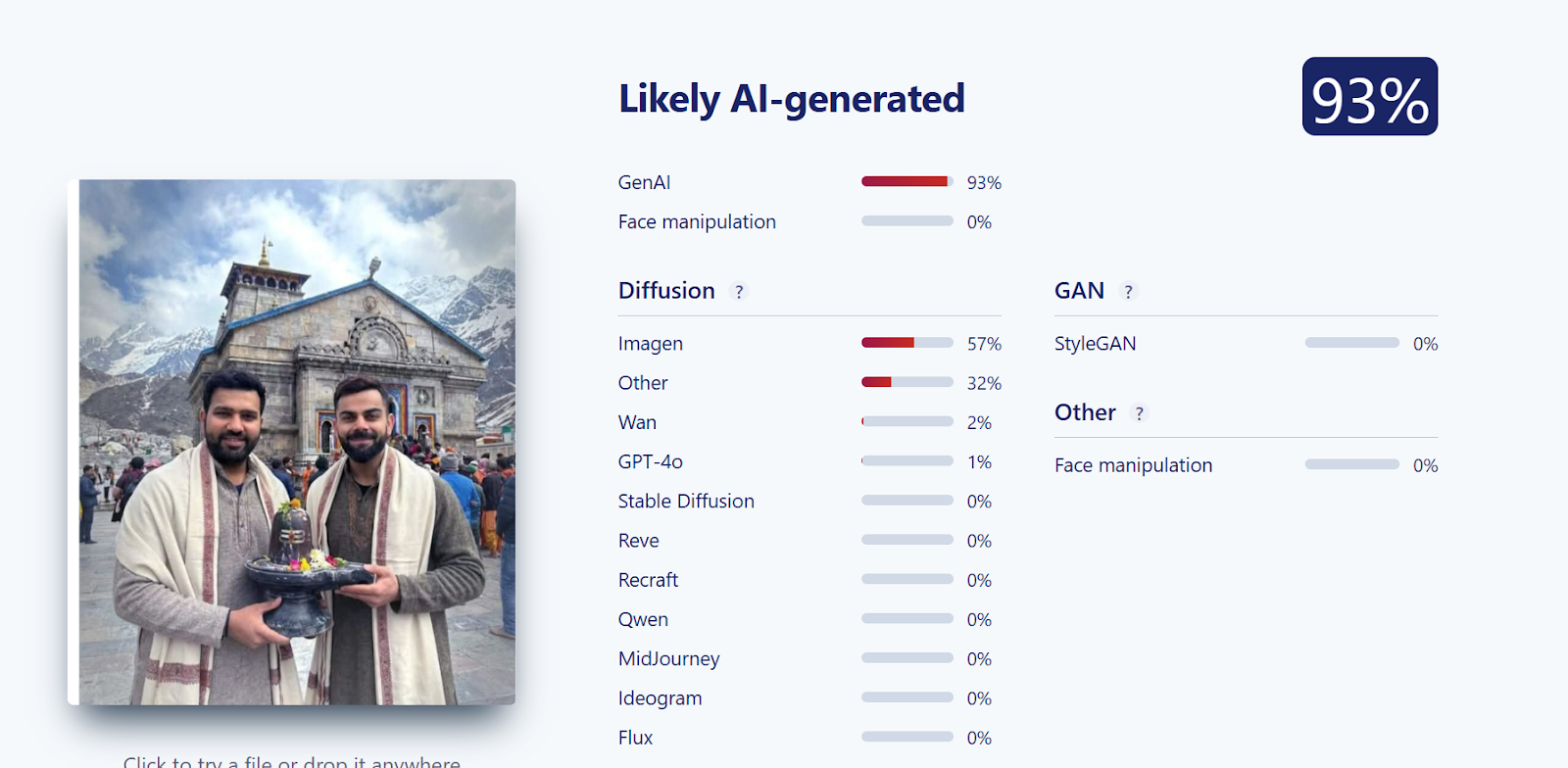
A photo featuring Indian cricketers Virat Kohli and Rohit Sharma is being widely shared on social media. In the image, both players are seen holding a Shivling, with the Kedarnath temple visible in the background. Users sharing the image claim that Virat Kohli and Rohit Sharma recently visited Kedarnath.
However, CyberPeace Foundation’s investigation found the claim to be false. Our verification established that the viral image is not real but has been created using Artificial Intelligence (AI) and is being circulated with a misleading narrative.
The Claim
An Instagram user shared the viral image on December 22, 2025, with the caption stating that Rohit Sharma and Virat Kohli are in Kedarnath. The post has since been widely reshared by other users, who assumed the image to be authentic. Link, archive link, screenshot:

Fact Check
On closely examining the viral image, the Desk noticed visual inconsistencies suggesting that it may be AI-generated. To verify this, the image was scanned using the AI detection tool HIVE Moderation. According to the results, the image was found to be 99 per cent AI-generated.
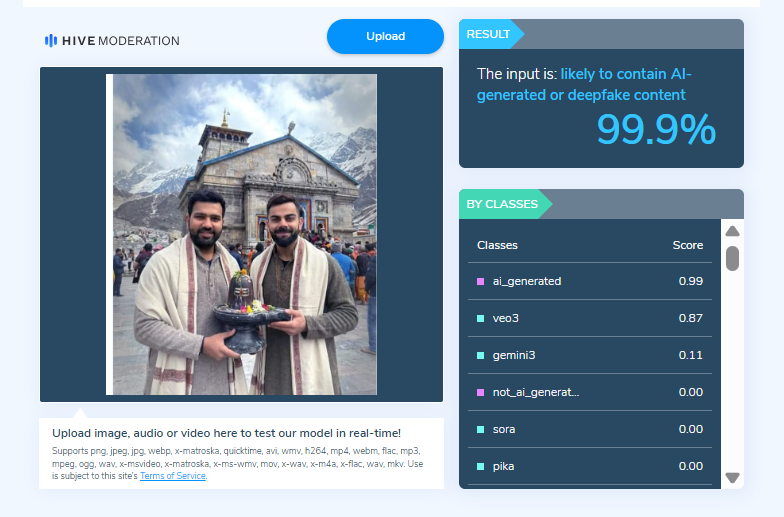
Further verification was conducted using another AI detection tool, Sightengine. The analysis revealed that the image was 93 per cent likely to be AI-generated, reinforcing the findings from the previous tool.
Conclusion
CyberPeace Foundation’s research confirms that the viral image claiming Virat Kohli and Rohit Sharma visited Kedarnath is fabricated. The image has been generated using AI technology and is being falsely shared on social media as a real photograph.

Brief Overview of the EU AI Act
The EU AI Act, Regulation (EU) 2024/1689, was officially published in the EU Official Journal on 12 July 2024. This landmark legislation on Artificial Intelligence (AI) will come into force just 20 days after publication, setting harmonized rules across the EU. It amends key regulations and directives to ensure a robust framework for AI technologies. The AI Act, a set of EU rules governing AI, has been in development for two years and now, the EU AI Act enters into force across all 27 EU Member States on 1 August 2024, with certain future deadlines tied up and the enforcement of the majority of its provisions will commence on 2 August 2026. The law prohibits certain uses of AI tools, including those that threaten citizens' rights, such as biometric categorization, untargeted scraping of faces, and systems that try to read emotions are banned in the workplace and schools, as are social scoring systems. It also prohibits the use of predictive policing tools in some instances. The law takes a phased approach to implementing the EU's AI rulebook, meaning there are various deadlines between now and then as different legal provisions will start to apply.
The framework puts different obligations on AI developers, depending on use cases and perceived risk. The bulk of AI uses will not be regulated as they are considered low-risk, but a small number of potential AI use cases are banned under the law. High-risk use cases, such as biometric uses of AI or AI used in law enforcement, employment, education, and critical infrastructure, are allowed under the law but developers of such apps face obligations in areas like data quality and anti-bias considerations. A third risk tier also applies some lighter transparency requirements for makers of tools like AI chatbots.
In case of failure to comply with the Act, the companies in the EU providing, distributing, importing, and using AI systems and GPAI models, are subject to fines of up to EUR 35 million or seven per cent of the total worldwide annual turnover, whichever is higher.
Key highlights of EU AI Act Provisions
- The AI Act classifies AI according to its risk. It prohibits Unacceptable risks such as social scoring systems and manipulative AI. The regulation mostly addresses high-risk AI systems.
- Limited-risk AI systems are subject to lighter transparency obligations and according to the act, the developers and deployers must ensure that the end-users are aware that the interaction they are having is with AI such as Chatbots and Deepfakes. The AI Act allows the free use of minimal-risk AI. This includes the majority of AI applications currently available in the EU single market like AI-enabled video games, and spam filters, but with the advancement of Gen AI changes with regards to this might be done. The majority of obligations fall on providers (developers) of high-risk AI systems that intend to place on the market or put into service high-risk AI systems in the EU, regardless of whether they are based in the EU or a third country. And also, a third-country provider where the high-risk AI system’s output is used in the EU.
- Users are natural or legal persons who deploy an AI system in a professional capacity, not affected end-users. Users (deployers) of high-risk AI systems have some obligations, though less than providers (developers). This applies to users located in the EU, and third-country users where the AI system’s output is used in the EU.
- General purpose AI or GPAI model providers must provide technical documentation, and instructions for use, comply with the Copyright Directive, and publish a summary of the content used for training. Free and open license GPAI model providers only need to comply with copyright and publish the training data summary, unless they present a systemic risk. All providers of GPAI models that present a systemic risk – open or closed – must also conduct model evaluations, and adversarial testing, and track and report serious incidents and ensure cybersecurity protections.
- The Codes of Practice will account for international approaches. It will cover but not necessarily be limited to the obligations, particularly the relevant information to include in technical documentation for authorities and downstream providers, identification of the type and nature of systemic risks and their sources, and the modalities of risk management accounting for specific challenges in addressing risks due to the way they may emerge and materialize throughout the value chain. The AI Office may invite GPAI model providers, and relevant national competent authorities to participate in drawing up the codes, while civil society, industry, academia, downstream providers and independent experts may support the process.
Application & Timeline of Act
The EU AI Act will be fully applicable 24 months after entry into force, but some parts will be applicable sooner, for instance the ban on AI systems posing unacceptable risks will apply six months after the entry into force. The Codes of Practice will apply nine months after entry into force. Rules on general-purpose AI systems that need to comply with transparency requirements will apply 12 months after the entry into force. High-risk systems will have more time to comply with the requirements as the obligations concerning them will become applicable 36 months after the entry into force. The expected timeline for the same is:
- August 1st, 2024: The AI Act will enter into force.
- February 2025: Prohibition of certain AI systems - Chapters I (general provisions) & II (prohibited AI systems) will apply; Prohibition of certain AI systems.
- August 2025: Chapter III Section 4 (notifying authorities), Chapter V (general purpose AI models), Chapter VII (governance), Chapter XII (confidentiality and penalties), and Article 78 (confidentiality) will apply, except for Article 101 (fines for General Purpose AI providers); Requirements for new GPAI models.
- August 2026: The whole AI Act applies, except for Article 6(1) & corresponding obligations (one of the categories of high-risk AI systems);
- August 2027: Article 6(1) & corresponding obligations apply.
The AI Act sets out clear definitions for the different actors involved in AI, such as the providers, deployers, importers, distributors, and product manufacturers. This means all parties involved in the development, usage, import, distribution, or manufacturing of AI systems will be held accountable. Along with this, the AI Act also applies to providers and deployers of AI systems located outside of the EU, e.g., in Switzerland, if output produced by the system is intended to be used in the EU. The Act applies to any AI system within the EU that is on the market, in service, or in use, covering both AI providers (the companies selling AI systems) and AI deployers (the organizations using those systems).
In short, the AI Act will apply to different companies across the AI distribution chain, including providers, deployers, importers, and distributors (collectively referred to as “Operators”). The EU AI Act also has extraterritorial application and can also apply to companies not established in the EU, or providers outside the EU if they -make an AI system or GPAI model available on the EU market. Even if only the output generated by the AI system is used in the EU, the Act still applies to such providers and deployers.
CyberPeace Outlook
The EU AI Act, approved by EU lawmakers in 2024, is a landmark legislation designed to protect citizens' health, safety, and fundamental rights from potential harm caused by AI systems. The AI Act will apply to AI systems and GPAI models. The Act creates a tiered risk categorization system with various regulations and stiff penalties for noncompliance. The Act adopts a risk-based approach to AI governance, categorizing potential risks into four tiers: unacceptable, high, limited, and low. Violations of banned systems carry the highest fine: €35 million, or 7 percent of global annual revenue. It establishes transparency requirements for general-purpose AI systems. The regulation also provides specific rules for general-purpose AI (GPAI) models and lays down more stringent requirements for GPAI models with 'high-impact capabilities' that could pose a systemic risk and have a significant impact on the internal market. For high-risk AI systems, the AI Act addresses the issues of fundamental rights impact assessment and data protection impact assessment.
The EU AI Act aims to enhance trust in AI technologies by establishing clear regulatory standards governing AI. We encourage regulatory frameworks that strive to balance the desire to foster innovation with the critical need to prevent unethical practices that may cause user harm. The legislation can be seen as strengthening the EU's position as a global leader in AI innovation and developing regulatory frameworks for emerging technologies. It sets a global benchmark for regulating AI. The companies to which the act applies will need to make sure their practices align with the same. The act may inspire other nations to develop their own legislation contributing to global AI governance. The world of AI is complex and challenging, the implementation of regulatory checks, and compliance by the concerned companies, all pose a conundrum. However, in the end, balancing innovation with ethical considerations is paramount.
At the same hand, the tech sector welcomes regulatory progress but warns that overly-rigid regulations could stifle innovation. Hence flexibility and adaptability are key to effective AI governance. The journey towards robust AI regulation has begun in major countries, and it is important that we find the right balance between safety and innovation and also take into consideration the industry reactions.
References:
- https://eur-lex.europa.eu/legal-content/EN/TXT/PDF/?uri=OJ:L_202401689
- https://www.theverge.com/2024/7/12/24197058/eu-ai-act-regulations-bans-deadline
- https://techcrunch.com/2024/07/12/eus-ai-act-gets-published-in-blocs-official-journal-starting-clock-on-legal-deadlines/
- https://www.wsgr.com/en/insights/eu-ai-act-to-enter-into-force-in-august.html
- https://www.techtarget.com/searchenterpriseai/tip/Is-your-business-ready-for-the-EU-AI-Act
- https://www.simmons-simmons.com/en/publications/clyimpowh000ouxgkw1oidakk/the-eu-ai-act-a-quick-guide
