
#FactCheck-Old Bihar train protest video falsely linked to CJP protest and India’s first hydrogen train.
Executive Summary
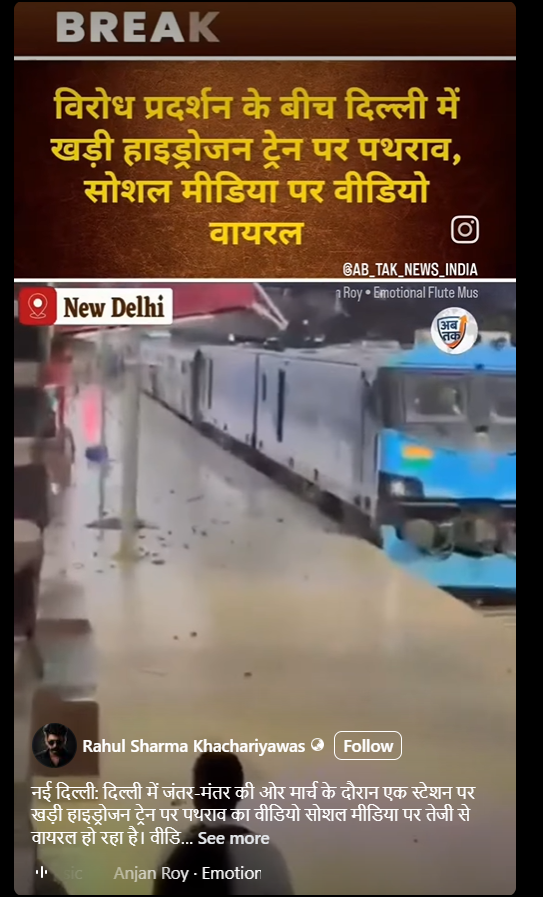
A video is being widely shared on social media with the claim that protesters during the Cockroach Janta Party (CJP) protest in Delhi pelted stones at India’s first hydrogen train. The viral video shows a train parked at a railway station being attacked with stones amid chaos and heavy commotion. Social media users are claiming that the incident took place at a Delhi railway station, where protesters targeted the country’s new hydrogen train during the CJP march towards Jantar Mantar and damaged public property. CyberPeace Research Wing’s research found the claim to be false. The viral video is not related to the CJP protest or India’s first hydrogen train. The video is from Bihar, where candidates appearing for a Bihar Police Prohibition Department examination had protested over train delays, leading to clashes and stone-pelting.
Claim:
A social media post claimed:“New Delhi: During the march towards Jantar Mantar, a video of stone-pelting on a hydrogen train parked at a railway station is going viral. Some people can be seen throwing stones at the train. Damaging public property is a punishable offence. Further action will be taken based on official information from authorities.”
https://www.facebook.com/reel/1573292581055475
Fact Check:
To verify the authenticity of the viral claim, we extracted keyframes from the video and conducted a reverse image search using Google Lens. During the research, we found the same video clip uploaded on the Facebook page News Bihar on June 14, 2026. According to the post’s caption, the incident took place at Danapur–Patliputra railway station in Patna, Bihar, where thousands of candidates appearing for the Bihar Police Prohibition Department examination became agitated due to train delays. The protest escalated after candidates blocked railway tracks, leading to a confrontation between police personnel and students, including stone-pelting.
https://www.facebook.com/reel/2476273089511309

During further research, we found a video uploaded by Republic World’s YouTube channel on June 14, 2026, which also contained visuals matching the viral clip. The report stated that students in Bihar staged an aggressive protest after trains were delayed. During the protest, clashes broke out between police and students, and authorities used mild force to control the situation.
https://www.youtube.com/shorts/AlamDZzPKLA

During our research, we also found a reply from the official X account of Northern Railway on a similar viral post. In its response, Northern Railway clarified that the train visible in the viral video was not a hydrogen train. The railway authority stated that the video was old and confirmed that hydrogen train services are operating safely and as per their scheduled timetable.

Conclusion:
CyberPeace Research Wing’s research found that the claim linking the viral video to stone-pelting on India’s first hydrogen train during the CJP protest is false. The viral video is from Bihar, where candidates appearing for the Bihar Police Prohibition Department examination protested over train delays, resulting in clashes and stone-pelting at a railway station. The video has been falsely linked to the CJP protest and hydrogen train.

Related Blogs

Introduction
Cyber financial offences in India have experienced an alarming surge both in terms of frequency and complexity. Be it phishing attacks or organised fraud syndicates, the nation has been facing a spurt in online financial threats, which leave the victims at their mercy because of procedural lags on the part of law enforcement agencies. To counter this, the Government of India has stepped up measures to create a Cyber-Secure Bharat, focusing on speedy resolution, accountability, and digital empowerment. A key move in this direction is the introduction of the e-Zero FIR initiative, brought forth by the Ministry of Home Affairs (MHA) with Union Home Minister Amit Shah at the helm. This newly developed digital-first system is expected to revolutionise the way cyber financial crimes, particularly those that result in high monetary losses, are handled and investigated.
What Is the e-Zero FIR Initiative?
The e-Zero FIR program is a technology-based platform that enables the automated registration of Zero FIRs for value cyber financial crimes. Led by the Indian Cybercrime Coordination Centre (I4C), Ministry of Home Affairs, the programme is now piloted in Delhi and aims to fill a pressing lacuna: the time lag involved in transitioning cybercrime complaints to First Information Reports (FIRs).
Complaints of financial frauds worth more than ₹10 lakh, reported through the National Cybercrime Reporting Portal (NCRP) or helpline number 1930, will be automatically turned into e-Zero FIRs under this scheme. Such electronic FIRs are directed to the e-Crime Police Station in Delhi, regardless of jurisdiction, and then relayed to the corresponding territorial cybercrime unit. Complainants can visit the cybercrime Police Station within 3 days and get the Zero FIR converted into a regular FIR.
Key Features of the Initiative
- Pilot Implementation in Delhi
Launched as a pilot project in Delhi, it will later serve as the first use case for the national rollout. The success of the pilot will determine its implementation in other states and Union Territories.
- Seamless Digital Integration
The project provides strong back-end integration between:
- NCRP (National Cybercrime Reporting Portal)
- e-FIR System (Delhi Police)
- CCTNS (Crime and Criminal Tracking Network & Systems – NCRB)
This integrated model enables complaints to pass smoothly between platforms and agencies.
- Zero FIR Auto-Registration and Routing
Now, for complaints lodged through 1930 or the National Cyber Crime Reporting Portal related to financial losses exceeding the threshold of ₹10 lakh, the system will automatically register a Zero FIR to the e-Crime Police Station of Delhi and then route it to the concerned territorial cybercrime police station, triggering immediate case processing.
- Victim-Centric Conversion Mechanism
Complainants are given 3 days from the time of filing to physically report to the police station and transform the e-Zero FIR into a conventional regular FIR under Section 173 (1) and 1(ii) of the newly enacted Bhartiya Nagrik Suraksha Sanhita (BNSS). This ensures legal redress is quicker and easier.
Impact and Significance: The CyberPeace View
The e-Zero FIR system is a significant change in India's cybercrime enforcement, offering quicker response times and improved recovery opportunities. Cyber fraud reported within the "golden hour" can boost recovery levels of financial fraud. The system also eliminates jurisdictional barriers and procedural bottlenecks, making it more victim-friendly. Union Home Minister Amit Shah emphasised the initiative's alignment with Prime Minister Narendra Modi's vision of a digitally resilient India. The system is a scalable national model of tech-based policing supported by organised digital workflows. The initiative allows for real-time analysis of fraud graphs and detection of fraud syndicates through identification and device-based clustering. This is a step towards more automated, context-aware cyber policing, focusing on AI, identity graphs, and velocity to prevent crimes. The system is a step towards a next-generation cyber law enforcement strategy, focusing on AI, identity graphs, and velocity.
Conclusion
The roll-out of the e-Zero FIR program is a turning point in India's battle against cybercrime. By marrying automation with inter-agency coordination and easy-to-use mechanisms, the government has eradicated one of the major stumbling blocks for victims, the delay in taking legal action. Though its pilot phase targets high-value financial frauds in Delhi, its potential for having a countrywide impact is vast. With digital transactions on the upswing and frauds getting more cunning, efforts like these are the key to making a safe, responsive, and victim-centric cyber environment. CyberPeace commends and welcomes this important move towards establishing a Cyber-Secure Bharat, wherein all citizens can make digital transactions with confidence.
References
- https://www.pib.gov.in/PressReleasePage.aspx?PRID=2129715
- https://www.mha.gov.in/en
- https://cybercrime.gov.in/
- https://www.ncrb.gov.in/
- https://economictimes.indiatimes.com/wealth/save/new-e-zero-fir-govt-launches-pilot-for-swift-action-against-cybercrimes-how-it-can-help-you/articleshow/121314437.cms?from=mdr

Executive Summary:
A video online alleges that people are chanting "India India" as Ohio Senator J.D. Vance meets them at the Republican National Convention (RNC). This claim is not correct. The CyberPeace Research team’s investigation showed that the video was digitally changed to include the chanting. The unaltered video was shared by “The Wall Street Journal” and confirmed via the YouTube channel of “Forbes Breaking News”, which features different music performing while Mr. and Mrs. Usha Vance greeted those present in the gathering. So the claim that participants chanted "India India" is not real.

Claims:
A video spreading on social media shows attendees chanting "India-India" as Ohio Senator J.D. Vance and his wife, Usha Vance greet them at the Republican National Convention (RNC).


Fact Check:
Upon receiving the posts, we did keyword search related to the context of the viral video. We found a video uploaded by The Wall Street Journal on July 16, titled "Watch: J.D. Vance Is Nominated as Vice Presidential Nominee at the RNC," at the time stamp 0:49. We couldn’t hear any India-India chants whereas in the viral video, we can clearly hear it.
We also found the video on the YouTube channel of Forbes Breaking News. In the timestamp at 3:00:58, we can see the same clip as the viral video but no “India-India” chant could be heard.

Hence, the claim made in the viral video is false and misleading.
Conclusion:
The viral video claiming to show "India-India" chants during Ohio Senator J.D. Vance's greeting at the Republican National Convention is altered. The original video, confirmed by sources including “The Wall Street Journal” and “Forbes Breaking News” features different music without any such chants. Therefore, the claim is false and misleading.
Claim: A video spreading on social media shows attendees chanting "India-India" as Ohio Senator J.D. Vance and his wife, Usha Vance greet them at the Republican National Convention (RNC).
Claimed on: X
Fact Check: Fake & Misleading
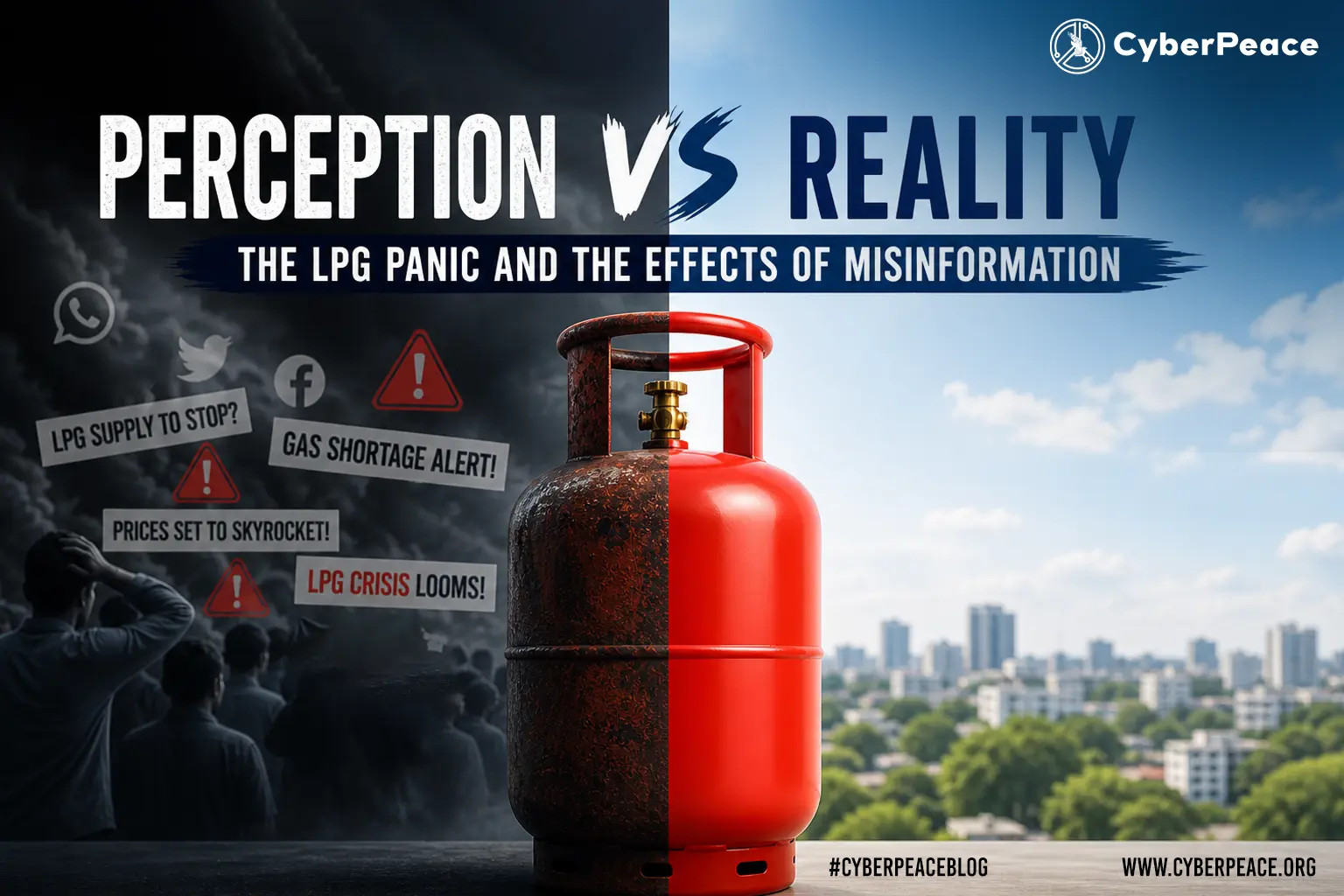
In recent months, conversations around the possible shortage of liquefied petroleum gas (LPG), a basic cooking fuel in Indian households, have quietly resurfaced across the country. From whispers in local markets to viral messages circulating on social media, concerns about LPG availability began to take hold in the public imagination. Though the immediacy of the situation has since faded, its echoes remain, reminding us how quickly uncertainty can spread. Like a ripple across still water, a single rumour can travel far, gathering force as it moves and blurring the line between perception and reality.
Against this backdrop, in April 2026, reports began circulating about a potential LPG shortage. The Union Government moved quickly to counter what it identified as misinformation, emphasising that supply remained stable and urging citizens not to engage in panic buying. A noticeable disconnect emerged between official communication and public perception. Across different regions, signs of anxiety-driven behaviour became evident. Instances of panic buying and hoarding increased, law enforcement agencies conducted raids to address such actions, and opportunistic thefts were reported, often exploiting widespread concern. These incidents highlight how misinformation, even when addressed promptly, can continue to shape public behaviour.
It is worth noting that rising prices also played a role in shaping public response, as increases in LPG rates contributed to a sense of urgency among consumers. Therefore, the surge in panic buying cannot be attributed solely to misinformation, but rather to a combination of economic pressures and perceived scarcity.
Misinformation Ecosystem - From Rumours to Behaviour
The spread of misinformation is occurring at an unprecedented pace and is, in large part, driven by the viral nature of social media. Digital platforms not only enable the rapid dissemination of information but also allow it to be amplified in ways that would not be possible through traditional media outlets. Often, the drive for virality outweighs any concern for accuracy, meaning that many individuals who spread misinformation are motivated more by the pursuit of attention than by any ideological agenda. Recent arrests of individuals involved in spreading misinformation about LPG and petrol shortages, much of which went viral, suggest that misinformation today is frequently driven by the desire for visibility rather than ideological motives. The information being circulated has largely followed a similar pattern, focusing on fears of an LPG shortage, expectations of price increases, and concerns about supply disruptions. Even though this information has not been verified, it has triggered behavioural responses among individuals. In several areas, including parts of Uttar Pradesh and Goa, the spread of misinformation through social media has led to panic buying, despite official assurances that there would be sufficient LPG supply to meet demand.
The impact of panic buying, and its associated misinformation, has already been seen in multiple sectors; these increased demands have placed pressure on the distribution network, leading to disruptions in access, as well as being out of stock of certain products. In many cases, commercial users of products (especially restaurants) have experienced significant disruption, threatening their continued operations, and industry representatives have alerted others about the inconsistent supply of commercial cylinders; likewise, consumers (households) are beginning to switch to alternative products (e.g., induction cooking) as a reflection of the anticipatory mindset to address the uncertainty created through perceptions of Product Scarcity.
State Response: Managing Misinformation or Behaviour?

The government has taken a variety of approaches, from advisories and enforcement actions to communicating with citizens indirectly. For example, State Governments have been directed to combat misinformation, monitor supply chains and take action against hoarding and black market activity. There has been a significant increase in the level of large- scale enforcement activity, with over 3,700 raids carried out to crack down on hoarding and black marketing related to LPG, in addition to confiscating cylinders and issuing penalties to those who break the law. In addition, the authorities have also focused on maintaining regular communication with the public in order to reassure them about the supply of LPG and fuel stability.
Geopolitical Context: Why Rumours Are Believable
Understanding today’s panic requires an understanding of the global environment: i.e., due to the ongoing conflict in West Asia, the energy markets are unstable, and energy supply is uncertain not only in West Asia but across a large part of the world. Even if domestic supply remains stable, public perception is affected by global instability. A clear example of this can be seen in neighbouring countries to India; Pakistan has seen significant increases in the cost of fuel, implemented measures such as reducing the number of days individuals work each week, and has created public support mechanisms; Bangladesh has imposed restrictions on the use of energy, has shortened the number of hours individuals can operate businesses each day, and has restricted the total amount of energy used; Sri Lanka has begun to ration fuel, and to increase the price of petrol; and Nepal has reduced the numbers of days individuals may work each week, and has adjusted supply.
All of these examples are not isolated instances, but are markers of a common regional environment. As we live in a global community that is connected in many ways, these developments will quickly affect public expectations everywhere. Therefore, for consumers in India, seeing evidence of rationing of fuel and shortages of fuel in neighbouring countries increases their belief that these types of problems could occur in their country.
Critical Perspective: Between Panic and Precaution
The LPG incident has brought about questions surrounding the nature of misinformation in terms of its definition & regulation. One of the main concerns is whether or not "misinformation" is being cast too widely. To be sure, false claims need to be addressed; however, not everything that is responded to publicly is based on untrue facts, as many times public responses are based on perceived risk via global and/or local incidents that occur. Perhaps the greatest challenge is the difficulty in differentiating precaution and panic. People’s memories of the COVID-19 pandemic are fresh in their minds and will serve to influence their behaviours moving onward, in that many people are stockpiling or preparing for uncertainty not out of irrational fear, but as an anticipatory response to their prior experiences.
Conclusion
The Indian LPG "crisis" is not so much a problem with actual supply chain breakdown as it is a result of how information and behaviour are connected through perception. This cohabitating environment of panic buying, law enforcement, and government assurance demonstrates an evident disconnect and gap between how governments present a narrative and how the public responds. While there is some role of misinformation within this discourse, the misinformation itself extends beyond any or all false claims about LPG supply and operates within a greater ecosystem of global uncertainty and personal experience. As such, and because of this, perception becomes an incredibly strong force in itself that produces true economic consequences.
Reference
- https://www.pib.gov.in/PressReleasePage.aspx?PRID=2248640&utm_source®=3&lang=2
- https://www.pmindia.gov.in/en/news_updates/pm-addresses-the-lok-sabha-on-the-ongoing-conflict-in-west-asia/
- https://www.ndtv.com/delhi-news/iran-war-middle-east-conflict-why-the-lpg-crisis-is-forcing-migrants-to-quietly-leave-delhi-11313629
- https://timesofindia.indiatimes.com/city/bareilly/thieves-steal-108-lpg-cylinders-from-godown-in-up/articleshow/130035518.cms
- https://indianexpress.com/article/india/arrested-rumours-lpg-petrol-shortage-police-chasing-views-10614193/
- https://www.hindustantimes.com/cities/lucknow-news/social-media-rumours-fuel-panic-buying-in-some-up-districts-situation-normal-in-lucknow-101774465353107.html
- https://timesofindia.indiatimes.com/city/goa/fear-of-shortage-price-rise-fuels-panic-buying-across-goa/articleshow/129810144.cms
- https://www.news18.com/cities/new-delhi-news/online-rumours-offline-rush-panic-buying-sweeps-petrol-pumps-across-cities-whats-the-truth-ws-ln-9995684.html
- https://m.economictimes.com/news/india/3700-raids-conducted-across-country-to-wipe-out-lpg-black-marketing-says-centre/articleshow/130025232.cms
- https://www.reuters.com/business/energy/induction-stoves-fly-off-shelves-india-gas-shortage-fears-spark-panic-buying-2026-03-12/
- https://www.ndtv.com/india-news/restaurant-body-warns-of-closures-over-commercial-lpg-supply-concerns-writes-to-minister-11194418
- https://www.freepressjournal.in/mumbai/fpj-dialogue-we-are-getting-only-1-cylinder-instead-of-10-says-ahar-president-vijay-shetty-on-mumbai-lpg-crisis
- https://www.hindustantimes.com/world-news/fuel-cuts-wfh-and-more-how-indias-neighbours-are-dealing-with-global-energy-crisis-triggered-by-us-iran-war-101775397199941.html
- https://www.abc.net.au/news/2026-03-30/four-step-fuel-supply-plan-national-cabinet-fuel-crisis/106512706
- https://tribune.net.ph/2026/04/07/philippines-scrambles-as-regional-oil-crisis-hits
