
#FactCheck: IIT Baba Abhay Singh Is Alive; False Death Claim Debunked by Hisar Police
Executive Summary
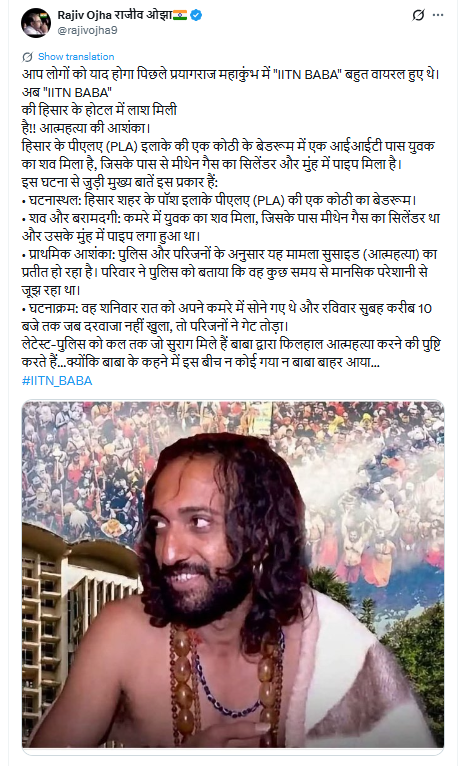
A social media post is being shared claiming that the body of IIT Baba Abhay Singh has been found in Hisar. The viral post also features a photograph of Abhay Singh, popularly known as IIT Baba. The caption accompanying the post reads, “The body of #IITian Baba was found in a bedroom in Hisar, along with a methane gas cylinder and a pipe in his mouth; suicide is suspected… Further details will emerge as the investigation progresses.”
CyberPeace Research found that the claim about IIT Baba Abhay Singh’s death is false.
Claim:
Social media users are claiming that ‘IITian Baba’, who came into the limelight during the Prayagraj Maha Kumbh, died by suicide in Hisar. The post alleges that his body was found in a room at a house in the PLA area of Hisar, with preliminary information suggesting that the police suspect suicide.
https://x.com/rajivojha9/status/2110238805177585752
https://archive.ph/submit/?url
Fact Check
To verify the claim that IIT Baba Abhay Singh’s body was found in Hisar, we first conducted a Google search using relevant keywords. However, we did not find any credible media reports confirming his death. During the search, we came across a report published on the Dainik Bhaskar website on October 15, 2026, which stated that Abhay Singh, popularly known as IIT Baba, is alive and currently in Dharamshala, Himachal Pradesh, with his wife.
According to the Dainik Bhaskar report, IIT Baba Abhay Singh denied the rumours of his death during a conversation. The report also stated that he had spoken to his family members amid the circulation of these rumours.

During our research, we found a video posted on the official X account of news agency IANS on October 14, 2026. In the video, Hisar Police social media in-charge Amarinder Singh clarified while speaking to the media that the claim circulating on social media about IIT Baba Abhay Singh’s death was
false.He explained that three days earlier, the body of a local resident named Rahul Jain had been found at his residence in the PLA area of Hisar, following which rumours about IIT Baba Abhay Singh’s death began circulating on social media. Amarinder Singh also appealed to people not to share misleading information.
https://x.com/ians_india/status/2110293986904768641?s=20

Conclusion
The evidence gathered during our research confirms that the claim that IIT Baba Abhay Singh’s body was found in Hisar is false. Hisar Police also refuted the claim after reports of his death went viral on social media.

Related Blogs

Introduction:
With improved capabilities and evasion strategies, the Vultur banking Trojan has reappeared and is a serious danger to Android users. The virus now employs numerous encrypted payloads, encrypted communication, and poses as legitimate apps. It is transmitted by trojanized dropper programs on the Google Play Store. Vultur targets victims via phone calls and SMS messages. With the help of this updated version of Vultur, attackers may take total control of compromised devices. They can perform a variety of remote control operations like install, remove, upload, and download files, halt the execution of programs, and circumvent the lock screen. The virus is now far more hazardous than it was previously because of its improved capacity to remotely access and manipulate machines.
Overview:
The Android banking malware Vultur is well-known for its ability to record screens. It was first identified by ThreatFabric in March 2021 and targets banking apps for remote control and keylogging.
The malicious apps were hosted on the Google Play Store by the Brunhilda dropper-framework, which was used for its distribution. Initial versions of the program used reputable remote access tools such as ngrok and AlphaVNC.
Hybrid attacks have been used in recent operations to disseminate the Brunhilda dropper via phone calls and SMS. The dropper uses a number of payloads to distribute an upgraded version of Vultur.
41 new Firebase Cloud Messaging (FCM) commands and seven new Command-and-Control (C2) methods are included in the most recent version of Vultur.
With the help of Android's Accessibility Services, these enhancements concentrate on remote access functionality that improves the malware's capacity to communicate with the victim's screen.
Modus operandi of Attack:
Hybrid Attack Method:
- Utilizes a phone call, two SMS messages, and trick users into installing malware.
- First SMS tricks victims into calling a certain number by claiming to have made significant, unlawful transactions, which gives the impression of urgency.
- Although there was no transaction in reality, the urgency motivates victims to act quickly.
Trozonized MacAfee App:
- The victims are told to install a trojanized version of the McAfee Security program from a given link during the phone call.
- This app looks harmless and has features similar to the original McAfee Security app, but it's actually the Brunhilda dropper.
- The victims are misled into assuming that the security software they are installing is authentic.
Execution of Vultur Payloads:
- Three payloads connected to Vultur are decrypted and executed via the Brunhilda dropper.
- Threat actors can carry out a variety of malicious operations, including keylogging and screen recording, on the victim's mobile device thanks to these payloads, which grant them total access over it.
- The infected device of the victim allows the threat actors to launch additional assaults or obtain private data.
Indication of the attack:
The symptoms of a Vultur banking Trojan infection include:
- Remote Access: This malware gives the hacker the ability to remotely use the infected device via clicking, scrolling, and swiping through Android's accessibility services.
- File Management: Through this, the malware is able to copy, share, remove, create, and locate files from devices it has infected.
- App Blocking: For instance; the malicious software can be programmed to stop the victims from opening a certain bunch of apps.
- Custom Notifications: Attackers can embed the malware with the functionality of displaying the customized notifications in the taskbar.
- Keyguard Disabling: The malware may be designed to turn off Screen Lock Guard feature so the lock screen security measure can be easily bypassed.
- Encrypted C2 Communication: The malware chooses AES data encryption, with Base64 text encoding to provide hidden traces for C2 communication.
- Payload Decryption: The malware uses native code, mostly written in C as well as C++, to decode the goods, thus, making a process of reversing more complicated.
- Spying on Financial Apps: The malware uses screen-streaming and keylogging as ways of acquiring facts about the victim’s mobile banking applications.
Indicator of Compromise:
File hash (SHA-256)
- edef007f1ca60fdf75a7d5c5ffe09f1fc3fb560153633ec18c5ddb46cc75ea21
- 89625cf2caed9028b41121c4589d9e35fa7981a2381aa293d4979b36cf5c8ff2
- 1fc81b03703d64339d1417a079720bf0480fece3d017c303d88d18c70c7aabc3
- 4fed4a42aadea8b3e937856318f9fbd056e2f46c19a6316df0660921dd5ba6c5
- 001fd4af41df8883957c515703e9b6b08e36fde3fd1d127b283ee75a32d575fc
- fc8c69bddd40a24d6d28fbf0c0d43a1a57067b19e6c3cc07e2664ef4879c221b
- 7337a79d832a57531b20b09c2fc17b4257a6d4e93fcaeb961eb7c6a95b071a06
- 7f1a344d8141e75c69a3c5cf61197f1d4b5038053fd777a68589ecdb29168e0c
- 26f9e19c2a82d2ed4d940c2ec535ff2aba8583ae3867502899a7790fe3628400
- 2a97ed20f1ae2ea5ef2b162d61279b2f9b68eba7cf27920e2a82a115fd68e31f
- c0f3cb3d837d39aa3abccada0b4ecdb840621a8539519c104b27e2a646d7d50d
- 92af567452ecd02e48a2ebc762a318ce526ab28e192e89407cac9df3c317e78d
- fa6111216966a98561a2af9e4ac97db036bcd551635be5b230995faad40b7607
- dc4f24f07d99e4e34d1f50de0535f88ea52cc62bfb520452bdd730b94d6d8c0e
- 627529bb010b98511cfa1ad1aaa08760b158f4733e2bbccfd54050838c7b7fa3
- f5ce27a49eaf59292f11af07851383e7d721a4d60019f3aceb8ca914259056af
- 5d86c9afd1d33e4affa9ba61225aded26ecaeb01755eeb861bb4db9bbb39191c
- 5724589c46f3e469dc9f048e1e2601b8d7d1bafcc54e3d9460bc0adeeada022d
- 7f1a344d8141e75c69a3c5cf61197f1d4b5038053fd777a68589ecdb29168e0c
- fd3b36455e58ba3531e8cce0326cce782723cc5d1cc0998b775e07e6c2622160
- 819044d01e8726a47fc5970efc80ceddea0ac9bf7c1c5d08b293f0ae571369a9
- 0f2f8adce0f1e1971cba5851e383846b68e5504679d916d7dad10133cc965851
- fb1e68ee3509993d0fe767b0372752d2fec8f5b0bf03d5c10a30b042a830ae1a
- d3dc4e22611ed20d700b6dd292ffddbc595c42453f18879f2ae4693a4d4d925a
- f4d7e9ec4eda034c29b8d73d479084658858f56e67909c2ffedf9223d7ca9bd2
- 7ca6989ccfb0ad0571aef7b263125410a5037976f41e17ee7c022097f827bd74
- c646c8e6a632e23a9c2e60590f012c7b5cb40340194cb0a597161676961b4de0
Command and Control Servers
- safetyfactor[.]online
- cloudmiracle[.]store
- flandria171[.]appspot[.]com (FCM)
- newyan-1e09d[.]appspot[.]com (FCM)
Droppers distribution URL’s
- mcafee[.]960232[.]com
- mcafee[.]353934[.]com
- mcafee[.]908713[.]com
- mcafee[.]784503[.]com
- mcafee[.]053105[.]com
- mcafee[.]092877[.]com
- mcafee[.]582630[.]com
- mcafee[.]581574[.]com
- mcafee[.]582342[.]com
- mcafee[.]593942[.]com
- mcafee[.]930204[.]com
Steps to be taken when your device is compromised?.
- Change the password: Vultur revealed multiple cases where threat actors can gain access to your financial and private information. To safeguard your account, reset passwords on other devices and create secure, unique passwords during the time. Instead of simply storing your password, a reputed password manager is the most secure way of storing information.
- Keep an eye on your transactions and accounts: It is advised that you regularly monitor your online accounts for any unusual or illegal activity. Keep a watch out for any irregularities, and report anything suspicious to the provider or authorities straight immediately.. Also check your credit reports and scores attentively to make sure that your identity or cards are not compromised.
- Make sure you are using identity theft protection: Many pieces of information about your identity are stored in an Android device. Cyber criminals can easily get hold of this data and make major damage to you, including stealing your money and identity. For your own protection, some of the identity theft protection services that monitor all your personal information and notify you on any unusual activity and, as well, helps you to freeze your accounts would be beneficial.
- Immediately get in touch with your banks and credit card companies: Your personal information such as credit card or bank details is of high risk to be exposed to hackers who could use them to make transactions without you knowing. You should inform your credit card and the lending bank about the situation as soon as possible. They would help you if your cards were used for fraudulent charges and your card be either frozen or canceled. Besides, they can get new cards issued.
- Make your contacts alert regarding the fraud you faced: Threat actors may access your social media or email accounts to send phishing messages or spam to people in your contact list, if they gain access to them. Moreover, they may masquerade as you and try to extort cash from you or disclose your personal information. Distributing a message to your contacts stating that they shouldn’t open or reply to any messages that look like they are not from you and look very strange or suspicious, will be a great idea.
- Make a backup and wipe all your device content in factory settings: You can always factory reset your device to ensure it is free of viruses and spyware. In other words, it will refresh Android and leave behind all your data and settings. Back up all the critical data prior to processing it and assure that everything is restored from a trustworthy source only.
Preventive measures to be taken:
- Avoid calling back to the hacker: If a hacker texts you claiming to have approved a sizable bank transaction, refrain from picking up the phone. You can always check by making a call to your own financial intuition. However, never pick up on an unknown number that someone else sends you.
- Avoid sideloading apps and shortened URLs: Try to avoid sideloading apps. That's the moment when you install apps from unofficial sources. Users may be tricked into downloading malware using short URLs.
- Be careful granting permissions: Be cautious when allowing permissions for apps. Think about whether an app really needs access to specific data or device functions.
- Limit the apps you have on your phone: On your phone, having plenty of apps might sometimes make it easier to become infected with malware. Over time, these apps may allow harmful code to enter your system, and the more programs you have to update and monitor, the greater the risk to your Android device. This is how to remove pointless apps from your Android device.
- Download apps from reputable sources: Additionally, make sure the programs you download are from reputable and authorized developers. Do your homework and read reviews before you install.
- Keep your Android device updated: With the help of software and security upgrades, your phone can automatically maintain security. Remember to install them.
- Have good antivirus software on all your devices: The best defense against malware on all of your devices is to install antivirus software. By blocking you from clicking on potentially dangerous links, antivirus software can keep malware off your devices and keep hackers from accessing your personal data.
Conclusion:
Vultur is a terrifying banking Trojan with a great deal of sophistication. It's unsettling that hackers can take complete control of your Android device, which emphasizes how crucial it is that you take precautions. It all starts with a text message in these attacks. You must take the time to independently contact your banking institution to check whether there are any issues. You may prevent having your entire device compromised and your personal information exposed by simply investing an additional few minutes.
Reference:
- https://research.nccgroup.com/2024/03/28/android-malware-vultur-expands-its-wingspan/
- https://www.threatfabric.com/blogs/vultur-v-for-vnc\
- https://www.tomsguide.com/computing/malware-adware/this-nasty-android-banking-trojan-lets-hackers-completely-hijack-your-phone-how-to-stay-safe
- https://thehackernews.com/2024/04/vultur-android-banking-trojan-returns.html?m=1
- https://www.smallbiztechnology.com/archive/2024/04/vultur-trojan-heightens-android-app-security-risks.html/
- https://securityaffairs.com/161320/malware/vultur-banking-trojan-android.html
- https://www.malwarebytes.com/blog/detections/android-trojan-spy-vultur
- https://www.scmagazine.com/brief/updated-vultur-android-banking-trojan-emerges
- https://innovatecybersecurity.com/security-threat-advisory/windows-server-updates-blamed-for-domain-controller-crashes-kb5035855-and-kb5035857/

Introduction
AI has revolutionized the way we look at growing technologies. AI is capable of performing complex tasks in fasten time. However, AI’s potential misuse led to increasing cyber crimes. As there is a rapid expansion of generative AI tools, it has also led to growing cyber scams such as Deepfake, voice cloning, cyberattacks targeting Critical Infrastructure and other organizations, and threats to data protection and privacy. AI is empowered by giving the realistic output of AI-created videos, images, and voices, which cyber attackers misuse to commit cyber crimes.
It is notable that the rapid advancement of technologies such as generative AI(Artificial Intelligence), deepfake, machine learning, etc. Such technologies offer convenience in performing several tasks and are capable of assisting individuals and business entities. On the other hand, since these technologies are easily accessible, cyber-criminals leverage AI tools and technologies for malicious activities or for committing various cyber frauds. By such misuse of advanced technologies such as AI, deepfake, and voice clones. Such new cyber threats have emerged.
What is Deepfake?
Deepfake is an AI-based technology. Deepfake is capable of creating realistic images or videos which in actuality are created by machine algorithms. Deepfake technology, since easily accessible, is misused by fraudsters to commit various cyber crimes or deceive and scam people through fake images or videos that look realistic. By using the Deepfake technology, cybercriminals manipulate audio and video content which looks very realistic but, in actuality, is fake. Voice cloning is also a part of deepfake. To create a voice clone of anyone's, audio can be deepfaked too, which closely resembles a real one but, in actuality, is a fake voice created through deepfake technology.
How Deepfake Can Harm Organizations or Enterprises?
- Reputation: Deepfakes have a negative impact on the reputation of the organization. It’s a reputation which is at stake. Fake representations or interactions between an employee and user, for example, misrepresenting CEO online, could damage an enterprise’s credibility, resulting in user and other financial losses. To be protective against such incidents of deepfake, organisations must thoroughly monitor online mentions and keep tabs on what is being said or posted about the brand. Deepfake-created content can also be misused to Impersonate leaders, financial officers and officials of the organisation.
- Misinformation: Deepfake can be used to spread misrepresentation or misinformation about the organisation by utilising the deepfake technology in the wrong way.
- Deepfake Fraud calls misrepresenting the organisation: There have been incidents where bad actors pretend to be from legitimate organisations and seek personal information. Such as helpline fraudsters, fake representatives from hotel booking departments, fake loan providers, etc., where bad actors use voice clones or deepfake-oriented fake video calls in order to propose themselves as belonging to legitimate organisations and, in actuality, they are deceiving people.
How can organizations combat AI-driven cybercrimes such as deepfake?
- Cybersecurity strategy: Organisations need to keep in place a wide range of cybersecurity strategies or use advanced tools to combat the evolving disinformation and misrepresentation caused by deepfake technology. Cybersecurity tools can be utilised to detect deepfakes.
- Social media monitoring: Social media monitoring can be done to detect any unusual activity. Organisations can select or use relevant tools and implement technologies to detect deepfakes and demonstrate media provenance. Real-time verification capabilities and procedures can be used. Reverse image searches, like TinEye, Google Image Search, and Bing Visual Search, can be extremely useful if the media is a composition of images.
- Employee Training: Employee education on cybersecurity will also play a significant role in strengthening the overall cybersecurity posture of the organisation.
Conclusion
There have been incidents where AI-driven tools or technology have been misused by cybercriminals or bad actors. Synthetic videos developed by AI are used by bad actors. Generative AI has gained significant popularity for many capabilities that produce synthetic media. There are concerns about synthetic media, such as its misuse of disinformation operations designed to influence the public and spread false information. In particular, synthetic media threats that organisations most often face include undermining the brand, financial gain, threat to the security or integrity of the organisation itself and Impersonation of the brand’s leaders for financial gain.
Synthetic media attempts to target organisations intending to defraud the organisation for financial gain. Example includes fake personal profiles on social networking sites and deceptive deepfake calls, etc. The organisation needs to have the proper cyber security strategy in place to combat such evolving threats. Monitoring and detection should be performed by the organisations and employee training on empowering on cyber security will also play a crucial role to effectively deal with evolving threats posed by the misuse of AI-driven technologies.
References:
- https://media.defense.gov/2023/Sep/12/2003298925/-1/-1/0/CSI-DEEPFAKE-THREATS.PDF
- https://www.securitymagazine.com/articles/98419-how-to-mitigate-the-threat-of-deepfakes-to-enterprise-organizations

Executive Summary:
In the age of virtuality, misinformation and misleading techniques shape the macula of the internet, and these threaten human safety and well-being. Recently, an alarming fake information has surfaced, intended to provide a fake Government subsidy scheme with the name of Indian Post. This serves criminals, who attack people's weaknesses, laying them off with proposals of receiving help in exchange for info. In this informative blog, we take a deep dive into one of the common schemes of fraud during this time. We will go through the stages involved which illustrates how one is deceived and offer practical tips to avoid the fall.
Introduction:
Digital communication reaches individuals faster, and as a result, misinformation and mails have accelerated their spread globally. People, therefore, are susceptible to online scams as they add credibility to phenomena. In India, the recently increased fake news draws its target with the deceptive claims of being a subsidy from the Government mainly through the Indian post. These fraudulent schemes frequently are spread via social networks and messaging platforms, influence trust of the individual’s in respectable establishments to establish fraud and collect private data.
Understanding the Claim:
There is a claim circulating on the behalf of the Government at the national level of a great subsidy of $1066 for deserving residents. The individual will be benefited with the subsidy when they complete the questionnaire they have received through social media. The questionnaire may have been designed to steal the individual’s confidential information by way of taking advantage of naivety and carelessness.
The Deceptive Journey Unveiled:
Bogus Offer Presentation: The scheme often appeals to people, by providing a misleading message or a commercial purposely targeted at convincing them to act immediately by instilling the sense of an urgent need. Such messages usually combine the mood of persuasion and highly evaluative material to create an illusion of being authentic.
Questionnaire Requirement: After the visitors land on attractive content material they are directed to fill in the questionnaire which is supposedly required for processing the economic assistance. This questionnaire requests for non private information in their nature.
False Sense of Urgency: Simultaneously, in addition to the stress-causing factor of it being a fake news, even the false deadline may be brought out to push in the technique of compliance. This data collection is intended to put people under pressure and influence them to make the information transfer that immediate without thorough examination.
Data Harvesting Tactics: Despite the financial help actually serving, you might be unaware but lies beneath it is a vile motive, data harvesting. The collection of facts through questionnaires may become something priceless for scammers that they can use for a good while to profit from identity theft, financial crimes and other malicious means.
Analysis Highlights:
- It is important to note that at this particular point, there has not been any official declaration or a proper confirmation of an offer made by the India Post or from the Government. So, people must be very careful when encountering such messages because they are often employed as lures in phishing attacks or misinformation campaigns. Before engaging or transmitting such claims, it is always advisable to authenticate the information from trustworthy sources in order to protect oneself online and prevent the spread of wrongful information
- The campaign is hosted on a third party domain instead of any official Government Website, this raised suspicion. Also the domain has been registered in very recent times.

- Domain Name: ccn-web[.]buzz
- Registry Domain ID: D6073D14AF8D9418BBB6ADE18009D6866-GDREG
- Registrar WHOIS Server: whois[.]namesilo[.]com
- Registrar URL: www[.]namesilo[.]com
- Updated Date: 2024-02-27T06:17:21Z
- Creation Date: 2024-02-11T03:23:08Z
- Registry Expiry Date: 2025-02-11T03:23:08Z
- Registrar: NameSilo, LLC
- Name Server: tegan[.]ns[.]cloudflare[.]com
- Name Server: nikon[.]ns[.]cloudflare[.]com
Note: Cybercriminal used Cloudflare technology to mask the actual IP address of the fraudulent website.
CyberPeace Advisory:
Verification and Vigilance: It makes complete sense in this case that you should be cautious and skeptical. Do not fall prey to this criminal act. Examine the arguments made and the facts provided by either party and consult credible sources before disclosures are made.
Official Channels: Governments usually invoke the use of reliable channels which can as well be by disseminating subsidies and assistance programs through official websites and the legal channels. Take caution for schemes that are not following the protocols previously established.
Educational Awareness: Providing awareness through education and consciousness about on-line scams and the approaches which are fraudulent has to be considered a primary requirement. Through empowering individuals with capabilities and targets we, as a collective, can be armed with information that will prevent erroneous scheme spreading.
Reporting and Action: In a case of mission suspicious and fraudulent images, let them understand immediately by making the authorities and necessary organizations alert. Your swift actions do not only protect yourself but also help others avoid the costs of related security compromises.
Conclusion:
The rise of the ‘Indian Post Countrywide - government subsidy fake news’ poses a stern warning of the present time that the dangers within the virtual ecosystem are. The art of being wise and sharp in terms of scams always reminds us to show a quick reaction to the hacks and try to do the things that we should identify as per the CyberPeace advisories; thereby, we will contribute to a safer Cyberspace for everyone. Likewise, the ability to critically judge, and remain alert, is important to help defeat the variety of tricks offenders use to mislead you online.
