
#FactCheck-Edited audio falsely claims PM Modi disrespected national anthem
Executive Summary
A video of Prime Minister Narendra Modi is being shared on social media with the claim that he disrespected the national anthem by continuing to walk while it was being played. The CyberPeace Research Wing’s investigation found that the claim is false. The audio heard in the viral clip has been added separately to the original footage, creating a misleading impression about what was happening in the video.
Claim
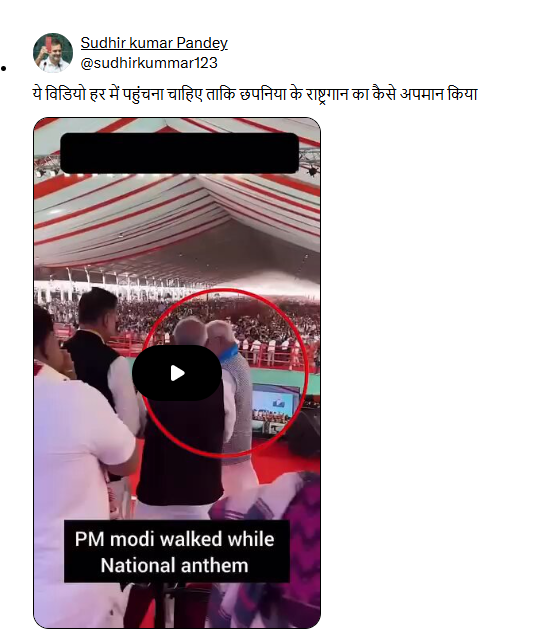
An X user shared the video claiming that Prime Minister Narendra Modi continued walking during the national anthem, thereby disrespecting it.
https://x.com/sudhirkummar123/status/2089044275665535414?s=20
Fact Check
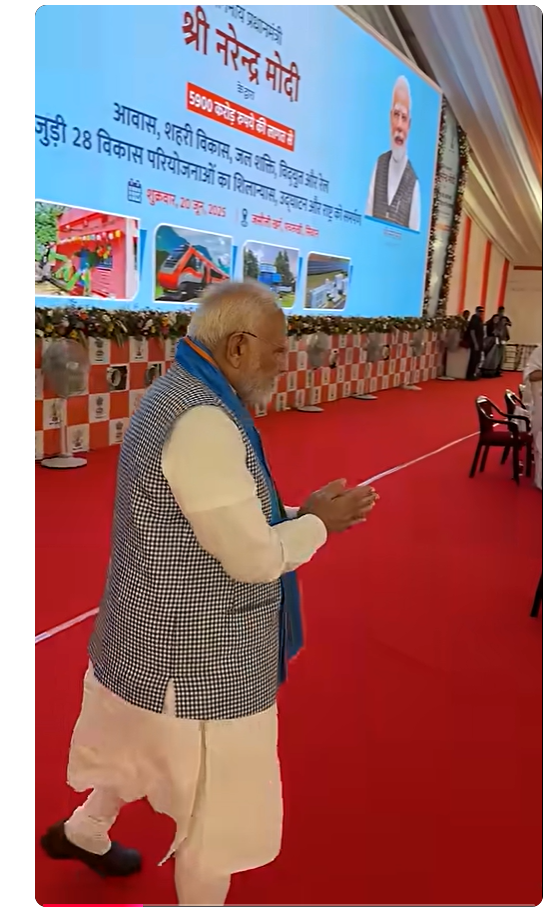
To verify the claim, the Desk conducted a reverse image search using keyframes from the viral video. The search led us to a longer version of the footage uploaded on Prime Minister Narendra Modi’s official YouTube channel on June 21, 2025. We reviewed the longer video and found that the audio in the viral clip does not match the original footage. The original video does not feature the national anthem being played. Instead, a female announcer on the stage can be heard asking the gathering to welcome Prime Minister Modi upon his arrival in Siwan, Bihar. The description accompanying the original video also states that people gave Prime Minister Modi a warm welcome upon his arrival in Siwan.
https://www.youtube.com/shorts/YhBryZZwlIk
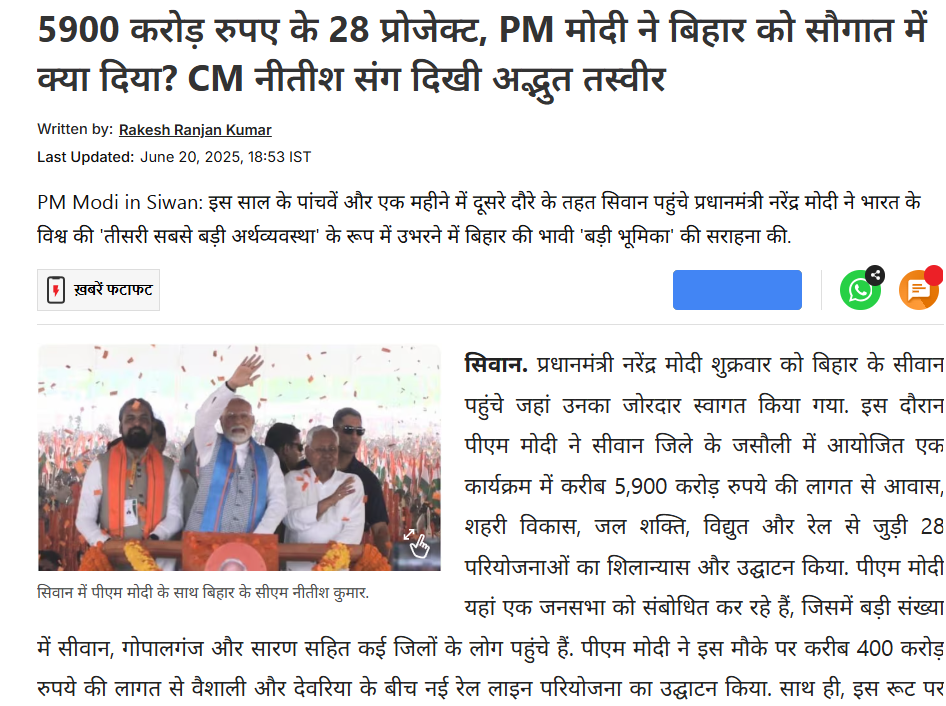
The investigation also found several media reports published on June 20, 2025, which reported that Modi had visited Siwan ahead of the Bihar Assembly elections and inaugurated or laid the foundation stones for development projects worth around Rs 5,900 crore. News18 report on PM Modi’s Siwan visit
The original footage therefore establishes that the scene was related to Modi’s welcome in Siwan and not to the playing of the national anthem.
Conclusion
The claim that Prime Minister Narendra Modi disrespected the national anthem by walking during its rendition is false. The original footage does not contain the national anthem. The audio heard in the viral clip has been added separately to the video, creating a false impression about the incident.

Related Blogs

Executive Summary
A video is going viral on social media showing a massive building engulfed in flames and collapsing into debris. It is being widely claimed that Iran launched a powerful attack that destroyed Israel’s army headquarters. However, research by CyberPeace reveals that this claim is misleading. The viral video is AI-generated and has no connection to any real-world event.
Claim
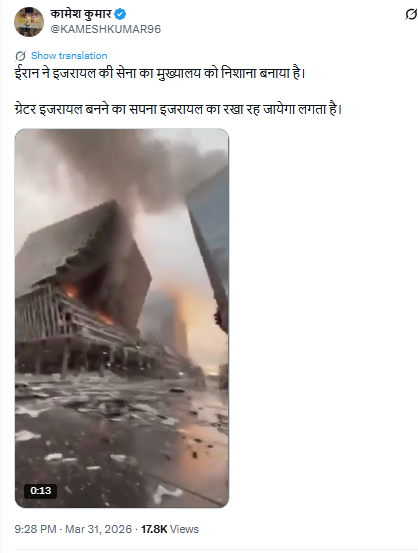
An X (formerly Twitter) user shared the viral video with the caption: “Iran has targeted Israel’s army headquarters. It seems Israel’s dream of becoming ‘Greater Israel’ will remain unfulfilled.”
Post link:
- https://x.com/KAMESHKUMAR96/status/2039009484069368083
Archived version:
- https://archive.ph/HKXkK
- https://x.com/KAMESHKUMAR96/status/2039009484069368083
- https://archive.ph/HKXkK
Similar videos have also been shared by other users on social media:
Fact Check
To verify the claim, we extracted keyframes from the viral video and conducted a reverse image search. During this process, we found several credible media reports confirming that Iran has carried out drone and missile attacks on Israel and the Gulf regions in recent times. However, none of these reports featured the viral video, indicating that it is not authentic footage.

- https://www.youtube.com/watch?v=fxDBX90bYng
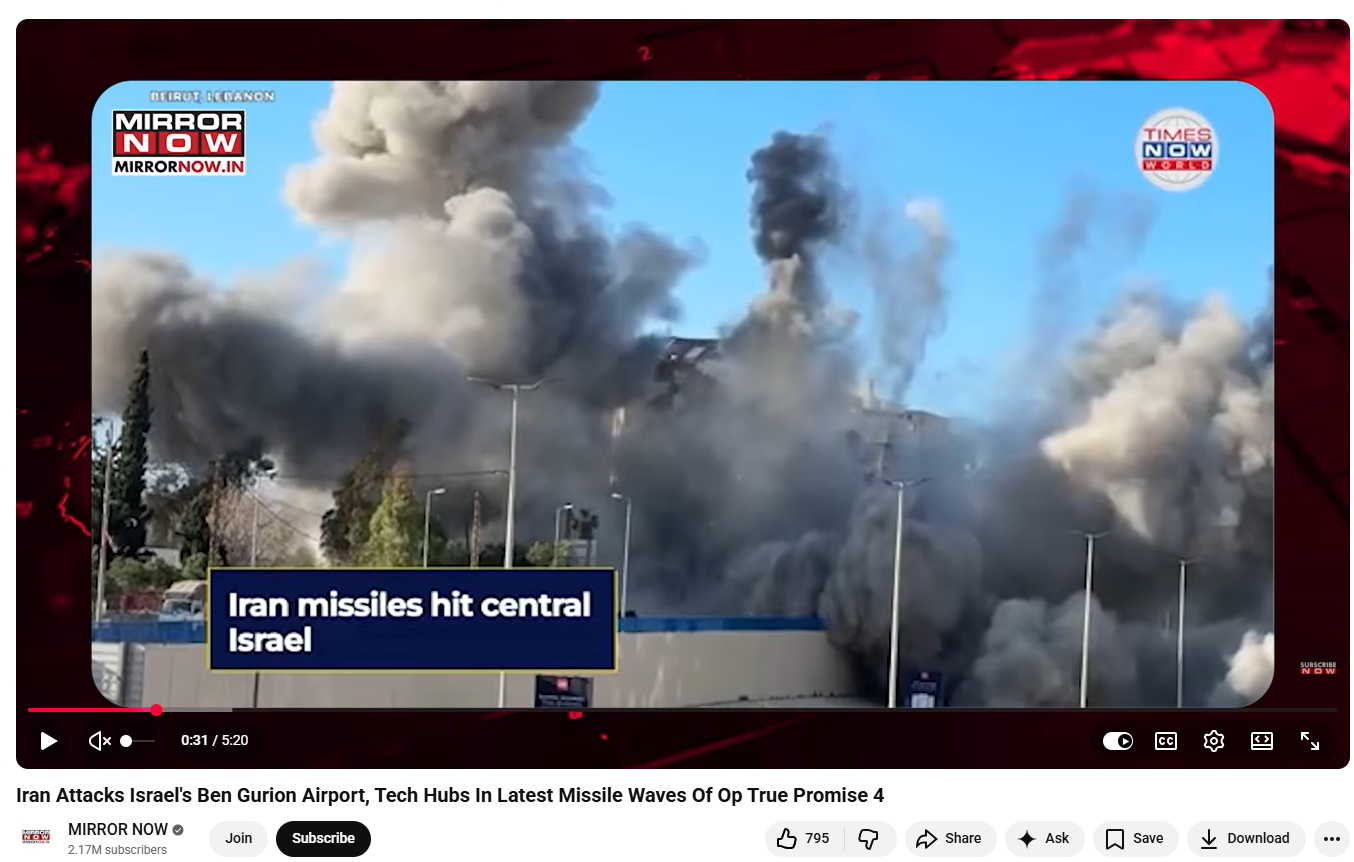
A closer examination of the video revealed multiple visual inconsistencies commonly associated with AI-generated content. For instance, a building on the left side appears to bend and collapse in a rubber-like manner—something that is physically unrealistic for structures made of concrete and steel. Additionally, the smoke and flames appear unnatural and lack realistic dynamics.
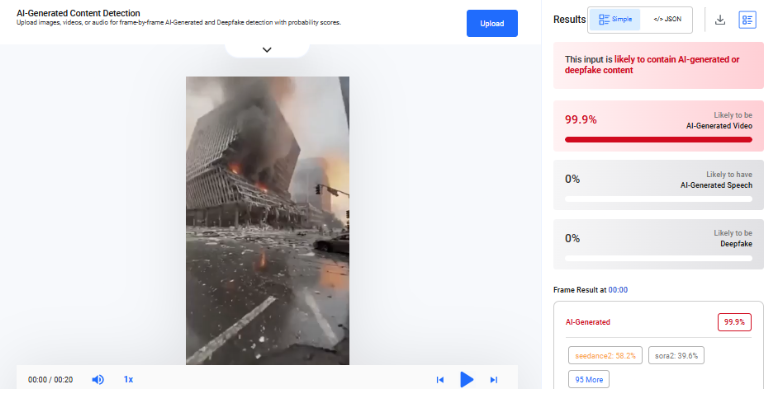
To further verify, we analyzed the video using the AI detection tool Hive Moderation, which classified it as 99.9% AI-generated.
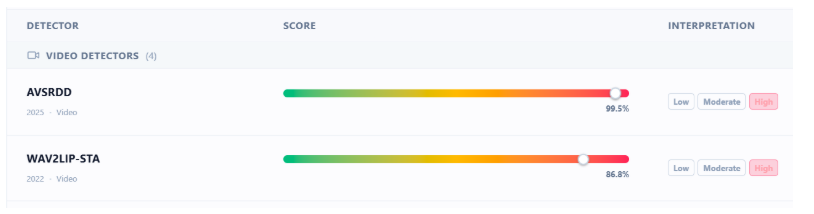
We also tested the video using the Deepfake-o-Meter platform.The AVSRDD (2025) model detected it as 99.5% AI-generated
Conclusion
Our research clearly establishes that the viral video claiming Iran destroyed Israel’s army headquarters is false and misleading. The footage does not appear in any credible news coverage of recent attacks, which strongly indicates that it is not real. Moreover, multiple AI detection tools consistently classify the video as artificially generated, with extremely high probability scores. Visual anomalies in the clip further support this finding.

Introduction
Sexual Offences against children have recently come under scrutiny after the decision of the Madras High Court which has ruled that watching and downloading child sexual porn is an inchoate crime. In response, the Supreme Court, on 23 September 2024, ruled that Section 15 of the POCSO and Section 67B of the IT Act penalise any form of use of child pornography, including storing and watching such pornographic content. Along with this, the Supreme Court has further recommended replacing the term “Child Pornography” which it said acts as a misnomer and does not capture the full extent of the crime, with a more inclusive term “Child Sexual Exploitative and Abuse Material” (CESAM). This term would more accurately reflect the reality that these images and videos are not merely pornographic but are records of incidents, where a child has either been sexually exploited and abused or where any abuse of children has been portrayed through any self-generated visual depiction.
Intermediaries cannot claim exemption from Liability U/S 79
Previously, intermediaries claimed safe harbour by only complying with the requirements stipulated under the MOU. As per the decision of the SC, now, an intermediary cannot claim exemption from the liability under Section 79 of the IT Act for any third-party information, data, or communication link made available or hosted by it unless due diligence is conducted by it and compliance is made of these provisions of the POCSO Act. This is as per the provisions of Sections 19 and 20 of the POCSO read with Rule 11 of the POCSO Rules which have a mandatory nature.
The due diligence under section 79 of the IT Act includes the removal of child pornographic content and immediate reporting of such content to the concerned police units in the manner specified under the POCSO Act and the Rules. In this way, the Supreme Court has broadened the Interpretation and scope of the ‘Due Diligence’ obligation under section 79 of the IT Act. It was also stated that is to be duly noted that merely because an intermediary complies with the IT Act, will not absolve it of any liability under the POCSO. This is unless it duly complies with the requirements and procedure set out under it, particularly Section 20 of the POCSO Act and Rule 11 of the POCSO Rules.
Bar on Judicial Use of the term ‘Child Porn’
Supreme Court found that the term child pornography can be trivialised as pornography is often seen as a consensual act between adults. Supreme Court emphasised using the term Child Sexual Exploitative and Abuse Material (CESAM) as it would emphasise the exploitation of children highlight the criminality of the act and shift the focus to a more robust framework to counter these crimes. The Supreme Court also stated that the Union of India should consider amending the POCSO Act to replace the "child pornography" term with "child sexual exploitative and abuse material" (CSEAM). This would reflect more accurately on the reality of such offences. Supreme Court also directed that the term "child pornography" shall not be used in any judicial order or judgment, and instead, the term "CSEAM" should be endorsed.
Curbing CSEAM Content on Social Media Platforms
Social Media Intermediaries and Expert Organisations play an important role in curbing CESAM content. Per the directions of the Apex Court, a need to impart positive age-appropriate sex education to prevent youth from engaging in harmful sexual behaviours, including the distribution, and viewing of CSEAM is important and all stakeholders must engage in proactive measures to counter these offences which are under the umbrella of CSEAM. This should entail promoting age-appropriated and lawful content on social media platforms and social media platforms to ensure compliance with applicable provisions.
Conclusion
In light of the Supreme Court’s landmark ruling, it is imperative to acknowledge the pressing necessity of establishing a safer online environment that shields children from exploitation. The shift towards using "Child Sexual Exploitative and Abuse Material" (CSEAM) emphasizes the severity of the crime and the need for a vigilant response. The social media intermediaries must respect their commitment to report and remove exploitive content and must ensure compliance with POCSO and IT regulations. Furthermore, comprehensive, age-appropriate sex education can also be used as a preventive measure, educating young people about the moral and legal ramifications of sexual offences, encouraging respect and awareness and ensuring safer cyberspace.
References
- https://www.scconline.com/blog/post/2024/09/23/storing-watching-child-pornography-crime-supreme-court-pocso-it-act/#:~:text=Supreme%20Court%3A%20The%20bench%20of,watching%20of%20such%20pornographic%20content
- https://timesofindia.indiatimes.com/india/supreme-court-viewing-child-porn-is-offence-under-pocso-it-acts/articleshow/113613572.cms
- https://bwlegalworld.com/article/dont-use-term-child-pornography-says-sc-urges-parliament-to-amend-pocso-act-534053
- https://indianexpress.com/article/india/child-pornography-law-pocso-it-supreme-court-9583376/

Artificial Intelligence (AI) provides a varied range of services and continues to catch intrigue and experimentation. It has altered how we create and consume content. Specific prompts can now be used to create desired images enhancing experiences of storytelling and even education. However, as this content can influence public perception, its potential to cause misinformation must be noted as well. The realistic nature of the images can make it hard to discern as artificially generated by the untrained eye. As AI operates by analysing the data it was trained on previously to deliver, the lack of contextual knowledge and human biases (while framing prompts) also come into play. The stakes are higher whilst dabbling with subjects such as history, as there is a fine line between the creation of content with the intent of mere entertainment and the spread of misinformation owing to biases and lack of veracity left unchecked. AI-generated images enhance storytelling but can also spread misinformation, especially in historical contexts. For instance, an AI-generated image of London during the Black Death might include inaccurate details, misleading viewers about the past.
The Rise of AI-Generated Historical Images as Entertainment
Recently, generated images and videos of various historical instances along with the point of view of the people present have been floating all over the internet. Some of them include the streets of London during the Black Death in the 1300s in England, the eruption of Mount Vesuvius at Pompeii etc. Hogne and Dan, two creators who operate accounts named POV Lab and Time Traveller POV on TikTok state that they create such videos as they feel that seeing the past through a first-person perspective is an interesting way to bring history back to life while highlighting the cool parts, helping the audience learn something new. Mostly sensationalised for visual impact and storytelling, such content has been called out by historians for inconsistencies with respect to details particular of the time. Presently, artists admit to their creations being inaccurate, reasoning them to be more of an artistic interpretation than fact-checked documentaries.
It is important to note that AI models may inaccurately depict objects (issues with lateral inversion), people(anatomical implausibilities), or scenes due to "present-ist" bias. As noted by Lauren Tilton, an associate professor of digital humanities at the University of Richmond, many AI models primarily rely on data from the last 15 years, making them prone to modern-day distortions especially when analysing and creating historical content. The idea is to spark interest rather than replace genuine historical facts while it is assumed that engagement with these images and videos is partly a product of the fascination with upcoming AI tools. Apart from this, there are also chatbots like Hello History and Charater.ai which enable simulations of interacting with historical figures that have piqued curiosity.
Although it makes for an interesting perspective, one cannot ignore that our inherent biases play a role in how we perceive the information presented. Dangerous consequences include feeding into conspiracy theories and the erasure of facts as information is geared particularly toward garnering attention and providing entertainment. Furthermore, exposure of such content to an impressionable audience with a lesser attention span increases the gravity of the matter. In such cases, information regarding the sources used for creation becomes an important factor.
Acknowledging the risks posed by AI-generated images and their susceptibility to create misinformation, the Government of Spain has taken a step in regulating the AI content created. It has passed a bill (for regulating AI-Generated content) that mandates the labelling of AI-generated images and failure to do so would warrant massive fines (up to $38 million or 7% of turnover on companies). The idea is to ensure that content creators label their content which would help to spot images that are artificially created from those that are not.
The Way Forward: Navigating AI and Misinformation
While AI-generated images make for exciting possibilities for storytelling and enabling intrigue, their potential to spread misinformation should not be overlooked. To address these challenges, certain measures should be encouraged.
- Media Literacy and Awareness – In this day and age critical thinking and media literacy among consumers of content is imperative. Awareness, understanding, and access to tools that aid in detecting AI-generated content can prove to be helpful.
- AI Transparency and Labeling – Implementing regulations similar to Spain’s bill on labelling content could be a guiding crutch for people who have yet to learn to tell apart AI-generated content from others.
- Ethical AI Development – AI developers must prioritize ethical considerations in training using diverse and historically accurate datasets and sources which would minimise biases.
As AI continues to evolve, balancing innovation with responsibility is essential. By taking proactive measures in the early stages, we can harness AI's potential while safeguarding the integrity and trust of the sources while generating images.
References:
- https://www.npr.org/2023/06/07/1180768459/how-to-identify-ai-generated-deepfake-images
- https://www.nbcnews.com/tech/tech-news/ai-image-misinformation-surged-google-research-finds-rcna154333
- https://www.bbc.com/news/articles/cy87076pdw3o
- https://newskarnataka.com/technology/government-releases-guide-to-help-citizens-identify-ai-generated-images/21052024/
- https://www.technologyreview.com/2023/04/11/1071104/ai-helping-historians-analyze-past/
- https://www.psypost.org/ai-models-struggle-with-expert-level-global-history-knowledge/
- https://www.youtube.com/watch?v=M65IYIWlqes&t=2597s
- https://www.vice.com/en/article/people-are-creating-records-of-fake-historical-events-using-ai/?utm_source=chatgpt.com
- https://www.reuters.com/technology/artificial-intelligence/spain-impose-massive-fines-not-labelling-ai-generated-content-2025-03-11/?utm_source=chatgpt.com
- https://www.theguardian.com/film/2024/sep/13/documentary-ai-guidelines?utm_source=chatgpt.com
