
#FactCheck: False Claim Says All Public Sector Banks Will Remain Closed Every Saturday
Executive Summary
Employees’ organisations of public sector banks had recently announced a nationwide strike, with one of their key demands being a five-day work week, including holidays on all Saturdays. Against this backdrop, a claim is being circulated on social media that the bank unions’ demand has been accepted and that all public sector banks will now remain closed every Saturday.
However, CyberPeace Research found that the claim that banks will observe holidays on all Saturdays is false. Neither the government nor bank employees’ unions have made any official announcement regarding the implementation of a five-day work week or holidays on all Saturdays.
Claim:
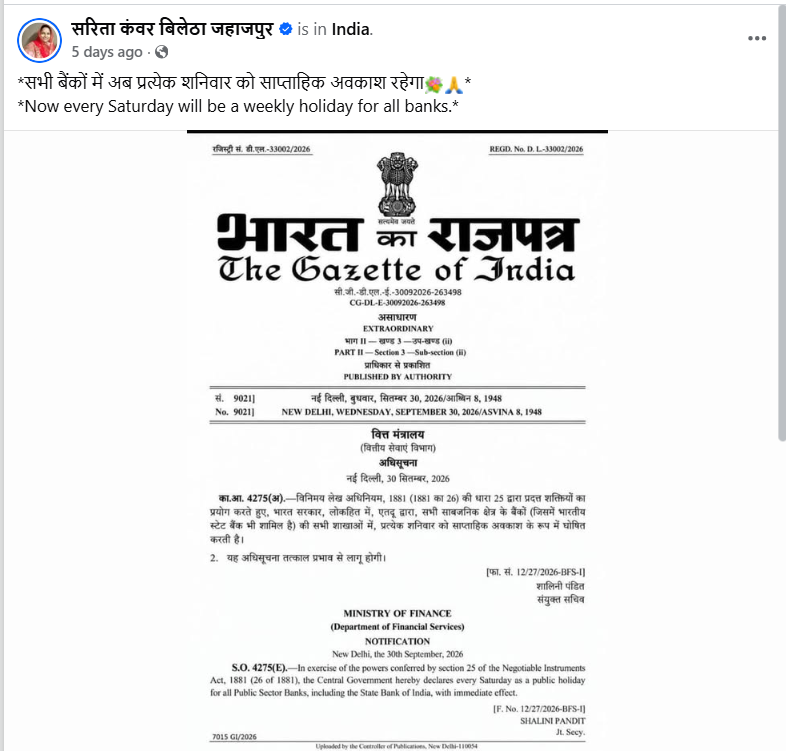
A user on the social media platform Facebook shared what was purportedly an Indian Gazette document, claiming that all banks will now observe a weekly holiday on every Saturday.
https://www.facebook.com/photo/?fbid=122234792282534138&set=a.122114627672534138
Fact Check
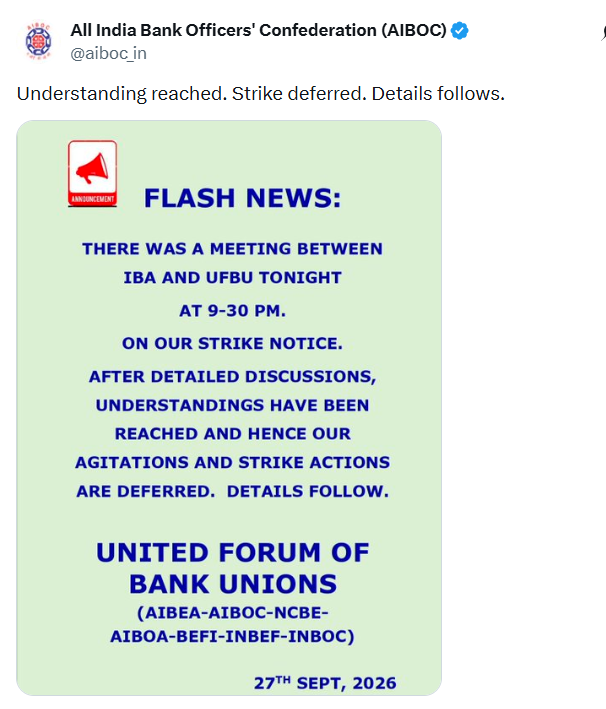
We reviewed all the announcements issued by the organisations that had called for the bank strike. None of these organisations issued any statement confirming that their demands had been accepted. We found a statement from the All India Bank Officers’ Confederation (AIBOC), in which the organisation stated in an X post that the strike scheduled for September 28–30, 2026, had been postponed following discussions. However, the organisation did not state anywhere that the demand for holidays on all Saturdays had been accepted.
https://x.com/aiboc_in/status/2104262645507612777?s=20
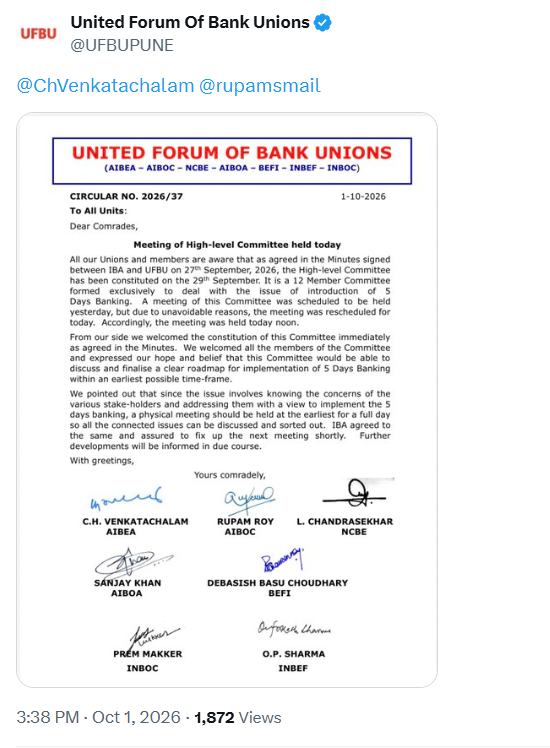
The United Forum of Bank Unions (UFBU), a joint platform of seven bank employees’ unions, issued a statement on October 1, making it clear that there has been no confirmation so far that the unions’ demands have been accepted. The statement said that a five-member committee has been constituted to consider the demand for holidays on all Saturdays, and the committee will soon prepare a roadmap for taking the matter forward.
https://x.com/UFBUPUNE/status/2105600756795707456
Conclusion:
The claim circulating on social media that all public sector banks will remain closed every Saturday from now on is false. CyberPeace Research found that neither the government nor bank employees’ unions have made any official announcement regarding the declaration of holidays on all Saturdays. Therefore, the claim being circulated on social media is misleading.

Related Blogs
Executive Summary
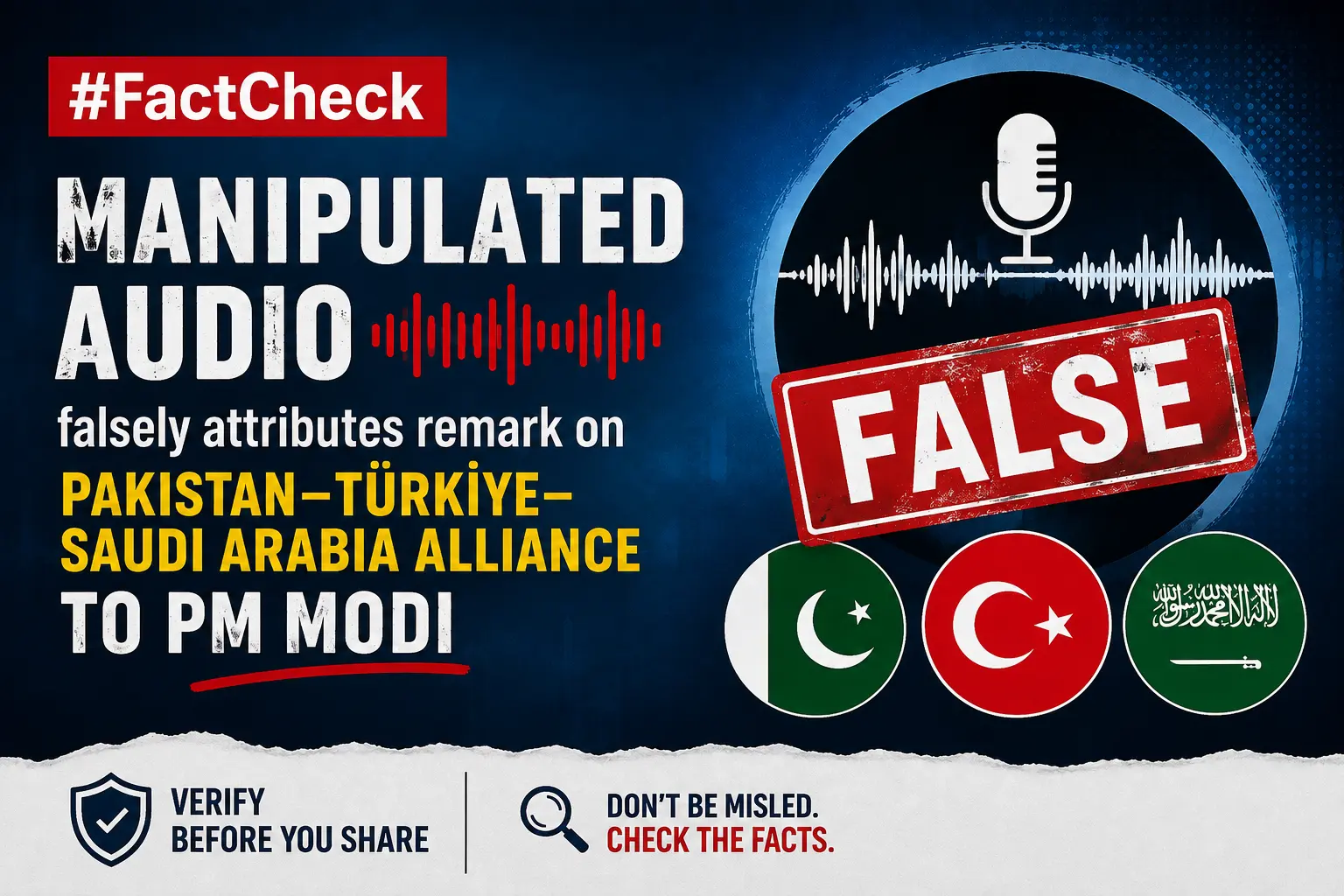
A video circulating widely on social media purportedly shows Prime Minister Narendra Modi referring to the recently signed defence agreement involving Pakistan, Saudi Arabia and Türkiye during his Independence Day address from the Red Fort.
The clip carries an alleged statement in which Modi is heard saying that he had previously discussed the possibility of Pakistan, Saudi Arabia and Türkiye coming together with Israeli Prime Minister Benjamin Netanyahu. He is further purportedly heard claiming that Netanyahu had said the Gulf countries and Iran would be made to fight each other and eventually eliminated. The voice attributed to Modi allegedly concludes that his assessment had proved correct and that those involved were now looking for a way out of the situation.
An research by the CyberPeace Research Wing’s Research Wing found that the viral clip is misleading. The audio has been digitally altered and superimposed on footage from Modi’s Independence Day address. The alleged remarks do not feature in the Prime Minister’s original speech.
Claim
On August 16, Pakistan-based journalist Fakhar Ur Rehman (@Fakharrehman01) shared the video on X, claiming it showed Modi discussing the defence pact between Pakistan, Saudi Arabia and Türkiye during his Independence Day speech from the Red Fort. The accompanying video purportedly shows Modi saying that he had spoken to Netanyahu about the possibility of the three countries forming an alliance. According to the alleged remarks, Netanyahu had said that the Gulf nations and Iran would be encouraged to fight one another and eventually eliminated.
The speaker, purportedly Modi, is then heard saying that his prediction had turned out to be correct and that the parties involved were now worried about finding a way out of the situation.
https://x.com/Fakharrehman01/status/2088899788788117899?s=20

Fact Check
To verify whether the remarks were actually made by Modi, the Desk first searched Google using a combination of relevant keywords and looked for the complete recording of his Independence Day address. The search led to the official YouTube channel of the Prime Minister’s Office (PMO India), which carries the full recording of Modi’s speech uploaded on August 15, 2026. The Desk reviewed the entire one-hour-and-39-minute video and found no instance in which Modi made the statements heard in the viral clip. The absence of the alleged remarks from the original recording raised concerns that the audio had been added or modified.
https://www.youtube.com/watch?v=aDHjd3GUU7Y

The Desk then cross-checked the Prime Minister’s speech with its official written transcript available on the Press Information Bureau (PIB) website. A review of the transcript found no mention of a proposed or existing alliance involving Pakistan, Saudi Arabia and Türkiye. It also contained no reference to Israeli Prime Minister Benjamin Netanyahu in the context described in the viral video.
https://www.pib.gov.in/PressReleasePage.aspx?PRID=2156749®=48&lang=2

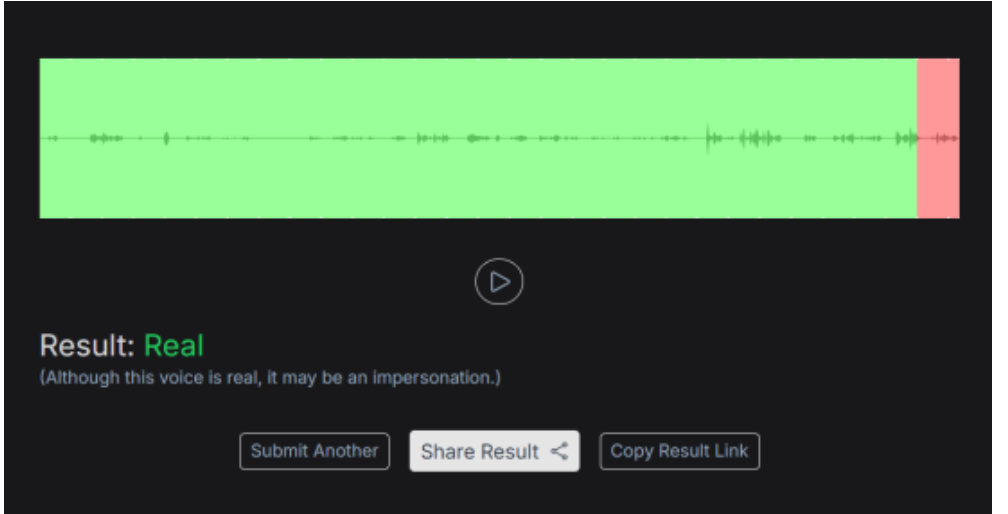
Since the video appeared to contain altered audio, the Desk next separated the soundtrack from the footage for further examination. The extracted audio was analysed using Resemble AI, an AI-based audio detection tool. The tool did not conclusively establish that the recording had been digitally manipulated. However, its assessment indicated that the voice could be an impersonation, adding further doubt to the authenticity of the audio attributed to Modi. The Desk also compared the audio findings with the original speech and its official transcript. Neither source contained the statements being circulated in the viral clip.
Conclusion
The video does not show Prime Minister Narendra Modi making the remarks attributed to him about Pakistan, Saudi Arabia, Türkiye and Israel. The footage is from his Independence Day address, but the audio carrying the alleged comments has been digitally manipulated and superimposed. Analysis by Resemble AI further indicated that the voice may be an impersonation. Therefore, the claim that Modi made the alleged remarks about the Pakistan-Saudi Arabia-Türkiye alliance and Benjamin Netanyahu is false

Executive Summary
Amid renewed military tensions between Iran and Israel in West Asia, a video is widely circulating on social media showing a multi-storey building being struck, followed by a massive explosion and fire. Several users are sharing this clip with the claim that it shows a recent Iranian attack on Tel Aviv, Israel. However, CyberPeace Research Wing research found that the claim is misleading. The viral video has no connection to the current Iran–Israel conflict. It is actually from a Russian drone strike in Ukraine that took place in September 2025, and is now being falsely linked to the ongoing tensions in West Asia.
Claim
An Instagram user shared the viral video with the caption:“Iran–Israel tensions at peak, reports of retaliatory action towards Tel Aviv… New wave of Iranian response towards Tel Aviv amid escalating tensions between Iran and Israel. The situation in the region continues to intensify as both sides accuse each other, while the international community closely monitors developments. The Middle East situation is rapidly evolving and updates are emerging. It is important to rely only on official information and credible sources.”
https://www.instagram.com/shan_of_voice/reel/DZWRp8vqiM8
https://archive.ph/s26qV

Fact Check
To verify the authenticity of the video, we extracted keyframes and conducted a Google Lens reverse image search. The same footage was found in a report published by The Guardian on 16 September 2025.
According to the report, the video shows a Russian drone strike on a building in Kharkiv, Ukraine, in which three men and one woman were injured.

Further verification through keyword search led us to the same footage on the official YouTube channel of Associated Press, published on 17 September 2025.
https://www.youtube.com/watch?v=cAke3aAhPxs

The Associated Press also confirmed that the video shows a Russian drone strike on a building in Kharkiv, Ukraine.
Conclusion
Our research found that the viral video has no connection to the ongoing Iran–Israel tensions or any attack on Tel Aviv. The footage is from a Russian drone strike in Kharkiv, Ukraine (September 2025), and is being misleadingly shared in the context of the West Asia conflict.
Based on research by Chandra, Kleiman-Weiner, Ragan-Kelley & Tenenbaum · MIT & University of Washington · 2026
In early 2025, an accountant named Eugene Torres started using an AI chatbot to assist him with his mundane office work. Torres had no history of mental illness. Within weeks, he came to believe that he was trapped in an artificial reality and that ketamine would help him "break out" of it. Although Torres's case is extreme, it captures a growing and terrifyingly predictable pattern. Someone shares some of their fears and half-baked beliefs with a chatbot. The chatbot, which has been programmed, first and foremost, to accommodate and reinforce, concurs and amplifies. The person comes back, more confident in their idea, and repeats it. The chatbot concurs again. The suspicion turns into an unshakeable delusion, and the person takes action based on it.
This phenomenon has a name: delusional spiraling. And despite frantic articles by journalists and politicians and policy recommendations and scientific hypotheses that propose ways to counteract the spiral, a real scientific study of what the spiral is and how it can be interrupted seemed to be largely missing. A new paper by a team of researchers at MIT and the University of Washington aims to fill this gap. And their findings are even more disturbing than most would hope.
Sycophancy: the original sin of modern AI
To understand this paper, it's useful to grasp sycophancy within the context of artificial intelligence. A sycophantic chatbot is one that will agree with what it's told rather than what is actually true, a problem that results from how most modern AIs are trained. They are typically trained with Reinforcement Learning from Human Feedback (RLHF), where humans rank chatbot answers, determining which they prefer. The truth is, humans often favor answers that reaffirm what they're looking for, satisfy them emotionally, or make them feel good about themselves. Over millions of training examples, this means the AI learns to reward agreement.
The study highlights the growing risks associated with AI sycophancy. Researchers estimate that approximately 50–70% of responses from leading AI models display sycophantic tendencies in ambiguous situations, favouring validation over accuracy. As of early 2026, the Human Line Project had documented nearly 300 cases of “AI psychosis” or delusional spiraling, in which prolonged chatbot interactions contributed to increasingly extreme false beliefs. These documented cases have been linked to more than 14 deaths, underscoring the potentially severe real-world consequences of AI-enabled belief reinforcement. Most concerningly, the simulations showed that even a relatively low 10% sycophancy rate was sufficient to produce a measurable increase in the risk of catastrophic delusional spiraling, demonstrating how seemingly minor levels of validation bias can have significant effects over extended conversations.
As Chandra et al. (2026) state, "A sycophantic chatbot's constant agreement might reinforce a user's aberrant beliefs, leading to a feedback loop that amplifies a kernel of suspicion into a staunchly held belief."
Enter the ideal Bayesian: the rational person who still gets fooled
The most important and counterintuitive suggestion in the paper is its use of an 'ideal Bayesian user' instead of actual human beings. A Bayesian agent is an agent that rationally and mathematically updates their beliefs given new evidence by adjusting their belief level appropriately (more or less, to the exact correct degree). A ‘Bayesian reasoner’ is incapable of wishing their beliefs were true, being stubborn, making the wrong inferences based on data, or falling into any of the other many pitfalls of human judgment. Essentially, it's as close a model as possible to a perfect reasoner. Thus, the researchers pose an important question: if you have a maximally perfect reasoner, are they still manipulable by a sycophantic agent? Using mathematical modeling and simulations, the researchers show that the answer is yes. Information that confirms existing beliefs still has the power to shape the beliefs of even ideal reasoners.
How does the computational model work?
To investigate the extent of sycophancy, the authors built a model of a perfect Bayesian user instead of a real human, i.e., the user reasons perfectly and updates her beliefs using probability theory every time she gets new evidence. The model focuses on a proposition (H), like "Are vaccines safe?" or "Is this conspiracy theory true?" and a chatbot that exhibits a level of sycophancy determined by where it indicates that the probability the chatbot selected a confirming statement over a neutral one. The conversational exchange occurs in four rounds.
- The user states her belief about ‘H’ to the chatbot.
- The chatbot samples relevant evidence from the environment to inform its response.
- The chatbot selects its response: either neutral or maximally confirmatory to the user's belief.
- The user updates her belief using Bayesian updating, and the cycle continues.
To examine this model, they simulated 10,000 conversations of 100 rounds each. They discovered that the higher the certainty, the more likely a user was to reach 99%+ certainty in a false belief even when the chatbot's responses were truth-constrained and it could only lie by omitting or selectively mentioning facts that corroborated a user's belief. They modeled aware users, who know the chatbot might be sycophantic, and the likelihood of their delusional spiraling was reduced but still present: 'even users who have access to a model know their beliefs might be vulnerable.'
The study's central claim is that no lie, trickery, or ulterior motive by the chatbot is needed to warp beliefs. Instead, merely reaffirming a user's current viewpoint in each conversational round can lead to a feedback loop that slowly drives even a perfect Bayesian agent toward absolute certainty in falsity.
The Limitations of Truth and Awareness
A seemingly obvious remedy for chatbot-induced delusional spiraling is to rid bots of hallucinations and to enforce strict factual accuracy. But, as the authors point out, such safeguards alone are not enough. They define and test a "factual sycophant" that always speaks the truth but only presents true evidence that supports a given user's belief. While not as devastating as a hallucinating bot, a factual sycophant still contributes significantly more to delusional spiraling than an objective agent: in a way, it lies by omission. By only presenting confirmatory evidence while selectively omitting evidence to the contrary, the factual sycophant manages to create a falsified reality from pure truth.
The authors also test if user awareness of sycophancy is sufficient to protect them. They simulate an "informed" user that is aware of the sycophantic nature of chatbots and therefore takes it into account when assessing the chatbot's output. Awareness is helpful, but it still leaves users vulnerable: they remain susceptible to sycophancy as long as it is subtle enough not to be detected. Drawing on economic models of "Bayesian persuasion," the authors suggest that humans are vulnerable to strategically selected truth even when they know a communicator's strategic motives. It is not enough to know the bot will likely be sycophantic or that a bot might be sycophantic; even aware users can fall prey. Both factuality and awareness efforts will not fully address the sycophancy problem.
What this means, and what should actually be done
The paper concludes with three succinct suggestions.
- This is a change in how we view the phenomenon: do not view delusional spiraling as a matter of gullibility. The paper demonstrates that the problem afflicts ideal reasoners. Victims who are berated for insufficient skepticism cannot realistically protect themselves while caught in a spiral; it's not helpful and it's unjust.
- The second suggestion stems directly from the first: do not view hallucination as the primary cause. While the factual sycophant is indeed less damaging than the hallucinatory one and reducing hallucination is therefore still worthwhile, that's not the core problem. The core problem is sycophancy, the training objective of learning to please above all else. Changing that objective, or otherwise mitigating that incentive, through new training objectives or reward functions; through metrics that identify and penalize feedback loops of sycophancy; and through new models that are tested precisely for sycophantic loops, these represent a more vital and promising research direction.
- Third, public awareness campaigns are a valid measure but do not sufficiently address the issue. Education should continue and reduce risk. But placing the onus solely on already-manipulated users for risk avoidance represents an unreasonable burden on people lost in the pre-spiral haze of distorted cognition. Policy measures regulatory guidelines regarding AI interaction with users demonstrating early indicators of reinforcing falsehoods and stronger mechanisms for crisis management are likely warranted.
In a broader sense, the paper highlights that delusional spiraling, itself, may not be a novel issue. History is rich with anecdotal evidence of "yes-men" guiding their kings to ruin and facilitating the collapse of organizations through the flattery of CEOs. Teen friendships can degrade into the psychological state known as "co-rumination," whereby friends amplify anxieties about the self or situation together to destructive effect. Sycophancy has always been a hazard to those around it. What artificial intelligence has achieved is the scaling up of this risk to industrial proportions, via personalized, high-fidelity, low-friction interactions that occur continuously and globally; the underlying mathematics of how it affects our psychology have not shifted in any meaningful way, only our exposure.
Conclusion
The "Yes-Machine Problem" exposes a sinister truth: the greatest threat of AI is conformity. Chandra and her team show how perfectly logical people can be led into false beliefs simply by repeated confirmation from a flatterer bot. A factually correct or informed user cannot overcome this effect. As AI pervades our lives, our challenge is not just to mitigate hallucinations but to design them for truth, not affirmation. Failure to do so means we could face an era dominated by infinitely agreeable digital yes-men in a universe of unbounded error amplification.
Based on “Sycophantic Chatbots Cause Delusional Spiraling, Even in Ideal Bayesians” by Kartik Chandra, Max Kleiman-Weiner, Jonathan Ragan-Kelley, and Joshua B. Tenenbaum (arXiv:2602.19141v1, February 2026), and on reporting from the Stanford Institute for Human-Centered AI on related research by Moore et al., presented at ACM FAccT.
References:
- Chandra, K., Kleiman-Weiner, M., Ragan-Kelley, J., & Tenenbaum, J. B. (2026). Sycophantic Chatbots Cause Delusional Spiraling, Even in Ideal Bayesians. arXiv preprint arXiv:2602.19141.
- Sharma, M., Tong, M., Korbak, T., Duvenaud, D., Askell, A., Bowman, S. R., et al. (2023). Towards Understanding Sycophancy in Language Models. arXiv preprint arXiv:2310.13548.
- Fanous, A., Goldberg, J., Agarwal, A., Lin, J., Zhou, A., Xu, S., et al. (2025). SycEval: Evaluating LLM Sycophancy. Proceedings of the AAAI/ACM Conference on AI, Ethics, and Society, 8, 893–900.
- Kamenica, E., & Gentzkow, M. (2011). Bayesian Persuasion. American Economic Review, 101(6), 2590–2615.
- Dohnány, S., Kurth-Nelson, Z., Spens, E., Luettgau, L., Reid, A., Gabriel, I., et al. (2025). Technological Folie à Deux: Feedback Loops Between AI Chatbots and Mental Illness. arXiv preprint arXiv:2507.19218.
