
#FactCheck: AI-Generated Footage Fuels False Claim of Strike on Al Udeid Air Base
Executive Summary
The ongoing conflict between the US-Israel and Iran has entered its third week. During this period, Iran reportedly targeted the US military base at Al Udeid in Qatar. Amid this, a video is going viral on social media showing people, vehicles, and chaos following an alleged attack. Some users are sharing it as footage of an Iranian missile strike on the Al Udeid Air Base. However, an research by the CyberPeacefound that the viral video is not real but AI-generated.
Claim:
An Instagram user “thenewscartel” shared the video on March 17, 2026, with the caption: “Al Udeid Air Base, Qatar (March 16, 2026): Iran launched ballistic missiles and drones at the US military’s largest Middle East base near Doha as retaliation for US-Israel strikes in Tehran. Qatar’s Defense Ministry confirmed multiple launches. Most were intercepted by Qatari air defense. One missile landed near the base or in an uninhabited area. No casualties or major damage reported. Explosions were heard in Doha, and smoke was seen in the sky.”

Fact Check:
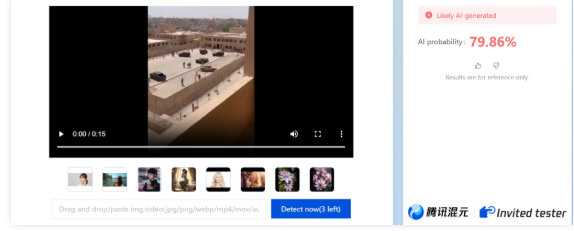
To verify the claim, we closely examined the viral video. We observed multiple visual inconsistencies—one person appears to be walking in reverse, another disappears and reappears, and the body shapes of people distort as they begin to run. These anomalies strongly indicate AI manipulation. We then analyzed the video using the AI detection tool Zhuque AI, which indicated an approximately 80 percent likelihood that the video is AI-generated.
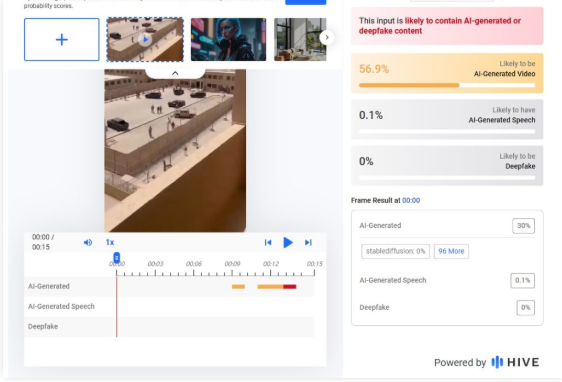
Further analysis using Hive Moderation showed around a 57 percent probability of the video being AI-generated.
Conclusion:
Our research found that the viral video being shared as footage of an Iranian attack on the US military base at Al Udeid in Qatar is AI-generated and not related to any real incident.

Related Blogs

Executive Summary:
A video is widely circulating on social media in which Israel’s Prime Minister Benjamin Netanyahu appears to praise India’s Prime Minister Narendra Modi. The viral clip is being shared with the claim that during a speech delivered on February 25, 2026, Netanyahu announced a special aid package for Afghanistan at the request of PM Modi. However, research by CyberPeace found the claim to be false. The research revealed that the circulating video was generated using artificial intelligence. The probe also confirmed that Netanyahu did not make any announcement related to Afghanistan or the Taliban during the speech.
Claim
On March 1, 2026, a social media user shared the viral video on Facebook claiming that Netanyahu praised PM Modi and announced a special assistance package for Afghanistan following India’s request. The links to the post and its archive are provided below, along with a screenshot.

Fact Check:
To verify the claim, we first searched Google using relevant keywords. However, we did not find any credible media reports supporting the claim that Israel had announced such an aid package for Afghanistan. Next, we extracted key frames from the viral video and performed a reverse image search using Google Lens. During this process, we found the original video on the YouTube channel of VERTEX, which had been uploaded on February 25, 2026.

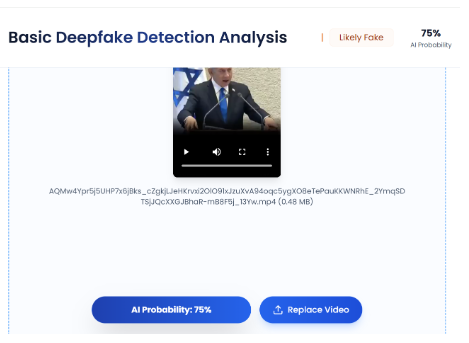
A detailed review of the original video revealed that the viral clip circulating on social media is not part of the original footage. This indicates that the circulating clip has been manipulated and shared with a misleading claim. In the original video, Netanyahu was addressing a special parliamentary session in Jerusalem, where he spoke about the growing trade, strategic cooperation, and strengthening diplomatic relations between India and Israel. He described the partnership between the two democracies as a significant and historic milestone in bilateral relations. Upon carefully listening to the viral clip, we noticed irregularities in the voice and tone, which raised suspicions that it might be AI-generated. We then analyzed the video using the AI detection tool TruthScan. The results indicated that the viral video has approximately a 75% probability of being AI-generated.
Conclusion
Our research found that the viral video was created using artificial intelligence. Moreover, Israel’s Prime Minister Benjamin Netanyahu did not make any announcement regarding Afghanistan or the Taliban during the speech being referenced. The claim circulating on social media is therefore false.

Introduction
The world has been surfing the wave of technological advancements and innovations for the past decade, and it all pins down to one device – our mobile phone. For all mobile users, the primary choices of operating systems are Android and iOS. Android is an OS created by google in 2008 and is supported by most brands like – One+, Mi, OPPO, VIVO, Motorola, and many more and is one of the most used operating systems. iOS is an OS that was developed by Apple and was introduced in their first phone – The iPhone, in 2007. Both OS came into existence when mobile phone penetration was slow globally, and so the scope of expansion and advancements was always in favor of such operating systems.
The Evolution
iOS
Ever since the advent of the iPhone, iOS has seen many changes since 2007. The current version of iOs is iOS 16. However, in the course of creating new iOS and updating the old ones, Apple has come out with various advancements like the App Store, Touch ID & Face ID, Apple Music, Podcasts, Augmented reality, Contact exposure, and many more, which have later become part of features of Android phone as well. Apple is one of the oldest tech and gadget developers in the world, most of the devices manufactured by Apple have received global recognition, and hence Apple enjoys providing services to a huge global user base.
Android
The OS has been famous for using the software version names on the food items like – Pie, Oreo, Nougat, KitKat, Eclairs, etc. From Android 10 onwards, the new versions were demoted by number. The most recent Android OS is Android 13; this OS is known for its practicality and flexibility. In 2012 Android became the most popular operating system for mobile devices, surpassing Apple’s iOS, and as of 2020, about 75 percent of mobile devices run Android.
Android vs. iOS
1. USER INTERFACE
One of the most noticeable differences between Android and iPhone is their user interface. Android devices have a more customizable interface, with options to change the home screen, app icons, and overall theme. The iPhone, on the other hand, has a more uniform interface with less room for customization. Android allows users to customize their home screen by adding widgets and changing the layout of their app icons. This can be useful for people who want quick access to certain functions or information on their home screen. IOS does not have this feature, but it does allow users to organize their app icons into folders for easier navigation.
2. APP SELECTION
Another factor to consider when choosing between Android and iOS is the app selection. Both platforms have a wide range of apps available, but there are some differences to consider. Android has a larger selection of apps overall, including a larger selection of free apps. However, some popular apps, such as certain music streaming apps and games, may be released first or only available on iPhone. iOS also has a more curated app store, meaning that all apps must go through a review process before being accepted for download. This can result in a higher quality of apps overall, but it can also mean that it takes longer for new apps to become available on the platform. iPhone devices tend to have less processing power and RAM. But they are generally more efficient in their use of resources. This can result in longer battery life, but it may also mean that iPhones are slower at handling multiple tasks or running resource-intensive apps.
3. PERFORMANCE
When it comes to performance, both Android and iPhone have their own strengths and weaknesses. Android devices tend to have more processing power and RAM. This can make them faster and more capable of handling multiple tasks simultaneously. However, this can also lead to Android devices having shorter battery life compared to iPhones.
4. SECURITY
Security is an important consideration for any smartphone user, and Android and iPhone have their own measures to protect user data. Android devices are generally seen as being less secure than iPhones due to their open nature. Android allows users to install apps from sources other than the Google Play Store, which can increase the risk of downloading malicious apps. However, Android has made improvements in recent years to address this issue. Including the introduction of Google Play Protect, which scans apps for malware before they are downloaded. On the other hand, iPhone devices have a more closed ecosystem, with all apps required to go through Apple‘s review process before being available for download. This helps reduce the risk of downloading malicious apps, but it can also limit the platform’s flexibility.
Conclusion
The debate about the better OS has been going on for some time now, and it looks like it will get more comprehensive in the times to come, as netizens go deeper into cyberspace, they will get more aware and critical of their uses and demands, which will allow them to opt for the best OS for their convenience. Although the Andriod OS, due to its integration, stands more vulnerable to security threats as compared to iOS, no software is secure in today’s time, what is secure is its use and application hence the netizen and the platforms need to increase their awareness and knowledge to safeguard themselves and the wholesome cyberspace.

Introduction
Assisted Reproductive Technology (“ART”) refers to a diverse set of medical procedures designed to aid individuals or couples in achieving pregnancy when conventional methods are unsuccessful. This umbrella term encompasses various fertility treatments, including in vitro fertilization (IVF), intrauterine insemination (IUI), and gamete and embryo manipulation. ART procedures involve the manipulation of both male and female reproductive components to facilitate conception.
The dynamic landscape of data flows within the healthcare sector, notably in the realm of ART, demands a nuanced understanding of the complex interplay between privacy regulations and medical practices. In this context, the Information Technology (Reasonable Security Practices And Procedures And Sensitive Personal Data Or Information) Rules, 2011, play a pivotal role, designating health information as "sensitive personal data or information" and underscoring the importance of safeguarding individuals' privacy. This sensitivity is particularly pronounced in the ART sector, where an array of personal data, ranging from medical records to genetic information, is collected and processed. The recent Assisted Reproductive Technology (Regulation) Act, 2021, in conjunction with the Digital Personal Data Protection Act, 2023, establishes a framework for the regulation of ART clinics and banks, presenting a layered approach to data protection.
A note on data generated by ART
Data flows in any sector are scarcely uniform and often not easily classified under straight-jacket categories. Consequently, mapping and identifying data and its types become pivotal. It is believed that most data flows in the healthcare sector are highly sensitive and personal in nature, which may severely compromise the privacy and safety of an individual if breached. The Information Technology (Reasonable Security Practices And Procedures And Sensitive Personal Data Or Information) Rules, 2011 (“SPDI Rules”) categorizes any information pertaining to physical, physiological, mental conditions or medical records and history as “sensitive personal data or information”; this definition is broad enough to encompass any data collected by any ART facility or equipment. These include any information collected during the screening of patients, pertaining to ovulation and menstrual cycles, follicle and sperm count, ultrasound results, blood work etc. It also includes pre-implantation genetic testing on embryos to detect any genetic abnormality.
But data flows extend beyond mere medical procedures and technology. Health data also involves any medical procedures undertaken, the amount of medicine and drugs administered during any procedure, its resultant side effects, recovery etc. Any processing of the above-mentioned information, in turn, may generate more personal data points relating to an individual’s political affiliations, race, ethnicity, genetic data such as biometrics and DNA etc.; It is seen that different ethnicities and races react differently to the same/similar medication and have different propensities to genetic diseases. Further, it is to be noted that data is not only collected by professionals but also by intelligent equipment like AI which may be employed by any facility to render their service. Additionally, dissemination of information under exceptional circumstances (e.g. medical emergency) also affects how data may be classified. Considerations are further nuanced when the fundamental right to identity of a child conceived and born via ART may be in conflict with the fundamental right to privacy of a donor to remain anonymous.
Intersection of Privacy laws and ART laws:
In India, ART technology is regulated by the Assisted Reproductive Technology (Regulation) Act, 2021 (“ART Act”). With this, the Union aims to regulate and supervise assisted reproductive technology clinics and ART banks, prevent misuse and ensure safe and ethical practice of assisted reproductive technology services. When read with the Digital Personal Data Protection Act, 2023 (“DPDP Act”) and other ancillary guidelines, the two legislations provide some framework regulations for the digital privacy of health-based apps.
The ART Act establishes a National Assisted Reproductive Technology and Surrogacy Registry (“National Registry”) which acts as a central database for all clinics and banks and their nature of services. The Act also establishes a National Assisted Reproductive Technology and Surrogacy Board (“National Board”) under the Surrogacy Act to monitor the implementation of the act and advise the central government on policy matters. It also supervises the functioning of the National Registry, liaises with State Boards and curates a code of conduct for professionals working in ART clinics and banks. Under the DPDP Act, these bodies (i.e. National Board, State Board, ART clinics and banks) are most likely classified as data fiduciaries (primarily clinics and banks), data processors (these may include National Board and State boards) or an amalgamation of both (these include any appropriate authority established under the ART Act for investigation of complaints, suspend or cancellation of registration of clinics etc.) depending on the nature of work undertaken by them. If so classified, then the duties and liabilities of data fiduciaries and processors would necessarily apply to these bodies. As a result, all bodies would necessarily have to adopt Privacy Enhancing Technologies (PETs) and other organizational measures to ensure compliance with privacy laws in place. This may be considered one of the most critical considerations of any ART facility since any data collected by them would be sensitive personal data pertaining to health, regulated by the Information Technology (Reasonable Security Practices And Procedures And Sensitive Personal Data Or Information) Rules, 2011 (“SPDI Rules 2011”). These rules provide for how sensitive personal data or information are to be collected, handled and processed by anyone.
The ART Act independently also provides for the duties of ART clinics and banks in the country. ART clinics and banks are required to inform the commissioning couple/woman of all procedures undertaken and all costs, risks, advantages, and side effects of their selected procedure. It mandatorily ensures that all information collected by such clinics and banks to not informed to anyone except the database established by the National Registry or in cases of medical emergency or on order of court. Data collected by clinics and banks (these include details on donor oocytes, sperm or embryos used or unused) are required to be detailed and must be submitted to the National Registry online. ART banks are also required to collect personal information of donors including name, Aadhar number, address and any other details. By mandating online submission, the ART Act is harmonized with the DPDP Act, which regulates all digital personal data and emphasises free, informed consent.
Conclusion
With the increase in active opt-ins for ART, data privacy becomes a vital consideration for all healthcare facilities and professionals. Safeguard measures are not only required on a corporate level but also on a governmental level. It is to be noted that in the 262 Session of the Rajya Sabha, the Ministry of Electronics and Information Technology reported 165 data breach incidents involving citizen data from January 2018 to October 2023 from the Central Identities Data Repository despite publicly denying. This discovery puts into question the safety and integrity of data that may be submitted to the National Registry database, especially given the type of data (both personal and sensitive information) it aims to collate. At present the ART Act is well supported by the DPDP Act. However, further judicial and legislative deliberations are required to effectively regulate and balance the interests of all stakeholders.
References
- The Information Technology (Reasonable Security Practices And Procedures And Sensitive Personal Data Or Information) Rules, 2011
- Caring for Intimate Data in Fertility Technologies https://dl.acm.org/doi/pdf/10.1145/3411764.3445132
- Digital Personal Data Protection Act, 2023
- https://www.wolterskluwer.com/en/expert-insights/pharmacogenomics-and-race-can-heritage-affect-drug-disposition
