
#FactCheck-Bangladesh Video Falsely Shared as Security Forces Action During West Bengal Elections 2026
Executive Summary
As West Bengal heads for vote counting on May 4, 2026, following the second phase of Assembly polling held on April 29, a video is being widely shared on social media. The clip shows security personnel baton-charging civilians, with users claiming it depicts force being used during the West Bengal Assembly Elections 2026. Research by CyberPeace Research Wing found that the viral claim is misleading. The video is actually from Bangladesh and is being falsely linked to the West Bengal elections to spread confusion.
Claim
A Facebook user named “Adv Mohd Salman” shared the clip on April 29, 2026, using Bengal-related hashtags and claiming that voters standing in line were beaten to influence the election outcome. The post alleged that free and fair voting rights were being suppressed.

Fact Check
To verify the claim, we closely examined the viral video. A vehicle visible in the footage had a registration number written in a non-Hindi script. Using Google Lens reverse image search, we found a matching image uploaded on Alamy on December 30, 2018. The image showed a military vehicle with the same script and registration style seen in the viral clip.
According to the description on the platform, the image was taken in Dhaka during Bangladesh’s national elections and showed Bangladeshi army personnel moving through a street near a polling station. This confirms that the viral footage is not related to the 2026 West Bengal Assembly elections.

Conclusion
Our research confirms that the video showing security personnel baton-charging civilians is from Bangladesh, not West Bengal. It is being falsely shared as footage from the 2026 West Bengal Assembly elections to mislead users.

Related Blogs
Introduction
In today’s hyper-connected world, information spreads faster than ever before. But while much attention is focused on public platforms like Facebook and Twitter, a different challenge lurks in the shadows: misinformation circulating on encrypted and closed-network platforms such as WhatsApp and Telegram. Unlike open platforms where harmful content can be flagged in public, private groups operate behind a digital curtain. Here, falsehoods often spread unchecked, gaining legitimacy because they are shared by trusted contacts. This makes encrypted platforms a double-edged sword. It is essential for privacy and free expression, yet uniquely vulnerable to misuse.
As Prime Minister Narendra Modi rightly reminded,
“Think 10 times before forwarding anything,” warning that even a “single fake news has the capability to snowball into a matter of national concern.”
The Moderation Challenge with End-to-End Encryption
Encrypted messaging platforms were built to protect personal communication. Yet, the same end-to-end encryption that shields users’ privacy also creates a blind spot for moderation. Authorities, researchers, and even the platforms themselves cannot view content circulating in private groups, making fact-checking nearly impossible.
Trust within closed groups makes the problem worse. When a message comes from family, friends, or community leaders, people tend to believe it without questioning and quickly pass it along. Features like large group chats, broadcast lists, and “forward to many” options further speed up its spread. Unlike open networks, there is no public scrutiny, no visible counter-narrative, and no opportunity for timely correction.
During the COVID-19 pandemic, false claims about vaccines spread widely through WhatsApp groups, undermining public health campaigns. Even more alarming, WhatsApp rumors about child kidnappers and cow meat in India triggered mob lynchings, leading to the tragic loss of life.
Encrypted platforms, therefore, represent a unique challenge: they are designed to protect privacy, but, unintentionally, they also protect the spread of dangerous misinformation.
Approaches to Curbing Misinformation on End-to-End Platforms
- Regulatory: Governments worldwide are exploring ways to access encrypted data on messaging platforms, creating tensions between the right to user privacy and crime prevention. Approaches like traceability requirements on WhatsApp, data-sharing mandates for platforms in serious cases, and stronger obligations to act against harmful viral content are also being considered.
- Technological Interventions: Platforms like WhatsApp have introduced features such as “forwarded many times” labels and limits on mass forwarding. These tools can be expanded further by introducing AI-driven link-checking and warnings for suspicious content.
- Community-Based Interventions: Ultimately, no regulation or technology can succeed without public awareness. People need to be inoculated against misinformation through pre-bunking efforts and digital literacy campaigns. Fact-checking websites and tools also have to be taught.
Best Practices for Netizens
Experts recommend simple yet powerful habits that every user can adopt to protect themselves and others. By adopting these, ordinary users can become the first line of defence against misinformation in their own communities:
- Cross-Check Before Forwarding: Verify claims from trusted platforms & official sources.
- Beware of Sensational Content: Headlines that sound too shocking or dramatic probably need checking. Consult multiple sources for a piece of news. If only one platform/ channel is carrying sensational news, it is likely to be clickbait or outright false.
- Stick to Trusted News Sources: Verify news through national newspapers and expert commentary. Remember, not everything on the internet/television is true.
- Look Out for Manipulated Media: Now, with AI-generated deepfakes, it becomes more difficult to tell the difference between original and manipulated media. Check for edited images, cropped videos, or voice messages without source information. Always cross-verify any media received.
- Report Harmful Content: Report misinformation to the platform it is being circulated on and PIB’s Fact Check Unit.
Conclusion
In closed, unmonitored groups, platforms like WhatsApp and Telegram often become safe havens where people trust and forward messages from friends and family without question. Once misinformation takes root, it becomes extremely difficult to challenge or correct, and over time, such actions can snowball into serious social, economic and national concerns.
Preventing this is a matter of shared responsibility. Governments can frame balanced regulations, but individuals must also take initiative: pause, think, and verify before sharing. Ultimately, the right to privacy must be upheld, but with reasonable safeguards to ensure it is not misused at the cost of societal trust and safety.
References
- India WhatsApp ‘child kidnap’ rumours claim two more victims (BBC) The people trying to fight fake news in India (BBC)
- Press Information Bureau – PIB Fact Check
- Brookings Institution – Encryption and Misinformation Report (2021)
- Curtis, T. L., Touzel, M. P., Garneau, W., Gruaz, M., Pinder, M., Wang, L. W., Krishna, S., Cohen, L., Godbout, J.-F., Rabbany, R., & Pelrine, K. (2024). Veracity: An Open-Source AI Fact-Checking System. arXiv.
- NDTV – PM Modi cautions against fake news (2022)
- Times of India – Govt may insist on WhatsApp traceability (2019)
- Medianama – Telegram refused to share ISIS channel data (2019)
The global race for Artificial Intelligence is heating up, and India has become one of its most important battlegrounds. Over the past few months, tech giants like OpenAI (ChatGPT), Google (Gemini), X (Grok), Meta (Llama), and Perplexity AI have stepped up their presence in the country, not by selling their AI tools, but by offering them free or at deep discounts.
At first, it feels like a huge win for India’s digital generation. Students, professionals, and entrepreneurs today can tap into some of the world’s most powerful AI tools without paying a rupee. It feels like a digital revolution unfolding in real time. Yet, beneath this generosity lies a more complicated truth. Experts caution that this wave of “free” AI access isn’t without strings attached. This offering impacts how India handles data privacy, the fairness of competition, and the pace of the development of homegrown AI innovation that the country is focusing on.
The Market Strategy: Free Now, Pay Later
The choice of global AI companies to offer free access in India is a calculated business strategy. With one of the world’s largest and fastest-growing digital populations, India is a market no tech giant wants to miss. By giving away their AI tools for free, these firms are playing a long game:
- Securing market share early: Flooding the market with free access helps them quickly attract millions of users before Indian startups have a chance to catch up. Recent examples are Perplexity, ChatGPT Go and Gemini AI which are offering free subscriptions to Indian users.
- Gathering local data: Every interaction, every prompt, question, or language pattern, helps these models learn from larger datasets to improve their product offerings in India and the rest of the world. Nothing is free in the world - as the popular saying goes, “if something is free, means you are the product. The same goes for these AI platforms: they monetise user data by analysing chats and their behaviour to refine their model and build paid products. This creates the privacy risk as India currently lacks specific laws to govern how such data is stored, processed or used for AI training.
- Create user dependency: Once users grow accustomed to the quality and convenience of these global models, shifting to Indian alternatives, even when they become paid, will be difficult. This approach mirrors the “freemium” model used in other tech sectors, where users are first attracted through free access and later monetised through subscriptions or premium features, raising ethical concerns.
Impact on Indian Users
For most Indians, the short-term impact of free AI access feels overwhelmingly positive. Tools like ChatGPT and Gemini are breaking down barriers by democratising knowledge and making advanced technology available to everyone, from students, professionals, to small businesses. It’s changing how people learn, think and do - all without spending a single rupee.But the long-term picture isn’t quite as simple. Beneath the convenience lies a set of growing concerns:
- Data privacy risks: Many users don’t realise that their chats, prompts, or queries might be stored and used to train global AI models. Without strong data protection laws in action, sensitive Indian data could easily find its way into foreign systems.
- Overdependence on foreign technology: Once these AI tools become part of people’s daily lives, moving away from them gets harder — especially if free access later turns into paid plans or comes with restrictive conditions.
- Language and cultural bias: Most large AI models are still built mainly around English and Western data. Without enough Indian language content and cultural representation, the technology risks overlooking the very diversity that defines India
Impact on India’s AI Ecosystem
India’s Generative AI market, valued at USD $ 1.30 billion in 2024, is projected to reach 5.40 billion by 2033. Yet, this growth story may become uneven if global players dominate early.
Domestic AI startups face multiple hurdles — limited funding, high compute costs, and difficulty in accessing large, diverse datasets. The arrival of free, GPT-4-level models sharpens these challenges by raising user expectations and increasing customer acquisition costs.
As AI analyst Kashyap Kompella notes, “If users can access GPT-4-level quality at zero cost, their incentive to try local models that still need refinement will be low.” This could stifle innovation at home, resulting in a shallow domestic AI ecosystem where India consumes global technology but contributes little to its creation.
CCI’s Intervention: Guarding Fair Competition
The Competition Commission of India (CCI) has started taking note of how global AI companies are shaping India’s digital market. In a recent report, it cautioned that AI-driven pricing strategies such as offering free or heavily subsidised access could distort healthy competition and create an uneven playing field for smaller Indian developers.
The CCI’s decision to step in is both timely and necessary. Without proper oversight, such tactics could gradually push homegrown AI startups to the sidelines and allow a few foreign tech giants to gain disproportionate influence over India’s emerging AI economy.
What the Indian Government Should Do
To ensure India’s AI landscape remains competitive, inclusive, and innovation-driven, the government must adopt a balanced strategy that safeguards users while empowering local developers.
1. Promote Fair Competition
The government should mandate transparency in free access offers, including their duration, renewal terms, and data-use policies. Exclusivity deals between foreign AI firms and telecom or device companies must be closely monitored to prevent monopolistic practices.
2. Strengthen Data Protection
Under the Digital Personal Data Protection (DPDP) Act, companies should be required to obtain explicit consent from users before using data for model training. Encourage data localisation, ensuring that sensitive Indian data remains stored within India’s borders.
3. Support Domestic AI Innovation
Accelerate the implementation of the IndiaAI Mission to provide public compute infrastructure, open datasets, and research funding to local AI developers like Sarvam AI, an Indian company chosen by the government to build the country's first homegrown large language model (LLM) under IndianAI Mission.
4. Create an Open AI Ecosystem
India should develop national AI benchmarks to evaluate all models, foreign or domestic, on performance, fairness, and linguistic diversity. And at the same time, they have their own national data Centre to train their indigenous AI models.
5. Encourage Responsible Global Collaboration
Speaking at the AI Action Summit 2025, the Prime Minister highlighted that governance should go beyond managing risks and should also promote innovation for the global good. Building on this idea, India should encourage global AI companies to invest meaningfully in the country’s ecosystem through research labs, data centres, and AI education programmes. Such collaborations will ensure that these partnerships not only expand markets but also create value, jobs and knowledge within India.
Conclusion
The surge of free AI access across India represents a defining moment in the nation’s digital journey. On one hand, it’s empowering millions of people and accelerating AI awareness like never before. On the other hand, it poses serious challenges from over-reliance on foreign platforms to potential risks around data privacy and the slow growth of local innovation. India’s real test will be finding the right balance between access and autonomy, allowing global AI leaders to innovate and operate here, but within a framework that protects the interests of Indian users, startups, and data ecosystems. With strong and timely action under the Digital Personal Data Protection (DPDP) Act, the IndiaAI Mission, and the Competition Commission of India’s (CCI) active oversight, India can make sure this AI revolution isn’t just something that happens to the country, but for it.
References
- https://www.moneycontrol.com/artificial-intelligence/cci-study-flags-steep-barriers-for-indian-ai-startups-calls-for-open-data-and-compute-access-to-level-playing-field-article-13600606.html#
- https://www.imarcgroup.com/india-generative-ai-market
- https://www.mea.gov.in/Speeches-Statements.htm?dtl/39020/Opening_Address_by_Prime_Minister_Shri_Narendra_Modi_at_the_AI_Action_Summit_Paris_February_11_2025
- https://m.economictimes.com/tech/artificial-intelligence/nasscom-planning-local-benchmarks-for-indic-ai-models/articleshow/124218208.cms
- https://indianexpress.com/article/business/centre-selects-start-up-sarvam-to-build-country-first-homegrown-ai-model-9967243/#

Executive Summary
A video clip carrying the logo of news channel Republic is being shared on social media. In the video, former Bangladesh Prime Minister Sheikh Hasina is allegedly heard saying, "If these radical Muslim terrorists do not back off from imposing terror-based governance over Bangladesh, our goal will be to finish them by any means. I will request Prime Minister Narendra Modi to make Bangla a single province by combining East and West Bengal. We will bring back a secular democracy, which I will lead in the future to restore Bangla to its secular roots." The CyberPeace Research Wing found that the visuals in the viral video are genuine, but the audio has been altered using artificial intelligence (AI) and is being circulated with a false claim.
Claim:
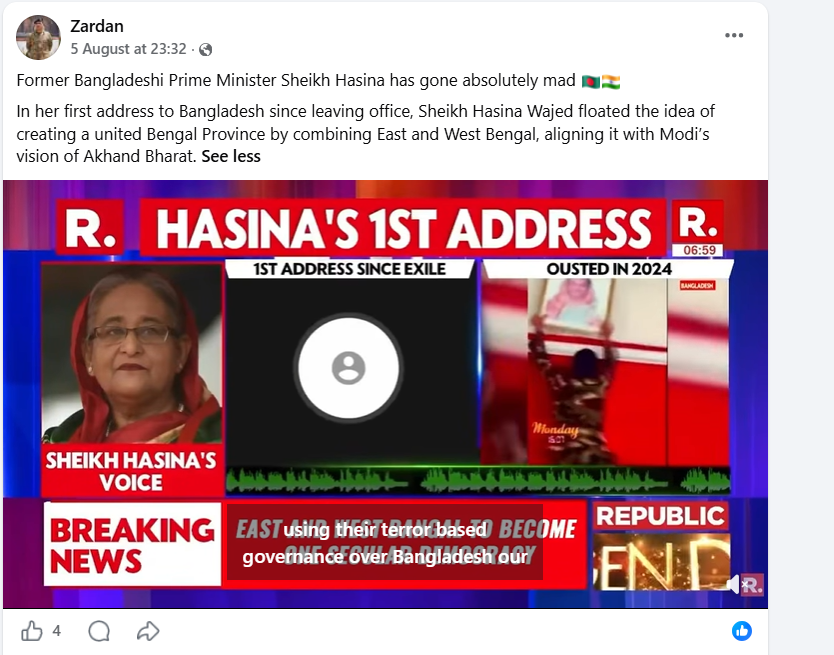
A Facebook user shared the video claiming that Sheikh Hasina proposed merging East and West Bengal to create a single province during her recent address. The link to the post, archive link, and screenshot are provided below.
https://www.facebook.com/reel/1567119714918951
FactCheck
During the research, several key frames from the viral video were extracted and a reverse image search was conducted using Google Lens. The search led us to the original video of Sheikh Hasina’s interaction available on the official social media accounts of Republic News. The link to the post and screenshot are provided below.
https://x.com/republic/status/2084999748755554323?ref_src=twsrc%5Etfw

Republic shared the original video on its official X account on August 5, 2026. A comparison between the viral clip and the original footage revealed that the alleged statement about merging East and West Bengal into a single province does not appear anywhere in the authentic video. In the original video, Sheikh Hasina can be heard discussing the responsibilities of law enforcement agencies during periods of unrest. The controversial audio added to the viral clip is not part of the original recording. Further analysis of the viral video’s audio raised suspicion that it was AI-generated. The video was scanned using the AI detection tool Hive Moderation, which indicated a 91 per cent probability that the speech used in the viral video was AI-generated.
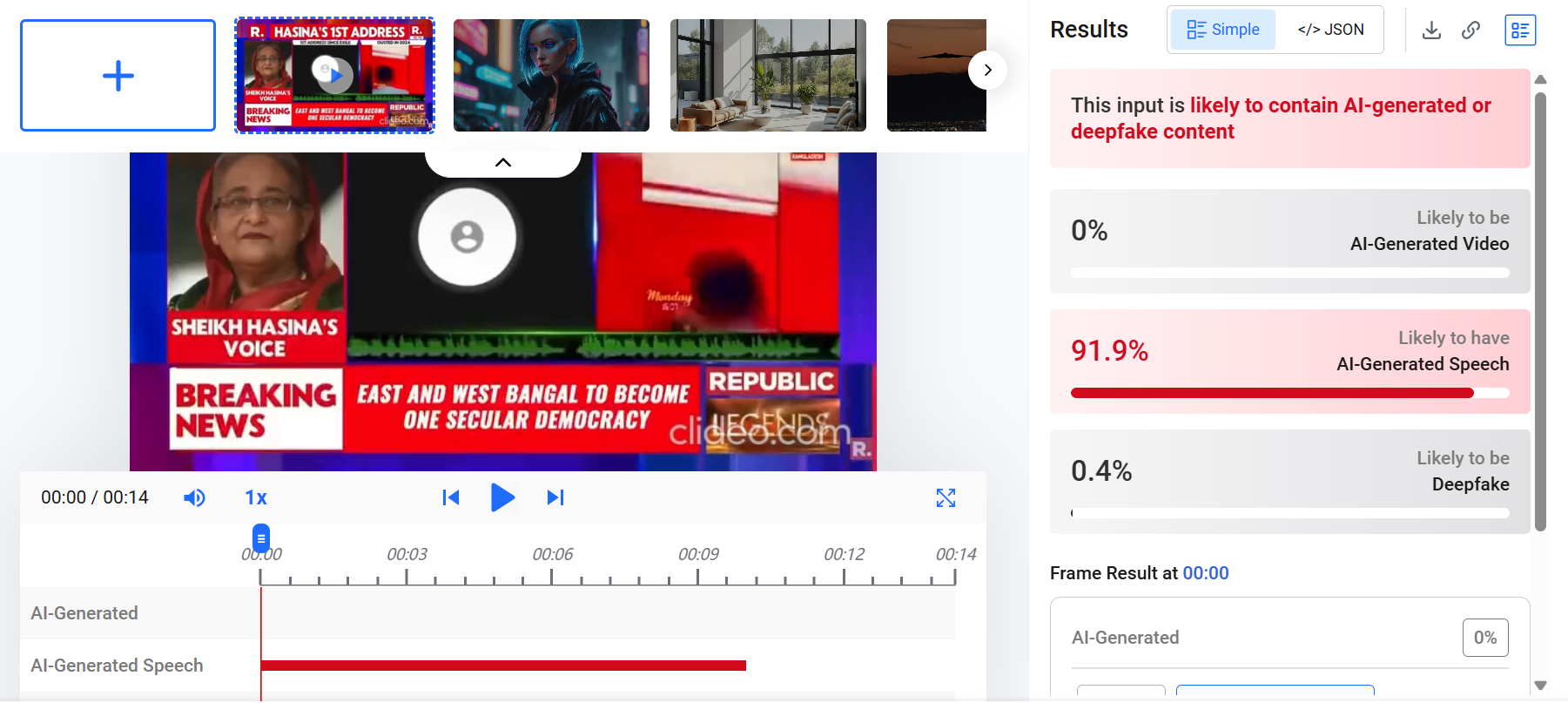
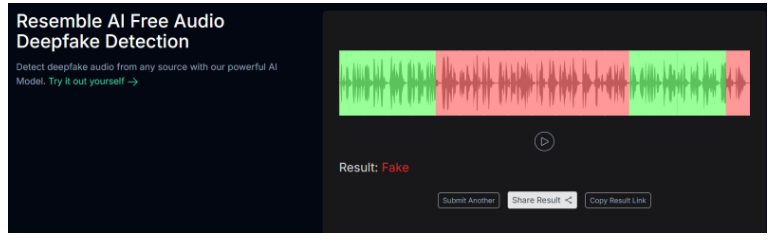
In the next step of the research, the viral audio was analysed using the Resemble AI tool. The results indicated that the audio was likely manipulated, suggesting that it had been altered using artificial intelligence (AI).
Conclusion:
The research found that the visuals used in the viral video are genuine, but the audio has been modified using AI and is being shared with a false claim. The claim that Sheikh Hasina spoke about merging East and West Bengal into a single province is false.
