
#FactCheck: AI-Manipulated Video Falsely Shows Ravish Kumar Criticising CJP, AAP Leaders
Executive Summary
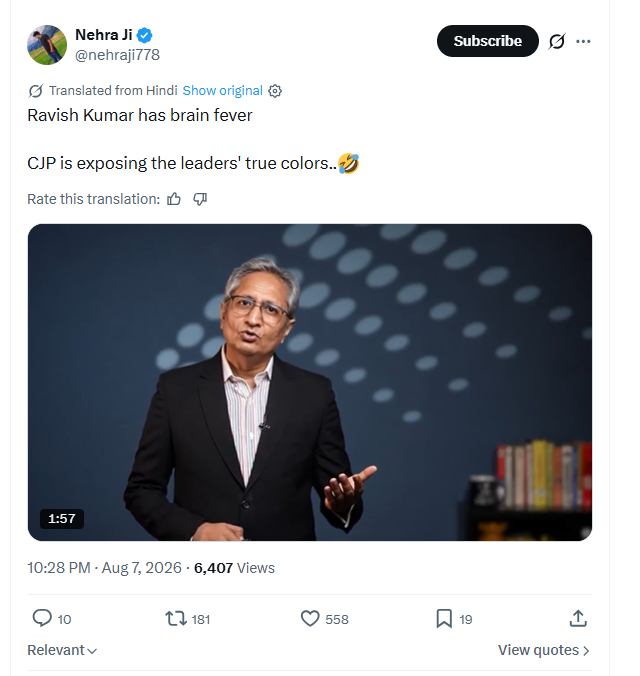
A video of journalist Ravish Kumar is being widely shared on social media. The video is being circulated with the claim that Kumar criticised Abhijeet Deepak, the CJP and Aam Aadmi Party (AAP) leaders over the CJP’s alleged absence from the ongoing student protest in Jharkhand. The CyberPeace Research Wing found the claim to be false. The research established that the original video of Ravish Kumar was digitally manipulated using artificial intelligence (AI), and altered audio was added before it was shared with a misleading claim.
Claim
A user on X (formerly Twitter) shared the viral video on August 7, 2026, with the caption: “Ravish Kumar has brain fever. CJP is exposing the leaders’ true colors.”
https://x.com/nehraji778/status/2085772474915164506
Factcheck
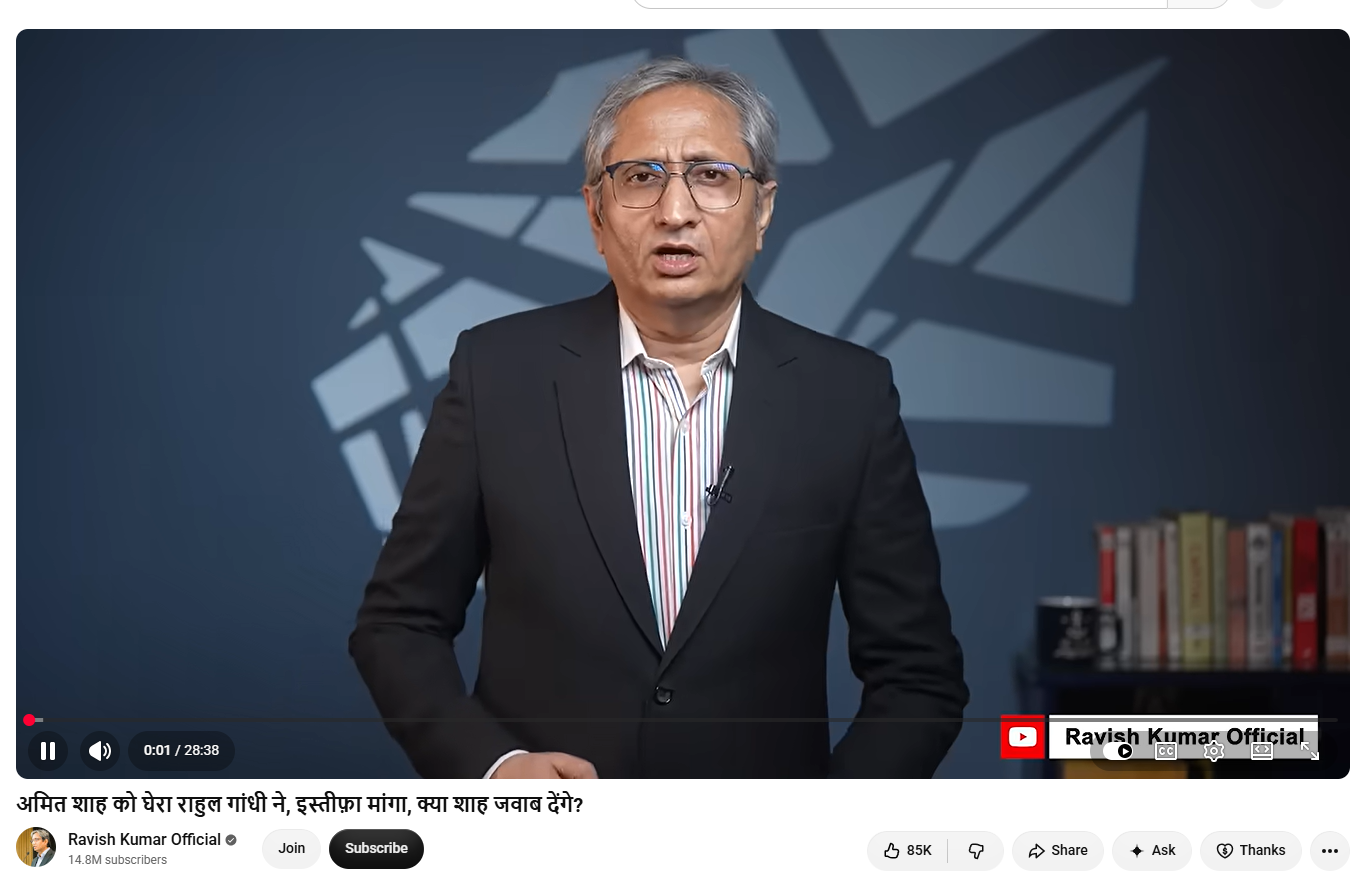
To verify the claim, we extracted several keyframes from the viral video and conducted a reverse image search using Google Lens. During the search, we found a video uploaded on Ravish Kumar’s official YouTube channel on July 29, 2026.
The visuals in the original video match those seen in the viral clip. Ravish Kumar can be seen wearing the same clothes and appearing in almost the same frame as in the viral video.
https://www.youtube.com/watch?v=Rdn_hfyZVRM
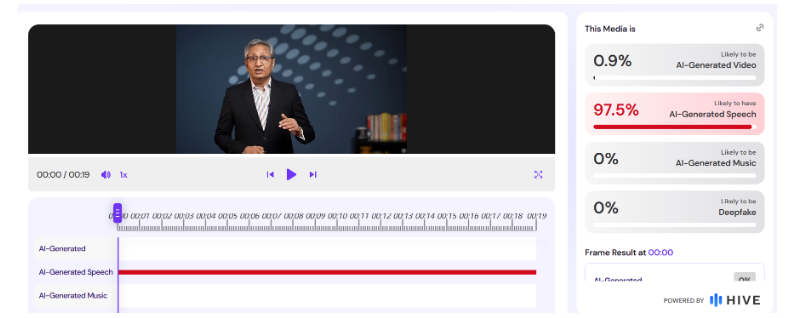
In the next step, we analysed the viral video using Hive Moderation. The tool indicated a 97 per cent probability that the video was AI-generated.
Conclusion
The research found that the viral claim is false. The visuals are taken from a genuine video of Ravish Kumar, but the original footage has been digitally manipulated and altered audio has been added using AI. The modified video is being circulated with a misleading claim that Kumar criticised Abhijeet Deepak, CJP and AAP leaders over the Jharkhand student protest.

Related Blogs

Artificial intelligence tends to attract extreme opinions. Some commentators argue it is eroding our capacity to think. Others believe it is freeing our minds for more valuable work. Both views miss the more important point: the effect of AI depends on how a person chooses to use it. Whether a chatbot supports someone's thinking or replaces it altogether comes down to that choice, and that choice is what separates an assistant from a substitute. Not long ago, generative AI was a novelty. Now it shows up daily in classrooms, newsrooms and offices - almost everywhere people write, plan or make decisions. That kind of shift is exactly why researchers have started looking closely at something harder to see: what happens inside the brain once thinking gets outsourced to a machine. The findings are worth knowing.
What the Brain Scans Actually Showed
One of the clearest pieces of evidence comes out of MIT's Media Lab. The study by Nataliya Kosmyna was carried out for 4 months in 2025 with the participation of all in all, there were 54 participants The fifty four participants were divided into three groups and assigned each group one unique but identical writing task. Group one wrote with ChatGPT open in front of them. The second used a standard search engine. The third had access to nothing but their own knowledge. Throughout, an Electroencephalogram (EEG device) sat on every participant's head, feeding the research team a live picture of brain activity as the essays took shape. It did not take long for the ChatGPT group's readings to pull away from the other two. Activity in regions linked to memory and analytical reasoning dropped noticeably. Several participants struggled later to recall, or even accurately quote, essays they had written only minutes before. Kosmyna's team gave this effect a name: cognitive debt, borrowed from the language of personal finance. The convenience arrives immediately; the cost turns up afterwards, in this case as weakened memory and independent reasoning.
A less-reported result from the same study points the other way. Participants who started the task unaided, then moved on to using ChatGPT, showed higher brain activity than before, not lower. That detail matters. It indicates the tool itself is not the problem. What seems to matter more is the mental effort a person has already put in before turning to AI for help.
Assistant or Substitute? The Line Is Thinner Than You Think
A study published in Frontiers in Psychology in July 2026 offers a useful distinction that extends the MIT findings. The researchers differentiate between dependent offloading, where a task is handed over because a person doubts their own ability to complete it, and autonomous offloading, where a person chooses to delegate part of a task while remaining in control of the overall process.
Dependent offloading, according to the study, gradually undermines a person's sense of competence, since it signals, even quietly, that they cannot manage without help. Autonomous offloading works differently. Here, too, the scientists are relieved to discover that giving a wide birth to any 'hardest' decisions-just taking AI's assistance where it can make an honest contribution-boosts rather than damages the confidence. The same holds for creative output too. The tool does not change between these two scenarios. What changes is who remains in charge of the process.
The Cost Nobody Is Measuring at Work
This pattern is not confined to academic settings. Earlier, in August 2026 the Conversation collated workplace data which brings up similar issues. Around six out of 10 workers don’t receive formal training on using AI and the same number say they have used artificial intelligence irresponsibly (or covertly) as part of their work.
A separate finding, from a July 2026 study by the Centre for AI Safety, adds further weight to this concern. Even the most capable AI agents tested were unable to complete around 85 per cent of assigned projects to a standard fit for paid, professional work. Put next to the workplace training gap, these numbers point to something organisations cannot really ignore. Many employees are trusting output from tools they were never taught to question, built by systems that make more mistakes than most people give them credit for. That is not a case for banning AI at work. It does mean employees need a clearer sense of where these tools are likely to fail, and the training to recognise it when they do.
Building the Habit of Human-Centred AI Use
Translating this research into practice requires a few deliberate habits.
Think before you prompt:Structuring an argument or outline before opening an AI tool matters more than it might seem. Even five minutes of this kind of preparation involves exactly the mental effort that the MIT study found missing in its heaviest AI users.
Treat AI output as a starting point:Whatever output an AI tool provides should be treated as a rough sketch to work on and not a finished product. Facts need checking. Awkward sentences need rewriting in your own words. At the end of the day, the person whose name goes on the piece is the one who answers for what is in it — which by itself is enough reason to go through it carefully before it is sent out.
Preserve AI-free time:A few hours each week, kept free of AI tools entirely, gives planning and brainstorming room to happen without shortcuts. Teams that build this into their schedule, rather than compressing every stage of a project with AI, generally produce stronger work as a result.
Examine the motivation:Using AI to move through an idea faster is one thing. Using it to dodge thinking about a problem altogether is something else. The second habit tends to catch up with people later, often without their noticing at first.
Conclusion
Whether AI functions as a cognitive assistant or a cognitive substitute depends less on the technology itself and more upon the way it is used. Used to support one's own thinking, AI appears to strengthen cognitive engagement. Used as a substitute for effort, it appears to accumulate a quiet cost, one that eventually surfaces in memory, confidence and the overall quality of work produced. The relevant question, each time AI is used, is a straightforward one: is it being used to assist thinking, or to replace it?
References
2. Chow, A. (2025) 'ChatGPT's Impact On Our Brains According to an MIT Study', TIME

Executive Summary
A photo is going viral on social media showing a young man dressed in traditional Arab attire warmly embracing an elderly woman. The post claims that the man flew in from Saudi Arabia to Kerala just to meet his “Hindu mother,” portraying the image as a heartwarming example of communal harmony. However, research by the CyberPeace found that the claim being shared with the image is misleading.
Claim
The viral post narrates an emotional story, alleging that years ago a Hindu woman from Kerala worked in Saudi Arabia caring for children and loved a young boy like her own son. After she returned to India, the boy—now grown up—reportedly searched for her for months, booked a flight, and finally reached Kerala to reunite with her. The post describes an emotional reunion filled with tears, affection, and a bond beyond religion and nationality.

Fact Check
A reverse image search of the viral picture led us to a video uploaded on August 18, 2023, on the YouTube channel of social media influencer Hashim Abbas. In the video, he is seen meeting and hugging the elderly woman while extending Onam greetings.

Further examination of Hashim Abbas’ social media accounts revealed several other videos from his Kerala visit. Our research also found that Abbas played a significant role in the Malayalam film Kondotty Pooram.

Additionally, we found a video posted on August 13, 2023, by actress and theatre artist Sandhya Rajendran, daughter of veteran Malayalam actress Vijayakumari. The video shows Vijayakumari teaching Onam songs to Hashim Abbas.

Conclusion
The evidence clearly establishes that the viral claim is misleading. The man seen in the image is Hashim Abbas, who was meeting senior Malayalam actress Vijayakumari to extend Onam greetings. The emotional story about a son flying from Saudi Arabia to reunite with his Hindu mother is fictional and not connected to the viral image.

Executive Summary
A video showing a building collapse is going viral on social media. It is being shared as footage of a tragic incident that took place in Satya Niketan, Delhi. The video is accompanied by claims that it shows the building collapse in Satya Niketan. However, a research by CyberPeace’s Research Wing found that the viral video is not from the incident in Satya Niketan, Delhi. The research revealed that the video is actually from Moradabad, Uttar Pradesh, where a building collapsed on September 5, 2026. Clear similarities were found between the viral video and visuals from the incident in Moradabad. This confirms that an old video is being shared on social media with a false context, linking it to the incident in Satya Niketan, Delhi.
Claim:
A user shared the viral video on YouTube with the caption: “Major accident in Delhi! A five-storey building collapsed.”
https://www.youtube.com/shorts/1qeW-pFoMd4

Fact Check
While investigating the viral video, we conducted a reverse image search using its keyframes. This led us to the same video, which was uploaded on an Instagram account on September 5, 2026. The text visible in the video identified the location as Moradabad, Uttar Pradesh.
https://www.instagram.com/p/Dc54OW2SOh3/

In the next stage of our research, we found the video on Republic Bharat’s Instagram channel, where it was also identified as being from Moradabad.
https://www.instagram.com/reels/Dc8XTlpgaRL/

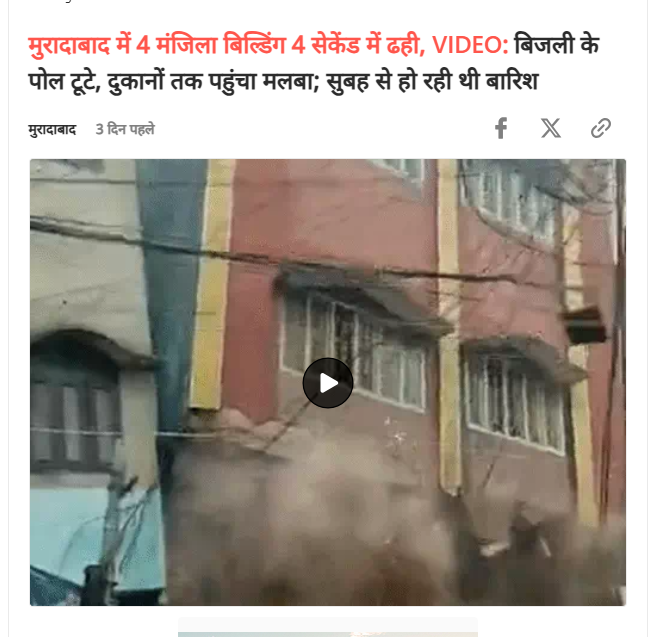
Based on the information gathered above, a keyword search led us to a report published by Dainik Bhaskar on September 5, 2026. The report also contained visuals matching those seen in the viral video. According to the Dainik Bhaskar report, on September 5, 2026, a four-storey dilapidated building collapsed in the Mughalpura area of Moradabad amid heavy rain, triggering panic in the area. However, the administration had sealed the building a day earlier after assessing its condition. The incident took place at around 3 p.m. The building was owned by a man named Sarfaraz Ali.
In our research, we also tried to geolocate the building seen collapsing in the viral video. We found that the building was located near Guiyan Bagh on Jama Masjid Road in Moradabad. The location can be seen in the image below.

Conclusion
The evidence gathered during our research clearly establishes that the video being circulated as footage of the tragic building collapse in Satya Niketan, Delhi, is not from Delhi. Our findings show that the viral video actually captures the collapse of a dilapidated four-storey building in the Mughalpura area of Moradabad, Uttar Pradesh, on September 5, 2026, amid heavy rainfall. The video was traced to multiple sources that identified the location as Moradabad, and further verification through media reports and geolocation confirmed that the visuals correspond to the same incident. Therefore, the viral video is being shared with a false context by incorrectly linking an incident in Moradabad to the building collapse in Satya Niketan, Delhi.
