
#FactCheck: AI-Manipulated Video Falsely Attributes ‘False-Flag Operation’ Remark on Kulgam Attack to Defence Expert Praful Bakshi
Executive Summary
A series of violent incidents on November 11 and 12 raised fresh security concerns in Jammu and Kashmir. Three CRPF personnel were injured after unidentified assailants opened fire on security personnel in Kulgam. In a separate incident, the bodies of two missing Special Police Officers (SPOs) were recovered in Kishtwar, bearing bullet injuries. Amid these developments, a video going viral on social media shows a man who appears to be defence expert Wing Commander Praful Bakshi (Retd.) linking the Kulgam attack to political developments in the country.
CyberPeace found in its research that the statement attributed to defence expert Praful Bakshi has been manipulated using AI. The remarks heard in the viral video do not match the statements he made in his original interview.
Claim:
An X user shared the video, attributing the remarks to defence expert Praful Bakshi.
https://x.com/HinduReformer/status/2120586331357417948

Fact Check
A keyword search led us to an ANI post published on November 12, featuring Praful Bakshi’s comments on the Kulgam attack. In the interview, Bakshi described the incident as unfortunate and spoke about intelligence failures as well as the need for better coordination among security agencies. He said, “It is a very sad incident. But the question is, Kulgam has been a scene of action, not only this time but on a number of occasions.”
https://x.com/ANI/status/2120541912570691590
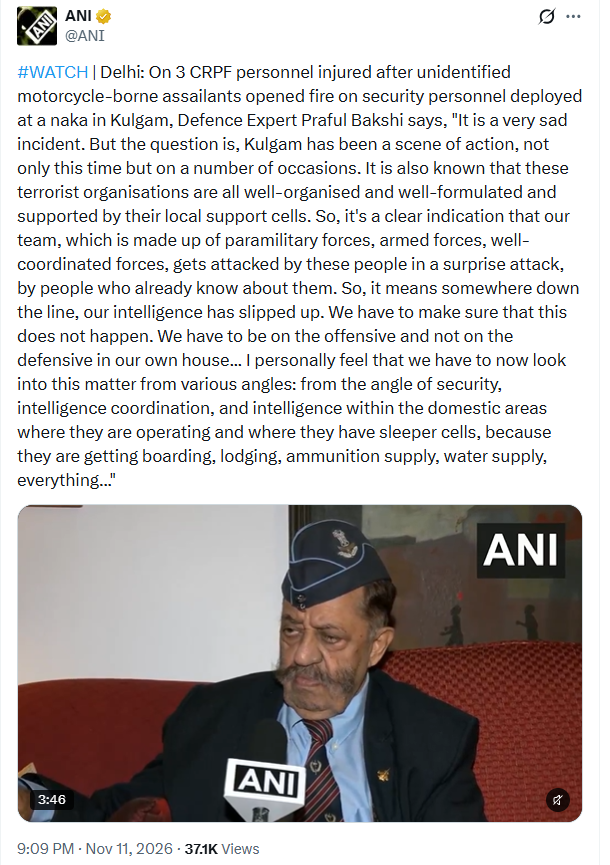
He further stated that terrorist organisations were well-organised and received support from local networks. He said the attack indicated a possible intelligence failure and stressed the need to prevent such incidents.Bakshi also called for a thorough review of security arrangements, coordination among intelligence agencies and the presence of sleeper cells in areas where such groups operate. However, at no point in his ANI interview did Bakshi describe the Kulgam attack as a ‘false-flag operation’ or link it to the Indian National Congress (INC) protests, demands for the Chief Election Commissioner’s resignation or the Arunachal Pradesh controversy. We examined the viral video using AI-content detection tools.An analysis using Hive Moderation indicated a high probability that the video was AI-generated or contained deepfake content.
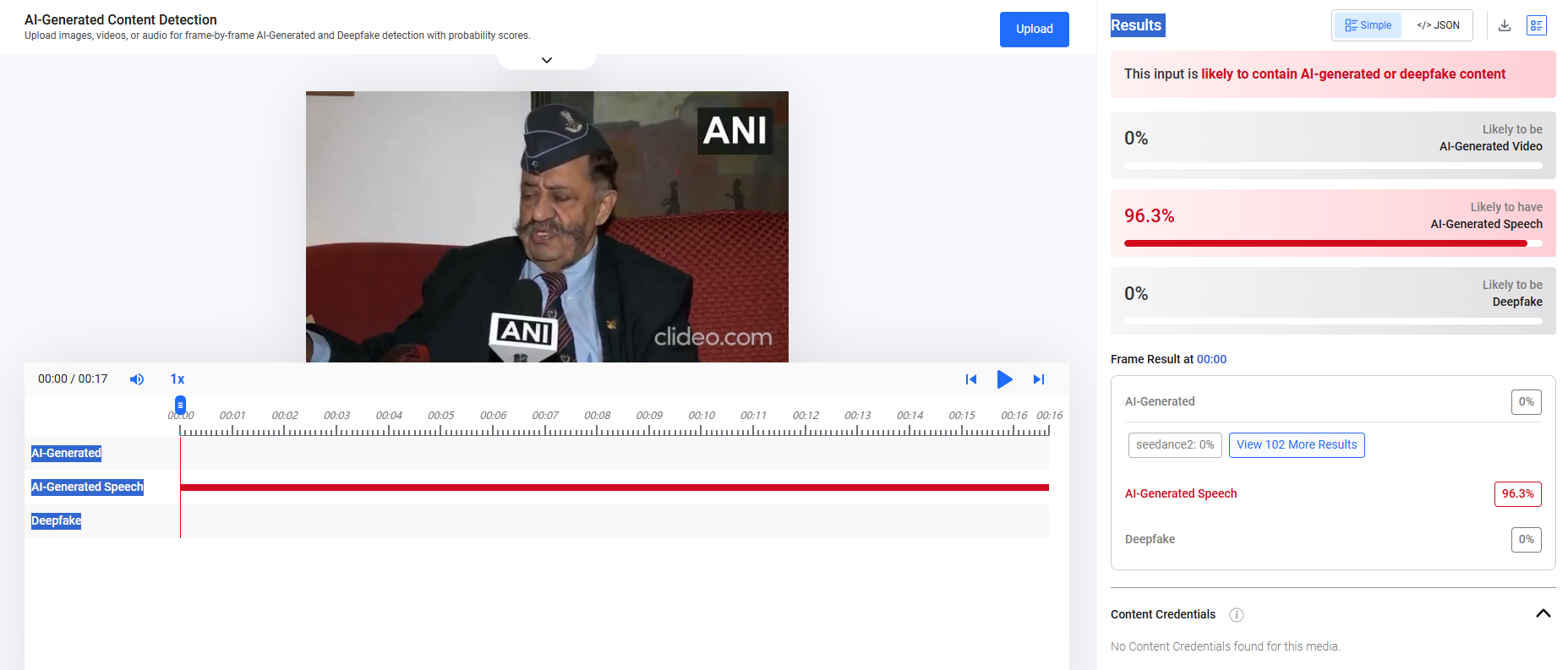
As part of our further research, we scanned the viral video using the AI detection tool Detect Video AI. According to the results, the viral video is 79 per cent AI-generated.

Conclusion
Our research established that the statement attributed to defence expert Praful Bakshi has been manipulated using AI. The remarks heard in the viral video do not match the statements he made in his original interview.

Related Blogs

Introduction
The G7 nations, a group of the most powerful economies, have recently turned their attention to the critical issue of cybercrimes and (AI) Artificial Intelligence. G7 summit has provided an essential platform for discussing the threats and crimes occurring from AI and lack of cybersecurity. These nations have united to share their expertise, resources, diplomatic efforts and strategies to fight against cybercrimes. In this blog, we shall investigate the recent development and initiatives undertaken by G7 nations, exploring their joint efforts to combat cybercrime and navigate the evolving landscape of artificial intelligence. We shall also explore the new and emerging trends in cybersecurity, providing insights into ongoing challenges and innovative approaches adopted by the G7 nations and the wider international community.
G7 Nations and AI
Each of these nations have launched cooperative efforts and measures to combat cybercrime successfully. They intend to increase their collective capacities in detecting, preventing, and responding to cyber assaults by exchanging intelligence, best practices, and experience. G7 nations are attempting to develop a strong cybersecurity architecture capable of countering increasingly complex cyber-attacks through information-sharing platforms, collaborative training programs, and joint exercises.
The G7 Summit provided an important forum for in-depth debates on the role of artificial intelligence (AI) in cybersecurity. Recognising AI’s transformational potential, the G7 nations have participated in extensive discussions to investigate its advantages and address the related concerns, guaranteeing responsible research and use. The nation also recognises the ethical, legal, and security considerations of deploying AI cybersecurity.
Worldwide Rise of Ransomware
High-profile ransomware attacks have drawn global attention, emphasising the need to combat this expanding threat. These attacks have harmed organisations of all sizes and industries, leading to data breaches, operational outages, and, in some circumstances, the loss of sensitive information. The implications of such assaults go beyond financial loss, frequently resulting in reputational harm, legal penalties, and service delays that affect consumers, clients, and the public. The increase in high-profile ransomware incidents has garnered attention worldwide, Cybercriminals have adopted a multi-faceted approach to ransomware attacks, combining techniques such as phishing, exploit kits, and supply chain Using spear-phishing, exploit kits, and supply chain hacks to obtain unauthorised access to networks and spread the ransomware. This degree of expertise and flexibility presents a substantial challenge to organisations attempting to protect against such attacks.

Focusing On AI and Upcoming Threats
During the G7 summit, one of the key topics for discussion on the role of AI (Artificial Intelligence) in shaping the future, Leaders and policymakers discuss the benefits and dangers of AI adoption in cybersecurity. Recognising AI’s revolutionary capacity, they investigate its potential to improve defence capabilities, predict future threats, and secure vital infrastructure. Furthermore, the G7 countries emphasise the necessity of international collaboration in reaping the advantages of AI while reducing the hazards. They recognise that cyber dangers transcend national borders and must be combated together. Collaboration in areas such as exchanging threat intelligence, developing shared standards, and promoting best practices is emphasised to boost global cybersecurity defences. The G7 conference hopes to set a global agenda that encourages responsible AI research and deployment by emphasising the role of AI in cybersecurity. The summit’s sessions present a path for maximising AI’s promise while tackling the problems and dangers connected with its implementation.
As the G7 countries traverse the complicated convergence of AI and cybersecurity, their emphasis on collaboration, responsible practices, and innovation lays the groundwork for international collaboration in confronting growing cyber threats. The G7 countries aspire to establish robust and secure digital environments that defend essential infrastructure, protect individuals’ privacy, and encourage trust in the digital sphere by collaboratively leveraging the potential of AI.
Promoting Responsible Al development and usage
The G7 conference will focus on developing frameworks that encourage ethical AI development. This includes fostering openness, accountability, and justice in AI systems. The emphasis is on eliminating biases in data and algorithms and ensuring that AI technologies are inclusive and do not perpetuate or magnify existing societal imbalances.
Furthermore, the G7 nations recognise the necessity of privacy protection in the context of AI. Because AI systems frequently rely on massive volumes of personal data, summit speakers emphasise the importance of stringent data privacy legislation and protections. Discussions centre around finding the correct balance between using data for AI innovation, respecting individuals’ privacy rights, and protecting data security. In addition to responsible development, the G7 meeting emphasises the importance of responsible AI use. Leaders emphasise the importance of transparent and responsible AI governance frameworks, which may include regulatory measures and standards to ensure AI technology’s ethical and legal application. The goal is to defend individuals’ rights, limit the potential exploitation of AI, and retain public trust in AI-driven solutions.
The G7 nations support collaboration among governments, businesses, academia, and civil society to foster responsible AI development and use. They stress the significance of sharing best practices, exchanging information, and developing international standards to promote ethical AI concepts and responsible practices across boundaries. The G7 nations hope to build the global AI environment in a way that prioritises human values, protects individual rights, and develops trust in AI technology by fostering responsible AI development and usage. They work together to guarantee that AI is a force for a good while reducing risks and resolving social issues related to its implementation.
Challenges on the way
During the summit, the nations, while the G7 countries are committed to combating cybercrime and developing responsible AI development, they confront several hurdles in their efforts. Some of them are:
A Rapidly Changing Cyber Threat Environment: Cybercriminals’ strategies and methods are always developing, as is the nature of cyber threats. The G7 countries must keep up with new threats and ensure their cybersecurity safeguards remain effective and adaptable.
Cross-Border Coordination: Cybercrime knows no borders, and successful cybersecurity necessitates international collaboration. On the other hand, coordinating activities among nations with various legal structures, regulatory environments, and agendas can be difficult. Harmonising rules, exchanging information, and developing confidence across states are crucial for effective collaboration.
Talent Shortage and Skills Gap: The field of cybersecurity and AI knowledge necessitates highly qualified personnel. However, skilled individuals in these fields need more supply. The G7 nations must attract and nurture people, provide training programs, and support research and innovation to narrow the skills gap.
Keeping Up with Technological Advancements: Technology changes at a rapid rate, and cyber-attacks become more complex. The G7 nations must ensure that their laws, legislation, and cybersecurity plans stay relevant and adaptive to keep up with future technologies such as AI, quantum computing, and IoT, which may both empower and challenge cybersecurity efforts.
Conclusion
To combat cyber threats effectively, support responsible AI development, and establish a robust cybersecurity ecosystem, the G7 nations must constantly analyse and adjust their strategy. By aggressively tackling these concerns, the G7 nations can improve their collective cybersecurity capabilities and defend their citizens’ and global stakeholders’ digital infrastructure and interests.
With AI touching new milestones everyday an increasing need for making it secure is also arising. As these AI companies increase their operations and position in the market as providers of powerful tools in the market. A recent concern due to Anthropic's recent privacy policy update which will be effective from July 8, 2026 shows how companies have begun expanding the amount of personal information they collect in the name of safety, compliance, and trust. While they are being demonstrated as measures to improve safety of users and prevent abuse, it raises important questions about privacy, biometric data, surveillance, data retention, and user autonomy, some of which we will be addressing in this article.
Identity Verification of consumers
One of the most notable update to Anthropic's privacy policy is the category of "Verification Data." According to the policy, users may be asked to verify their age or identity in certain circumstances. Depending on the verification method, Anthropic may collect:
- Images of government-issued identity documents;
- Information appearing on those documents, including identification numbers and date of birth for age verification;
- Photographs or videos of the user;
- Facial geometry templates, which may constitute biometric data under certain legal frameworks; and
- The outcome of the verification process.
At first, this may appear similar to the Know Your Customer (KYC) procedures employed by banks or financial institutions but Claude is not a banking service. It is a consumer AI platform. The issue is not that verification exists, but that the circumstances under which it may be required remain undefined.
THE PROBLEM WITH “CERTAIN CIRCUMSTANCES”
The policy refers to verification being required in "certain circumstances." The public notification from Anthropic mentions that these circumstances may include access to particular features, routine platform integrity checks, abuse prevention mechanisms, policy enforcement activities, or legal compliance obligations. The ambiguity of this phrase raises important concerns. From a user perspective, it is difficult to determine, When verification may be triggered ? Whether verification applies only to suspicious accounts ? Whether access to future features may depend upon verification ? Whether users in particular regions will face more frequent verification requirements ? Whether verification requests may increase as AI regulation expands ? This broad language and discretionary power that the company has along with flexibility in the hands of the company creates uncertainty for users who may have initially joined a platform expecting only an email address and payment information to be required.
Government IDs collection: A new risk category
Almost all AI services have operated without collecting government-issued identity documents. Once a company begins processing such information, the privacy implications change dramatically. Because government issued IDs contain: Full legal names, Dates of birth, Identification numbers, Addresses, Photographs and information regarding nationality. When companies collect these documents, they will have an important database of highly sensitive personal information. Even if the company itself does not retain the documents indefinitely, the existence of a verification process introduces additional privacy and security risks. As per Anthropic has stated that identity verification is conducted through third-party providers such as Persona. According to article on the official site titled ‘Identity verification on Claude’, Persona stores the identity documents and selfie data, while Anthropic retains access to verification records when necessary. From the user's perspective, several important realities remain: First, the data still exists somewhere. Second, another third party organization is now involved in processing highly sensitive personal information. Third, Anthropic retains the ability to access verification records under certain circumstances. Therefore, although Anthropic may not directly maintain copies of every uploaded identity document, the practical result remains that sensitive information enters a broader ecosystem of entities and systems. Identity documents today are among the most valuable forms of personal information from the perspective of fraudsters, cybercriminals, and malicious actors. Therefore, any system that handles such documents becomes an attractive target for attack.
More information on persona’s government ID verification- https://withpersona.com/blog/what-is-government-id-verification
The Biometric Dimension
Another significant aspect of the update is the reference to facial geometry templates. Unlike passwords, biometric identifiers cannot easily be changed if compromised. A person can replace a password or even obtain a new identification card, but they cannot simply obtain a new face. Facial geometry templates are sensitive because they enable automated identity matching. Although these templates, as claimed, are not equivalent to photographs, they are nevertheless derived from unique physical characteristics of a person. In many jurisdictions, including parts of the European Union and several U.S. states, biometric data receives enhanced legal protection because of its permanence and sensitivity, let us see how it unfolds in these jurisdictions.
The Unanswered Retention Question
It is unclear in the policy as to how long the data will be retained because retention limits serve as one of the most important safeguards in modern privacy law, they have given another vague answer that “They're bound to protect it with industry-standard security controls and delete it in line with the retention limits we've set and applicable law.” The longer sensitive information remains stored, the greater the likelihood of unauthorized access, misuse, accidental disclosure, or legal compulsion.
Court Orders and Government Access
Anthropic may be required to disclose information pursuant to valid legal processes such as subpoenas, court orders, warrants, or regulatory directives. The existence of identity verification records means that future requests could potentially be linked to verified identities rather than pseudonymous accounts. This does not mean governments receive unrestricted access to user data. However, it does mean that once identity verification information exists within a company's ecosystem, it may become subject to lawful disclosure requirements. The privacy implications are therefore materially different from those associated with anonymous or pseudonymous AI usage.
Shifting Responsibility onto Users
Another concern is that the privacy policy states that users are responsible for ensuring they possess the necessary rights, permissions, or authority when uploading files, connecting third-party services, or instructing Claude to retrieve information. Anthropic is effectively informing users that they bear responsibility for ensuring that uploaded or connected data is lawfully accessible. As AI assistants gain greater capabilities, this transfer of responsibility from platform to user is likely to become increasingly common. Beyond individual privacy, Anthropic's verification policy also raises larger questions about data sovereignty and the cross-border movement of sensitive personal information. In India, the Justice K.S. Puttaswamy (Retd.) v. Union of India judgment recognized privacy as a fundamental right under Article 21 of the Constitution, affirming that individuals have the right to informational self-determination and control over their personal data. Yet, under Anthropic's verification framework, an Indian user may be required to upload a government-issued identity document and biometric information, which are processed by Persona, a U.S.-based identity verification company acting on behalf of Anthropic. Although users voluntarily consent to this process, it nevertheless results in highly sensitive identity information crossing national borders and entering the control of foreign private entities governed primarily by foreign contractual arrangements and multiple legal regimes. While governments issue identity documents as sovereign instruments of citizenship, their verification and processing are increasingly outsourced to multinational technology companies. Questions arise not only about how securely such information is handled, but also about which country's laws ultimately govern access, retention, disclosure, and accountability when personal data leaves the jurisdiction in which it originated. Under the Digital Personal Data Protection Act, 2023, cross-border transfer of personal data is generally permitted unless the Central Government specifically restricts transfers to certain jurisdictions. Therefore, a foreign company processing identity documents is not, by itself, unlawful but this legality does not eliminate legitimate concerns. Users realistically have limited bargaining power and little practical understanding of how long their identity documents, biometric templates, or verification records will be retained, who within the corporate ecosystem may access them, or how they may be disclosed pursuant to foreign legal processes.
Conclusion
The policy is commendable in some respects because it openly identifies the categories of information that may be collected rather than obscuring them behind vague terminology. However, important concerns remain regarding the extent of verification triggers, the handling of biometric information, the absence of clearly disclosed retention periods, and the long-term implications of linking AI accounts to government-issued identities. As AI systems become more integrated into daily life, these questions will likely become central issues in debates about digital privacy, surveillance, autonomy, and the future governance of artificial intelligence.
Introduction
With the rise of AI deepfakes and manipulated media, it has become difficult for the average internet user to know what they can trust online. Synthetic media can have serious consequences, from virally spreading election disinformation or medical misinformation to serious consequences like revenge porn and financial fraud. Recently, a Pune man lost ₹43 lakh when he invested money based on a deepfake video of Infosys founder Narayana Murthy. In another case, that of Babydoll Archi, a woman from Assam had her likeness deepfaked by an ex-boyfriend to create revenge porn.
Image or video manipulation used to leave observable traces. Online sources may advise examining the edges of objects in the image, checking for inconsistent patterns, lighting differences, observing the lip movements of the speaker in a video or counting the number of fingers on a person’s hand. Unfortunately, as the technology improves, such folk advice might not always help users identify synthetic and manipulated media.
The Coalition for Content Provenance and Authenticity (C2PA)
One interesting project in the area of trust-building under these circumstances has been the Coalition for Content Provenance and Authenticity (C2PA). Started in 2019 by Adobe and Microsoft, C2PA is a collaboration between major players in AI, social media, journalism, and photography, among others. It set out to create a standard for publishers of digital media to prove the authenticity of digital media and track changes as they occur.
When photos and videos are captured, they generally store metadata like the date and time of capture, the location, the device it was taken on, etc. C2PA developed a standard for sharing and checking the validity of this metadata, and adding additional layers of metadata whenever a new user makes any edits. This creates a digital record of any and all changes made. Additionally, the original media is bundled with this metadata. This makes it easy to verify the source of the image and check if the edits change the meaning or impact of the media. This standard allows different validation software, content publishers and content creation tools to be interoperable in terms of maintaining and displaying proof of authenticity.
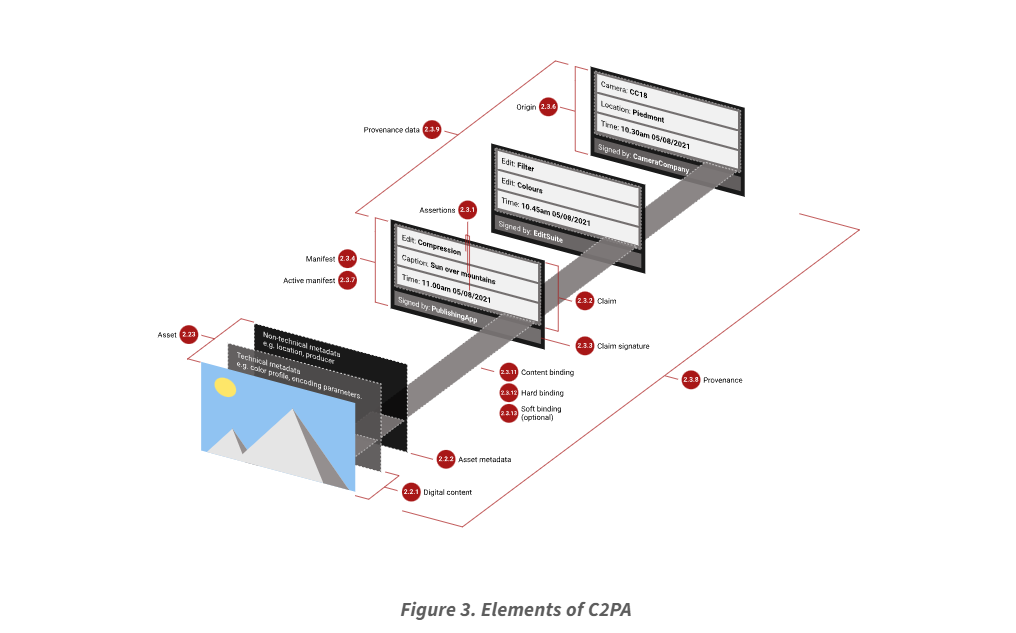
The standard is intended to be used on an opt-in basis and can be likened to a nutrition label for digital media. Importantly, it does not limit the creativity of fledgling photo editors or generative AI enthusiasts; it simply provides consumers with more information about the media they come across.
Could C2PA be Useful in an Indian Context?
The World Economic Forum’s Global Risk Report 2024, identifies India as a significant hotspot for misinformation. The recent AI Regulation report by MeitY indicates an interest in tools for watermarking AI-based synthetic content for ease of detecting and tracking harmful outcomes. Perhaps C2PA can be useful in this regard as it takes a holistic approach to tracking media manipulation, even in cases where AI is not the medium.
Currently, 26 India-based organisations like the Times of India or Truefy AI have signed up to the Content Authenticity Initiative (CAI), a community that contributes to the development and adoption of tools and standards like C2PA. However, people are increasingly using social media sites like WhatsApp and Instagram as sources of information, both of which are owned by Meta and have not yet implemented the standard in their products.
India also has low digital literacy rates and low resistance to misinformation. Part of the challenge would be showing people how to read this nutrition label, to empower people to make better decisions online. As such, C2PA is just one part of an online trust-building strategy. It is crucial that education around digital literacy and policy around organisational adoption of the standard are also part of the strategy.
The standard is also not foolproof. Current iterations may still struggle when presented with screenshots of digital media and other non-technical digital manipulation. Linking media to their creator may also put journalists and whistleblowers at risk. Actual use in context will show us more about how to improve future versions of digital provenance tools, though these improvements are not guarantees of a safer internet.
The largest advantage of C2PA adoption would be the democratisation of fact-checking infrastructure. Since media is shared at a significantly faster rate than it can be verified by professionals, putting the verification tools in the hands of people makes the process a lot more scalable. It empowers citizen journalists and leaves a public trail for any media consumer to look into.
Conclusion
From basic colour filters to make a scene more engaging, to removing a crowd from a social media post, to editing together videos of a politician to make it sound like they are singing a song, we are so accustomed to seeing the media we consume be altered in some way. The C2PA is just one way to bring transparency to how media is altered. It is not a one-stop solution, but it is a viable starting point for creating a fairer and democratic internet and increasing trust online. While there are risks to its adoption, it is promising to see that organisations across different sectors are collaborating on this project to be more transparent about the media we consume.
References
- https://c2pa.org/
- https://contentauthenticity.org/
- https://indianexpress.com/article/technology/tech-news-technology/kate-middleton-9-signs-edited-photo-9211799/
- https://photography.tutsplus.com/articles/fakes-frauds-and-forgeries-how-to-detect-image-manipulation--cms-22230
- https://www.media.mit.edu/projects/detect-fakes/overview/
- https://www.youtube.com/watch?v=qO0WvudbO04&pp=0gcJCbAJAYcqIYzv
- https://www3.weforum.org/docs/WEF_The_Global_Risks_Report_2024.pdf
- https://indianexpress.com/article/technology/tech-news-technology/ai-law-may-not-prescribe-penal-consequences-for-violations-9457780/
- https://thesecretariat.in/article/meity-s-ai-regulation-report-ambitious-but-no-concrete-solutions
- https://www.ndtv.com/lifestyle/assam-what-babydoll-archi-viral-fame-says-about-india-porn-problem-8878689
- https://www.meity.gov.in/static/uploads/2024/02/9f6e99572739a3024c9cdaec53a0a0ef.pdf
