
#FactCheck: AI-Generated Video Falsely Shared as Real Footage of a Baby Elephant Being Rescued from a Railway Track
Executive Summary
A video is being shared on social media showing a baby elephant apparently trapped in a railway track. In the video, its leg can be seen stuck between the tracks, while a train appears to be approaching. The video further shows rescuers using a hydraulic machine to remove part of the railway track and safely free the baby elephant. CyberPeace Research found that the viral claim is false. Our research found that the video is AI-generated and is being shared on social media with a false and misleading claim.
Claim:
A user on Facebook shared the video claiming that an elephant’s leg got stuck in a railway track, following which people risked their lives to safely rescue the animal. The post link, archive link and screenshot are provided below.
https://www.facebook.com/reel/992948767150505

Fact Check
During our research, we conducted a reverse image search of different keyframes from the viral video. However, we did not find any credible media report or other authentic source related to the incident. However, during our research, we found some social media posts featuring the same video. These posts have labelled the video as AI-generated content.
https://www.youtube.com/shorts/TCQ2n6LDr_Q

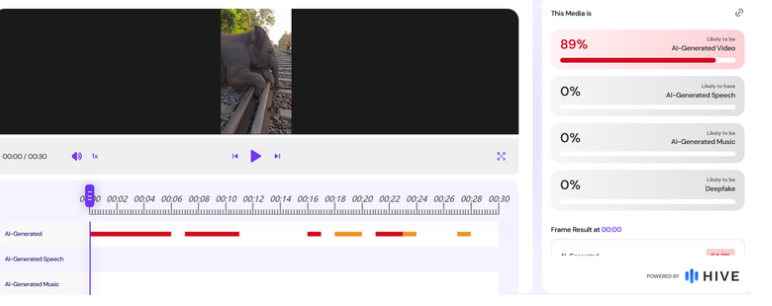
We then scanned the viral video using the Hive Detect tool. According to the tool’s analysis, the video was identified as potentially AI-generated with an 89% score.
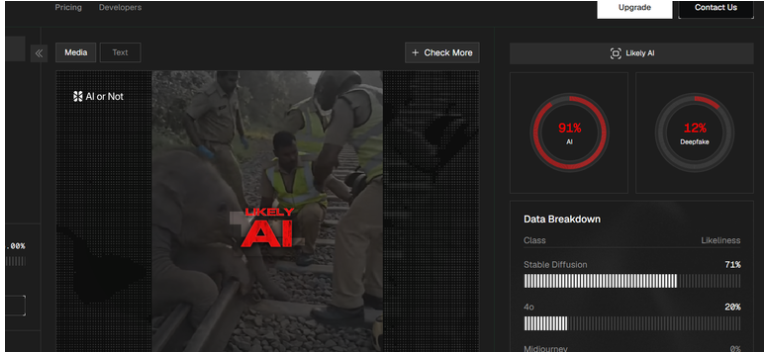
At the end of our research, we also examined the video using the AIorNot tool. According to its analysis, the visuals in the video were identified as AI-generated with a 91% probability.
Conclusion
Our research found that the video being shared on social media does not depict a real incident. During our research into the source and context of the video, we found no credible information supporting the claim. Furthermore, an analysis of the video using AI detection tools also confirmed that it is AI-generated.

Related Blogs
.webp)
Overview:
WazirX is the platform for cryptocurrencies, based in India that has been hacked, and it made a loss of more than $230 million in cryptocurrency. This case concerned an unauthorized transaction with a multisignature or multisig, wallet controlled through Liminal’a digital asset management platform. These attacking incidents have thereafter raised more questions on the security of the Cryptocurrency exchanges and efficiency of the existing policies and laws.
Wallet Configuration and Security Measures
This wallet was breached and had a multisig setting meaning that more than one signature was needed to authorize a transaction. Specifically, it had six signatories: five are funded by WazirX and one is funded by Liminal. Every transaction needed the approval of at least three signatories of WazirX, all of whom had addressed security concerns by using Ledger’s hardware wallets; while the Liminal, too, had a signatory, for approval.
To further increase the level of security of the transactions, a whitelisting policy was introduced, only limited addresses were authorized to receive funds. This system was rather vulnerable, and the attackers managed to grasp the discrepancy between the information available through Liminal’s interface and the content of the transaction to seize unauthorized control over the wallet and implement the theft.
Modus Operandi: Attack Mechanics
The cyber attack appears to have been carefully carried out, with preliminary investigations suggesting the following tactics:
- Payload Manipulation: The attackers apparently substituted the transaction’s payload during signing; hence, they can reroute the collected funds into an unrelated wallet.
- Chain Hopping: To make it much harder to track their movements, the attackers split large amounts of money across multiple blockchains and broke tens of thousands of dollars into thousands of transactions involving different cryptocurrencies. This technique makes it difficult to trace people and things.
- Zero Balance Transactions: There were also some instances where it ended up with no Ethereum (ETH) in the balance and such wallets also in use for the purpose of further anonymization of the transactions.
- Analysis of the blockchain data suggested the enemy might have been making the preparations for this attack for several days prior to their attack and involved a high amount of planning.
Actions taken by WazirX:
Following the attack, WazirX implemented a series of immediate actions:
- User Notifications: The users were immediately notified of the occurrence of the breach and the possible risk it posed to them.
- Law Enforcement Engagement: The matters were reported to the National Cyber Crime Reporting Portal and specific authorities of which the Financial Intelligence Unit (FIU) and the Computer Emergency Response Team (CERT-In).
- Service Suspension: WazirX had suspended all its trading operations and user deposits’ and withdrawals’ to minimize further cases and investigate.
- Global Outreach: The exchange contacted more than 500 cryptocurrency exchanges and requested to blacklist the wallet’s addresses linked to the theft.
- Bounty Program: A bounty program was announced to encourage people to share information that can enable the authorities to retrieve the stolen money. A maximum of 23 million dollars was placed on the bounty.
Further Investigations
WazirX stated that it has contracted the services of cybersecurity professionals to help in the prosecution process of identifying and compensating for the losses. The exchange is still investigating the forensic data and working with the police for tracking the stolen assets. Nevertheless, the prospects of full recovery may be quite questionable primarily because of complexity of the attack and the methods used by the attackers.
Precautionary measures:
The WazirX cyber attack clearly implies that there is the necessity to improve the security and the regulation of the cryptocurrency industry. As exchanges become increasingly targeted by hackers, there is a pressing need for:
- Stricter Security Protocols: The commitment to technical innovations, such as integration of MFA, as well as constant monitoring of the users’ wallets’ activities.
- Regulatory Oversight: Formalization of the laws that require proper security for the cryptocurrency exchange platforms to safeguard their users as well as their investments.
- Community Awareness: To bypass such predicaments, there is a need to study on emergent techniques in spreading awareness, particularly in cases of scams or phishing attempts that are likely to follow such breaches.
Conclusion:
The cyber attack on WazirX in the field of cryptocurrency market, shows weaknesses and provides valuable lessons for enhancing the security. This attack highlights critical vulnerabilities in cryptocurrency exchanges, even though employing advanced security measures like multisignature wallets and whitelisting policies. The attack's complexity, involving payload manipulation, chain hopping, and zero balance transactions, underscores the attackers' meticulous planning and the challenges in tracing stolen assets. This case brings a strong message regarding the necessity of solid security measures, and constant attention to security in the rapidly growing world of digital assets. Furthermore, the incident highlights the importance of community awareness and education on emerging threats like scams and phishing attempts, which usually follow such breaches. By fostering a culture of vigilance and knowledge, the cryptocurrency community can better defend against future attacks.
Reference:
https://wazirx.com/blog/important-update-cyber-attack-incident-and-measures-to-protect-your-assets/
https://www.linkedin.com/pulse/wazirx-cyberattack-in-depth-analysis-jyqxf
.webp)
The world of Artificial Intelligence is entering a new phase with the rise of Agentic AI, often described as the third wave of AI evolution. Unlike earlier systems that relied on static models (that learn from the information that is fed) and reactive outputs, Agentic AI introduces intelligent agents that can make decisions, take initiative, and act autonomously in real time. These systems are designed to require minimal human oversight while actively collaborating and learning continuously. Such capabilities indicate an incoming shift, especially in the ways in which Indian businesses can function. For better understanding, Agentic AI is capable of streamlining operations, personalising services, and driving innovations at scale.
India and Agentic AI
Building as we go, India is making continuous strides in the AI revolution- deliberating on government frameworks, and simultaneously adapting. At Microsoft's Pinnacle 2025 summit in Hyderabad, India's pivotal role in shaping the future of Agentic AI was brought to the spotlight. With over 17 million developers on GitHub and ambitions to become the world's largest developer community by 2028, India's tech talent is gearing up to lead global AI innovations. Microsoft's Azure AI Foundry, also highlighted the country's growing influence in the AI landscape.
Indian companies are actively integrating Agentic AI into their operations to enhance efficiency and customer experience. Zomato is leveraging AI agents to optimise delivery logistics, ensuring timely and efficient service. Infosys has developed AI-driven copilots to assist developers in code generation, reducing development time, requiring fewer people to work on a particular project, and improving software quality.
As per a report by Deloitte, the Indian AI market is projected to grow potentially $20 billion by 2028. However, this is accompanied by significant challenges. 92% of Indian executives identify security concerns as the primary obstacle to responsible AI usage. Additionally, regulatory uncertainties and privacy risks associated with sensitive data were also highlighted.
Challenges in Adoption
Despite the enthusiasm, several barriers hinder the widespread adoption of Agentic AI in India:
- Skills Gap: While the AI workforce is expected to grow to 1.25 million by 2027, the current growth rate of 13% is considered to be insufficient with respect to the demands of the market.
- Data Infrastructure: Effective AI systems require robust, structured, and accessible datasets. Many organisations lack the necessary data maturity, leading to flawed AI outputs and decision-making failures.
- Trust and Governance: Building trust in AI systems is crucial. Concerns over data privacy, ethical usage, and regulatory compliance require robust governance frameworks to ensure the adoption of AI in a responsible manner.
- Looming fear of job loss: As AI continues to take up more sophisticated roles, a general feeling of hesitancy with respect to the loss of employment/human labour might come in the way of adopting such measures.
- Outsourcing: Currently, most companies prefer outsourcing or buying AI solutions rather than building them in-house. This gives rise to the issue of adapting to evolving needs.
The Road Ahead
To fully realise the potential of Agentic AI, India must address the following challenges :
- Training the Workforce: Initiatives and workshops tailored for employees that provide AI training can prove to be helpful. Some relevant examples are Microsoft’s commitment to provide AI training to 2 million individuals by 2025 and Infosys's in-house AI training programs.
- Data Readiness: Investing in modern data infrastructure and promoting data literacy are essential to improve data quality and accessibility.
- Establishing Governance Frameworks: Developing clear regulatory guidelines and ethical standards will foster trust and facilitate responsible AI adoption. Like the IndiaAI mission, efforts regarding evolving technology and keeping up with it are imperative.
Agentic AI holds unrealised potential to transform India's business landscape when coupled with innovation and a focus on quality that enhances global competitiveness. India is at a position where by proactively addressing the existing challenges, this potential can be realised and set the foundation for a new technological revolution (along with in-house development), solidifying its position as a global AI leader.
References
- https://economictimes.indiatimes.com/tech/artificial-intelligence/india-facing-shortage-of-agentic-ai-professionals-amid-surge-in-demand/articleshow/120651512.cms?from=mdr
- https://economictimes.indiatimes.com/tech/artificial-intelligence/india-a-global-leader-in-agentic-ai-adoption-deloitte-report/articleshow/119906474.cms?from=mdr
- https://inc42.com/features/from-zomato-to-infosys-why-indias-biggest-companies-are-betting-on-agentic-ai/
- https://www.hindustantimes.com/india-news/agentic-ai-next-big-leap-in-workplace-automation-101742548406693.html
- https://www.deloitte.com/in/en/about/press-room/india-rides-the-agentic-ai-wave.html
- https://www.businesstoday.in/tech-today/news/story/ais-next-chapter-starts-in-india-microsoft-champions-agentic-ai-at-pinnacle-2025-474286-2025-05-01
- https://www.hindustantimes.com/opinion/calm-before-ai-storm-a-moment-to-prepare-101746110985736.html
- https://www.financialexpress.com/life/technology/why-agentic-ai-is-the-next-big-thing/3828357/
Introduction
We inhabit an era where digital connectivity, while empowering, has also unleashed a relentless tide of cyber vulnerabilities, where personal privacy is constantly threatened, and crimes like sextortion are the perfect example of the sinister side of our hyperconnected world. Social media platforms, instant messaging apps, and digital content-sharing tools have all grown rapidly, changing how people communicate with one another and making it harder to distinguish between the private and public domains. The rise of sophisticated cybercrimes that use the very tools meant to connect us is the price paid for this unparalleled convenience. Sextortion, a portmanteau of “sex’ and “extortion”, stands out among them as a particularly pernicious kind of internet exploitation. Under the threat of disclosing their private information, photos, or videos, people are forced to engage in sexual behaviours or provide intimate content. Sextortion’s psychological component is what makes it particularly harmful, it feeds on social stigma, shame, and fear, which discourage victims from reporting the crime and feed the cycle of victimisation and silence. This cybercrime targets vulnerable people from all socioeconomic backgrounds and is not limited by age, gender, or location.
The Economy of Shame: Sextortion as a Cybercrime Industry
A news report from June 03, 2025, reveals a sextortion racket busted in Delhi, where a money trail of over Rs. 5 crore was identified by different teams of the Crime branch. From synthetic financial identities to sextortion and other cyber frauds, a recipe for a sophisticated cybercrime chain was found. To believe this is an aberration is to overlook the reality that it is symptomatic of a much wider and largely uncharted criminal framework. According to the FBI’s 2024 IC3 report, “extortion (including sextortion)” has skyrocketed to 86,415 complaints with losses of $143 million reported in the United States (US) alone. This indicates that coercive image-based threats are no longer an isolated cybercrime but an everyday occurrence. Sextortion is no longer an isolated cybercrime; it has metamorphosed into a systematic, industrialised criminal enterprise. Another news report dated 19th July, 2025, where Delhi Police has detained four people suspected of participating in a sextortion scheme that targeted a resident of the Bhagwanpur Khera neighbourhood of Shahdara. The suspected people were allegedly arrested on a complaint wherein the victim was manipulated and fell prey to a dating site.
The threat is amplified by the usage of deepfake technology, which allows offenders to create obscene content that looks believable. The approach, which relies on the stigma attached to sexual imagery in conservative societies like India, is that victims frequently give in to requests out of fear of damaging their reputations. The combination of cybercrime and cutting-edge technology highlights the lopsided power that criminals possess, leaving victims defenceless and law enforcement unable to keep up.
Legal Remedies and the Evolving Battle Against Sextortion
Given the complexity of these crimes, India has recognised sextortion and similar cyber-enabled financial crimes under a number of legal frameworks. A change to recognising cyber-enabled sexual exploitation as an organised criminal business is shown by the introduction of specific provisions like Section 111 in the Bhartiya Nyaya Sanhita (BNS), 2023, which classifies organised cybercrimes including extortion and frauds which fall under its expansive interpretation, as a serious offence. Similarly, Section 318 (2) criminalises cheating with a maximum sentence of three years in prison or a fine, whereas Section 336 (2) makes digital forgery a crime with a maximum sentence with a maximum sentence of two years in prison or a fine. In addition to these regulations, cheating by personation through computer resources is punishable by the Information Technology Act, 2000, specifically Section 66D, which carries a maximum sentence of three years in prison and a maximum fine of Rs. 1 lakh. Due to issues with attribution, cross-border jurisdiction, and the discreet nature of digital evidence, enforcement is still inconsistent even with current statutory restrictions.
The government and its agencies recognise that laws achieve real impact only when backed by awareness initiatives and accessible, localised mechanisms for redressal. Several Indian states and the Department of Telecommunications launched numerous campaigns to educate the public about and safeguard their mobile communication assets against identity theft, financial fraud, and cyberscams. Initiatives like Cyber Saathi Initiative and Cyber Dost by MHA, with the goal of improving forensic and victim reporting skills.
Conclusion
At CyberPeace, we understand that the best defence against online abuse is prevention. Our goal is to provide people with the information and resources to identify, avoid and report sextortion attempts like CyberPeace Helpline and organise awareness campaigns on safe digital habits. In order to remain updated with the constantly looming danger, our research and policy advocacy also focus on developing more robust legal and technological safeguards.
To every reader: think before you share, secure your accounts, and never let shame silence you. If you or someone you know becomes a victim, report it immediately, help is available, and justice is possible. Together we can reclaim the internet as a space of trust, not terror.
References
- https://www.hindustantimes.com/india-news/delhi-police-busts-sextortion-cyberfraud-rackets-6-held-101748959601825.html
- https://timesofindia.indiatimes.com/city/delhi/delhi-police-arrests-four-for-sextortion-and-blackmail-in-shahdara/articleshow/122767656.cms
- https://cdn.ncw.gov.in/wp-content/uploads/2025/05/CyberSaheli.pdf
