
#FactCheck- Old Kerala church raid video falsely shared with exaggerated ₹7000 crore cash seizure claim
Executive Summary
A set of two images is being widely circulated on social media claiming that the Enforcement Directorate (ED) recently raided a church in Kerala and seized ₹7000 crore in black money. The viral post also alleges that the media deliberately suppressed the news. CyberPeace Research Wing research found the claim to be misleading. The visuals are not recent and are linked to an Income Tax Department action conducted in 2020 at the Believers Eastern Church in Kerala.
Claim:
A Facebook user shared the viral post claiming that ₹7000 crore in black money was seized from a Kerala-based church run by a bishop named Yohannan, and alleged that mainstream media ignored the incident.
Post link: https://www.facebook.com/reel/2143680196569943 , https://archive.ph/submit/

Fact Check:
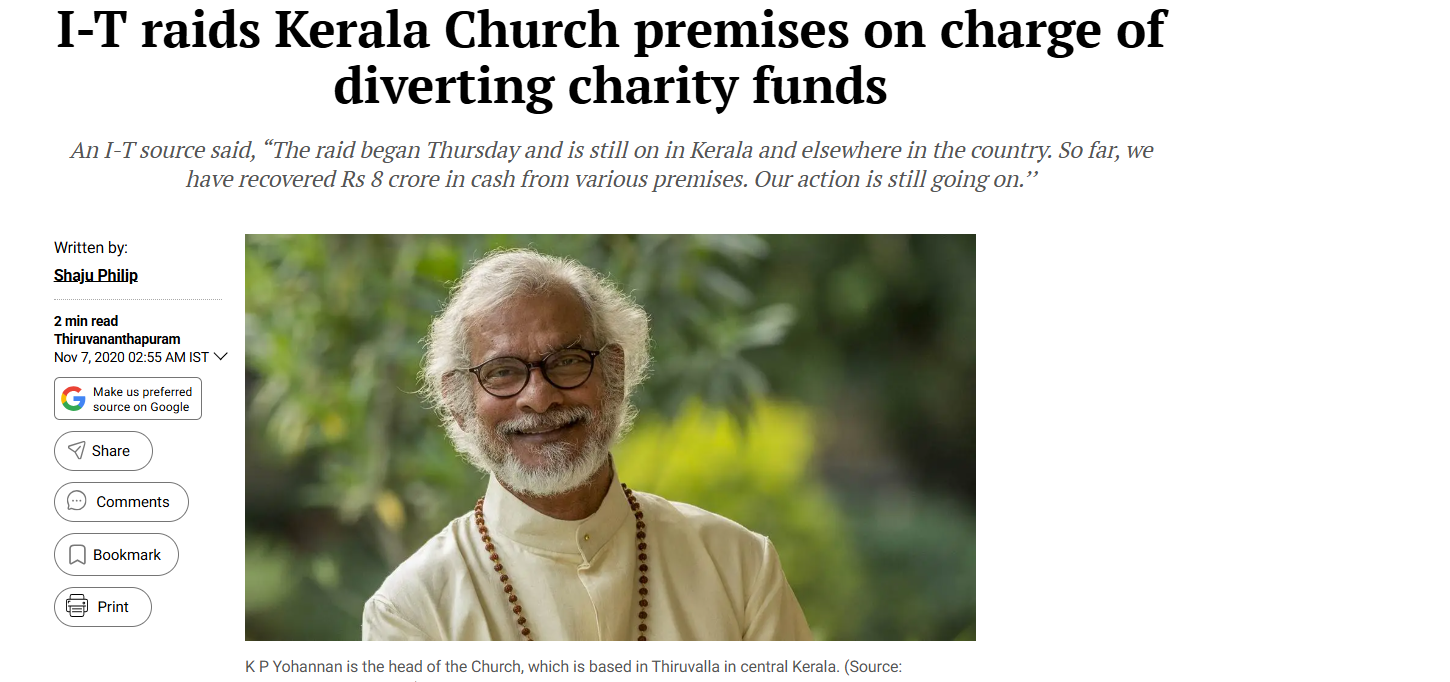
A keyword search related to the alleged raid on Believers Church in Kerala led to several news reports published in November 2020. A report published in The Hindu on November 6, 2020 stated that a crackdown by the Income Tax Department on the Thiruvalla-based Believers Eastern Church had reportedly uncovered several irregularities. https://www.thehindu.com/news/national/kerala/raids-bring-to-light-shady-deals-of-believers-church/article33041420.ece

Further verification from the official Income Tax Department website confirmed details of the search operation. According to the press release, approximately ₹6 crore in unexplained cash was recovered during the raid, including ₹3.85 crore from a place of worship in Delhi. https://www.incometaxindia.gov.in/Lists/Press%20Releases/Attachments/872/PressRelease_ITD_conducts_searches_in_Kerala_6_11_20.pdf
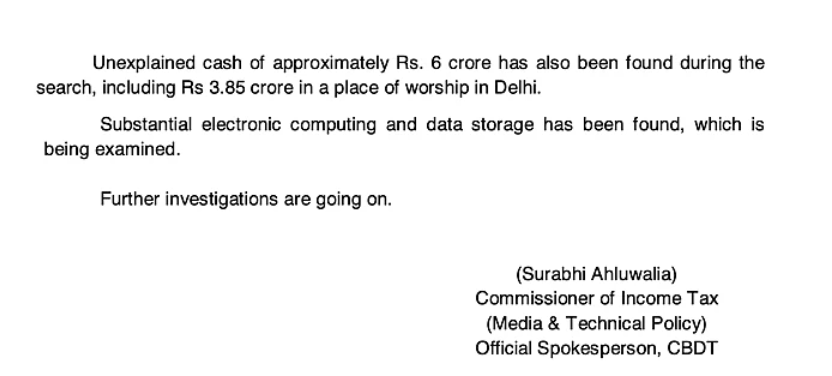
The release also noted that evidence suggested possible cash siphoning running into hundreds of crores of rupees.Additional media reports, including The Indian Express, stated that the total seizure amounted to around ₹14 crore. https://indianexpress.com/article/india/kerala/i-t-raids-kerala-church-premises-on-charge-of-diverting-charity-funds-6984466/
Conclusion:
The research confirms that the viral claim is misleading. The incident is from 2020 and not recent. During the Income Tax Department raid on the Believers Eastern Church in Kerala, around ₹6 crore in cash was recovered, with total seizures reported up to ₹14 crore in media reports. There is no evidence of any ₹7000 crore seizure as claimed in the viral post.

Related Blogs

Introduction
Digital Public Infrastructure (DPI) serves as the backbone of e-governance, enabling governments to deliver services more efficiently, transparently, and inclusively. By leveraging information and communication technology (ICT), digital governance systems reconfigure traditional administrative processes, making them more accessible and citizen-centric. However, the successful implementation of such systems hinges on overcoming several challenges, from ensuring data security to fostering digital literacy and addressing infrastructural gaps.
This article delves into the key enablers that drive effective DPI and outlines the measures already undertaken by the government to enhance its functionality. Furthermore, it outlines strategies for their enhancement, emphasizing the need for a collaborative, secure, and adaptive approach to building robust e-governance systems.
Key Enablers of DPI
Digital Public Infrastructure (DPI), the foundation for e-governance, relies on common design, robust governance, and private sector participation for efficiency and inclusivity. This requires common principles, frameworks for collaboration, capacity building, and the development of common standards. Some of the key measures undertaken by the government in this regard include:
- Data Protection Framework: The Digital Personal Data Protection (DPDP) Act of 2023 establishes a framework to ensure consent-based data sharing and regulate the processing of digital personal data. It delineates the responsibilities of data fiduciaries in safeguarding users' digital personal data.
- Increasing Public-Private Partnerships: Refining collaboration between the government and the private sector has accelerated the development, maintenance, expansion, and trust of the infrastructure of DPIs, such as the AADHAR, UPI, and Data Empowerment and Protection Architecture (DEPA). For example, the Asian Development Bank attributes the success of UPI to its “consortium ownership structure”, which enables the wide participation of major financial stakeholders in the country.
- Coordinated Planning: The PM-Gati Shakti establishes a clear coordination framework involving various inter-governmental stakeholders at the state and union levels. This aims to significantly reduce project duplications, delays, and cost escalations by streamlining communication, harmonizing project appraisal and approval processes, and providing a comprehensive database of major infrastructure projects in the country. This database called the National Master Plan, is jointly accessible by various government stakeholders through APIs.
- Capacity Building for Government Employees: The National e-Governance Division of the Ministry of Electronics and Information Technology routinely rolls out multiple training programs to build the technological and managerial skills required by government employees to manage Digital Public Goods (DPGs). For instance, it recently held a program on “Managing Large Digital Transformative Projects”. Additionally, the Ministry of Personnel, Public Grievances, and Pensions has launched the Integrated Government Online Training platform (iGOT) Karmayogi for the continuous learning of civil servants across various domains.
Digital Governance; Way Forward
E-governance utilizes information and communication technology (ICT) such as Wide Area Networks, the Internet, and mobile computing to implement existing government activities, reconfiguring the structures and processes of governance systems. This warrants addressing certain inter-related challenges such as :
- Data Security: The dynamic and ever-changing landscape of cyber threats necessitates regular advancements in data and information security technologies, policy frameworks, and legal provisions. Consequently, the digital public ecosystem must incorporate robust data cybersecurity measures, advanced encryption technologies, and stringent privacy compliance standards to safeguard against data breaches.
- Creating Feedback Loops: Regular feedback surveys will help government agencies improve the quality, efficiency, and accessibility of digital governance services by tailoring them to be more user-friendly and enhancing administrative design. This is necessary to build trust in government services and improve their uptake among beneficiaries. Conducting the decennial census is essential to gather updated data that can serve as a foundation for more informed and effective decision-making.
- Capacity Building for End-Users: The beneficiaries of key e-governance projects like Aadhar and UPI may have inadequate technological skills, especially in regions with weak internet network infrastructure like hilly or rural areas. This can present challenges in the access to and usage of technological solutions. Robust capacity-building campaigns for beneficiaries can provide an impetus to the digital inclusion efforts of the government.
- Increasing the Availability of Real-Time Data: By prioritizing the availability of up-to-date information, governments and third-party enterprises can enable quick and informed decision-making. They can effectively track service usage, assess quality, and monitor key metrics by leveraging real-time data. This approach is essential for enhancing operational efficiency and delivering improved user experience.
- Resistance to Change: Any resistance among beneficiaries or government employees to adopt digital governance goods may stem from a limited understanding of digital processes and a lack of experience with transitioning from legacy systems. Hand-holding employees during the transitionary phase can help create more trust in the process and strengthen the new systems.
Conclusion
Digital governance is crucial to transforming public services, ensuring transparency, and fostering inclusivity in a rapidly digitizing world. The successful implementation of such projects requires addressing challenges like data security, skill gaps, infrastructural limitations, feedback mechanisms, and resistance to change. Addressing these challenges with a strategic, multi-stakeholder approach can ensure the successful execution and long-term impact of large digital governance projects. By adopting robust cybersecurity frameworks, fostering public-private partnerships, and emphasizing capacity building, governments can create efficient and resilient systems that are user-centric, secure, and accessible to all.
References
- https://www.adb.org/sites/default/files/publication/865106/adbi-wp1363.pdf
- https://www.jotform.com/blog/government-digital-transformation-challenges/
- https://aapti.in/wp-content/uploads/2024/06/AaptixONI-DPIGovernancePlaybook_compressed.pdf
- https://community.nasscom.in/sites/default/files/publicreport/Digital%20Public%20Infrastructure%2022-2-2024_compressed.pdf
- https://proteantech.in/articles/Decoding-Digital-Public-Infrastructure-in-India/

Executive Summary
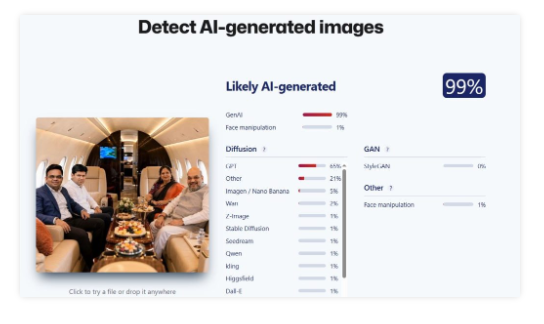
Prime Minister Narendra Modi recently appealed to citizens to reduce the consumption of gold and edible oil for a year. He also urged people to conserve petrol, diesel, and cooking gas amid the crisis arising from the ongoing tensions in West Asia involving the United States, Israel, and Iran. Amid this backdrop, a purported image of Union Home Minister Amit Shah and his son Jay Shah, who currently serves as Chairman of the International Cricket Council, has gone viral on social media. The image shows them seated inside a chartered aircraft along with two other individuals. Several social media users shared the picture as genuine while targeting the central government and Amit Shah.
However, CyberPeace Research Wing reseach found that the viral image is fake and was generated using Artificial Intelligence (AI).
Claim
An Instagram user named “Om Prakash Shukla” shared the viral image on May 24, 2026, with the caption:“People are sacrificing their desires for the nation, while they are enjoying luxury.”
https://www.instagram.com/p/DYuFqnmCh7T

Fact Check
To verify the authenticity of the viral image, we conducted a Google Lens search. However, the image was not found on any credible news platform, which raised suspicion about its authenticity. We also performed keyword-based searches related to the image using Google Search, but found no authentic reports or media coverage associated with the picture.
Further reseach involved analysing the image using AI detection tools. We first examined the picture using the “Sight Engine” AI detection tool, which indicated a 99 percent probability that the image was AI-generated.
We also tested the image using another AI detection platform called “TruthScan.” This tool likewise suggested, with around 97 percent probability, that the image had been created using artificial intelligence

Conclusion
The reseach found that the viral image featuring Union Home Minister Amit Shah and ICC Chairman Jay Shah inside a chartered aircraft is AI-generated. The image was digitally created using AI tools, and the viral claim associated with it is false.

Executive Summary
Amid rising tensions involving Iran, Israel and the United States following reports in early April 2026 that Iran had shot down an American fighter aircraft, a picture is going viral on social media claiming to show Iranian soldiers standing beside the wreckage of a destroyed helicopter while holding the Iranian flag. Research by CyberPeace Research Wing found that the viral claim is false. The image has been created using artificial intelligence and does not depict any real incident. The picture was generated using Google AI tools and is being misleadingly circulated online with different claims.
Claim
A Facebook page named “official salman 09” shared the image on May 1, 2026, along with a lengthy caption describing the scene as a symbol of Iran’s battlefield success. The post portrayed the image as evidence of a helicopter being brought down during ongoing tensions in the Middle East and suggested that the photo reflected strength, morale and victory in war.
- https://www.facebook.com/permalink.phpstory_fbid=pfbid02TAac6JwZha2UU4T8QiCGq4ENmsnNSwvigaz3vKxr9UWLbhghNsnMMpZdQ3dUuQ1rl&id=100092392280139
- https://archive.ph/

Fact Check
To verify the authenticity of the image, we first conducted a reverse image search using Google Lens. The image did not appear in any credible news reports or authentic media coverage. Instead, it was found circulating mainly on social media platforms, raising suspicion about its authenticity. We then analyzed the image using Google’s SynthID detector. The analysis confirmed the presence of a SynthID watermark with a “very high confidence” score, indicating that the image had been generated using Google AI tools. SynthID is Google’s watermarking technology used to identify AI-generated content created through its models.

Further verification using another AI-detection platform, Hive Moderation, also indicated a high probability that the image had been generated using AI. The tool identified Gemini as the likely source and assessed the image as overwhelmingly AI-generated.

Conclusion
Our research confirms that the viral image is AI-generated and unrelated to any real-world event. The picture showing soldiers holding the Iranian flag near helicopter wreckage was created using Google AI tools and is being falsely shared on social media to spread misleading claims.
