
#FactCheck: AI-Generated Video Falsely Shared as Footage of Vehicles Swept Away in Floods on Tibet-Nepal Border
Executive Summary
A video showing vehicles being swept away by floodwaters is going viral on social media. It is being claimed that the video shows flooding along the Nepal-Tibet border.However, CyberPeace Research found that the video is AI-generated.
Claim
The video shows debris suddenly falling from a mountain while vehicles are moving along a road. During the incident, vehicles seen on the road near a fast-flowing river are swept away into the water one after another. The archive of the post can be viewed here.
https://www.facebook.com/reel/1796949138009288

Fact Check
To verify the viral video claiming to show vehicles being swept away by floods along the Tibet-Nepal border, we conducted a reverse image search of its keyframes. However, during our research, we did not find the video in any credible media report or authentic source that identified it as genuine footage of flooding along the Nepal-Tibet border. During our research, we closely examined the video and noticed several inconsistencies that raised questions about its authenticity. In cases where heavy vehicles are caught in or swept away by fast-flowing water, the force of the current, the vehicles losing balance and being submerged are generally visible. In contrast, the vehicles in the viral video appear to float almost in a straight direction through the water without any visible resistance, raising doubts about the authenticity of the footage.
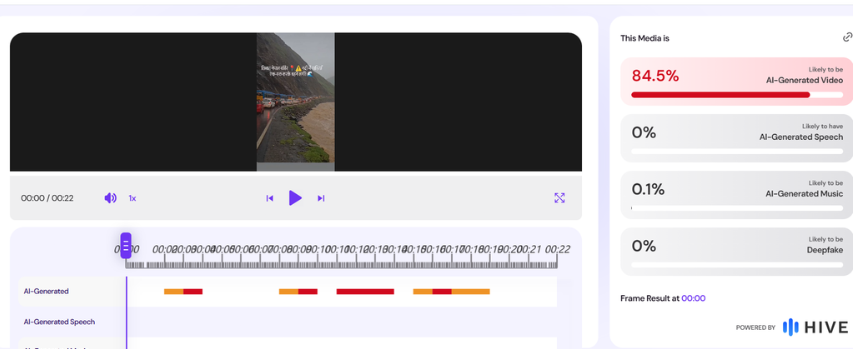
The video also shows several blue buses travelling on the road. On closer examination, the design and appearance of these buses appear to be almost identical. In addition, the letters and numbers visible on some vehicle number plates appear unusual, blurred and distorted. Such visual inconsistencies are commonly observed in AI-generated content. To further verify these findings, we scanned the viral video using the AI detection tool Hive Detect. The tool’s analysis identified the video as potentially AI-generated, with a score of 84.5 per cent.
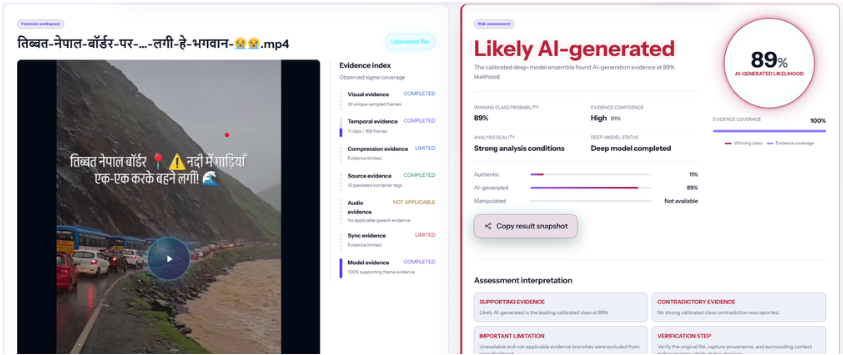
We also analysed the video using another AI detection platform, DetectVideo AI. The tool likewise identified the video as potentially AI-generated, with a score of 89 per cent.
Conclusion
The evidence gathered during our research makes it clear that the video being circulated with the claim that vehicles were swept away by floodwaters along the Tibet-Nepal border is AI-generated.

Related Blogs

Executive Summary: A video circulating on social media claims that retired Lieutenant General P.R. Shankar questioned the capability of newly appointed Army Chief Lt Gen Dhiraj Seth, suggesting he may not be able to effectively counter Pakistan or China. The clip further alleges that the appointment involved political influence and favoritism. CyberPeace Research Wing research found the claim to be false and misleading. The original video contains no such remarks regarding the new Army Chief or his appointment.
Claim: An X user shared the viral video on June 16, 2026, alleging that Lt Gen P.R. Shankar raised concerns over the appointment of the new Army Chief and questioned his competence in handling threats from Pakistan and China. https://x.com/indiain24hr/status/2066916021982908502 , https://archive.ph/vAnjo

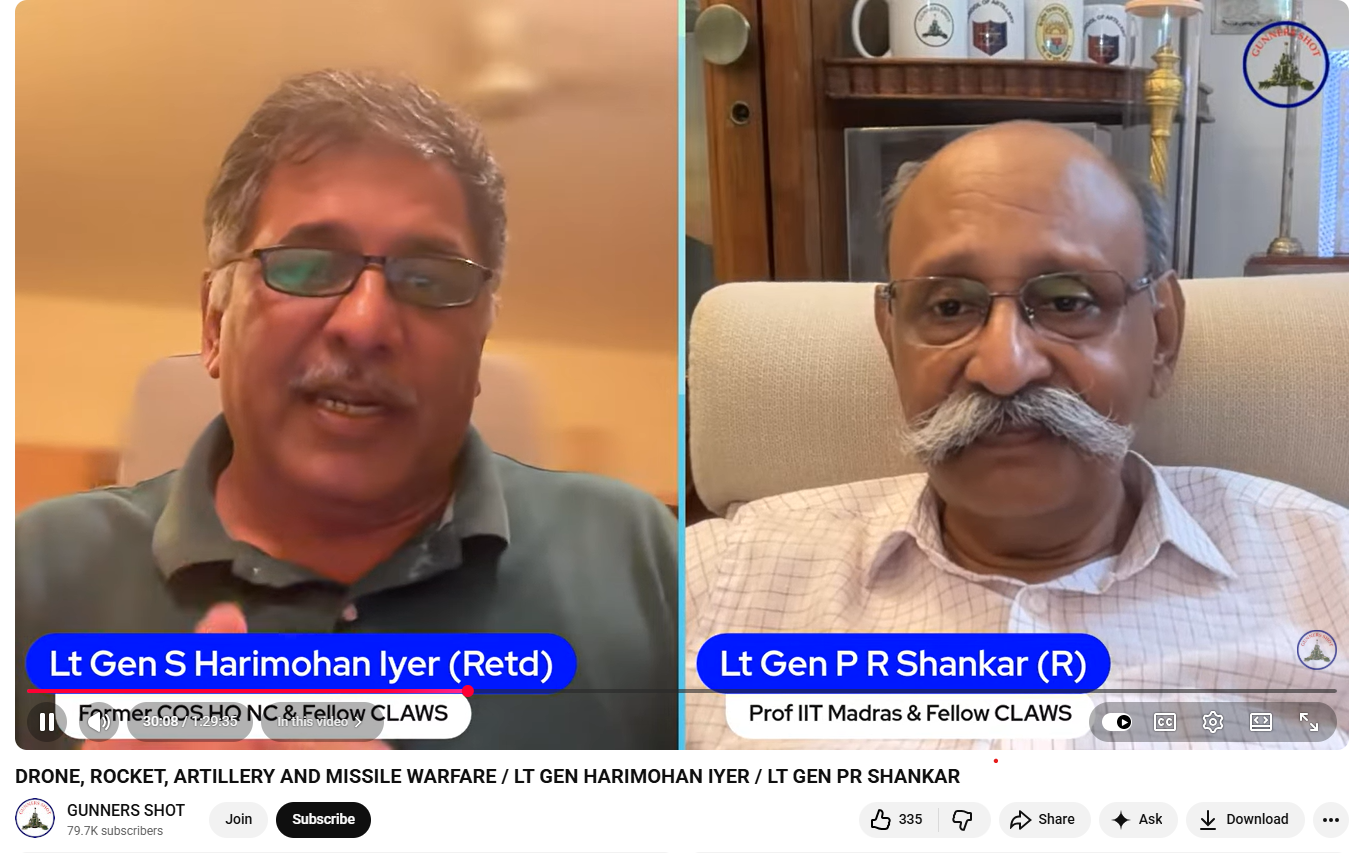
Fact Check: A Google search using relevant keywords did not yield any credible media reports supporting the claim, raising initial doubts about its authenticity. A reverse image search of keyframes from the viral video led to a YouTube livestream uploaded on June 13, 2026. The original video showed Lt Gen P.R. Shankar discussing modern military concepts such as drone warfare, rocket systems, artillery and missile warfare (DRaM Warfare), with no reference to Lt Gen Dhiraj Seth or his appointment.
https://www.youtube.com/live/60JMMlHRmjA
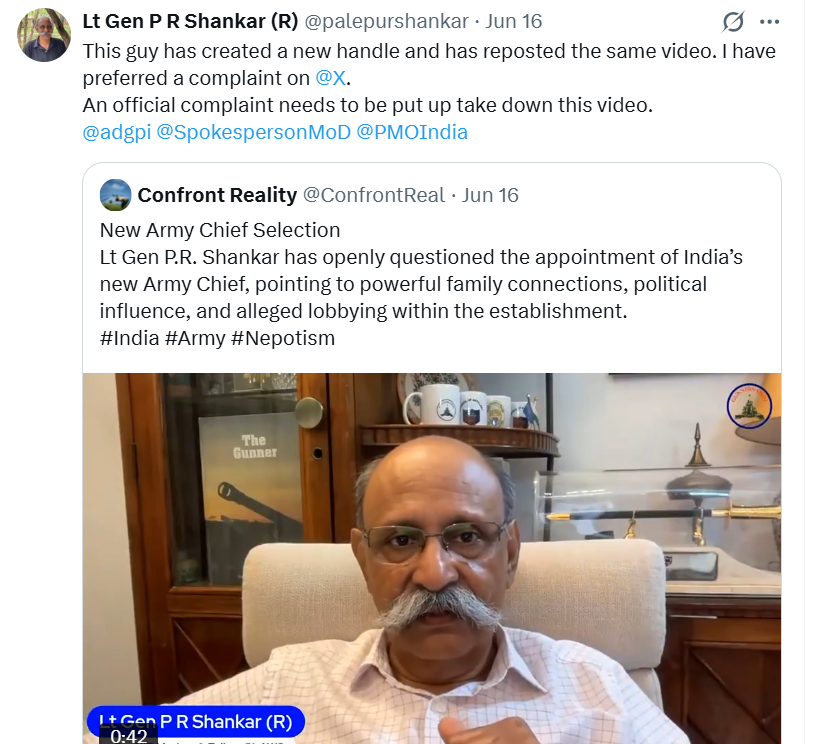
Further verification revealed that Lt Gen P.R. Shankar himself has labelled the circulating clip as fake on his official X account and has stated that a formal complaint has been filed against such manipulated content.
https://x.com/palepurshankar/status/2066826145707024778
Additionally, AI detection analysis using Hive Moderation indicated that the audio in the viral video has a 99% probability of being AI-generated.
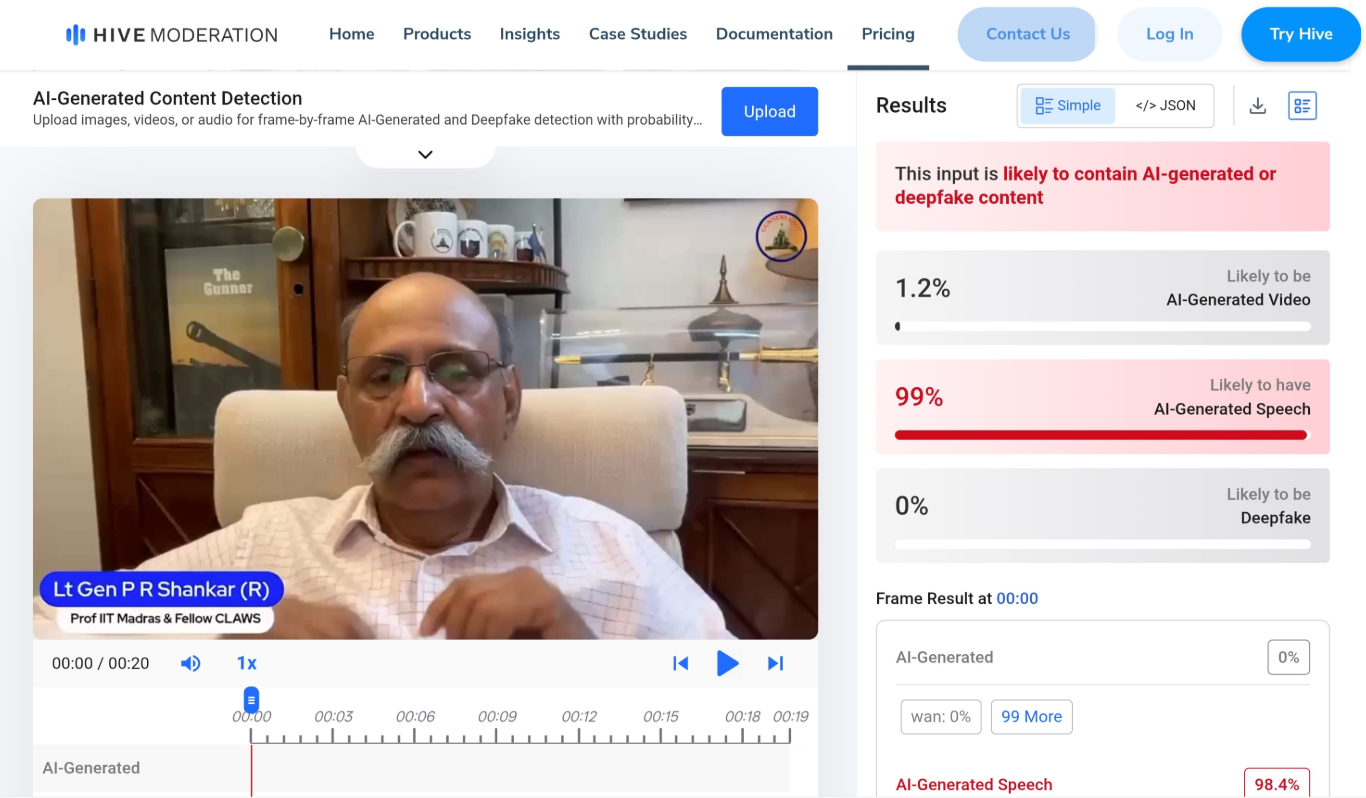
Conclusion: The research confirms that the viral video is an AI-generated deepfake. The original video does not contain any remarks about Lt Gen Dhiraj Seth or his appointment. The content has been digitally manipulated and is being circulated with a misleading narrative.

Introduction
The geographical world has physical boundaries, but the digital one has a different architecture and institutions are underprepared when it comes to addressing cybersecurity breaches. Cybercrime, which may lead to economic losses, privacy violations, national security threats and have psycho-social consequences, is forecast to continuously increase between 2024 and 2029, reaching an estimated cost of at least 6.4 trillion U.S. dollars (Statista). As cyber threats become persistent and ubiquitous, they are becoming a critical governance challenge. Lawmakers around the world need to collaborate on addressing this emerging issue.
Cybersecurity Governance and its Structural Elements
Cybersecurity governance refers to the strategies, policies, laws, and institutional frameworks that guide national and international preparedness and responses to cyber threats to governments, private entities, and individuals. Effective cybersecurity governance ensures that digital risks are managed proactively while balancing security with fundamental rights like privacy and internet freedom. It includes, but is not limited to :
- Policies and Legal Frameworks: Laws that define the scope of cybercrime, cybersecurity responsibilities, and mechanisms for data protection. Eg: India’s National Cybersecurity Policy (NCSP) of 2013, Information Technology Act, 2000, and Digital Personal Data Protection Act, 2023, EU’s Cybersecurity Act (2019), Cyber Resilience Act (2024), Cyber Solidarity Act (2025), and NIS2 Directive (2022), South Africa’s Cyber Crimes Act (2021), etc.
- Regulatory Bodies: Government agencies such as data protection authorities, cybersecurity task forces, and other sector-specific bodies. Eg: India’s Computer Emergency Response Team (CERT-In), Indian Cyber Crime Coordination Centre (I4C), Europe’s European Union Agency for Cybersecurity (ENISA), and others.
- Public-Private Knowledge Sharing: The sharing of the private sector’s expertise and the government’s resources plays a crucial role in improving enforcement and securing critical infrastructure. This model of collaboration is followed in the EU, Japan, Turkey, and the USA.
- Research and Development: Apart from the technical, the cyber domain also includes military, politics, economy, law, culture, society, and other elements. Robust, multi-sectoral research is necessary for formulating international and regional frameworks on cybersecurity.
Challenges to Cybersecurity Governance
Governments face several challenges in securing cyberspace and protecting critical assets and individuals despite the growing focus on cybersecurity. This is because so far the focus has been on cybersecurity management, which, considering the scale of attacks in the recent past, is not enough. Stakeholders must start deliberating on the aspect of governance in cyberspace while ensuring that this process is multi-consultative. (Savaş & Karataş 2022). Prominent challenges which need to be addressed are:
- Dynamic Threat Landscape: The threat landscape in cyberspace is ever-evolving. Bad actors are constantly coming up with new ways to carry out attacks, using elements of surprise, adaptability, and asymmetry aided by AI and quantum computing. While cybersecurity measures help mitigate risks and minimize damage, they can’t always provide definitive solutions. E.g., the pace of malware development is much faster than that of legal norms, legislation, and security strategies for the protection of information technology (IT). (Efe and Bensghir 2019).
- Regulatory Fragmentation and Compliance Challenges: Different countries, industries, or jurisdictions may enforce varying or conflicting cybersecurity laws and standards, which are still evolving and require rapid upgrades. This makes it harder for businesses to comply with regulations, increases compliance costs, and jeopardizes the security posture of the organization.
- Trans-National Enforcement Challenges: Cybercriminals operate across jurisdictions, making threat intelligence collection, incident response, evidence-gathering, and prosecution difficult. Without cross-border agreements between law enforcement agencies and standardized compliance frameworks for organizations, bad actors have an advantage in getting away with attacks.
- Balancing Security with Digital Rights: Striking a balance between cybersecurity laws and privacy concerns (e.g., surveillance laws vs. data protection) remains a profound challenge, especially in areas of CSAM prevention and identifying terrorist activities. Without a system of checks and balances, it is difficult to prevent government overreach into domains like journalism, which are necessary for a healthy democracy, and Big Tech’s invasion of user privacy.
The Road Ahead: Strengthening Cybersecurity Governance
All domains of human life- economy, culture, politics, and society- occur in digital and cyber environments now. It follows naturally, that governance in the physical world translates into governance in cyberspace. It must be underpinned by features consistent with the principles of openness, transparency, participation, and accountability, while also protecting human rights. In cyberspace, the world is stateless and threats are rapidly evolving with innovations in modern computing. Thus, cybersecurity governance requires a global, multi-sectoral approach utilizing the rules of international law, to chart out problems, and solutions, and carry out detailed risk analyses. (Savaş & Karataş 2022).
References
- https://www.statista.com/forecasts/1280009/cost-cybercrime-worldwide#statisticContainer
- https://link.springer.com/article/10.1365/s43439-021-00045-4#citeas
- https://digital-strategy.ec.europa.eu/en/policies/cybersecurity-policies#ecl-inpage-cybersecurity-strategy

Introduction
According to a new McAfee survey, 88% of American customers believe that cybercriminals will utilize artificial intelligence to "create compelling online scams" over the festive period. In the meanwhile, 31% believe it will be more difficult to determine whether messages from merchants or delivery services are genuine, while 57% believe phishing emails and texts will be more credible. The study, which was conducted in September 2023 in the United States, Australia, India, the United Kingdom, France, Germany, and Japan, yielded 7,100 responses. Some people may decide to cut back on their online shopping as a result of their worries about AI; among those surveyed, 19% stated they would do so this year.
In 2024, McAfee predicts a rise in AI-driven scams on social media, with cybercriminals using advanced tools to create convincing fake content, exploiting celebrity and influencer identities. Deepfake technology may worsen cyberbullying, enabling the creation of realistic fake content. Charity fraud is expected to rise, leveraging AI to set up fake charity sites. AI's use by cybercriminals will accelerate the development of advanced malware, phishing, and voice/visual cloning scams targeting mobile devices. The 2024 Olympic Games are seen as a breeding ground for scams, with cybercriminals targeting fans for tickets, travel, and exclusive content.
AI Scams' Increase on Social Media
Cybercriminals plan to use strong artificial intelligence capabilities to control social media by 2024. These applications become networking goldmines because they make it possible to create realistic images, videos, and audio. Anticipate the exploitation of influencers and popular identities by cybercriminals.
AI-powered Deepfakes and the Rise in Cyberbullying
The negative turn that cyberbullying might take in 2024 with the use of counterfeit technology is one trend to be concerned about. This cutting-edge technique is freely accessible to youngsters, who can use it to produce eerily convincing synthetic content that compromises victims' privacy, identities, and wellness.
In addition to sharing false information, cyberbullies have the ability to alter public photographs and re-share edited, detailed versions, which exacerbates the suffering done to children and their families. The study issues a warning, stating that deepfake technology would probably cause online harassment to take a negative turn. With this sophisticated tool, young adults may now generate frighteningly accurate synthetic content in addition to using it for fun. The increasing severity of these deceptive pictures and phrases can cause serious, long-lasting harm to children and their families, impairing their identity, privacy, and overall happiness.
Evolvement of GenAI Fraud in 2023
We simply cannot get enough of these persistent frauds and fake emails. People in general are now rather adept at [recognizing] those that are used extensively. But if they become more precise, such as by utilizing AI-generated audio to seem like a loved one's distress call or information that is highly personal to the person, users should be much more cautious about them. The rise in popularity of generative AIs brings with it a new wrinkle, as hackers can utilize these systems to refine their attacks:
- Writing communications more skillfully in order to deceive consumers into sending sensitive information, clicking on a link, or uploading a file.
- Recreate emails and business websites as realistically as possible to prevent arousing concern in the minds of the perpetrators.
- People's faces and voices can be cloned, and deepfakes of sounds or images can be created that are undetectable to the target audience. a problem that has the potential to greatly influence schemes like CEO fraud.
- Because generative AIs can now hold conversations, and respond to victims efficiently.
- Conduct psychological manipulation initiatives more quickly, with less money spent, and with greater complexity and difficulty in detecting them. AI generative already in use in the market can write texts, clone voices, or generate images and program websites.
AI Hastens the Development of Malware and Scams
Even while artificial intelligence (AI) has many uses, cybercriminals are becoming more and more dangerous with it. Artificial intelligence facilitates the rapid creation of sophisticated malware, illicit web pages, and plausible phishing and smishing emails. As these risks become more accessible, mobile devices will be attacked more frequently, with a particular emphasis on audio and visual impersonation schemes.
Olympic Games: A Haven for Scammers
The 2024 Olympic Games are seen as a breeding ground for scams, with cybercriminals targeting fans for tickets, travel, and exclusive content. Cybercriminals are skilled at profiting from big occasions, and the buzz that will surround the 2024 Olympic Games around the world will make it an ideal time for scams. Con artists will take advantage of customers' excitement by focusing on followers who are ready to purchase tickets, arrange travel, obtain special content, and take part in giveaways. During this prominent event, vigilance is essential to avoid an invasion of one's personal records and financial data.
Development of McAfee’s own bot to assist users in screening potential scammers and authenticators for messages they receive
Precisely such kind of technology is under the process of development by McAfee. It's critical to emphasize that solving the issue is a continuous process. AI is being manipulated by bad actors and thus, one of the tricksters can pull off is to exploit the fact that consumers fall for various ruses as parameters to train advanced algorithms. Thus, the con artists may make use of the gadgets, test them on big user bases, and improve with time.
Conclusion
According to the McAfee report, 88% of American customers are consistently concerned about AI-driven internet frauds that target them around the holidays. Social networking poses a growing threat to users' privacy. By 2024, hackers hope to take advantage of AI skills and use deepfake technology to exacerbate harassment. By mimicking voices and faces for intricate schemes, generative AI advances complex fraud. The surge in charitable fraud affects both social and financial aspects, and the 2024 Olympic Games could serve as a haven for scammers. The creation of McAfee's screening bot highlights the ongoing struggle against developing AI threats and highlights the need for continuous modification and increased user comprehension in order to combat increasingly complex cyber deception.
References
- https://www.fonearena.com/blog/412579/deepfake-surge-ai-scams-2024.html
- https://cxotoday.com/press-release/mcafee-reveals-2024-cybersecurity-predictions-advancement-of-ai-shapes-the-future-of-online-scams/#:~:text=McAfee%20Corp.%2C%20a%20global%20leader,and%20increasingly%20sophisticated%20cyber%20scams.
- https://timesofindia.indiatimes.com/gadgets-news/deep-fakes-ai-scams-and-other-tools-cybercriminals-could-use-to-steal-your-money-and-personal-details-in-2024/articleshow/106126288.cms
- https://digiday.com/media-buying/mcafees-cto-on-ai-and-the-cat-and-mouse-game-with-holiday-scams/
