
#FactCheck: AI-Generated Video Falsely Shared as Footage of Houthi Attack on Riyadh Airport
Executive Summary:
A missile attack was reportedly carried out by Yemen-based Houthi militants at King Khalid International Airport in Riyadh, the capital of Saudi Arabia, on October 8, damaging an aircraft at the airport. Following the attack, a video has gone viral on social media. The video is being shared with the claim that it shows footage from the time of the Houthi attack. CyberPeace Research found that the video is not authentic. It was created using AI with the help of an image from 2016.
Claim:
A Facebook user shared the video with the caption: “New video footage has emerged showing the moments when King Khalid International Airport in Riyadh, the capital of Saudi Arabia, was targeted.”
https://www.facebook.com/reel/1482618257069151

Fact Check:
To verify the viral claim, we conducted a Google keyword search using relevant terms. However, we did not find any credible media reports corroborating the claim.A reverse image search led us to a similar image on the stock photo website Shutterstock. According to the listing, the image was taken on March 1, 2016, at King Khalid International Airport in Riyadh, showing an aircraft preparing for takeoff. A close examination of the viral video makes it clear that the same image was used to create the viral video.

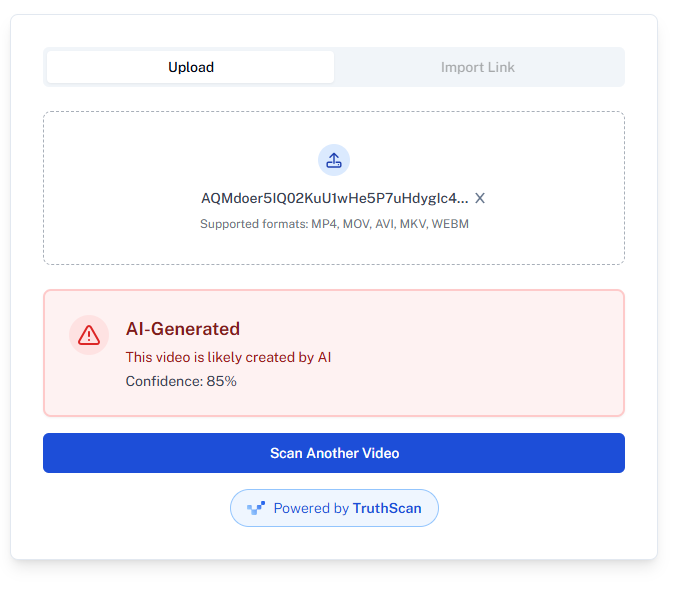
Upon closely examining the viral video, we suspected that it could be AI-generated. We then scanned the viral video using the AI detection tool Undetectable AI. According to the results, the video was found to be 85% AI-generated.
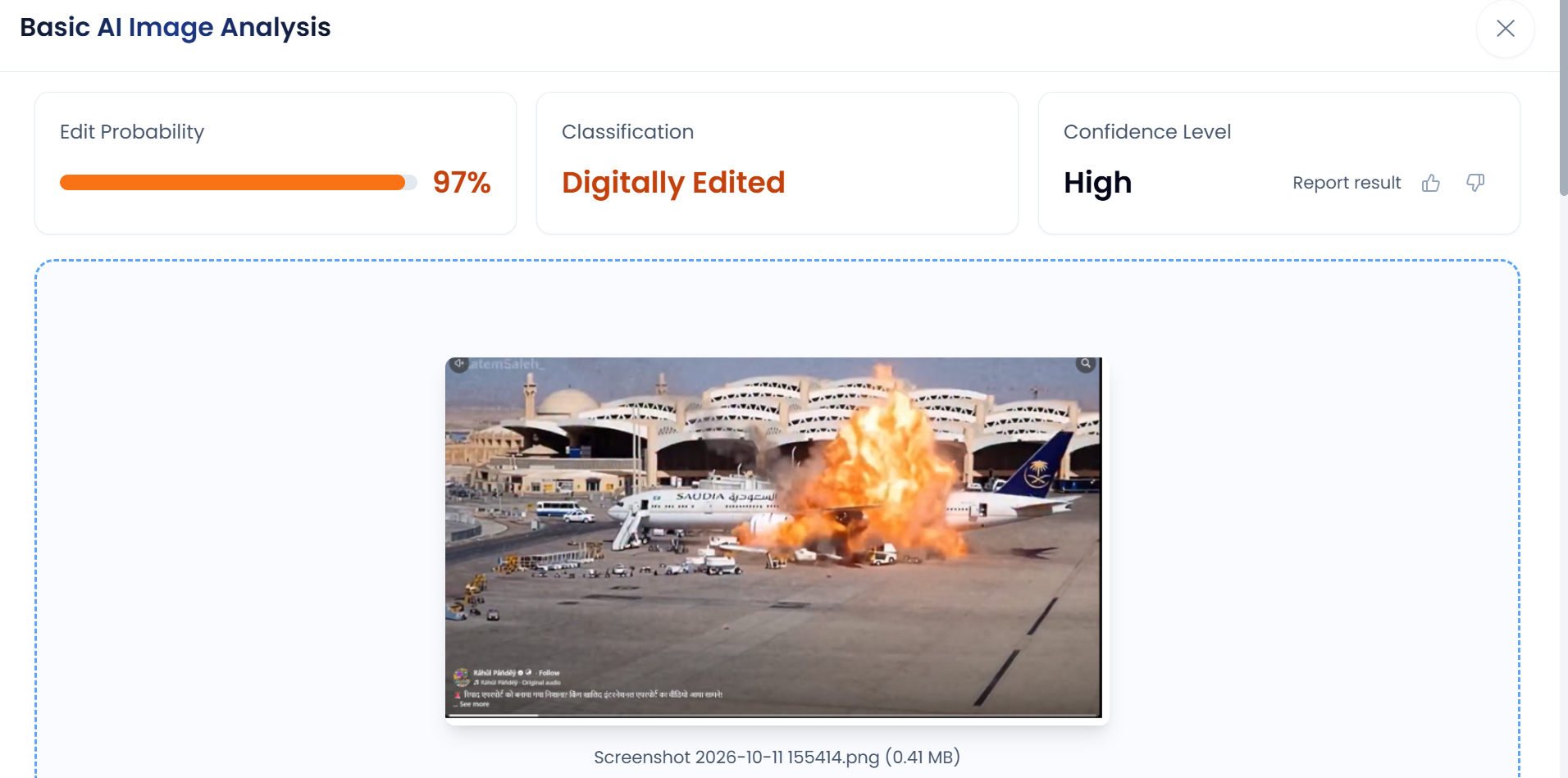
As part of our further research, we scanned the viral image using TruthScan. According to the results, the image was found to be 97% AI-generated.
Conclusion:
CyberPeace Research found the viral claim to be misleading. The video being shared as footage of the alleged Houthi missile attack on King Khalid International Airport in Riyadh is not authentic. Our research revealed that the video was AI-generated using a photograph taken at the airport on March 1, 2016. AI detection tools further indicated that the video and the image showed strong signs of being AI-generated.

Related Blogs

Introduction
Human Trafficking has been a significant concern and threat to society for a very long time. The aspects of our physical safety also have been influenced by human traffickers and the modus operandi they have adopted and deployed over the years. We are always cautious of younger children in regard to trafficking whenever we go out to crowded or unknown places. This concern and threat have also migrated to cyberspace and now pose new and different tangents of threats. These crimes are committed using technology and are further substantiated by different cybercrimes.
What is Cyber-Enabled Human Trafficking?
Cyber-enabled human trafficking is the new evolution of human trafficking in the digital age. Bad actors lure the victims via the internet and use social engineering to exploit their vulnerabilities to get them into their traps. In today's time, crime is often substantiated in lieu of fake job offers and a better lifestyle in new and major metropolitan cities. Now this crime has gone beyond the geographical boundaries of our nation, and often the victims end up in remote locations in the Middle East or South East Asia.
Cybercrime Hubs in Myanmar
The reports have indicated that a lot of trafficked victims are taken down to various cybercrime hubs in Myanmar. The victims are often lured on the pretext of job offers overseas, which pay handsomely. The victims make their way into the foreign nation but are then cornered by the bad actors and are segregated and taken into different hubs. The victims are often school graduates and seek basic jobs for their earnings. The victims are taken into Cybercrime hubs which Chinese syndicate criminals allegedly run.The victims are kept in tough conditions, beaten up, and held captive in remote jungles. Once the victim has lost hope, the criminals train them to commit cyber frauds like phishing. The victims are given scripts and mobile numbers to commit cybercrimes. The victims are given targets to ensure their survival, and due to the dark and threatening conditions, the victims just give up on the demands just to remain alive. Some of the victims make their way back home as well, but that is after 6-7 years of such constant torture and abuse to commit cybercrimes. The majority of such survivors face trouble seeking legal assistance as the criminals are almost impossible to track, thus making redressal for crimes and rehabilitation for survivors tough.
How to stay safe?
The criminals in such acts often target the vulnerable sector of the population, these people generally hail from tier 3 towns and rural areas. These victims aspire for a better life and earning opportunities, and due to less education and minimal awareness, they fail to see the traps set by the victims. The population at large can deploy the following measures and safe practices to avoid such horrific threats-
- Avoid Stranger interaction: Avoid interacting with strangers on any online platform or portal. Social media sites are the most used platforms by bad actors to make contact with potential victims.
- Do not Share: Avoid sharing any personal information with anyone online, and avoid filling out third-party surveys/forms seeking personal information.
- Check, Check and Recheck: Always be on alert for threats and always check and cross-check any link or platform you use or access.
- Too good to be true: If something feels like Too good to be true, it probably is and hence avoid falling for attractive job offers and work-from-home opportunities on social media platforms.
- Know your helplines: One should know the helpline numbers to make sure to exercise the reporting duty and also encourage your family members to report in case of any threat or issue.
- Raise Awareness: It is the duty of all netizens to raise awareness in society to arm more people against cybercrimes and fraud.
Conclusion
The name of cybercriminals is spreading all across the ecosystems, and now the technology is being deployed by such bad actors to even substantiate physical crimes. We need to be on alert and remain aware of such crimes and the modus Operandi of cyber criminals. Awareness and education are our best weapons to combat the threats and issues of cyber-enabled human trafficking, as the criminals feed on our vulnerabilities, lets eradicate them for once and for all and work towards creating a wholesome safe cyber ecosystem for all.https://www.scmp.com/week-asia/politics/article/3228543/inside-chinese-run-crime-hubs-myanmar-are-conning-world-we-can-kill-you-here
Introduction
For years, Indian companies could get away with vague privacy promises. That window closed on 13 November 2025, when the government notified the Digital Personal Data Protection Rules, giving teeth to the broad principles Parliament had passed back in 2023 under the DPDP Act. The Rules turned soft commitments into specific, auditable duties, and a lot of organisations are only now realising how much that actually changes.
Start with Section 8(4). It requires every Data Fiduciary to put "appropriate technical and organisational measures" in place. Most readers skim past "organisational" and focus on the technical half, but that's a mistake, because the word is doing real work. It's asking for defined roles, written policies, staff training, and someone actually watching whether any of it holds up over time, not just firewalls and encryption keys. Section 8(5) goes further, demanding reasonable security safeguards against breaches, and Rule 6 spells out exactly what that phrase means in practice: encrypt data at rest and in transit, restrict access on a need to know basis, require multi factor authentication, log and monitor activity, run regular vulnerability checks, bind your data processors contractually to the same standard, and keep relevant logs for at least a year.
Then there's Rule 7, and this is where the clock starts running. Once a Data Fiduciary becomes aware of a breach, the Data Protection Board must be told without delay, and a full report has to follow within 72 hours covering what happened, when, why, what's being done about it, and confirmation that affected individuals were notified. Unlike GDPR, there's no minimum severity threshold here. A breach affecting ten people triggers the same obligation as one affecting ten million. And CERT-In's existing six hour reporting window under its 2022 Directions still applies separately, which means a serious incident can trigger two overlapping regulatory clocks running side by side.
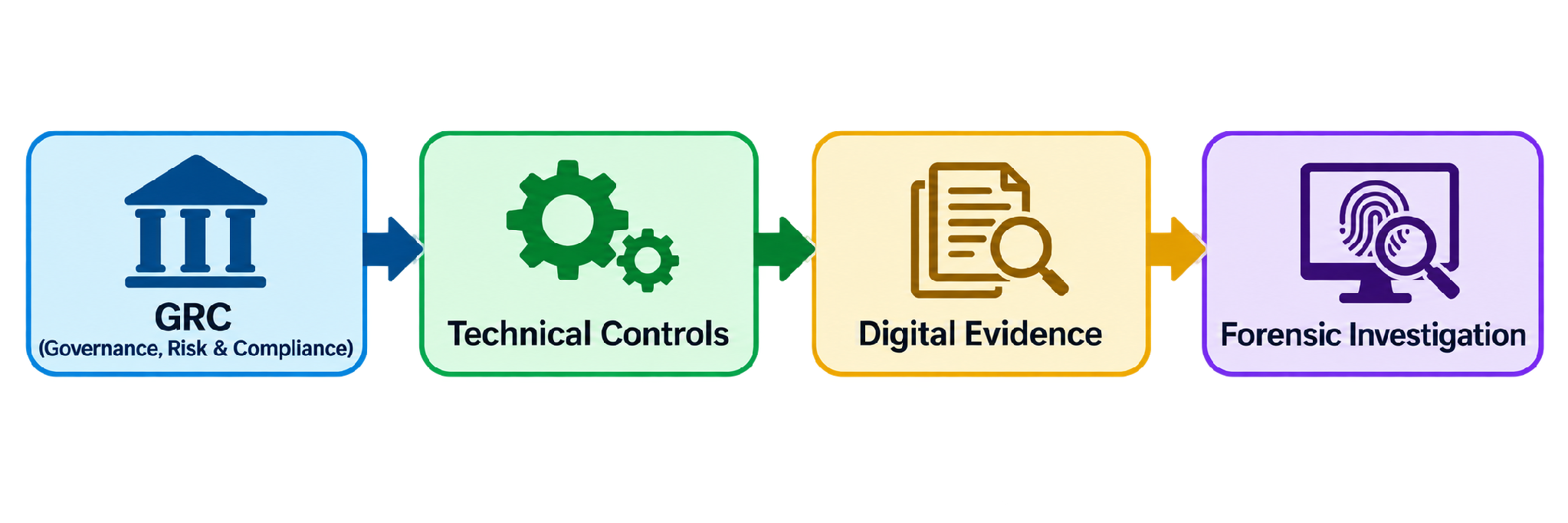
Put all of this together and a pattern emerges. The law assumes an organisation already knows what it's protecting, has actually protected it, kept usable records the whole way through, and can explain clearly what happened the moment something breaks. That coordination job belongs to Governance, Risk and Compliance, or GRC for short. GRC decides who's accountable, which risks actually matter, which controls address them, and how anyone checks whether compliance is real rather than assumed. Skip that structure and security work tends to splinter into a pile of disconnected tasks nobody truly owns.
GRC gives a legal duty somewhere to live. Forensic readiness is what lets an organisation prove, months or years later, that the duty was actually being met.
The Role of Governance, Risk and Compliance
On paper, most cybersecurity programmes look fine. There's an incident response plan somewhere, access control rules exist, logging is "in place," and someone has a title that says they're responsible for security. None of that gets tested until something actually breaks. A phishing compromise, a ransomware infection, a leaked database, a hijacked admin account, whatever the trigger, the questions that follow are always the same, and they're not comfortable ones. What happened, exactly, and when did it start? Which systems, which data, were actually touched? Were the controls the organisation claims to run genuinely functioning at that moment, or just described in a slide deck somewhere? And can anyone produce records solid enough to answer those questions with confidence rather than a shrug?
This is the exact seam where GRC and digital forensics meet. GRC lays out what's expected, who's responsible, and what evidence a control should be generating in the background. Digital forensics is the craft of taking whatever technical traces actually exist and turning them into an account of events that will hold up to scrutiny. Passing an audit was never really the point. Being able to stand in front of a regulator, mid incident, and show that the processes described on paper were real, active, and generating trustworthy evidence, that's the actual bar.
Why Compliance Alone Falls Short
Compliance, in the narrow sense, just means meeting whatever legal, contractual, or internal requirement applies. But a policy sitting in a document repository proves nothing about what actually happens on a Tuesday afternoon when someone requests admin access. A written incident response plan says nothing about whether the team can actually execute it under real pressure, at 2am, with a ransomware note on every screen. A logging policy is close to worthless if the logs it promises were switched off somewhere along the way, or overwritten, or scattered across systems that were never synchronised to the same clock.
NIST's Cybersecurity Framework 2.0 essentially built this concern into its core structure, placing "Govern" alongside Identify, Protect, Detect, Respond, and Recover as one of five equal functions rather than background paperwork sitting off to the side. India's own regulatory posture pushes in the same direction. CERT-In's 2022 Directions require certain incidents to be reported within six hours of discovery, and its guidance for government entities leans heavily on documented incident handling and disciplined evidence practices. The underlying message from both is identical: figure out, before anything goes wrong, whether the evidence you'll eventually need is actually going to exist when someone asks for it.
Where GRC and Forensics Actually Connect
A good GRC programme spells out what's supposed to happen. Forensic readiness is what lets you later prove what actually did.
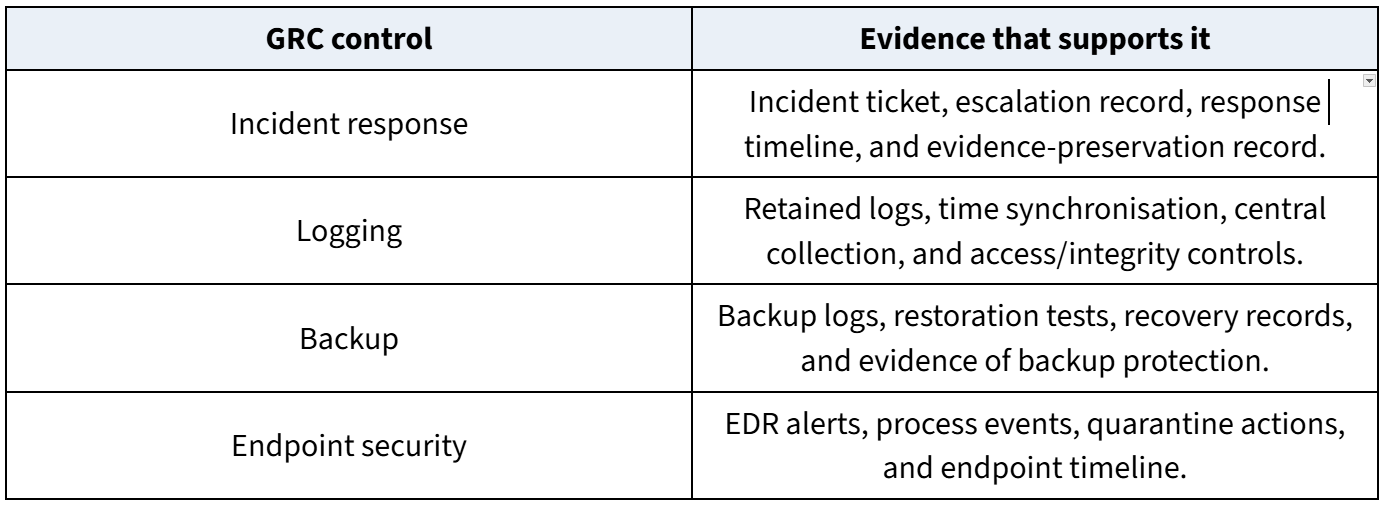
Access control is a useful example here. On the GRC side, an organisation might require least privilege access, multi factor authentication, periodic reviews of who holds privileged accounts, and prompt removal of access once someone leaves or changes roles. On the forensic side, none of that means anything without the underlying records that let investigators actually test it, authentication logs, MFA usage history, privilege change records, and account activity trails. The table below lines up a few common GRC controls against the specific evidence needed to show they were genuinely operating.
A Practical Scenario: After a Ransomware Incident
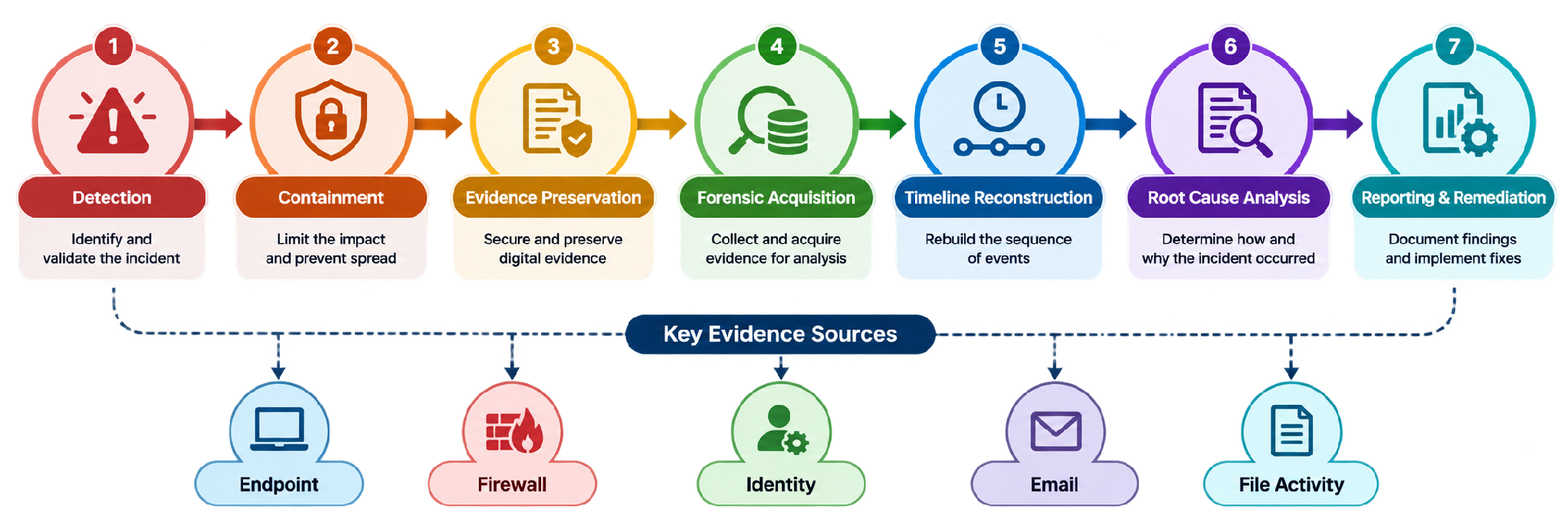
Picture a mid-sized company waking up to find half its file servers encrypted. There's an incident response plan somewhere in the shared drive, technically, but nobody's actually run through it in over a year. The security team isolates the obviously compromised endpoint and starts escalating. Now the forensic side of the house has to reconstruct what happened, working backward through endpoint telemetry, authentication logs, firewall events, email traffic, and file activity, hunting for the original point of entry, how the attacker escalated privileges, how they moved sideways through the network, what data they actually touched, and finally how the ransomware got deployed.
This is where the quality of everything collected beforehand suddenly matters a great deal. If server clocks were never properly synchronised, the timeline investigators build might not line up cleanly enough to trust. If logs only ever lived locally on individual machines rather than being pulled centrally, some of them are probably gone by now. If nobody ever bothered logging administrator actions, there are going to be real, unexplained gaps in the story. And if whatever evidence does exist wasn't collected the right way, its integrity can be challenged later, sometimes fatally, in a legal or regulatory proceeding. CERT-In actually ran a programme on exactly this in July 2026, "Inside the Breach," covering system artefacts, investigative technique, and chain of custody requirements, precisely because this is where real investigations tend to succeed or quietly fall apart.
Building a Forensic Ready GRC Programme
For an organisation starting more or less from scratch, forensic readiness doesn't need to be bolted on as some separate initiative. It can be built straight into the GRC programme that already exists. Start by identifying the systems, applications, cloud services, and privileged accounts that actually matter. Map the real risks and regulatory requirements onto the controls meant to address them. Then get specific about what evidence each control should be generating, and how that evidence gets protected and kept over time. Time synchronisation, centralised logging, tightly controlled access to security records, and clear ownership of preservation, escalation, and investigation all need to exist well before an incident, not be improvised during one. And none of it means much until it's actually been tested, through tabletop exercises and simulated incidents rather than assumed to work because it's written down somewhere. NIST SP 800-61 Revision 3 frames incident response as one continuous loop of preparation, detection, response, recovery, and improvement, rather than a series of separate boxes to check.
There's one question worth asking of every important control an organisation runs: could you actually prove this was working at the moment an incident happened? If the honest answer is no, what you have is a compliance process on paper, and a forensic readiness gap sitting quietly underneath it.
Conclusion
Cyber readiness was never really about how many policies sit in a binder or how many boxes get ticked in an audit. It shows up, or doesn't, in the hours right after something breaks, when an organisation has to move fast, preserve evidence that can actually stand up to scrutiny, explain clearly what happened, and prove that governance and technical controls were genuinely working together rather than just coexisting on paper. GRC sets the direction, the accountability, the risk priorities, and the compliance expectations. Digital forensics does the work of preserving and interpreting the technical evidence once something actually happens. Forensic readiness sits in between the two, making sure they're actually talking to each other long before an incident forces the conversation. The practical task for most organisations comes down to something simple to say, if not always simple to build: design controls that hold up under real incident response, not just an auditor's checklist. The strongest compliance posture was never the one with the thickest binder. It's the one that can back every document up with evidence, on the day it actually matters.
References
- Digital Personal Data Protection Act, 2023, Sections 8(4), 8(5), 8(6). https://www.meity.gov.in/writereaddata/files/Digital%20Personal%20Data%20Protection%20Act%202023.pdf
- Digital Personal Data Protection Rules, 2025, Rules 6 and 7, notified 13 November 2025. https://www.meity.gov.in
- National Institute of Standards and Technology, The NIST Cybersecurity Framework (CSF) 2.0, CSWP 29, 2024. https://csrc.nist.gov/pubs/cswp/29/the-nist-cybersecurity-framework-csf-20/final
- Indian Computer Emergency Response Team (CERT-In), Directions under Section 70B of the Information Technology Act, 2000, dated 28 April 2022. https://www.cert-in.org.in/Directions70B.jsp
- Indian Computer Emergency Response Team (CERT-In), Guidelines on Information Security Practices for Government Entities. https://www.cert-in.org.in/Downloader?fileName=CIPS-2026-0014.pdf&pageid=5&type=2
- National Institute of Standards and Technology, SP 800-86: Guide to Integrating Forensic Techniques into Incident Response, 2006. https://csrc.nist.gov/pubs/sp/800/86/final
- International Organization for Standardization, ISO/IEC 27037:2012, Guidelines for identification, collection, acquisition and preservation of digital evidence. CERT-In, "Inside the Breach: Advanced Cyber Forensics & Incident Investigation," 31 July 2026. https://www.cert-in.org.in/s2cMainServlet?pageid=PRSTNVIEW03&reCode=CIWS-2026-3569
- National Institute of Standards and Technology, SP 800-61 Rev. 3: Incident Response Recommendations and Considerations for Cybersecurity Risk Management, 2025. https://csrc.nist.gov/pubs/sp/800/61/r3/final
- Matters.ai, "DPDP Breach Notification: 72-Hour Rule & ₹200 Cr Penalty." https://www.matters.ai/article/dpdp-breach-notification MediaNama, "Data Breach Reporting Timeline of DPDP Rules 2025 Explained." https://www.medianama.com/2025/11/223-data-breach-reporting-timeline-of-dpdp-rules-2025-explained/

Digital vulnerabilities like cyber-attacks and data breaches proliferate rapidly in the hyper-connected world that is created today. These vulnerabilities can compromise sensitive data like personal information, financial data, and intellectual property and can potentially threaten businesses of all sizes and in all sectors. Hence, it has become important to inform all stakeholders about any breach or attack to ensure they can be well-prepared for the consequences of such an incident.
The non-reporting of reporting can result in heavy fines in many parts of the world. Data breaches caused by malicious acts are crimes and need proper investigation. Organisations may face significant penalties for failing to report the event. Failing to report data breach incidents can result in huge financial setbacks and legal complications. To understand why transparency is vital and understanding the regulatory framework that governs data breaches is the first step.
The Current Indian Regulatory Framework on Data Breach Disclosure
A data breach essentially, is the unauthorised processing or accidental disclosure of personal data, which may occur through its acquisition, sharing, use, alteration, destruction, or loss of access. Such incidents can compromise the affected data’s confidentiality, integrity, or availability. In India, the Information Technology Act of 2000 and the Digital Personal Data Protection Act of 2023 are the primary legislation that tackles cybercrimes like data breaches.
- Under the DPDP Act, neither materiality thresholds nor express timelines have been prescribed for the reporting requirement. Data Fiduciaries are required to report incidents of personal data breach, regardless of their sensitivity or impact on the Data Principal.
- The IT (Indian Computer Emergency Response Team and Manner of Performing Functions and Duties) Rules, 2013, the IT (Reasonable Security Practices and Procedures and Sensitive Personal Data or Information) Rules, 2011, along with the Cyber Security Directions, under section 70B(6) of the IT Act, 2000, relating to information security practices, procedure, prevention, response and reporting of cyber incidents for Safe & Trusted Internet prescribed in 2022 impose mandatory notification requirements on service providers, intermediaries, data centres and corporate entities, upon the occurrence of certain cybersecurity incidents.
- These laws and regulations obligate companies to report any breach and any incident to regulators such as the CERT-In and the Data Protection Board.
The Consequences of Non-Disclosure
A non-disclosure of a data breach has a manifold of consequences. They are as follows:
- Legal and financial penalties are the immediate consequence of a data breach in India. The DPDP Act prescribes a fine of up to Rs 250 Crore from the affected parties, along with suits of a civil nature and regulatory scrutiny. Non-compliance can also attract action from CERT-In, leading to more reputational damage.
- In the long term, failure to disclose data breaches can erode customer trust as they are less likely to engage with a brand that is deemed unreliable. Investor confidence may potentially waver due to concerns about governance and security, leading to stock price drops or reduced funding opportunities. Brand reputation can be significantly tarnished, and companies may struggle with retaining and attracting customers and employees. This can affect long-term profitability and growth.
- Companies such as BigBasket and Jio in 2020 and Haldiram in 2022 have suffered from data breaches recently. Poor transparency and delay in disclosures led to significant reputational damage, legal scrutiny, and regulatory actions for the companies.
Measures for Improvement: Building Corporate Reputation via Transparency
Transparency is critical when disclosing data breaches. It enhances trust and loyalty for a company when the priority is data privacy for stakeholders. Ensuring transparency mitigates backlash. It demonstrates a company’s willingness to cooperate with authorities. A farsighted approach instils confidence in all stakeholders in showcasing a company's resilience and commitment to governance. These measures can be further improved upon by:
- Offering actionable steps for companies to establish robust data breach policies, including regular audits, prompt notifications, and clear communication strategies.
- Highlighting the importance of cooperation with regulatory bodies and how to ensure compliance with the DPDP Act and other relevant laws.
- Sharing best public communications practices post-breach to manage reputational and legal risks.
Conclusion
Maintaining transparency when a data breach happens is more than a legal obligation. It is a good strategy to retain a corporate reputation. Companies can mitigate the potential risks (legal, financial and reputational) by informing stakeholders and cooperating with regulatory bodies proactively. In an era where digital vulnerabilities are ever-present, clear communication and compliance with data protection laws such as the DPDP Act build trust, enhance corporate governance, and secure long-term business success. Proactive measures, including audits, breach policies, and effective public communication, are critical in reinforcing resilience and fostering stakeholder confidence in the face of cyber threats.
References
- https://www.meity.gov.in/writereaddata/files/Digital%20Personal%20Data%20Protection%20Act%202023.pdf
- https://www.cert-in.org.in/PDF/CERT-In_Directions_70B_28.04.2022.pdf
- https://chawdamrunal.medium.com/the-dark-side-of-covering-up-data-breaches-why-transparency-is-crucial-fe9ed10aac27
- https://www.dlapiperdataprotection.com/index.html?t=breach-notification&c=IN
