
#FactCheck: AI-Generated Video Falsely Shared as CCTV Footage of Bull Saving Young Man
Executive Summary
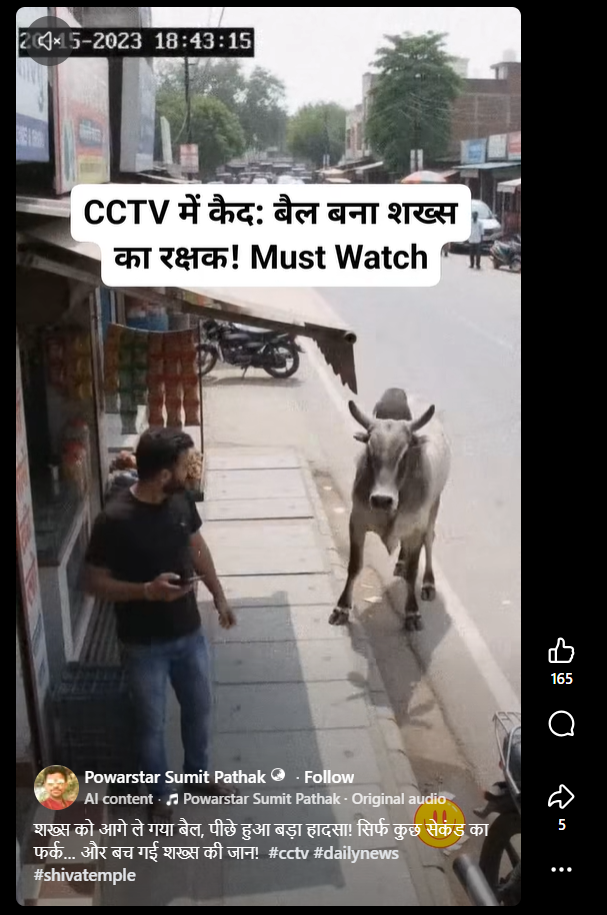
A video circulating on social media shows a bull pushing a young man who appears to be engrossed in looking at his mobile phone. Users sharing the video claim that the CCTV footage captured an incident in which the bull pushed the man and saved him from a mishap. CyberPeace Research found the viral claim to be false. Our research found that the viral video is AI-generated and is being shared with a misleading claim.
Claim
A Facebook user shared the viral video with the caption, “The one whose life is being protected by God Himself.” The post link, archive link and screenshot are provided below.
https://www.facebook.com/reel/2568861153629568

Fact-check
To verify the viral claim, we conducted a Google Lens search using keyframes from the video. During the search, we found the same video on the Facebook page of user ‘Powarstar Sumit Pathak’. The video, uploaded on October 4, 2026, carries an ‘AI content’ label.
https://www.facebook.com/reel/1473526454600527
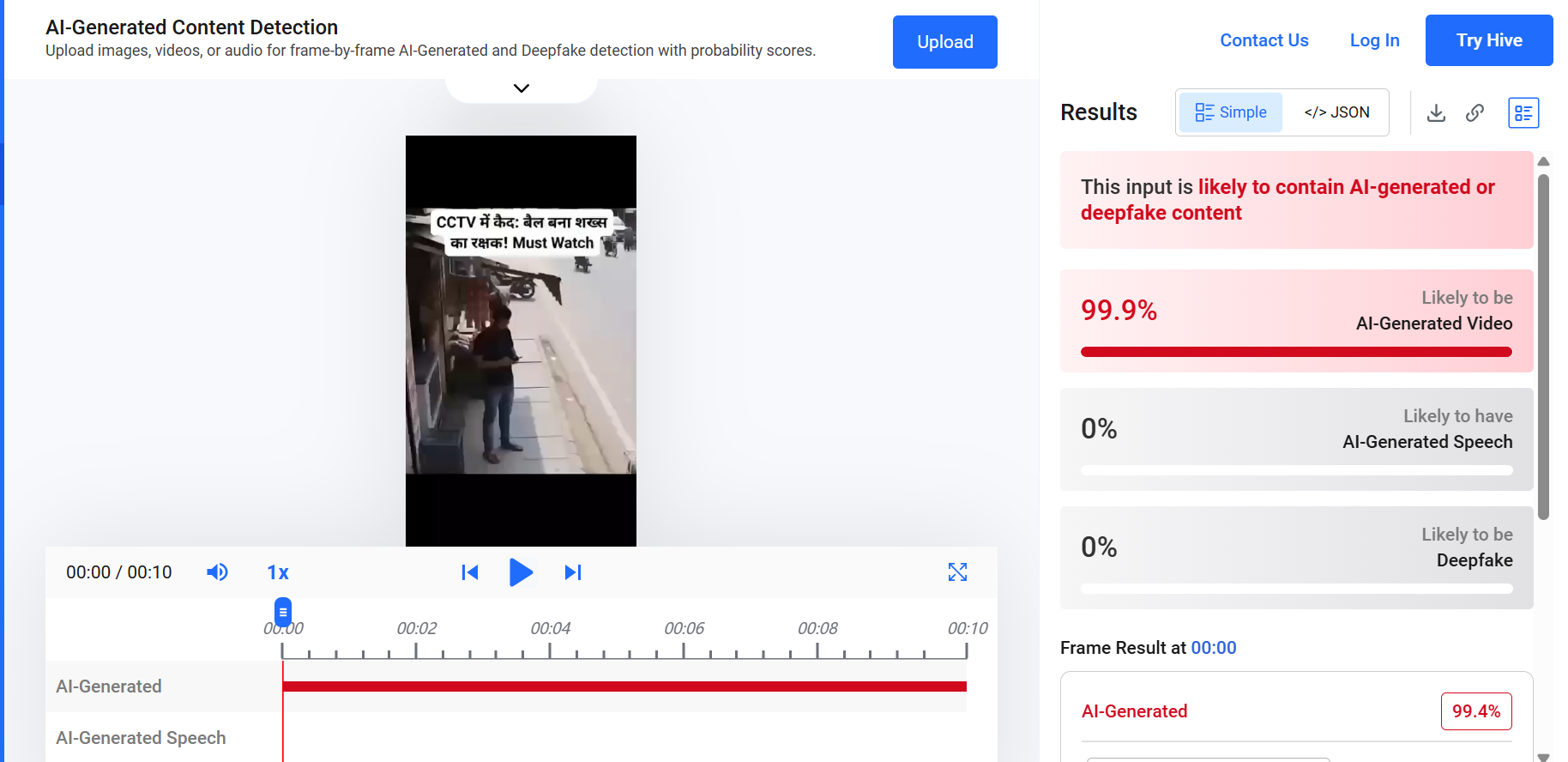
As part of our further research, we scanned the viral video using the AI detection tool Hive Moderation. The results indicated that the video is 99% likely to be AI-generated.
Conclusion
Our research found that the viral video is AI-generated and is being shared with a misleading claim. The video does not show an actual incident involving a bull saving a young man, as claimed in social media posts. The viral claim is therefore false.

Related Blogs
Introduction
The Telecom Regulatory Authority of India (TRAI) issued a consultation paper titled “Encouraging Innovative Technologies, Services, Use Cases, and Business Models through Regulatory Sandbox in Digital Communication Sector. The paper presents a draft sandbox structure for live testing of new digital communication products or services in a regulated environment. TRAI seeks comments from stakeholders on several parts of the framework.
What is digital communication?
Digital communication is the use of internet tools such as email, social media messaging, and texting to communicate with other people or a specific audience. Even something as easy as viewing the content on this webpage qualifies as digital communication.
Aim of Paper
- Frameworks are intended to support regulators’ desire for innovation while also ensuring economic resilience and consumer protection. Considering this, the Department of Telecom (DoT) asked TRAI to offer recommendations on a regulatory sandbox framework. TRAI approaches the issue with the goal of encouraging creativity and hastening the adoption of cutting-edge digital communications technologies.
- Artificial intelligence, the Internet of Things, edge computing, and other emerging technologies are revolutionizing how we connect, communicate, and access information, driving the digital communication sector to rapidly expand. To keep up with this dynamic environment, an enabling environment for the development and deployment of novel technologies, services, use cases, and business models is required.
- The regulatory sandbox concept is becoming increasingly popular around the world as a means of encouraging innovation in a range of industries. A regulatory sandbox is a regulated environment in which businesses and innovators can test their concepts, commodities, and services while operating under changing restrictions.
- Regulatory Sandbox will benefit the telecom startup ecosystem by providing access to a real-time network environment and other data, allowing them to evaluate the reliability of new applications before releasing them to the market. Regulatory Sandbox also attempts to stimulate cross-sectoral collaboration for carrying out such testing by engaging the assistance of other ministries and departments in order to give the starting company with a single window for acquiring all clearances.
What is regulatory sandbox?
- A regulatory sandbox is a controlled regulatory environment in which new products or services are tested in real-time.
- It serves as a “safe space” for businesses because authorities may or may not allow certain relaxations for the sole purpose of testing.
- The sandbox enables the regulator, innovators, financial service providers, and clients to perform field testing in order to gather evidence on the benefits and hazards of new financial innovations, while closely monitoring and mitigating their risks.
What are the advantages of having a regulatory sandbox?
- Firstly, regulators obtain first-hand empirical evidence on the benefits and risks of emerging technologies and their implications, allowing them to form an informed opinion on the regulatory changes or new regulations that may be required to support useful innovation while mitigating the associated risks.
- Second, sandbox customers can evaluate the viability of a product without the need for a wider and more expensive roll-out. If the product appears to have a high chance of success, it may be authorized and delivered to a wider market more quickly.
Digital communication sector and Regulatory Sandbox
- Many countries’ regulatory organizations have built sandbox settings for telecom tech innovation.
- These frameworks are intended to encourage regulators’ desire for innovation while also promoting economic resilience and consumer protection.
- In this context, the Department of Telecom (DoT) had asked TRAI to give recommendations on a regulatory sandbox framework.
- Written comments on the drafting framework will be received until July 17, 2023, and counter-comments will be taken until August 1, 2023. The Authority’s goal in the digital communication industry is to foster creativity and expedite the use of emerging technologies such as artificial intelligence (AI), the Internet of Things (IoT), and edge computing. These technologies are changing the way individuals connect, engage, and access information, causing rapid changes in the industry.
Conclusion
According to TRAI, these technologies are changing how individuals connect, engage, and obtain information, resulting in significant changes in the sector.
The regulatory sandbox also wants to stimulate cross-sectoral collaboration for carrying out such testing by engaging the assistance of other ministries and departments in order to give the starting company with a single window for acquiring all clearances. The consultation paper covers some of the worldwide regulatory sandbox frameworks in use in the digital communication industry, as well as some of the frameworks in use inside the country in other sectors.
.webp)
Executive Summary
A 20-second video showing skyscrapers submerged in water is being widely circulated on social media with the claim that it depicts the flood situation in Surat, Gujarat. The video is also being used by some users to criticize the Bharatiya Janata Party (BJP) government in Gujarat and Prime Minister Narendra Modi. Many social media users are sharing the clip as authentic footage of flooding in Surat. CyberPeace Research Wing’s research found the viral claim to be false. Our research revealed that the video is AI-generated and has no connection with Surat. While it is true that heavy rainfall caused flooding in parts of Surat and nearby districts in early July 2026, the viral video does not show any real scenes from the city.
Claim
Facebook user ‘Amresh Kumar’ shared the viral video on July 16, 2026, with the caption, “Thirty years of the Modi-BJP government. Drone footage of Gujarat Model – Surat city.”
https://www.facebook.com/reel/2440459239767277

Fact Check
To verify the claim, we first conducted a keyword search using terms related to flooding in Surat during July 2026. Our search confirmed that Surat experienced heavy rainfall during the first week of July, resulting in waterlogging and disruption in several low-lying areas. According to a report published by Bhaskar.com on July 8, 2026, intense rainfall led to flooding in several parts of Surat, and a few deaths due to electrocution were also reported.

However, none of the credible reports or images from the actual flooding resembled the scenes shown in the viral video. To further investigate, we analysed the video using multiple AI detection tools.We first scanned the video using Hive Moderation, which indicated a 99.9% probability that the footage was generated using Artificial Intelligence.
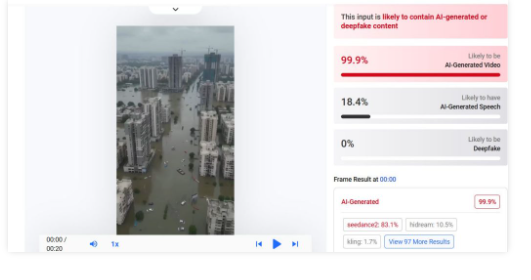
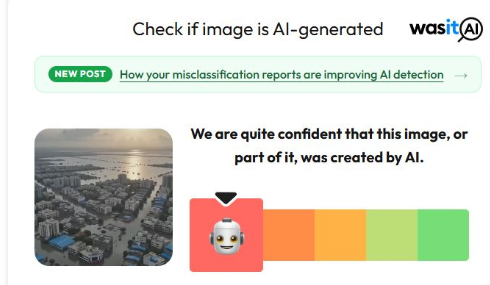
For additional verification, we examined the clip using another AI detection platform, WasItAI, which also concluded that the video had been created using AI. The analysis from multiple tools strongly suggests that the viral footage is digitally generated and does not represent a real event.
Conclusion
Our research found that the viral video being shared as drone footage of flooding in Surat is fake. Although Surat experienced heavy rainfall and flooding in early July 2026, the video circulating on social media is AI-generated and has no connection with the actual situation in the city. The clip is being falsely shared to spread misleading information.

Introduction
In the face of escalating cybercrimes in India, criminals are adopting increasingly inventive methods to deceive victims. Imagine opening your phone to the notification of an incoming message from a stranger with a friendly introduction - a beginning that appears harmless, but is the beginning of an awful financial nightmare. "Pig Butchering '' scam—an increasingly sophisticated form of deception that's gaining more widespread popularity. Unlike any other scams, this one plays a long game, spinning a web of trust before it strikes. It's a modern-day financial thriller happening in the real world, with real victims. "pig butchering" scam, involves building trust through fake profiles and manipulating victims emotionally to extort money. The scale of such scams has raised concerns, emphasising the need for awareness and vigilance in the face of evolving cyber threats.
How does 'Pig Butchering' Scam Work?
At its core, the scam starts innocuously, often with a stranger reaching out via text, social media, or apps like WhatsApp or WeChat. The scammer, hiding behind a well-crafted and realistic online persona, seeks to forge a connection. This could be under the pretence of friendship or romance, employing fake photos and stories to seem authentic. Gradually, the scammer builds a rapport, engaging in personal and often non-financial conversations. They may portray themselves as a widow, single parent, or even a military member to evoke empathy and trust. Over time, this connection pivots to investment opportunities, with the scammer presenting lucrative tips or suggestions in stocks or cryptocurrencies. Initially, modest investments are encouraged, and falsified returns are shown to lure in larger sums. Often, the scammer claims affiliation with a profitable financial institution or success in cryptocurrency trading. They direct victims to specific, usually fraudulent, trading platforms under their control. The scam reaches its peak when significant investments are made, only for the scammer to manipulate the situation, block access to the trading platform, or vanish, leaving the victim with substantial losses.
Real-Life Examples and Global Reach
These scams are not confined to one region. In India, for instance, scammers use emotional manipulation, often starting with a WhatsApp message from an unknown, attractive individual. They pose as professionals offering part-time jobs, leading victims through tasks that escalate in investment and complexity. These usually culminate in cryptocurrency investments, with victims unable to withdraw their funds, the money often traced to accounts in Dubai.
In the West, several cases highlight the scam's emotional and financial toll: A Michigan woman was lured by an online boyfriend claiming to make money from gold trading. She invested through a fake brokerage, losing money while being emotionally entangled. A Canadian man named Sajid Ikram lost nearly $400,000 in a similar scam, initially misled by a small successful withdrawal. In California, a man lost $440,000, succumbing to pressure to invest more, including retirement savings and borrowed money. A Maryland victim faced continuous demands from scammers, losing almost $1.4 million in hopes of recovering previous losses. A notable case involved US authorities seizing about $9 million in cryptocurrency linked to a global pig butchering scam, showcasing its extensive reach.
Safeguarding Against Such Scams
Vigilance is crucial to prevent falling victim to these scams. Be skeptical of unsolicited contacts and wary of investment advice from strangers. Conduct thorough research before any financial engagement, particularly on unfamiliar platforms. Indian Cyber Crime Coordination Center warns of red flags like sudden large virtual currency transactions, interest in high-return investments mentioned by new online contacts, and atypical customer behaviour.
Victims should report incidents to various Indian and foreign websites and the Securities Exchange Commission. Financial institutions are advised to report suspicious activities related to these scams. In essence, the pig butchering scam is a cunning blend of emotional manipulation and financial fraud. Staying informed and cautious is key to avoiding these sophisticated traps.
Conclusion
The Pig Butchering Scams are one of the many new breeds of emerging cyber scams that have become a bone of contention for cyber security organisations. It is imperative for netizens to stay vigilant and well-informed about the dynamics of cyberspace and emerging cyber crimes.
References
- https://www.sentinelassam.com/more-news/national-news/from-impersonating-cbi-officers-to-pig-butchering-cyber-criminals-get-creative
- https://hiindia.com/from-impersonating-cbi-officers-to-pig-butchering-cyber-criminals-get-creative/
