
#FactCheck: AI-Generated Video Falsely Portrayed as Calf Mistaking Cow Poster for Mother
Executive Summary
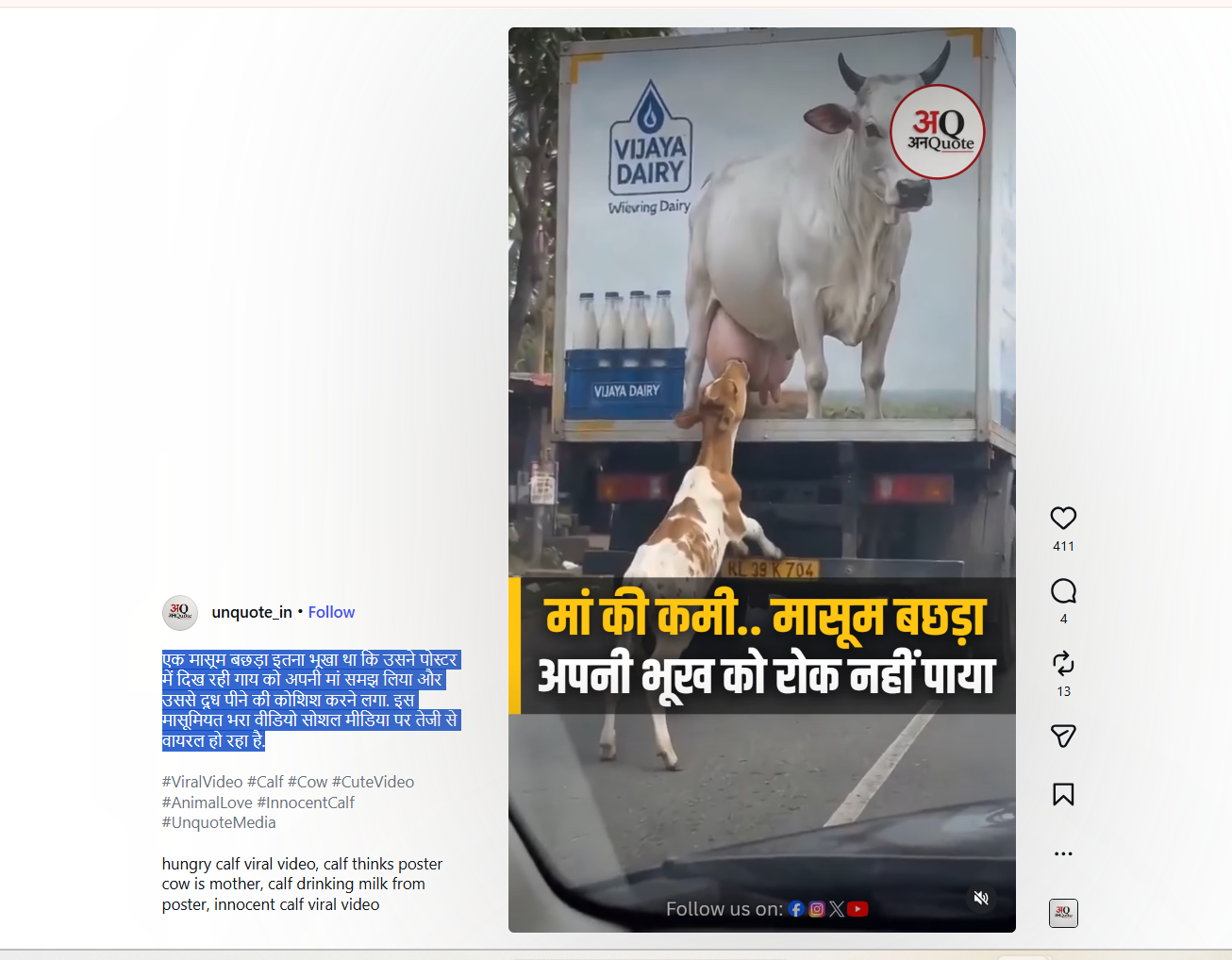
A video is being shared on social media showing a young calf running behind a milk truck on a road. A large image of a white cow is printed on the back of the truck. The calf appears to mistake the image for its real mother and tries to reach its udders. The video is being widely shared online with emotional captions. Research by the CyberPeace Research Wing found the viral claim to be false. Our research revealed that the viral video is AI-generated.
Claim:
An Instagram user shared the viral video with the caption: “A helpless calf was so hungry that it mistook the cow shown in the poster for its mother and tried to drink milk from her. This heartwarming video of innocence is rapidly going viral on social media.
https://www.instagram.com/reels/Dc5Gh-1DUl7/
Fact Check
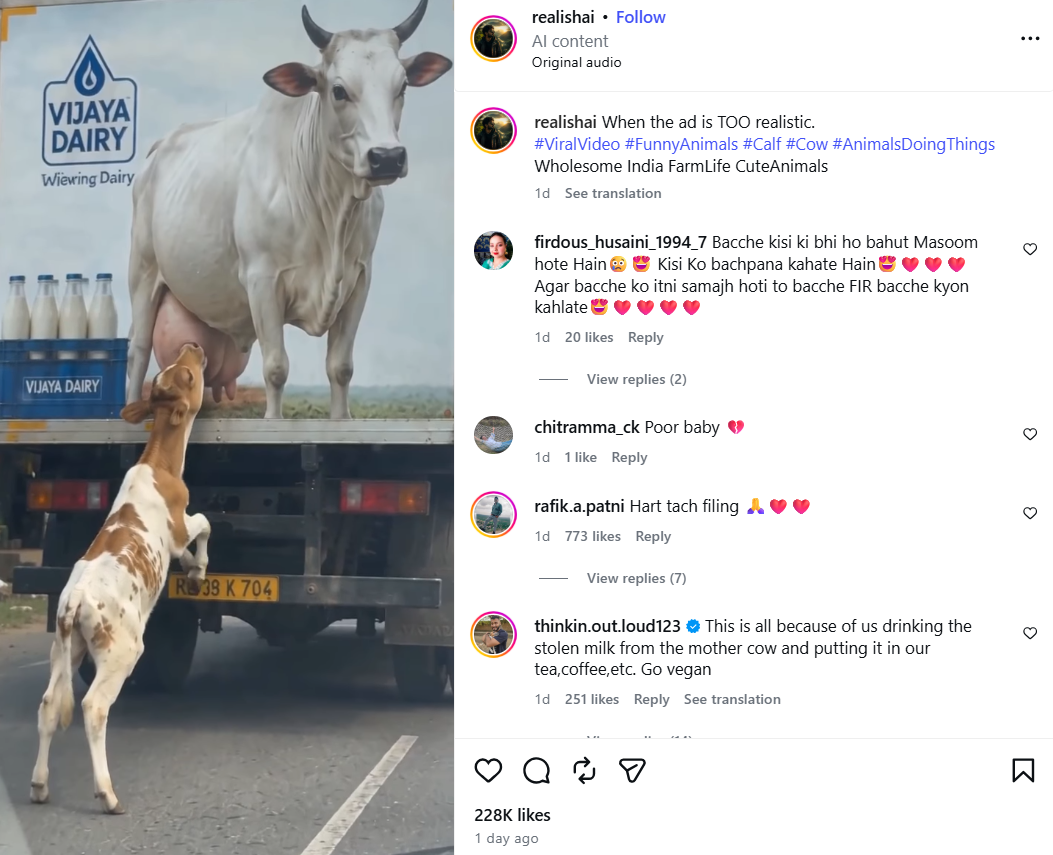
To verify the viral claim, we conducted a Google search using relevant keywords but found no credible media reports supporting the claim. In the next step of our research, we extracted keyframes from the video and performed a reverse image search on Google. This led us to the same video on an account named ‘realishai’. Our research found that the account creates and shares AI-generated videos.”
https://www.instagram.com/realishai/
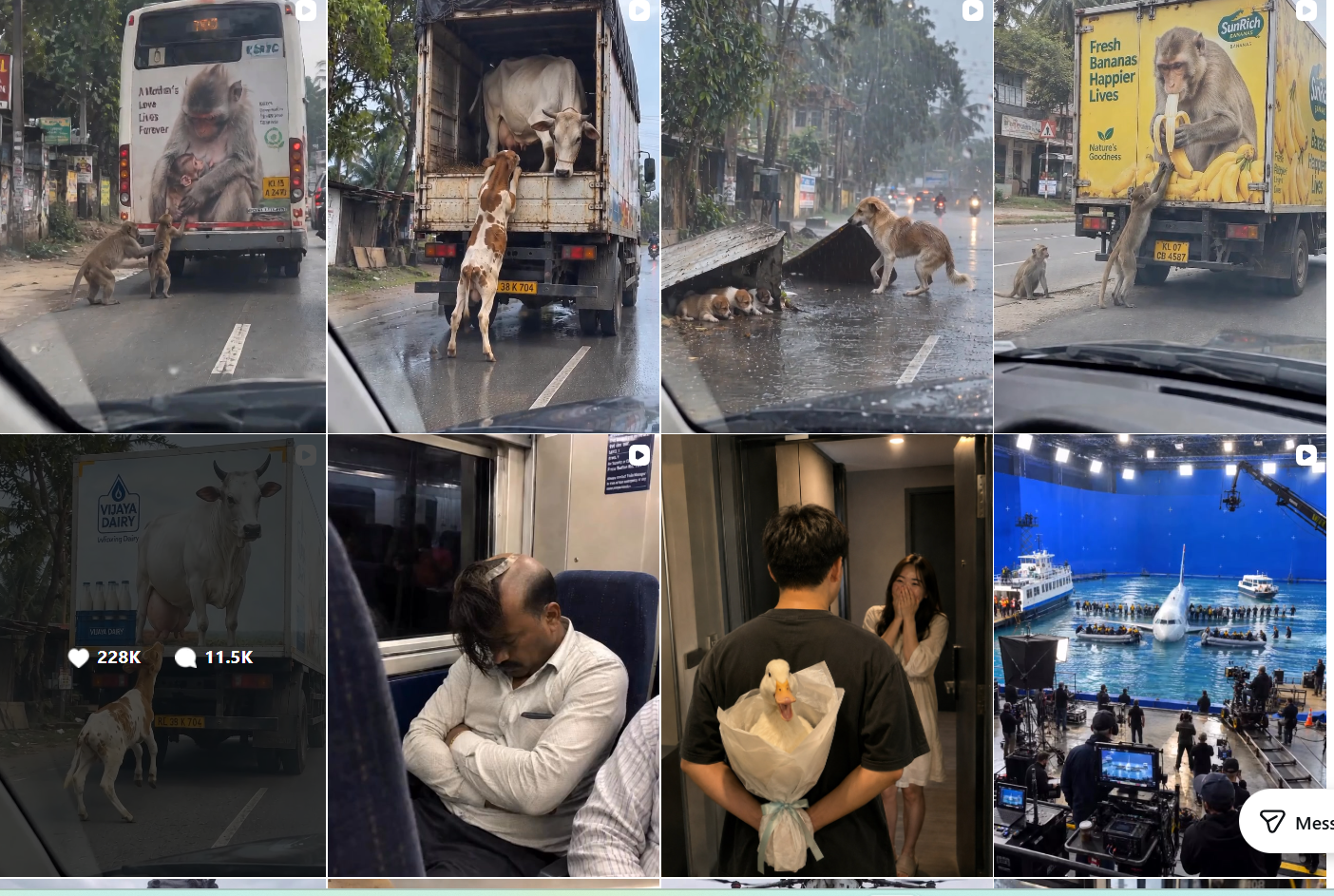
We also found several other AI-generated videos similar to the viral clip on the same account.
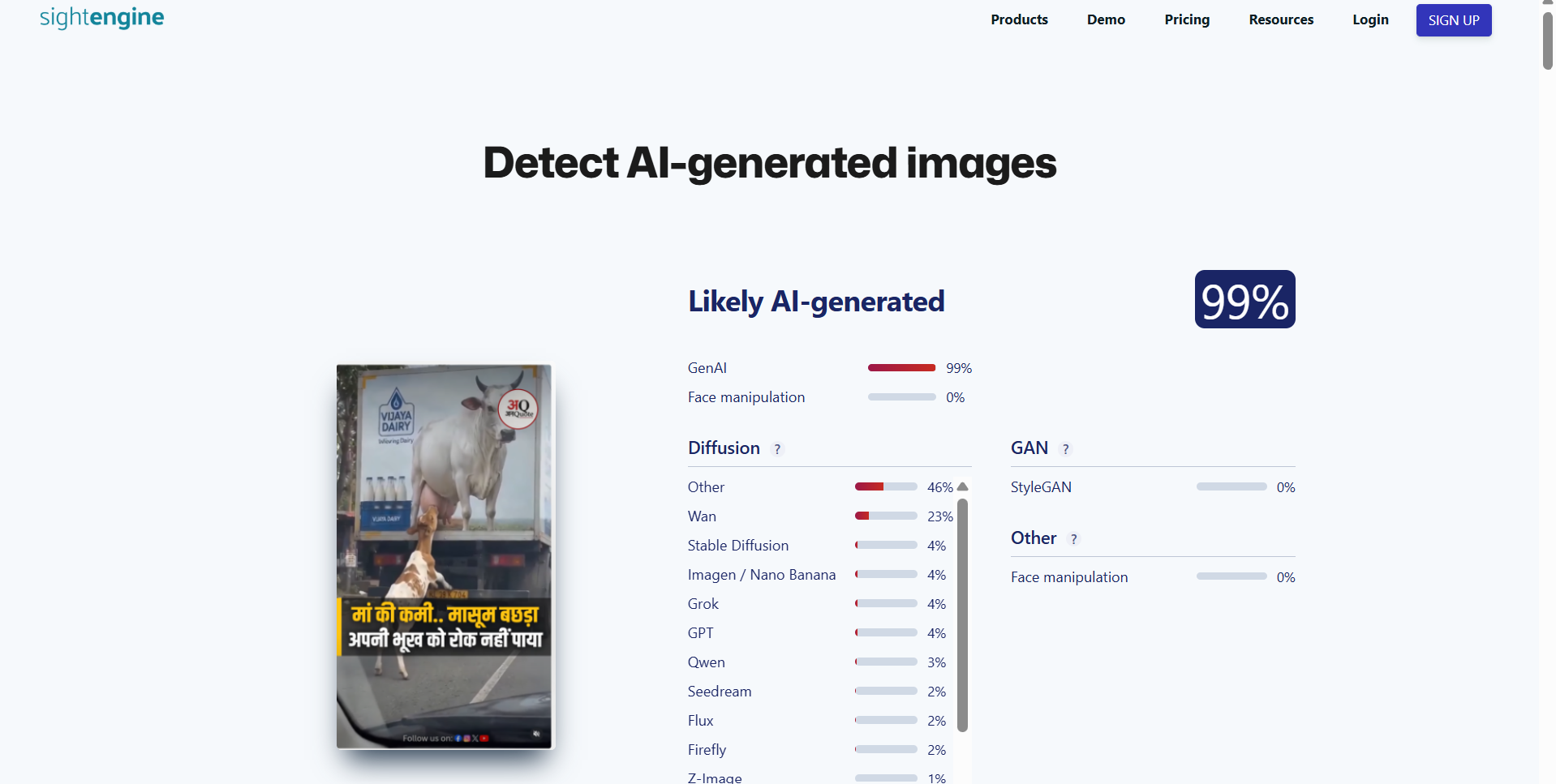
In the next step of our research, we scanned the viral video using the AI detection tool Sightengine. According to the results, the viral video is 99 per cent AI-generated.
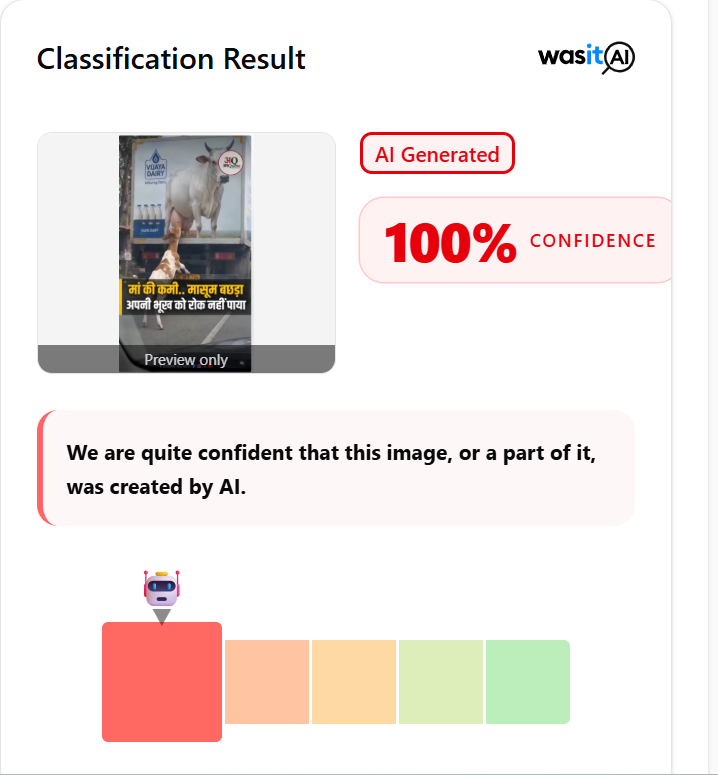
In the next step of our research, we scanned the viral video using the AI detection tool Wasit AI. According to the results, the viral video is AI-generated.
Conclusion
Our research found the viral claim to be false. The research established that the viral video is AI-generated and does not depict a real incident.

Related Blogs

Executive Summary
A video is being shared on social media with the claim that it shows Iran’s attack on a US military base located in Kuwait. It is being claimed that the video is from a recent attack carried out by Iran. CyberPeace Research Wing ’s research found the claim to be false. The research revealed that the video is actually from Panwan, a coastal town in southern Pakistan. The footage was published in connection with reports of a suicide attack carried out by a prominent militant organisation. The video has no connection with the alleged Iranian attack on a US military base in Kuwait.
Claim:
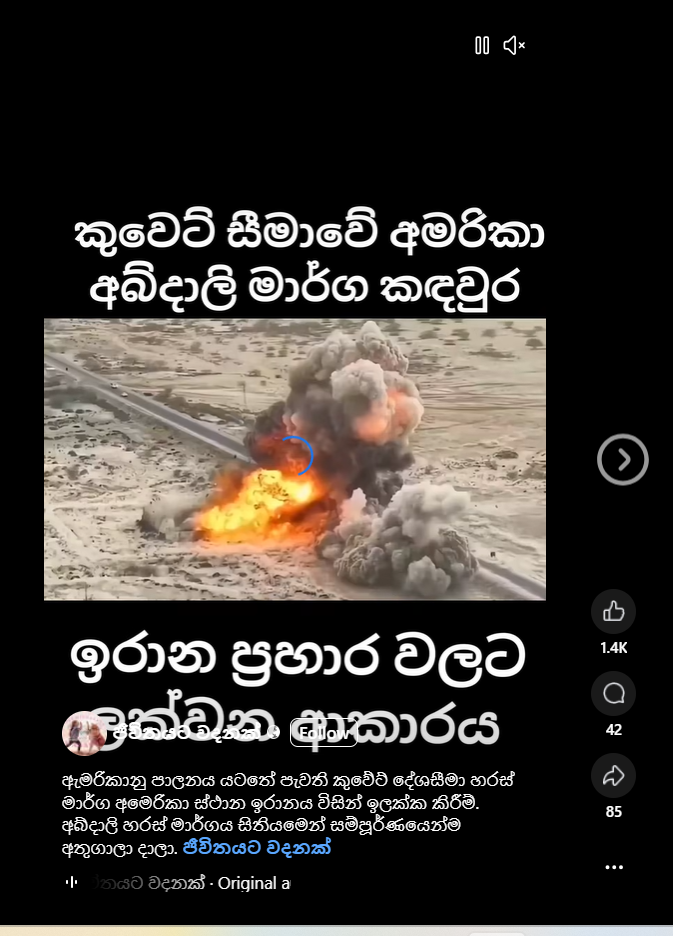
A Facebook post shared in the Sinhala language on July 25, 2026, claimed: “Iran targeted US-controlled Kuwaiti border checkpoints. The Abdali border checkpoint has been completely destroyed.” The post was shared along with a video of around one minute. In the video, a blue truck can be seen entering a secured compound. Within seconds, a massive explosion takes place, followed by a thick cloud of smoke rising into the sky. Text written in Sinhala on the video claimed: “Watch how Iran is attacking the US Abdali border crossing base located on the Kuwait border.”
https://www.facebook.com/reel/979364938493872
https://web.archive.org/web/20260730055635/https://www.facebook.com/reel/979364938493872
Factcheck
As part of the research, keyframes from the viral video were extracted and a reverse image search was conducted. During the search, we found a report published by India Today on July 4, 2026. According to the report, the footage actually shows a suicide attack carried out by the Pakistan-based Baloch Liberation Army (BLA) militant group.
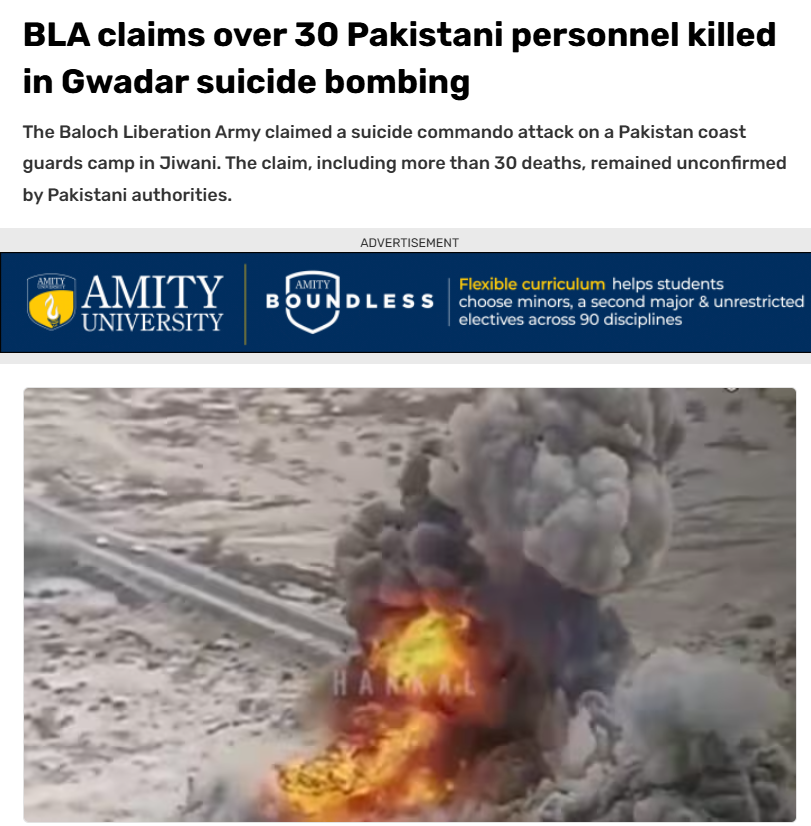
Further research led us to a report about a suicide bombing in Gwadar, Pakistan. According to the report, the BLA claimed responsibility for the attack and claimed that more than 30 security personnel were killed. Journalist Diksha Bisla also shared details about the incident.
https://www.facebook.com/watch/?v=1233630812123459

A search on Google Maps showed the Panwan area and a structure along Gwadar Road that resembles the location visible in the viral video.

Conclusion:
CyberPeace Research Wing ’s research found that the claim is false. The viral video is not related to any alleged Iranian attack on a US military base in Kuwait. The footage is from Panwan, a coastal town in southern Pakistan, and was circulated during reports of a suicide attack claimed by the Baloch Liberation Army (BLA).

Executive Summary
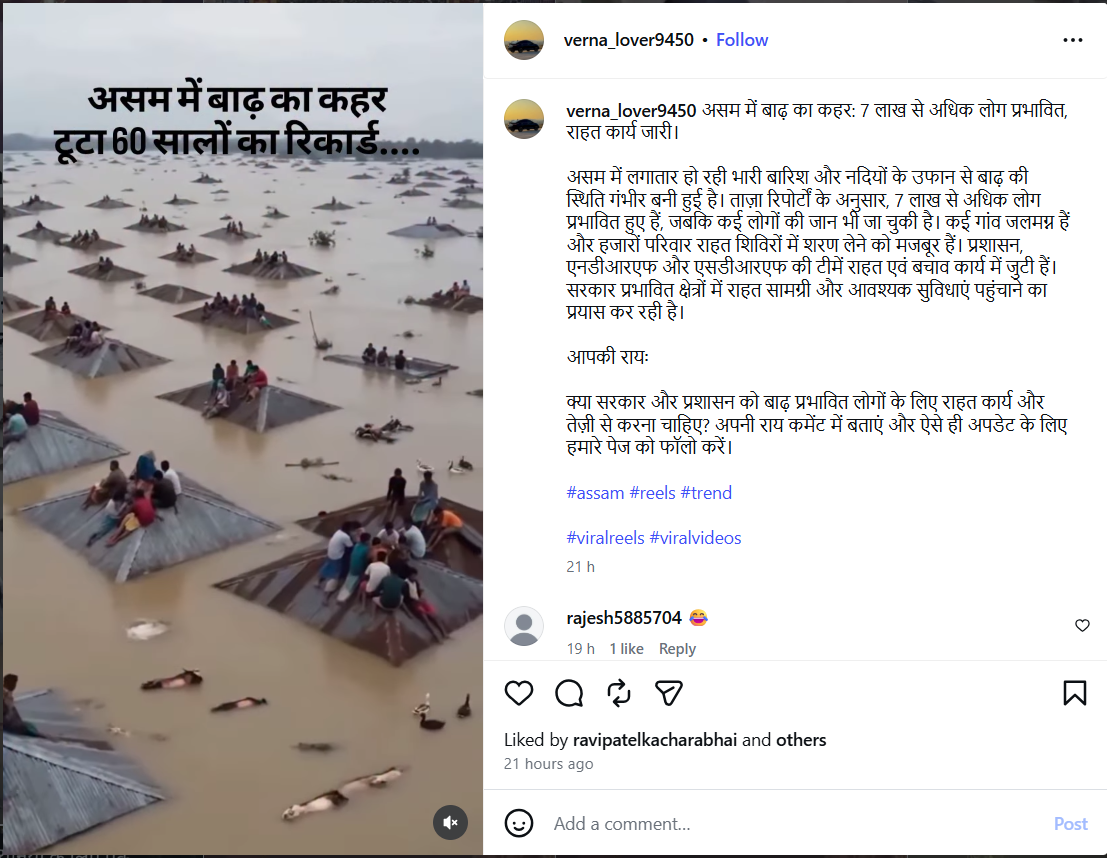
A video is being widely shared on social media showing a flood-affected area. In the video, several houses appear to be almost completely submerged in water, with only their triangular rooftops visible above the surface. Several people can be seen sitting on these rooftops, while ducks and other animals appear to be floating in the water. The video is being shared with the claim that it shows the real situation during the recent floods in Assam. CyberPeace Research Wing’s research found the claim to be misleading. The research revealed that the viral video is not from any real flood incident but was created using Artificial Intelligence (AI). Although the flood situation in Assam is real and several parts of the state have been affected, the viral video has no connection with those events. The AI-generated video is being falsely shared as an actual visual from the Assam floods.
Claim
A user on Instagram shared the viral video on July 27, 2026, claiming that Assam continues to face severe flooding, with more than seven lakh people affected. The post link, archive link and screenshot are provided below.
https://www.instagram.com/reel/DbSVmAApQf6/
FactCheck
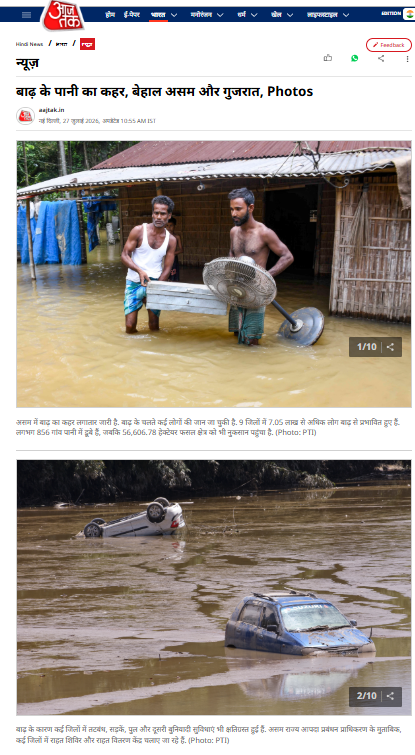
To verify the authenticity of the viral claim, we extracted several key frames from the video and conducted a reverse image search using Google Lens. The search did not reveal any credible news report, official source, or reliable information confirming that the video showed real flood visuals from Assam. During the research, we found a report published by Aaj Tak on July 27, 2026. According to the report, the flood situation in Assam remained severe, with several deaths reported and more than 7.05 lakh people affected across nine districts of the state. The report link and screenshot are provided below.
As the video appeared suspicious, we analysed it using the AI detection tool HIVE Moderation. The tool’s analysis indicated a 98.8 percent probability that the video was AI-generated, suggesting that it was not a real recording.

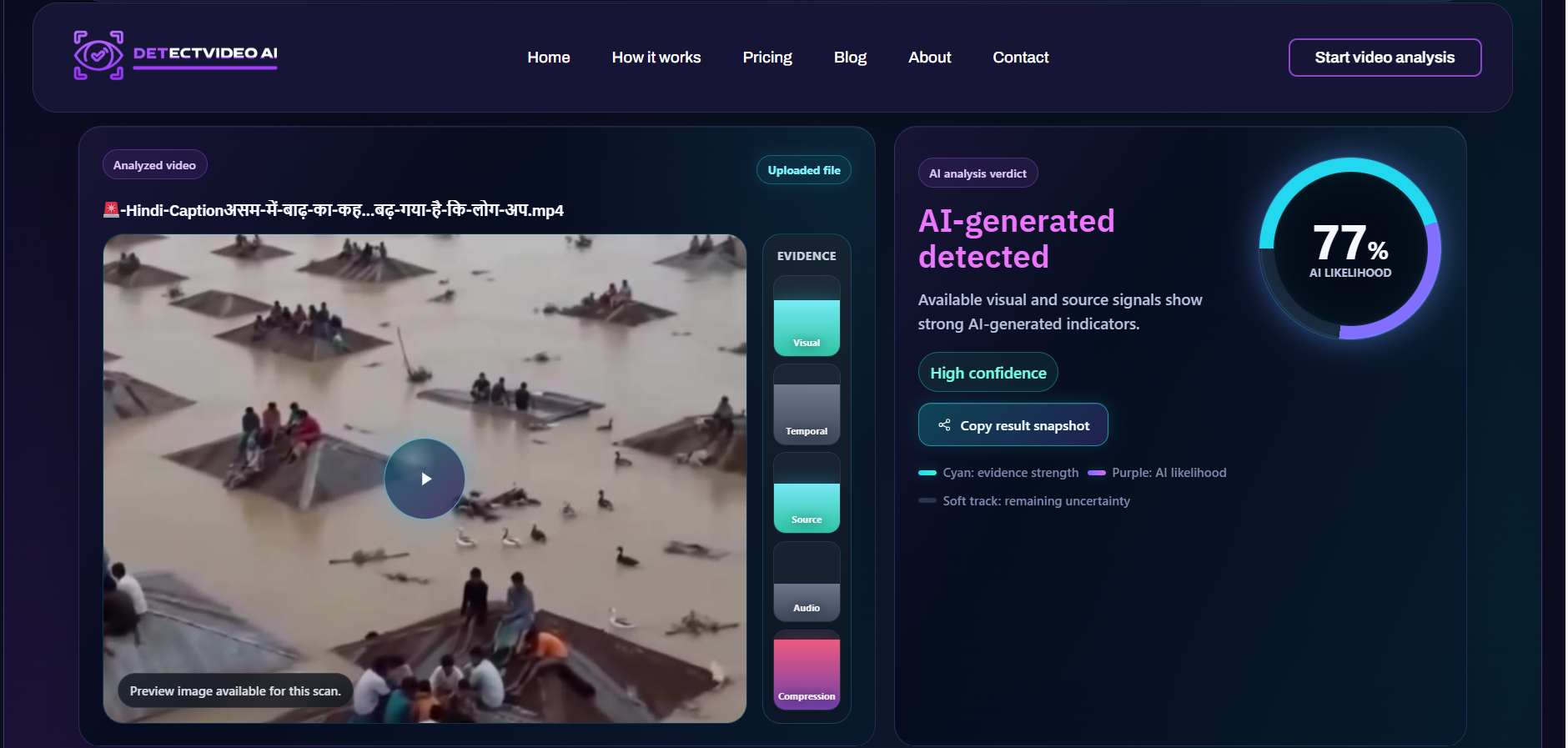
Further research was carried out using another AI detection tool, DetectVideo.AI, which found a 77 percent likelihood of the video being AI-generated.
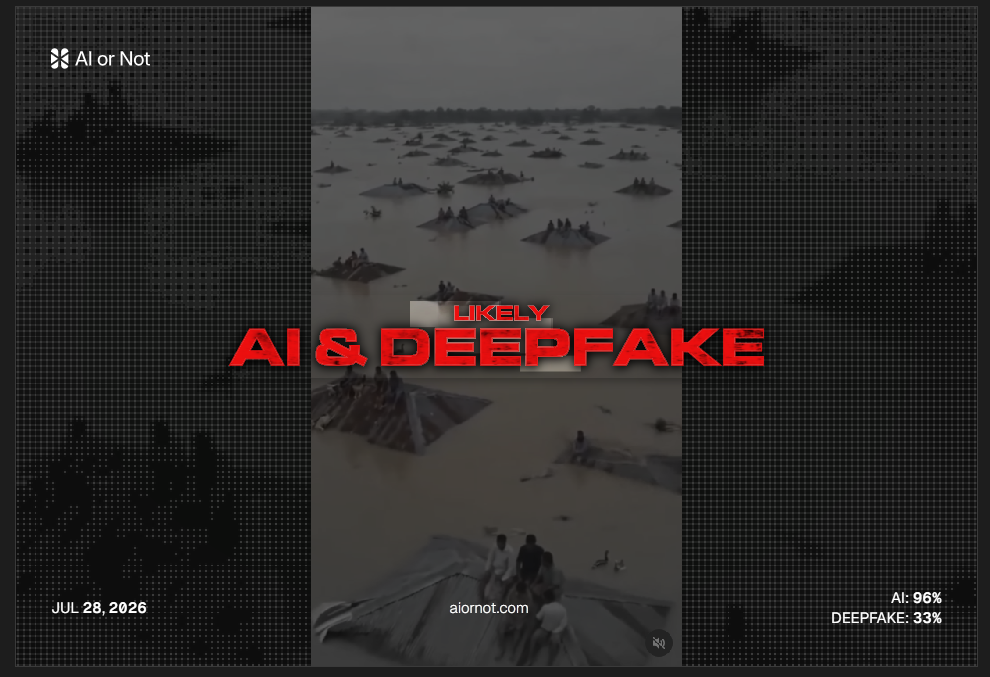
For additional verification, we extracted key frames from the viral video and analysed them using another AI detection tool, AI or Not. The tool’s assessment indicated a 96 percent probability that the visuals were AI-generated.
Conclusion
The research established that the viral video is not from a real flood incident but was created using AI. While flooding in Assam is a real situation, this AI-generated video is unrelated to the actual floods and is being circulated on social media with a misleading claim.
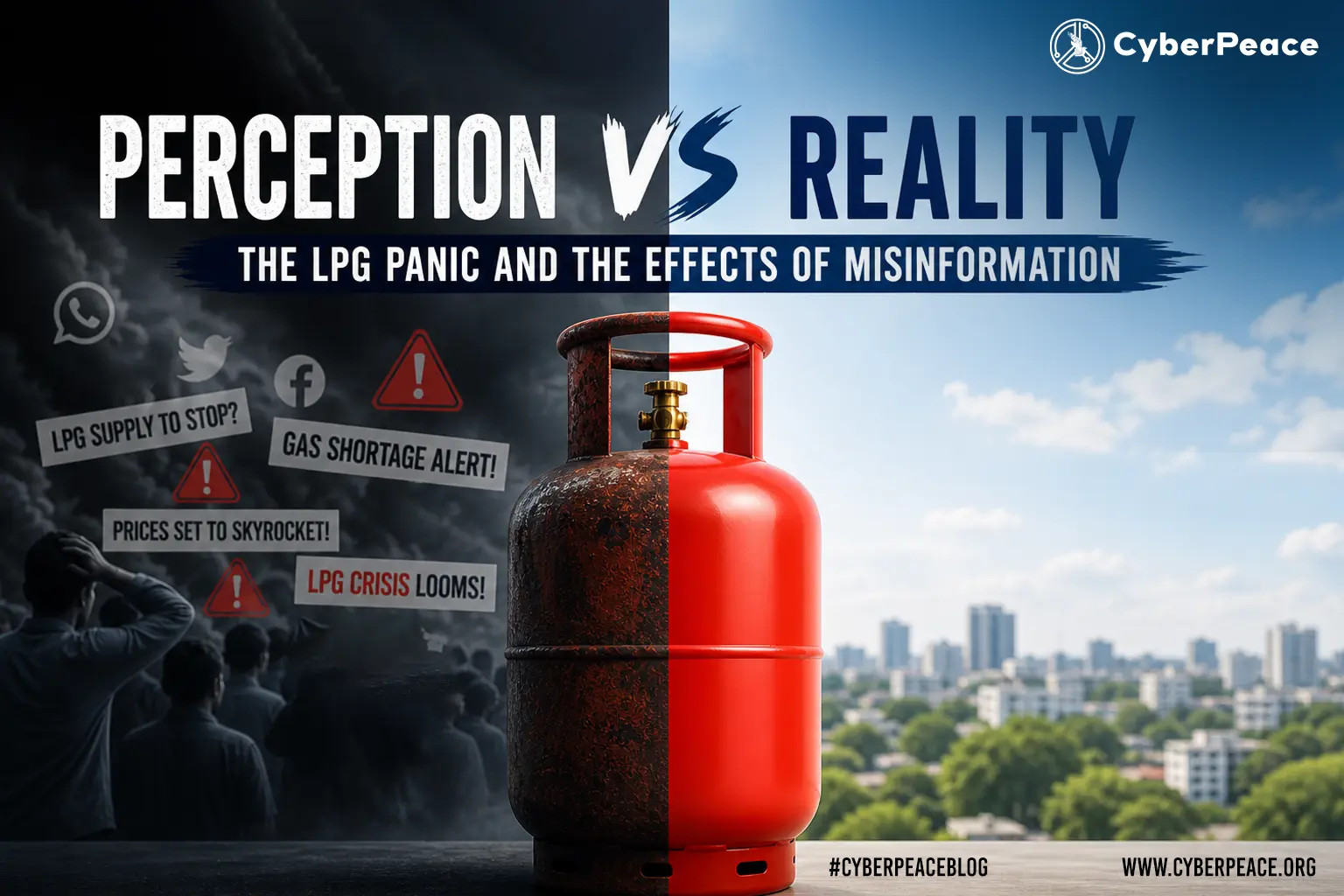
In recent months, conversations around the possible shortage of liquefied petroleum gas (LPG), a basic cooking fuel in Indian households, have quietly resurfaced across the country. From whispers in local markets to viral messages circulating on social media, concerns about LPG availability began to take hold in the public imagination. Though the immediacy of the situation has since faded, its echoes remain, reminding us how quickly uncertainty can spread. Like a ripple across still water, a single rumour can travel far, gathering force as it moves and blurring the line between perception and reality.
Against this backdrop, in April 2026, reports began circulating about a potential LPG shortage. The Union Government moved quickly to counter what it identified as misinformation, emphasising that supply remained stable and urging citizens not to engage in panic buying. A noticeable disconnect emerged between official communication and public perception. Across different regions, signs of anxiety-driven behaviour became evident. Instances of panic buying and hoarding increased, law enforcement agencies conducted raids to address such actions, and opportunistic thefts were reported, often exploiting widespread concern. These incidents highlight how misinformation, even when addressed promptly, can continue to shape public behaviour.
It is worth noting that rising prices also played a role in shaping public response, as increases in LPG rates contributed to a sense of urgency among consumers. Therefore, the surge in panic buying cannot be attributed solely to misinformation, but rather to a combination of economic pressures and perceived scarcity.
Misinformation Ecosystem - From Rumours to Behaviour
The spread of misinformation is occurring at an unprecedented pace and is, in large part, driven by the viral nature of social media. Digital platforms not only enable the rapid dissemination of information but also allow it to be amplified in ways that would not be possible through traditional media outlets. Often, the drive for virality outweighs any concern for accuracy, meaning that many individuals who spread misinformation are motivated more by the pursuit of attention than by any ideological agenda. Recent arrests of individuals involved in spreading misinformation about LPG and petrol shortages, much of which went viral, suggest that misinformation today is frequently driven by the desire for visibility rather than ideological motives. The information being circulated has largely followed a similar pattern, focusing on fears of an LPG shortage, expectations of price increases, and concerns about supply disruptions. Even though this information has not been verified, it has triggered behavioural responses among individuals. In several areas, including parts of Uttar Pradesh and Goa, the spread of misinformation through social media has led to panic buying, despite official assurances that there would be sufficient LPG supply to meet demand.
The impact of panic buying, and its associated misinformation, has already been seen in multiple sectors; these increased demands have placed pressure on the distribution network, leading to disruptions in access, as well as being out of stock of certain products. In many cases, commercial users of products (especially restaurants) have experienced significant disruption, threatening their continued operations, and industry representatives have alerted others about the inconsistent supply of commercial cylinders; likewise, consumers (households) are beginning to switch to alternative products (e.g., induction cooking) as a reflection of the anticipatory mindset to address the uncertainty created through perceptions of Product Scarcity.
State Response: Managing Misinformation or Behaviour?

The government has taken a variety of approaches, from advisories and enforcement actions to communicating with citizens indirectly. For example, State Governments have been directed to combat misinformation, monitor supply chains and take action against hoarding and black market activity. There has been a significant increase in the level of large- scale enforcement activity, with over 3,700 raids carried out to crack down on hoarding and black marketing related to LPG, in addition to confiscating cylinders and issuing penalties to those who break the law. In addition, the authorities have also focused on maintaining regular communication with the public in order to reassure them about the supply of LPG and fuel stability.
Geopolitical Context: Why Rumours Are Believable
Understanding today’s panic requires an understanding of the global environment: i.e., due to the ongoing conflict in West Asia, the energy markets are unstable, and energy supply is uncertain not only in West Asia but across a large part of the world. Even if domestic supply remains stable, public perception is affected by global instability. A clear example of this can be seen in neighbouring countries to India; Pakistan has seen significant increases in the cost of fuel, implemented measures such as reducing the number of days individuals work each week, and has created public support mechanisms; Bangladesh has imposed restrictions on the use of energy, has shortened the number of hours individuals can operate businesses each day, and has restricted the total amount of energy used; Sri Lanka has begun to ration fuel, and to increase the price of petrol; and Nepal has reduced the numbers of days individuals may work each week, and has adjusted supply.
All of these examples are not isolated instances, but are markers of a common regional environment. As we live in a global community that is connected in many ways, these developments will quickly affect public expectations everywhere. Therefore, for consumers in India, seeing evidence of rationing of fuel and shortages of fuel in neighbouring countries increases their belief that these types of problems could occur in their country.
Critical Perspective: Between Panic and Precaution
The LPG incident has brought about questions surrounding the nature of misinformation in terms of its definition & regulation. One of the main concerns is whether or not "misinformation" is being cast too widely. To be sure, false claims need to be addressed; however, not everything that is responded to publicly is based on untrue facts, as many times public responses are based on perceived risk via global and/or local incidents that occur. Perhaps the greatest challenge is the difficulty in differentiating precaution and panic. People’s memories of the COVID-19 pandemic are fresh in their minds and will serve to influence their behaviours moving onward, in that many people are stockpiling or preparing for uncertainty not out of irrational fear, but as an anticipatory response to their prior experiences.
Conclusion
The Indian LPG "crisis" is not so much a problem with actual supply chain breakdown as it is a result of how information and behaviour are connected through perception. This cohabitating environment of panic buying, law enforcement, and government assurance demonstrates an evident disconnect and gap between how governments present a narrative and how the public responds. While there is some role of misinformation within this discourse, the misinformation itself extends beyond any or all false claims about LPG supply and operates within a greater ecosystem of global uncertainty and personal experience. As such, and because of this, perception becomes an incredibly strong force in itself that produces true economic consequences.
Reference
- https://www.pib.gov.in/PressReleasePage.aspx?PRID=2248640&utm_source®=3&lang=2
- https://www.pmindia.gov.in/en/news_updates/pm-addresses-the-lok-sabha-on-the-ongoing-conflict-in-west-asia/
- https://www.ndtv.com/delhi-news/iran-war-middle-east-conflict-why-the-lpg-crisis-is-forcing-migrants-to-quietly-leave-delhi-11313629
- https://timesofindia.indiatimes.com/city/bareilly/thieves-steal-108-lpg-cylinders-from-godown-in-up/articleshow/130035518.cms
- https://indianexpress.com/article/india/arrested-rumours-lpg-petrol-shortage-police-chasing-views-10614193/
- https://www.hindustantimes.com/cities/lucknow-news/social-media-rumours-fuel-panic-buying-in-some-up-districts-situation-normal-in-lucknow-101774465353107.html
- https://timesofindia.indiatimes.com/city/goa/fear-of-shortage-price-rise-fuels-panic-buying-across-goa/articleshow/129810144.cms
- https://www.news18.com/cities/new-delhi-news/online-rumours-offline-rush-panic-buying-sweeps-petrol-pumps-across-cities-whats-the-truth-ws-ln-9995684.html
- https://m.economictimes.com/news/india/3700-raids-conducted-across-country-to-wipe-out-lpg-black-marketing-says-centre/articleshow/130025232.cms
- https://www.reuters.com/business/energy/induction-stoves-fly-off-shelves-india-gas-shortage-fears-spark-panic-buying-2026-03-12/
- https://www.ndtv.com/india-news/restaurant-body-warns-of-closures-over-commercial-lpg-supply-concerns-writes-to-minister-11194418
- https://www.freepressjournal.in/mumbai/fpj-dialogue-we-are-getting-only-1-cylinder-instead-of-10-says-ahar-president-vijay-shetty-on-mumbai-lpg-crisis
- https://www.hindustantimes.com/world-news/fuel-cuts-wfh-and-more-how-indias-neighbours-are-dealing-with-global-energy-crisis-triggered-by-us-iran-war-101775397199941.html
- https://www.abc.net.au/news/2026-03-30/four-step-fuel-supply-plan-national-cabinet-fuel-crisis/106512706
- https://tribune.net.ph/2026/04/07/philippines-scrambles-as-regional-oil-crisis-hits
