
#FactCheck-AI-Generated Video Fake Claims Waterlogging Inside Noida International Airport Terminal
Executive Summary
A video circulating rapidly on social media claims to show severe waterlogging inside the passenger terminal of the newly constructed Noida International Airport in Uttar Pradesh. The clip displays passengers navigating flooded check-in areas with their luggage, while a female reporter holding a mic labeled "Sach Bolo" criticizes the state government over poor infrastructure. However, a research by the CyberPeace Research Wing confirmed that the video is completely fake and created using artificial intelligence (AI).
The Claim
On August 14, 2026, Instagram user shyamgupta_yuvaneta posted the clip with a caption targeting the government over alleged corruption and poor infrastructure at the Noida Airport
https://www.instagram.com/reels/DcAOGgcgUrp

Fact-Check
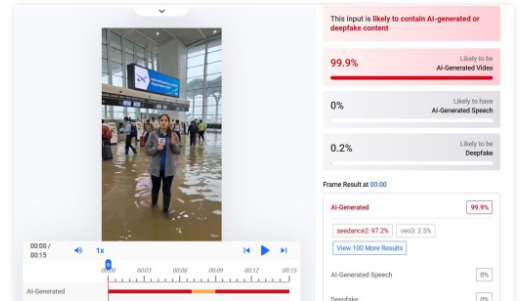
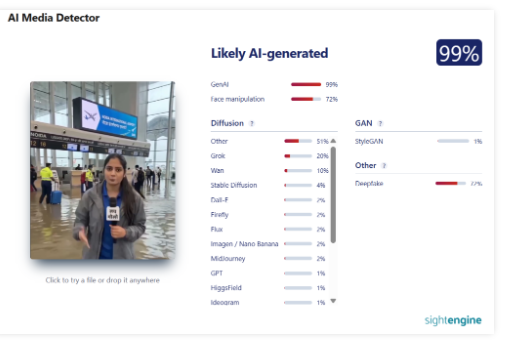
An initial analysis of the video revealed unnatural physical movements among the people shown and an artificial voice modulation typical of AI-generated content. To verify this, the video was run through standard AI detection tools:
Hive Moderation: Flagged the video as 99.9% likely to be AI-generated.
Sightengine: Returned a 99% probability that the content was artificially generated.
Further verification of official communications revealed a post by the official X (formerly Twitter) account of Noida International Airport (@NIAirport) on August 15, 2026. The airport authority clarified that fake videos depicting waterlogging inside the passenger terminal were circulating online and refuted the claims entirely. While recent heavy rainfall did cause temporary water accumulation in an underpass connecting the terminal to the parking area, the passenger terminal building itself remained unaffected.
https://x.com/NIAirport/status/2088481969462272065?s=20

Conclusion
The viral video showing waterlogging inside the Noida International Airport terminal is fake and AI-generated. The actual incident of waterlogging was restricted to an outer subway connecting the parking area, not the main terminal building.

Related Blogs
Introduction
Earlier this month, lawmakers in Colorado, a U.S. state, were summoned to a special legislative session to rewrite their newly passed Artificial Intelligence (AI) law before it even takes effect. Although the discussion taking place in Denver may seem distant, evolving regulations like this one directly address issues that India will soon encounter as we forge our own course for AI governance.
The Colorado Artificial Intelligence Act
Colorado became the first U.S. state to pass a comprehensive AI accountability law, set to come into force in 2026. It aims to protect people from bias, discrimination, and harm caused by predictive algorithms since AI tools have been known to reproduce societal biases by sidelining women from hiring processes, penalising loan applicants from poor neighbourhoods, or through welfare systems that wrongly deny citizens their benefits. But the law met resistance from tech companies who threatened to pull out form the state, claiming it is too broad in scope in its current form and would stifle innovation. This brings critical questions about AI regulation to the forefront:
- Who should be responsible when AI causes harm? Developers, deployers, or both?
- How should citizens seek justice?
- How can tech companies be incentivised to develop safe technologies?
Colorado’s governor has called a special session to update the law before it kicks in.
What This Means for India
India is on its path towards framing a dedicated AI-specific law or directions, and discussions are underway through the IndiaAI Mission, the proposed Digital India Act, committee set by the Delhi High Court on deepfake and other measures. But the dilemmas Colorado is wrestling with are also relevant here.
- AI uptake is growing in public service delivery in India. Facial recognition systems are expanding in policing, despite accuracy and privacy concerns. Fintech apps using AI-driven credit scoring raise questions of fairness and transparency.
- Accountability is unclear. If an Indian AI-powered health app gives faulty advice, who should be liable- the global developer, the Indian startup deploying it, or the regulator who failed to set safeguards?
- India has more than 1,500 AI startups (NASSCOM), which, like Colorado’s firms, fear that onerous compliance could choke growth. But weak guardrails could undermine public trust in AI altogether.
Lessons for India
India’s Ministry of Electronics and IT ( MEITy) favours a light-touch approach to AI regulation, and exploring and advancing ways for a future-proof guideline. Further, lessons from other global frameworks can guide its way.
- Colorado’s case shows us the necessity of incorporating feedback loops in the policy-making process. India should utilise regulatory sandboxes and open, transparent consultation processes before locking in rigid rules.
- It will also need to explore proportionate obligations, lighter for low-risk applications and stricter for high-risk use cases such as policing, healthcare, or welfare delivery.
- Europe’s AI Act is heavy on compliance, the U.S. federal government leans toward deregulation, and Colorado is somewhere in between. India has the chance to create a middle path, grounded in our democratic and developmental context.
Conclusion
As AI becomes increasingly embedded in hiring, banking, education, and welfare, opportunities for ordinary Indians are being redefined. To shape how this pans out, states like Tamil Nadu and Telangana have taken early steps to frame AI policies. Lessons will emerge from their initiative in addressing AI governance. Policy and regulation will always be contested, but contestations are a part of the process.
The Colorado debate shows us how participative law-making, with room for debate, revision, and iteration, is not a weakness but a necessity. For India’s emerging AI governance landscape, the challenge will be to embrace this process while ensuring that citizen rights and inclusion are balanced well with industry concerns. CyberPeace advocates for responsible AI regulation that balances innovation and accountability.
References
- https://www.cbsnews.com/colorado/news/colorado-lawmakers-look-repeal-replace-controversial-artificial-intelligence-law/
- https://www.naag.org/attorney-general-journal/a-deep-dive-into-colorados-artificial-intelligence-act/
- https://carnegieendowment.org/research/2024/11/indias-advance-on-ai-regulation?lang=en
- https://the-captable.com/2024/12/india-ai-regulation-light-touch/
- https://indiaai.gov.in/article/tamilnadu-s-ai-policy-six-step-tamdef-guidance-framework-and-deepmax-scorecard

What Is a VPN and its Significance
A Virtual Private Network (VPN) creates a secure and reliable network connection between a device and the internet. It hides your IP address by rerouting it through the VPN’s host servers. For example, if you connect to a US server, you appear to be browsing from the US, even if you’re in India. It also encrypts the data being transferred in real-time so that it is not decipherable by third parties such as ad companies, the government, cyber criminals, or others.
All online activity leaves a digital footprint that is tracked for data collection, and surveillance, increasingly jeopardizing user privacy. VPNs are thus a powerful tool for enhancing the privacy and security of users, businesses, governments and critical sectors. They also help protect users on public Wi-Fi networks ( for example, at airports and hotels), journalists, activists and whistleblowers, remote workers and businesses, citizens in high-surveillance states, and researchers by affording them a degree of anonymity.
What VPNs Do and Don’t
- What VPNs Can Do:
- Mask your IP address to enhance privacy.
- Encrypt data to protect against hackers, especially on public Wi-Fi.
- Bypass geo-restrictions (e.g., access streaming content blocked in India).
- What VPNs Cannot Do:
- Make you completely anonymous and protect your identity (websites can still track you via cookies, browser fingerprinting, etc.).
- Protect against malware or phishing.
- Prevent law enforcement from tracing you if they have access to VPN logs.
- Free VPNs usually even share logs with third parties.
VPNs in the Context of India’s Privacy Policy Landscape
In April 2022, CERT-In (Computer Emergency Response Team- India) released Directions under Section 70B (6) of the Information Technology (“IT”) Act, 2000, mandating VPN service providers to store customer data such as “validated names of subscribers/customers hiring the services, period of hire including dates, IPs allotted to / being used by the members, email address and IP address and time stamp used at the time of registration/onboarding, the purpose for hiring services, validated address and contact numbers, and the ownership pattern of the subscribers/customers hiring services” collected as part of their KYC (Know Your Customer) requirements, for a period of five years, even after the subscription has been cancelled. While this directive was issued to aid with cybersecurity investigations, it undermines the core purpose of VPNs- anonymity and privacy. It also gave operators very little time to carry out compliance measures.
Following this, operators such as NordVPN, ExpressVPN, ProtonVPN, and others pulled their physical servers out of India, and now use virtual servers hosted abroad (e.g., Singapore) with Indian IP addresses. While the CERT-In Directions have extra-territorial applicability, virtual servers are able to bypass them since they physically operate from a foreign jurisdiction. This means that they are effectively not liable to provide user information to Indian investigative agencies, beating the whole purpose of the directive. To counter this, the Indian government could potentially block non-compliant VPN services in the future. Further, there are concerns about overreach since the Directions are unclear about how long CERT-In can retain the data it acquires from VPN operators, how it will be used and safeguarded, and the procedure of holding VPN operators responsible for compliance.
Conclusion: The Need for a Privacy-Conscious Framework
The CERT-In Directions reflect a governance model which, by prioritizing security over privacy, compromises on safeguards like independent oversight or judicial review to balance the two. The policy design renders a lose-lose situation because virtual VPN services are still available, while the government loses oversight. If anything, this can make it harder for the government to track suspicious activity. It also violates the principle of proportionality established in the landmark privacy judgment, Puttaswamy v. Union of India (II) by giving government agencies the power to collect excessive VPN data on any user. These issues underscore the need for a national-level, privacy-conscious cybersecurity framework that informs other policies on data protection and cybercrime investigations. In the meantime, users who use VPNs are advised to choose reputable providers, ensure strong encryption, and follow best practices to maintain online privacy and security.
References
- https://www.kaspersky.com/resource-center/definitions/what-is-a-vpn
- https://internetfreedom.in/top-secret-one-year-on-cert-in-refuses-to-reveal-information-about-compliance-notices-issued-under-its-2022-directions-on-cybersecurity/#:~:text=tl;dr,under%20this%20new%20regulatory%20mandate.
- https://www.wired.com/story/vpn-firms-flee-india-data-collection-law/#:~:text=Starting%20today%2C%20the%20Indian%20Computer,years%2C%20even%20after%20they%20have

Executive Summary
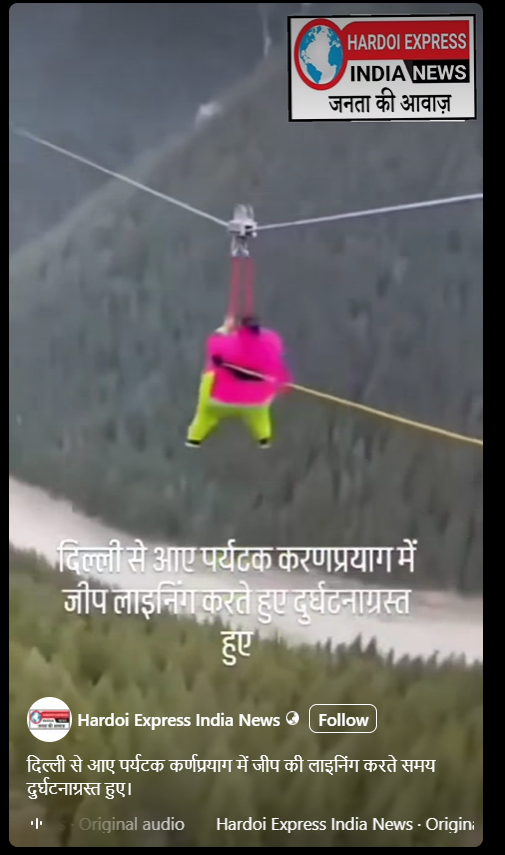
A video is being shared on social media claiming that a female tourist from Delhi fell into a deep gorge during ziplining in Karnaprayag. In the viral video, a woman dressed in bright pink and yellow clothes is seen ziplining amidst high mountains, when suddenly the zipline wire breaks and she falls from a significant height into a deep gorge. Social media users are sharing this video, presenting it as a real incident. Research by the CyberPeace Research Wing revealed that the claim of a Delhi woman tourist's death during a zipline accident in Karnaprayag is baseless. The viral video is AI-generated.
Claim
According to the claim, this accident took place in Karnaprayag, Uttarakhand, where a female tourist from Delhi became a victim of this horrific mishap. Several social media users are claiming that the woman died in this accident.
https://www.facebook.com/reel/26108544868822432
Fact Check
To investigate the video viral as a zipline accident in Karnaprayag, we conducted a reverse search of its keyframes. During this, we found the video uploaded as a Short on a Pakistani YouTube channel, @Zoyaqueen-w2t, on June 2, 2026. Hashtags like '#funnyshorts' were used in the caption of this video. Scanning this account revealed that several other fictional videos related to similar zipline accidents have also been uploaded here. Apart from this, the video was also shared with funny hashtags in some social media posts from May 2026.
https://www.youtube.com/shorts/Gzha_J7Fqv0
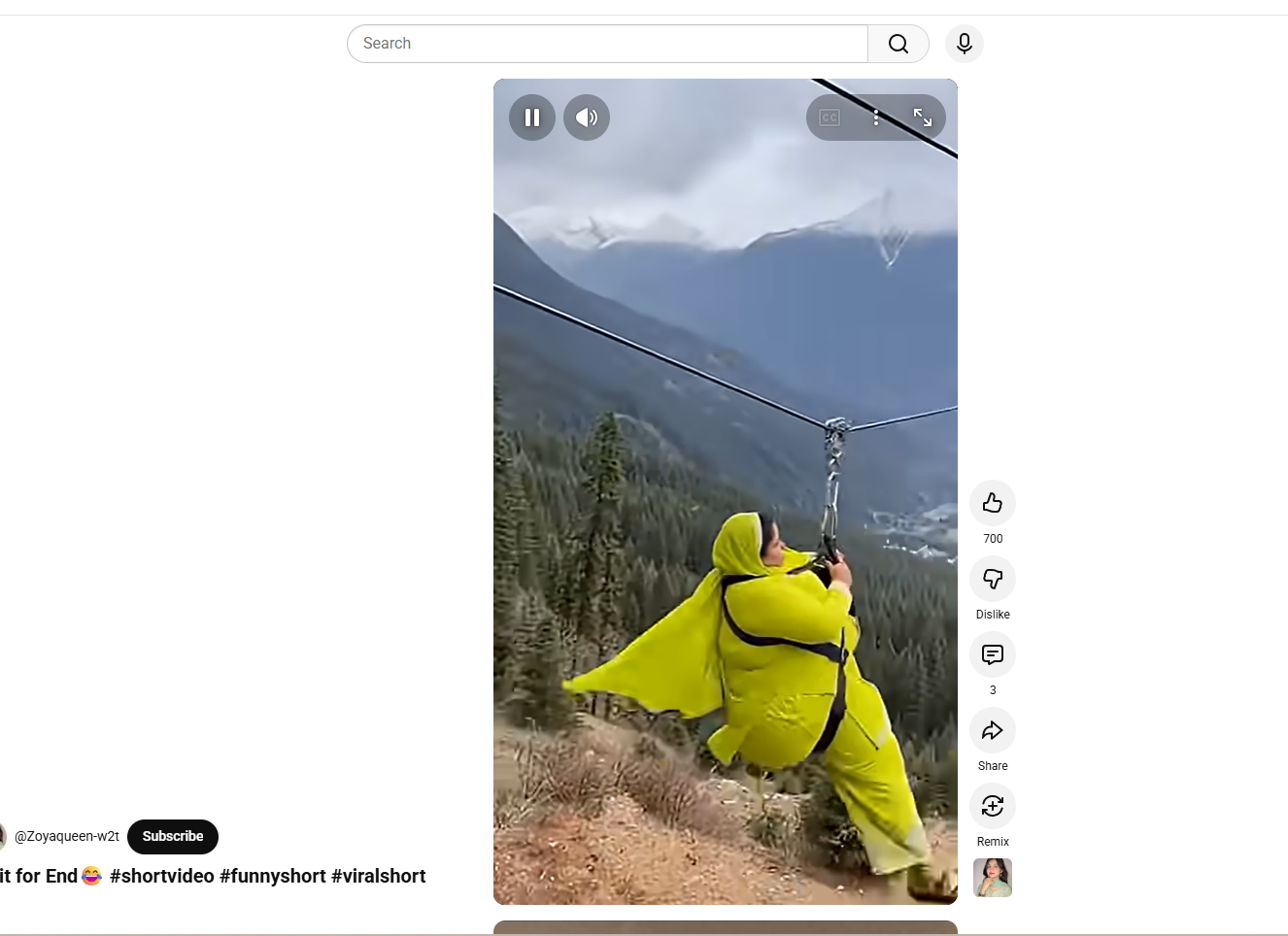
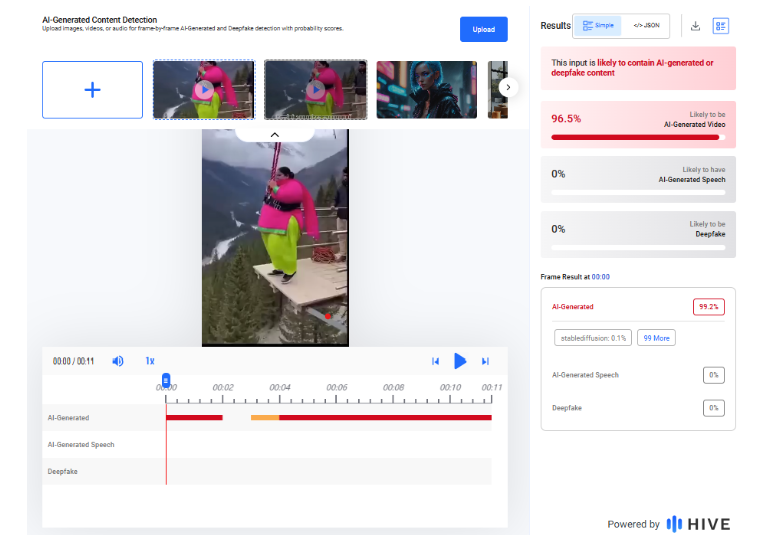
Following this, searching with relevant keywords yielded no credible media reports regarding any such zipline accident in Karnaprayag, Uttarakhand, in recent times. Subsequently, we scanned the viral video of the alleged zipline accident using the AI detection tool 'Hive Moderation'. During the analysis, the tool classified the video as highly likely to be AI-generated, with a score of 99.2%.
Conclusion
From the evidence gathered in our research , it is clear that the claim regarding the death of a female tourist from Delhi during a zipline accident in Karnaprayag is baseless. The viral video is not of a real incident, but is AI-generated.
