
#FactCheck: AI-Generated Image Falsely Links Hardeep Puri to Jeffrey Epstein
Executive Summary
A photo is being shared on social media with the claim that it shows Union Minister Hardeep Puri alongside convicted sex offender Jeffrey Epstein. The post also claims that the image establishes an association between the two. CyberPeace Research found that the viral image is not authentic but AI-generated and is being shared with a misleading claim.
Claim
An X user shared the viral image with the following caption: “Given the gravity of Hardeep Puri's associations with history’s worst known pedophile and child murderer, we humbly request Modi ji to initiate a Supreme Court review for a DEATH PENALTY and uphold India's international standing and reputation on the world stage.”
https://x.com/PrabhsehajSingh/status/2113284787452657974?s=20

Fact Check
To verify the viral claim, we searched Google using relevant keywords. During the search, we found a report published by Dainik Bhaskar that featured photographs of convicted American sex offender Jeffrey Epstein and Union Minister Hardeep Puri. However, the photographs included in the report were completely different from the viral image.

As the next step in our research, we examined the viral image closely and suspected that it was AI-generated. We then scanned the image using the AI detection tool Hive Moderation. According to the results, the viral image is 99 per cent likely to be AI-generated.

We also scanned the image using another AI detection tool, Wasit AI, which indicated that the viral image is AI-generated.

Conclusion
Our research found that the viral image is not authentic but AI-generated and is being shared with a misleading claim.

Related Blogs

Executive Summary
A video is being shared on social media with the claim that at least 20 people were injured and several others were killed in police firing during a protest against the Election Commissioner in Delhi. The post further claims that the protesters marched towards foreign embassies. CyberPeace Research found that the viral video is related to a protest by garment workers in Bangladesh. It has no connection to any incident involving Delhi Police or any protest against the Election Commissioner in Delhi.
Claim
A social media post claims that massive protests have erupted in Delhi against the Election Commissioner. It further alleges that at least 20 people were injured and several others killed in Delhi Police firing. The post also claims that protesters marched towards several foreign embassies, including the Israeli Embassy, and that the situation in Delhi is deteriorating.
https://x.com/Anushitiwari22/status/2117175390989107290

Fact Check
To verify the viral video, we extracted its keyframes and conducted a reverse image search. During the search, we found the video on an Instagram channel, where it was shared with the claim that garment workers in Bangladesh had taken to the streets demanding higher wages.
https://www.instagram.com/reels/DfPQefAic64/

In the next step of our research, we found the video on an X account. The post claimed that violent protests had once again erupted in Bangladesh. According to the post, nearly two years ago, protesters had removed the then government from power and taken control of the country, following which the then prime minister had to leave the country and come to India.The post further claimed that factory workers had taken to the streets this time to demand higher wages. They alleged that they were being exploited
https://x.com/_AfricanSoil/status/2116860302440443948
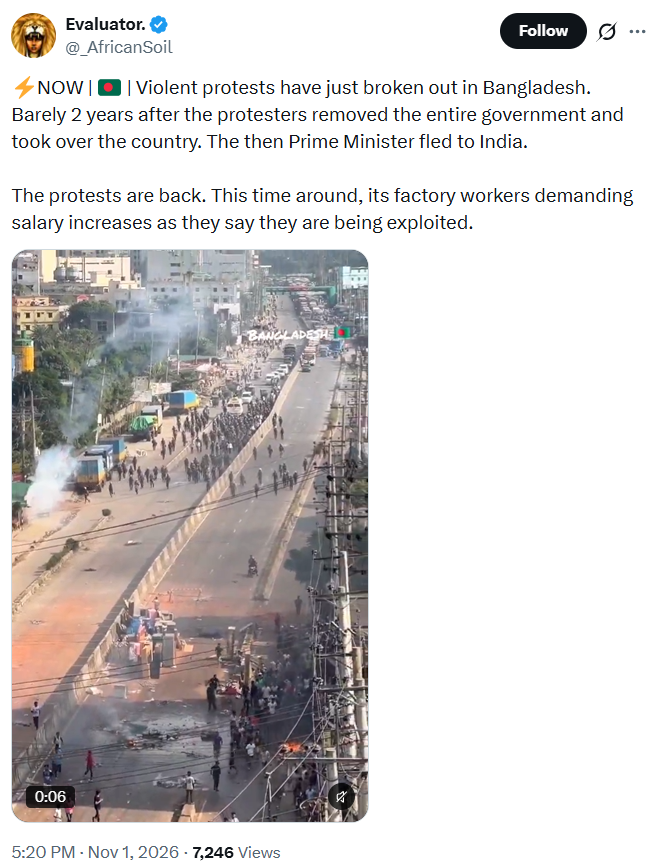
Taking our research forward, we examined the video using Google Street View and identified the location as Konabari, Gazipur. This established that the viral video is from Dhaka, Bangladesh, and not Delhi.

Conclusion
Our research found that the viral video is related to a protest by garment workers in Bangladesh. It has no connection to any incident of Delhi Police firing or any protest against the Election Commissioner in Delhi

Introduction
The much-awaited DPDP Rules have now finally been released in the official Gazette on 3rd January 2025 for consultation. The draft Digital Personal Data Protection Rules, 2025 (DPDP Rules) invites objections and suggestions from stakeholders that can be submitted on MyGov (https://mygov.in) by 18th February 2025.
DPDP Rules at Glance
- Processing of Children's Data: The draft rules say that ‘A Data Fiduciary shall adopt appropriate technical and organisational measures to ensure that verifiable consent of the parent is obtained before the processing of any personal data of a child’. It entails that children below 18 will need parents' consent to create social media accounts.
- The identity of the parents and their age can be verified through reliable details of identity and age available with the Data Fiduciary, voluntarily provided identity proof or virtual token mapped to the same. The data fiduciaries are also required to observe due diligence for checking that the individual identifying themselves as the parent is an adult who is identifiable, if required, in connection with compliance with any law for the time being in force in India. Additionally, the government will also extend exemptions from these specific provisions pertaining to processing of children's data to educational institutions, and child welfare organisations.
- Processing of Personal Data Outside India: The draft rules specify that the transfer of personal data outside India, whether it is processed within the country or outside in connection with offering goods or services to individuals in India, is permitted only if the Data Fiduciary complies with the conditions prescribed by the Central Government through general or specific orders.
- Intimation of Personal Data Breach: On becoming aware of a personal data breach, the Data Fiduciary must promptly notify the affected Data Principals in a clear and concise manner through their user account or registered communication method. This notification should include a description of the breach (nature, extent, timing, and location), potential consequences for the Data Principal, measures taken or planned to mitigate risks, recommended safety actions for the Data Principal, and contact information of a representative to address queries. Additionally, the Data Fiduciary must inform the Board without delay, providing details of the breach, its likely impact, and initial findings. Within 72 hours (or a longer period allowed by the Board upon request), the Data Fiduciary must submit updated information, including the facts and circumstances of the breach, mitigation measures, findings about the cause, steps to prevent recurrence, and a report on notifications given to affected Data Principals.
- Data Protection Board: The draft rules propose establishing the Data Protection Board, which will function as a digital office, enabling remote hearings, and will hold powers to investigate breaches, impose penalties, and perform related regulatory functions.
Journey of Digital Personal Data Protection Act, 2023
The foundation for the single statute legislation on Data Protection was laid down in 2017, in the famous ‘Puttaswami judgment,’ which is also well recognised as the Aadhar Card judgment. In this case, ‘privacy’ was recognised as intrinsic to the right to life and personal liberty, guaranteed by Article 21 of the Constitution of India, thus making ‘Right to Privacy’ a fundamental right. In the landmark Puttaswamy ruling, the apex court of India stressed the need for a comprehensive data protection law.
Eight years on and several draft bills later, the Union Cabinet approved the Digital Personal Data Protection Bill (DPDP) on 5th July 2023. The bill was tabled in the Lok Sabha on 3rd August 2023, and It was passed by Lok Sabha on 7th August, and the bill passed by Rajya Sabha on 9th August and got the president's assent on 11th August 2023; and India finally came up with the ‘Digital Personal Data Protection Act, 2023. This is a significant development that has the potential to bring about major improvements to online privacy and the handling of digital personal data by the platforms.
The Digital Personal Data Protection Act, 2023, is a newly-enacted legislation designed to protect individuals' digital personal data. It aims to ensure compliance by Data Fiduciaries and imposes specific obligations on both Data Principals and Data Fiduciaries. The Act promotes consent-based data collection practices and establishes the Data Protection Board to oversee compliance and address grievances. Additionally, it includes provisions for penalties of up to ₹250 crores in the event of a data breach. However, despite the DPDP Act being passed by parliament last year, the Act has not yet taken effect since its rules and regulations are still not finalised.
Conclusion
It is heartening to see that the Ministry of Electronics and Technology (MeitY) has finally released the draft of the much-awaited DPDP rules for consultation from stakeholders. Though noting certain positive aspects, there is still room for addressing certain gaps and multiple aspects under the draft rules that require attention. The public consultation, including the inputs from the tech platforms, is likely to see critical inputs on multiple aspects under the proposed rules. One such key area of interest will be the requirement of verifiable parental consent, which will likely include recommendations for a balanced approach which maintains children’s safety and mechanisms for the requirement of verifiable consent. The Provisions permitting government access to personal data on grounds of national security are also expected to face scrutiny. The proposed rules, after the consultation process, will be taken into consideration for finalisation after 18th February 2025. The move towards establishing a robust data protection law in India signals a significant step toward enhancing trust and accountability in the digital ecosystem. However, its success will hinge on effective implementation, clear compliance mechanisms, and the adaptability of stakeholders to this evolving regulatory landscape.
References

Modern international trade heavily relies on data transfers for the exchange of digital goods and services. User data travels across multiple jurisdictions and legal regimes, each with different rules for processing it. Since international treaties and standards for data protection are inadequate, states, in an effort to protect their citizens' data, have begun extending their domestic privacy laws beyond their borders. However, this opens a Pandora's box of legal and administrative complexities for both, the data protection authorities and data processors. The former must balance the harmonization of domestic data protection laws with their extraterritorial enforcement, without overreaching into the sovereignty of other states. The latter must comply with the data privacy laws in all states where it collects, stores, and processes data. While the international legal community continues to grapple with these challenges, India can draw valuable lessons to refine the Digital Personal Data Protection Act, 2023 (DPDP) in a way that effectively addresses these complexities.
Why Extraterritorial Application?
Since data moves freely across borders and entities collecting such data from users in multiple states can misuse it or use it to gain an unfair competitive advantage in local markets, data privacy laws carry a clause on their extraterritorial application. Thus, this principle is utilized by states to frame laws that can ensure comprehensive data protection for their citizens, irrespective of the data’s location. The foremost example of this is the European Union’s (EU) General Data Protection Regulation (GDPR), 2016, which applies to any entity that processes the personal data of its citizens, regardless of its location. Recently, India has enacted the DPDP Act of 2023, which includes a clause on extraterritorial application.
The Extraterritorial Approach: GDPR and DPDP Act
The GDPR is considered the toughest data privacy law in the world and sets a global standard in data protection. According to Article 3, its provisions apply not only to data processors within the EU but also to those established outside its territory, if they offer goods and services to and conduct behavioural monitoring of data subjects within the EU. The enforcement of this regulation relies on heavy penalties for non-compliance in the form of fines up to €20 million or 4% of the company’s global turnover, whichever is higher, in case of severe violations. As a result, corporations based in the USA, like Meta and Clearview AI, have been fined over €1.5 billion and €5.5 million respectively, under the GDPR.
Like the GDPR, the DPDP Act extends its jurisdiction to foreign companies dealing with personal data of data principles within Indian territory under section 3(b). It has a similar extraterritorial reach and prescribes a penalty of up to Rs 250 crores in case of breaches. However, the Act or DPDP Rules, 2025, which are currently under deliberation, do not elaborate on an enforcement mechanism through which foreign companies can be held accountable.
Lessons for India’s DPDP on Managing Extraterritorial Application
- Clarity in Definitions: GDPR clearly defines ‘personal data’, covering direct information such as name and identification number, indirect identifiers like location data, and, online identifiers that can be used to identify the physical, physiological, genetic, mental, economic, cultural, or social identity of a natural person. It also prohibits revealing special categories of personal data like religious beliefs and biometric data to protect the fundamental rights and freedoms of the subjects. On the other hand, the DPDP Act/ Rules define ‘personal data’ vaguely, leaving a broad scope for Big Tech and ad-tech firms to bypass obligations.
- International Cooperation: Compliance is complex for companies due to varying data protection laws in different countries. The success of regulatory measures in such a scenario depends on international cooperation for governing cross-border data flows and enforcement. For DPDP to be effective, India will have to foster cooperation frameworks with other nations.
- Adequate Safeguards for Data Transfers: The GDPR regulates data transfers outside the EU via pre-approved legal mechanisms such as standard contractual clauses or binding corporate rules to ensure that the same level of protection applies to EU citizens’ data even when it is processed outside the EU. The DPDP should adopt similar safeguards to ensure that Indian citizens’ data is protected when processed abroad.
- Revised Penalty Structure: The GDPR mandates a penalty structure that must be effective, proportionate, and dissuasive. The supervisory authority in each member state has the power to impose administrative fines as per these principles, up to an upper limit set by the GDPR. On the other hand, the DPDP’s penalty structure is simplistic and will disproportionately impact smaller businesses. It must take into regard factors such as nature, gravity, and duration of the infringement, its consequences, compliance measures taken, etc.
- Governance Structure: The GDPR envisages a multi-tiered governance structure comprising of
- National-level Data Protection Authorities (DPAs) for enforcing national data protection laws and the GDPR,
- European Data Protection Supervisor (EDPS) for monitoring the processing of personal data by EU institutions and bodies,
- European Commission (EC) for developing GDPR legislation
- European Data Protection Board (EDPB) for enabling coordination between the EC, EDPS, and DPAs
In contrast, the Data Protection Board (DPB) under DPDP will be a single, centralized body overseeing compliance and enforcement. Since its members are to be appointed by the Central Government, it raises questions about the Board’s autonomy and ability to apply regulations consistently. Further, its investigative and enforcement capabilities are not well defined.
Conclusion
The protection of the human right to privacy ( under the International Covenant on Civil and Political Rights and the Universal Declaration of Human Rights) in today’s increasingly interconnected digital economy warrants international standard-setting on cross-border data protection. In the meantime, States relying on the extraterritorial application of domestic laws is unavoidable. While India’s DPDP takes measures towards this, they must be refined to ensure clarity regarding implementation mechanisms. They should push for alignment with data protection laws of other States, and account for the complexity of enforcement in cases involving extraterritorial jurisdiction. As India sets out to position itself as a global digital leader, a well-crafted extraterritorial framework under the DPDP Act will be essential to promote international trust in India’s data governance regime.
Sources
- https://gdpr-info.eu/art-83-gdpr/
- https://gdpr-info.eu/recitals/no-150/
- https://gdpr-info.eu/recitals/no-51/
- https://www.meity.gov.in/static/uploads/2024/06/2bf1f0e9f04e6fb4f8fef35e82c42aa5.pdf
- https://www.eqs.com/compliance-blog/biggest-gdpr-fines/#:~:text=ease%20the%20burden.-,At%20a%20glance,In%20summary
- https://gdpr-info.eu/art-3-gdpr/
- https://www.legal500.com/developments/thought-leadership/gdpr-v-indias-dpdpa-key-differences-and-compliance-implications/#:~:text=Both%20laws%20cover%20'personal%20data,of%20personal%20data%20as%20sensitive.
