
#FactCheck -Viral Video of Israeli Strike in Lebanon Misrepresented as Iranian Attack on US Base in Kuwait
Executive Summary
Amid heightened tensions in West Asia following the conflict involving the United States, Israel and Iran, a video showing a large explosion behind a building is being widely shared on social media.
Users claim that the footage shows an Iranian missile strike on a US military base in Kuwait. However, CyberPeace Research Wing research found the claim to be misleading. The viral video is actually from an Israeli airstrike in southern Lebanon. While Kuwait said its air defence systems intercepted missiles and drones during regional hostilities, the viral footage has no connection to any alleged attack on a US base in Kuwait.
Claim
An Instagram user, “indiscope24hr,” shared the video on May 28, 2026, with text overlaid on the clip stating:“Iran launches a deadly missile attack on a US base in Kuwait.”The caption claimed that Iran targeted a US airbase in retaliation for American military action and that Kuwait’s air defence systems were intercepting incoming missiles and drones.

Fact Check
To verify the claim, we extracted key frames from the viral video and conducted a reverse image search using Google Lens. This led us to a post shared on May 28, 2026, by the Instagram account “iltv_israel,” which identified the footage as an Israeli Air Force strike on a Hezbollah target in the southern Lebanese city of Tyre.

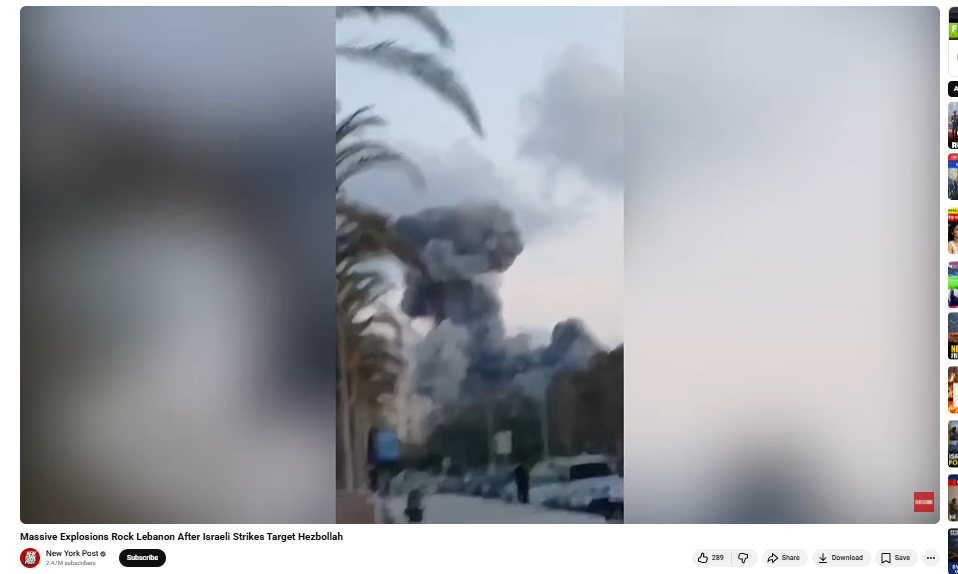
Further research found the same footage in a video report uploaded by the New York Post’s YouTube channel on May 28, 2026. According to the report, Israel carried out strikes targeting Hezbollah positions in Tyre, southern Lebanon.
We also found the clip in a video report published by NBC News. The report stated that Israel intensified strikes in southern Lebanon despite an existing ceasefire agreement.
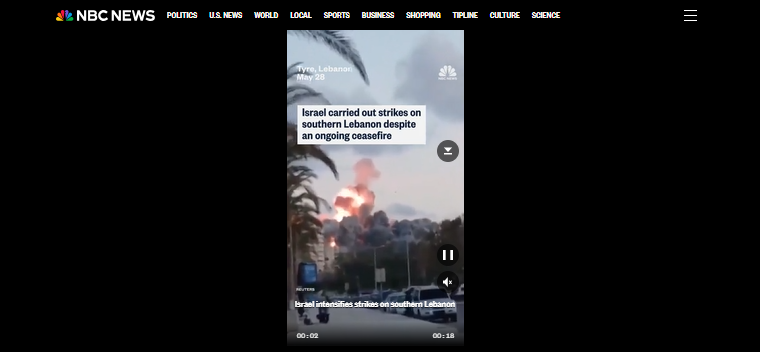
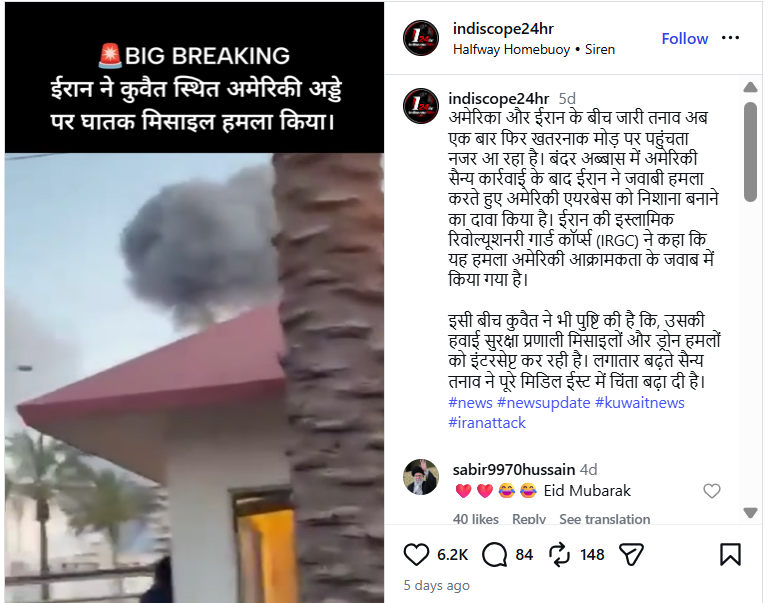
The matching visuals across these reports confirm that the viral footage originated from Lebanon and not from Kuwait.
Conclusion
The viral claim is misleading. The video does not show an Iranian missile strike on a US military base in Kuwait. It actually depicts an Israeli airstrike carried out in the Lebanese city of Tyre on May 28, 2026, and is being shared with a false context on social media.

Related Blogs

Executive Summary:
Amid escalating tensions between Afghanistan and Pakistan, a video is being widely shared on social media claiming that Afghanistan has shot down a Pakistani fighter jet. The posts further allege that the incident marks the formal beginning of a war between the two countries. However, research conducted by the CyberPeace found the viral claim to be false and the research revealed that the circulating video is not authentic but AI-generated.
Claim
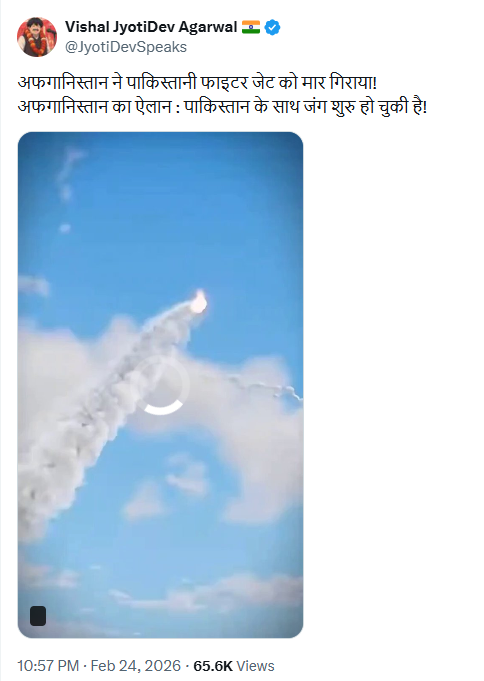
On February 24, 2026, a user on X (formerly Twitter) shared the viral video with the caption: “Afghanistan has shot down a Pakistani fighter jet! Afghanistan announces that war with Pakistan has begun.”
- Original post link: https://x.com/JyotiDevSpeaks/status/2026348257186545914
- Archived link: https://ghostarchive.org/archive/7l00Y
Fact Check:
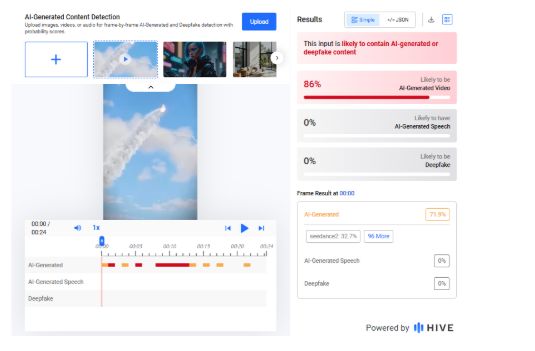
A careful review of the viral video revealed unusual visual patterns and artificial-looking effects, raising suspicions that it may have been created using artificial intelligence.We analyzed the video using the AI detection tool Hive Moderation, which indicated an 86 percent probability that the video was AI-generated.
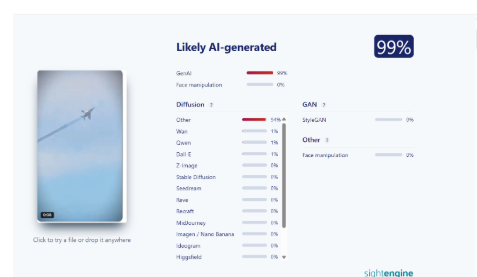
To further verify the findings, we scanned the footage using another AI detection platform, Sightengine. The results showed a 99 percent likelihood that the video was AI-generated.
To understand the broader context of the ongoing tensions, we conducted a keyword search and found a report published on February 22, 2026, by BBC Hindi. According to the report, Pakistan claimed it had targeted “seven terrorist hideouts and camps” along the Pakistan–Afghanistan border based on intelligence inputs. Meanwhile, a spokesperson for the Taliban government in Afghanistan stated that Pakistani airstrikes in Nangarhar and Paktika provinces resulted in the deaths of dozens of people, including women and children.
- https://www.bbc.com/hindi/articles/clyz8141397o
Conclusion
Our research confirms that the viral video claiming Afghanistan shot down a Pakistani fighter jet and formally declared war on Pakistan is fake. The footage is AI-generated and is being circulated with a false and misleading narrative.

One of the best forums for many video producers is YouTube. It also has a great chance of generating huge profits. YouTube content producers need assistance to get the most views, likes, comments, and subscribers for their videos and channels. As a result, some people could use YouTube bots to unnaturally raise their ranks on the YouTube site, which might help them get more organic views and reach a larger audience. However, this strategy is typically seen as unfair and can violate the YouTube platform’s terms of service.
As YouTube grows in popularity, so does the usage of YouTube bots. These bots are software programs that may automate operations on the YouTube platform, such as watching, liking, or disliking videos, subscribing to or unsubscribing from channels, making comments, and adding videos to playlists, among others. There have been YouTube bots around for a while. Many YouTubers widely use these computer codes to increase the number of views on their videos and accounts, which helps them rank higher in YouTube’s algorithm. Researchers discovered a new bot that takes private information from YouTube users’ accounts.
CRIL (Cyble Research and Intelligence Labs) has been monitoring new and active malware families CRIL has discovered a new YouTube bot virus capable of viewing, liking, and commenting on YouTube videos. Furthermore, it is capable of stealing sensitive information from browsers and acting as a bot that accepts orders from the Command and Control (C&C) server to carry out other harmful operations.
The Bot Insight
This YouTube bot has the same capabilities as all other YouTube bots, including the ability to view, like, and comment on videos. Additionally, it has the ability to steal private data from browsers and act as a bot that takes commands from a Command and Control (C&C) server for various malicious purposes. Researchers from Cyble discovered the inner workings of this information breach the Youtube bot uses the sample hash(SHA256) e9dac8b677a670e70919730ee65ab66cc27730378b9233d944ad7879c530d312.They discovered that it was created using the.NET compiler and is an executable file with a 32-bit size.
- The virus runs an AntiVM check as soon as it is executed to thwart researchers’ attempts to find and analyze malware in a virtual environment.
- It stops the execution if it finds that it is operating in a regulated setting. If not, it will carry out the tasks listed in the argument strings.
- Additionally, the virus creates a mutex, copies itself to the %appdata% folder as AvastSecurity.exe, and then uses cmd.exe to run.
- The new mutex makes a task scheduler entry and aids in ensuring
- The victim’s system’s installed Chromium browsers are used to harvest cookies, autofill information, and login information by the AvastSecurity.exe program.
- In order to view the chosen video, the virus runs the YouTube Playwright function, passing the previously indicated arguments along with the browser’s path and cookie data.
- YouTube bot uses the YouTube Playwright function to launch the browser environment with the specified parameters and automate actions like watching, liking, and commenting on YouTube videos. The feature is dependent on Microsoft. playwright’s kit.
- The malware establishes a connection to a C2 server and gets instructions to erase the entry for the scheduled task and end its own process, extract log files to the C2 server, download and run other files, and start/stop watching a YouTube movie.
- Additionally, it verifies that the victim’s PC has the required dependencies, including the Playwright package and the Chrome browser, installed. When it gets the command “view,” it will download and install these dependencies if they are missing.
Recommendations
The following is a list of some of the most critical cybersecurity best practices that serve as the first line of defense against intruders. We propose that our readers follow the advice provided below:
- Downloading pirated software from warez/torrent websites should be avoided. Such a virus is commonly found in “Hack Tools” available on websites such as YouTube, pirate sites, etc.
- When feasible, use strong passwords and impose multi-factor authentication.
- Enable automatic software updates on your laptop, smartphone, and other linked devices.
- Use a reputable antivirus and internet security software package on your linked devices, such as your computer, laptop, and smartphone.
- Avoid clicking on suspicious links and opening email attachments without verifying they are legitimate.Inform staff members on how to guard against dangers like phishing and unsafe URLs.
- Block URLs like Torrent/Warez that might be used to propagate malware.To prevent malware or TAs from stealing data, keep an eye on the beacon at the network level.
Conclusion
Using YouTube bots may be a seductive strategy for content producers looking to increase their ranks and expand their viewership on the site. However, the employment of bots is typically regarded as unfair and may violate YouTube’s terms of service. Utilizing YouTube bots carries additional risk because they might be identified, which could lead to account suspension or termination for the user. Mitigating this pressing issue through awareness drives and surveys to determine the bone of contention is best. NonProfits and civil society organizations can bridge the gap between the tech giant and the end user to facilitate better know-how about these unknown bots.

Executive Summary:
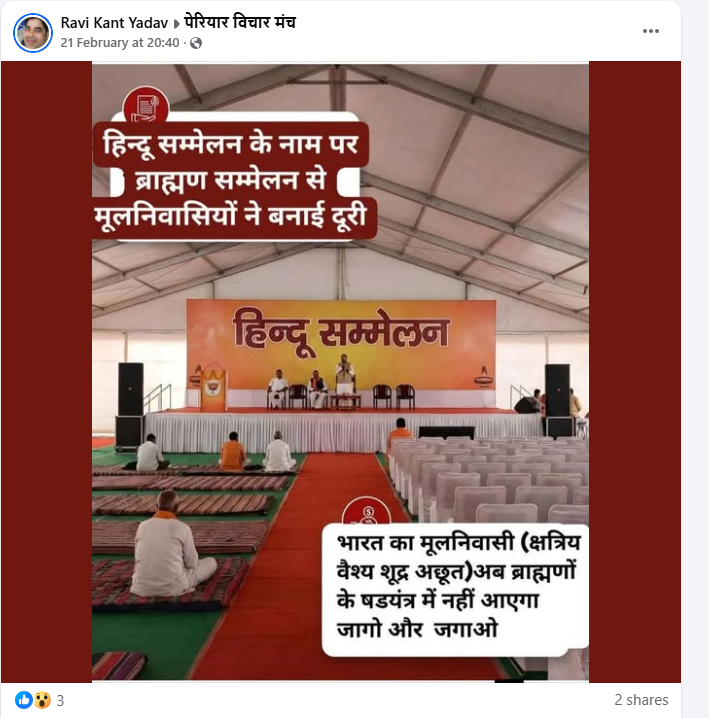
A photo circulating on social media shows a stage with the words “Hindu Sammelan” (Hindu Conference) written in large letters. In front of the stage, rows of chairs appear largely empty, with only a few people seated while most seats remain vacant.
Users sharing the image claim that the event, held under the banner of a “Hindu Sammelan,” was in fact a “Brahmin Sammelan,” and that indigenous communities chose to stay away, resulting in poor attendance.
It is noteworthy that, on the occasion of the centenary year of the Rashtriya Swayamsevak Sangh (RSS), various “Hindu Sammelan” events are being organized across the country. The viral image is being linked to this broader context.
However, research conducted by the CyberPeace found the viral claim to be false. Our research revealed that the image being shared on social media is not authentic but AI-generated and is being circulated with a misleading narrative.
Claim
On February 21, 2026, a Facebook user shared the viral image. The original and archived links are provided below
- https://www.facebook.com/photo?fbid=935049042540479&set=gm.2425972001215469&idorvanity=465387370607285
- https://ghostarchive.org/archive/sxC6d
Fact Check:
A keyword search on Google confirmed that several “Hindu Sammelan” events have indeed been organized across the country as part of the RSS centenary year. For instance, media reports have covered such events in different cities, including Nagpur.

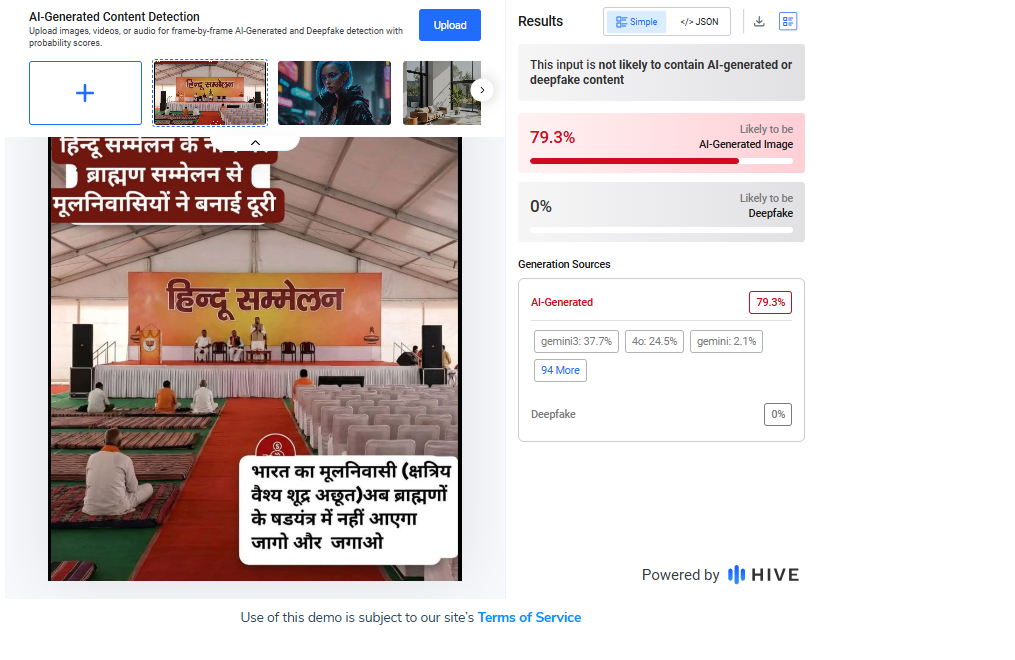
However, upon closely examining the viral image, we observed certain visual inconsistencies and unnatural elements that raised suspicion of AI generation. We first analyzed the image using the AI detection tool Hive Moderation, which indicated a 79.3 percent probability that the image was AI-generated.
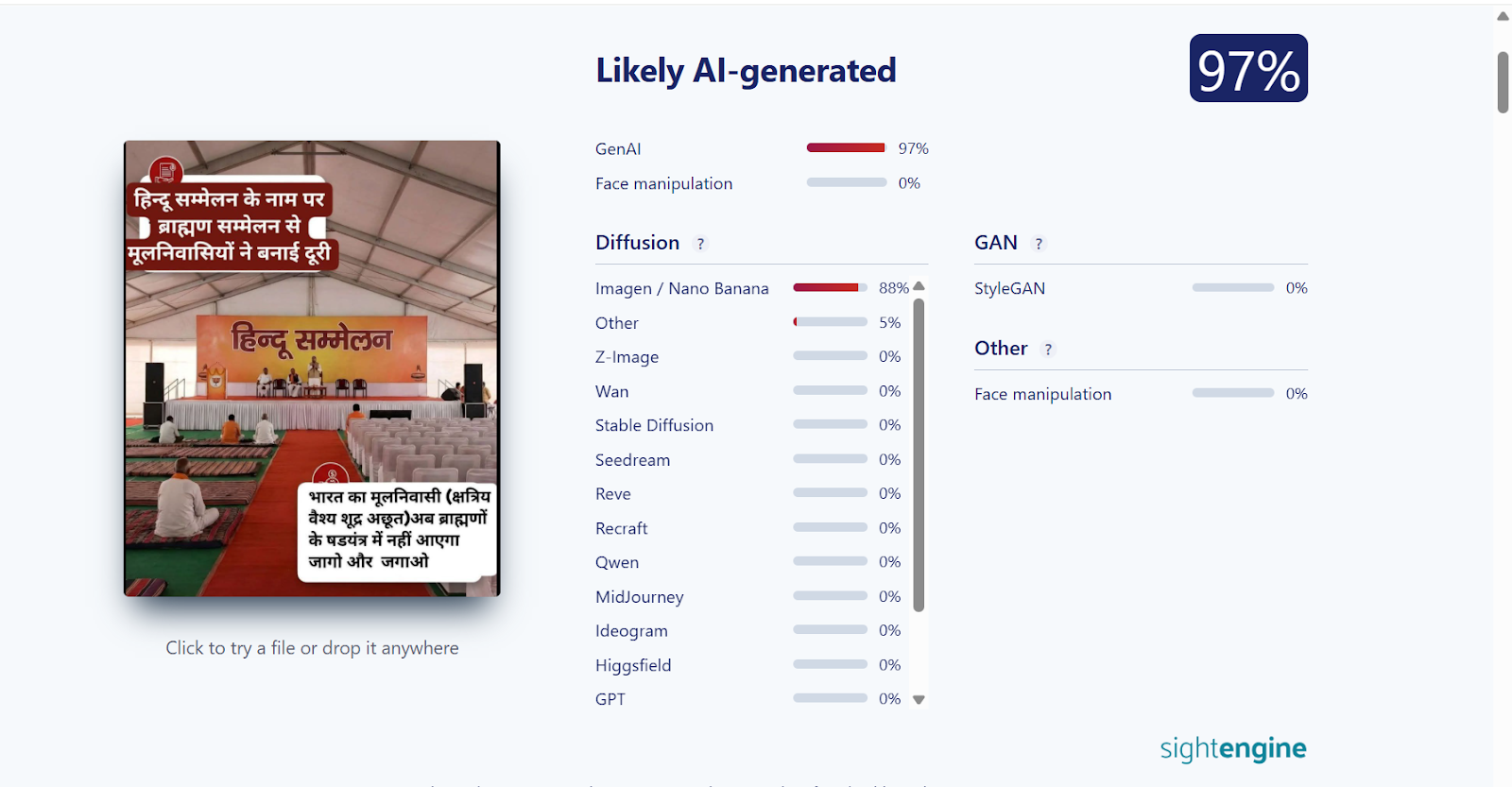
To further verify, we scanned the image using another AI detection platform, Sightengine. The results showed a 97 percent likelihood that the image was AI-generated.
Conclusion
Our research confirms that the image circulating on social media is not genuine. It has been artificially created using AI technology and is being shared with a misleading claim.
